
The latter-day work of Tsai Ming-liang—beginning, let’s say, around 2009’s Face or 2013’s Stray Dogs, and extending at least to 2024’s Abiding Nowhere—are not merely devoted to the master-shot style or scant narratives; for the admiring viewer, they briefly make other forms of cinema almost impossible to comprehend. It’s surprising, then, to look back and realize Tsai was not always so rigid.
Revisiting The Hole, his 1998 feature beginning a North American rollout on a new 35mm print this Friday at Film at Lincoln Center, presents a style that, while anticipatory of later films, nevertheless permits something broader, certainly more musical. By the time of its perfect final image, we’re in the realm of the outright sentimental.
One could also know nothing of Tsai, experience The Hole in this ideal form, and suspect they’ve encountered one of the 20th century’s very last great films. Big World Pictures’ release is enough of an occasion that the Taiwanese director lent some of his time to discuss this long-past project, in so doing proving rather lucid on the place it’s since taken in his career. Little surprise, however, that Tsai is looking forward: our conversation concludes with unbearably tantalizing hints at his next phase.
The Film Stage: When is the last time you watched The Hole?
Tsai Ming-liang: That was last year, because in Austin they did a retrospective of my career. Because of that particular retrospective, I had the good fortune of watching this particular print of The Hole, and I was very happy to be able to do that. There are actually two versions of The Hole: one was edited, the TV version, for Arte, and that particular version is 20 minutes less than this whole, entire version; the print is the complete version of the film.
I’ve seen all of your features, but given how they’re distributed in the United States, almost all of them at home. Watching The Hole in a theater and on a print was a different process, like the experience I recently had seeing What Time Is It There? on 35mm. What are your feelings about the divide between watching movies at home or theatrically—for the size of the screen, the sound, attention span?
I do think that watching films at home is something that is very convenient, but I do think that, as a result, a lot has been lost in the process of viewing these films at home rather than on the big screen. For me, to watch something on the big screen really showcases the unique quality of films, and that is the only way you can see the true details of the film and what the filmmaker is trying to present. In addition, the sound needs that kind of environment—on the big screen, in the big theater—in order for you to really immerse yourself.
And then the fact that it’s in complete darkness is something that is not totally controllable. Those are all the different elements that make the viewing experience even more unique, and also the only way you can express the true power of films in the movie theater. So I do think that I have been trying to make some efforts in Taiwan specifically, and also in Asia in general—trying to sort of create this movement of bringing the audience back to the theater. I think that this is not an easy task, but at the same time, I think that is the only way for you to really enjoy and appreciate the true power of films: in the theater rather than at home, no matter how convenient that might be.
I found myself rewatching some of your earlier films, like Rebels of the Neon God and Vive L’Amour, and was surprised at their faster pace. I think there are more shots in the first five minutes of Rebels than in your last five movies combined. There’s also quite a lot of camera movement in Vive L’Amour—almost a dance-like quality. It seems that The River and The Hole do more to begin a slower, more static cinema. Did something in particular account for this shift?
I do think that has something to do with the fact that before I made Rebels of the Neon God and Vive L’Amour, I was making a lot of TV productions, or films made for TV. So that was the predecessor, and I was primed at the time with that type of style going into the first two films. Also, because of the fact that the kind of style required this completely different narrative in terms of the storytelling needing to be very, very clear, the camera shots needing to be very smooth. At the time, those were the things that I took into consideration as I was making the first two films.
But later on, I do think that I want to make sure that every single film I make, there will be new things in the film, and you can tell that there are differences from one to the next. Including the elements of thinking about how I can include no music. I also think about having a clear narrative structure, storytelling, clear camera shots; I want to somehow use one single camera shot. Also thinking about how I can incorporate, later on, the musical elements into the film. So I do think these are all a different way I not only, on the one hand, want to get closer to the audience with every single film that I make, but also want to make sure that I create something new for each and every single film that I make.
I know you had an initial scenario for The Hole that you essentially abandoned when you found the locations. Which is surprising—the film actually has one of your stronger stories. Do you remember the process of finding it through shooting? Could you talk a bit about making the film come together that way?
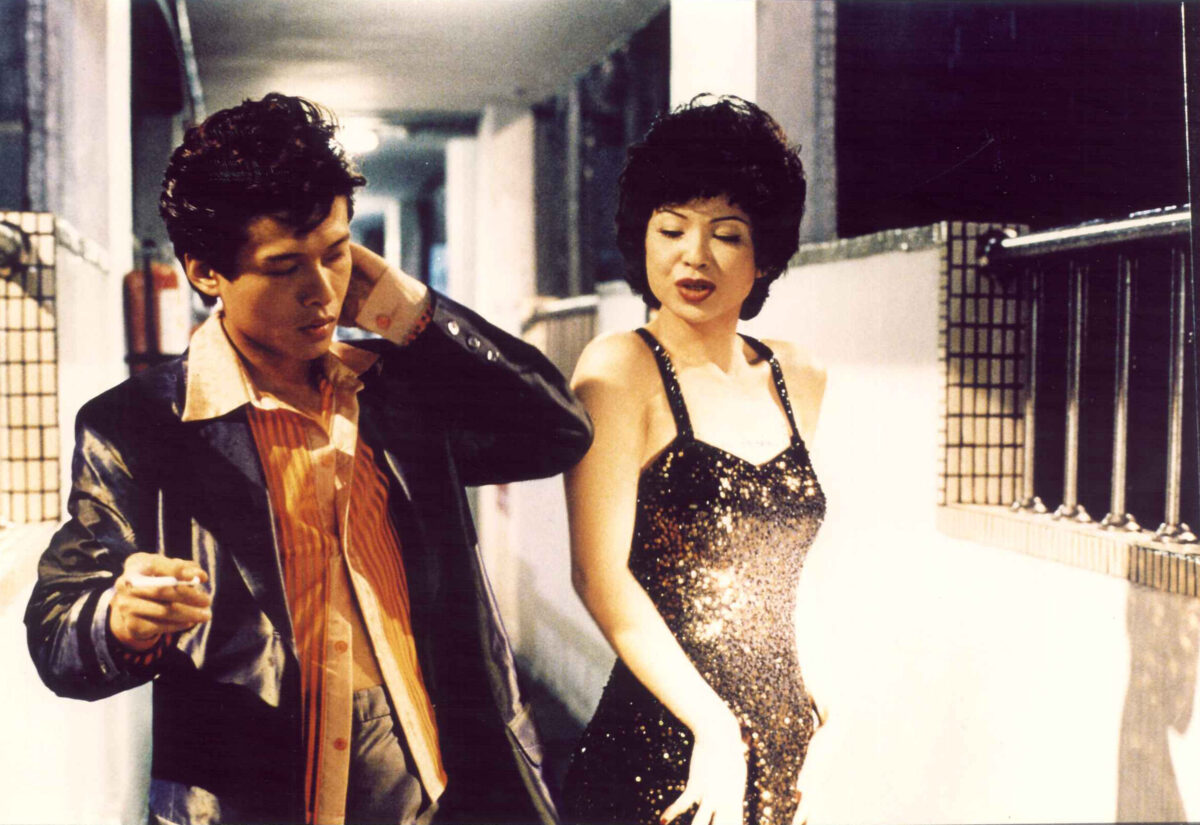
The Hole started as a commissioned work by a French team that wanted to have multiple perspectives on 2000—to capture the kind of turn at the end of the century going into the next century. For me, thinking about this kind of transition from one to the next, I can’t help but start thinking about, “This has to have the kind of non-stop raining atmospheres and situations that I want to create.” And also, I think that the turn of a century should feel very cool, very wet, very dark. There’s almost a hopelessness, and there’s no way out. Those are all the different kinds of moods or feelings that I wanted to create for this particular commission work.
Later on it sort of evolved into something where I wanted to incorporate something new: the musical elements of the film. I am personally a big fan of the old songs from the ‘60s, and also the musicals back in the ‘60s—either from Hollywood or from Hong Kong—and therefore I felt that this would be a great resource I want to tap into, and I selected one particular singer, Grace Chang, because of the fact that she was, at the time, very westernized. The way that she sings is very expressive, very avant-garde, very striking.
So for me, that is such a great element to include for this particular commission work. And then the location. When I identified this particular location—which is sort of in the marginalized space within the city proper, and it’s a housing project that is for people who are not so well-off that they would live in this particular environment—it almost gave me a sense of a prison-like environment. So we never left that particular housing project for one month for the entire production of the film.
We spent the entire month either in the market space of the housing project, in the apartments, in the public space of the housing project. And because of this particular, very unique environment, it also makes it more feasible for us to create the kind of non-stop raining scenes that I want to create for the film—not only visually, but also audio to capture the kind of turn-of-the-century raining scenes for this particular commission work.
I’m terrified of water damage, and your films are often quite upsetting for their focus on them—the many images of these endless streams of water entering a space and destroying them. I’d like to know a bit about your interest in that as a dramatic device.
All these elements, especially the water damage one, have something to do with my own lived experience. And I am an overseas Chinese that sort of migrated from Malaysia to Taiwan as a quote-unquote “international student” and have been living here since. So that kind of diasporic experience informed my connection or my understanding of water, since I have been staying in rental-housing units and have been sort of changing my residences very frequently as a result of my sort of diasporic status. Because of that, I tend to stay in very old rental units that will have many water-related damages—including maybe the pipe bursts, the kind of leaks, or the kind of inundations and overflowing of water as a result of heavy rain.
So those are all the elements that I actually had lived through, and I felt that definitely informed the way I devised the film. The other elements of lived experience I mentioned also have something to do with the plotline that had been designed for The Hole. It is my experience that, at the time, I was living in this particular housing unit in this mountainous region of the city, and I remember that my downstairs neighbors that don’t usually live there—they just sort of show up once in a while over the years—but one day a plumber knocked on my door and told me that there’s a leak and they’re trying to figure out what is going on for the downstairs neighbor. So the plumber dug a hole in my floor, which is the ceiling of my downstairs neighbor, and then, for whatever reason, he just disappeared for a month. I lived a month of my life there with a hole in my floor, and that is something that I just used, integrated into the plotline of this particular film because of that lived experience.
So I do think that the turn of the century, for me, is something that was full of challenges. I was not very optimistic about the future; I tended to take a very, very pessimistic viewpoint of the progressions of our future at the time. So not only the elements of water damage as one of the challenges; I also thought that illnesses would be something that I want to incorporate into this particular film to represent the kind of challenges and the concerns I have for our future at the juncture of the turn of the century.
I still love the work you’re making, like Abiding Nowhere. What are you developing now?
I’ve been invited to do many projects, and two or three actually are in the pipeline right now as part of the Walker series. I’m going to go to Korea soon to film the 13th installment of my Walker series. And I do think that I see the past 10 years of the Walker series as one long film that I have been developing and making. Maybe because of the fact that I’m older now, I am, in addition to the Walker series, also thinking about making a very unique and one-of-a-kind narrative film in the future.
The way that I see this is sort of semi-narrative: you can say that it’s a narrative film, but you can also see this as completely different from the conventional narrative film. I also have the intention to somehow use this particular new film that I am envisioning to work with and to reunite all the actors I have worked with in the past, for all my previous films, into this particular film project. So those are all the things in the pipeline and things that I am thinking about going forward.
That sounds amazing. As is, you’ve done so much to shape what I love about cinema and how I think about it, so I thank you for the time.
Recently I rewatched Ozu’s film, Tokyo Story, and other films, and I really think that I, myself, am very much informed and influenced by many of the films, the greats.
The Hole begins a 35mm rollout on Friday, July 10 at Film at Lincoln Center and will expand.