
If, as Lou Reed said, writing about music is like trying to dance about architecture, dissecting comedy is… let’s assume there’s a terrible metaphor that’s nevertheless hilarious and gets at the truth (or a mangled version of such) of this folly. I can’t think of it because I’m not as funny as David Wain, whose imprint on 21st-century American comedy isn’t quite so large as Judd Apatow or Tim Heidecker, but plainly bolder than the former and as alchemical as the latter. All this while sharing comedic talent with both; but everybody who appears in a David Wain production, be it a fellow member of The State or an A-list celebrity, comes away seeming funnier and braver for it. The larger system, meanwhile, has yet to fully catch up.
Wain’s first feature in eight years, Gail Daughtry and the Celebrity Sex Pass, is built from that combination: this film would have no center sans Wain and Ken Marino’s just-surreal-enough script, but that script wouldn’t function without Zoey Deutch’s charmingly naive performance as a character that wouldn’t retain interest if not for a supporting ensemble buoyed by Marino and a self-satirizing Jon Slattery and Jon Hamm. Pull one piece and the film, as it often threatens to, completely deflates; instead its parlaying of recognizable tropes into absurdity (and vice versa) offers deep pleasure.
Having admired Wain’s work for most of my life, it was no small occasion to speak with him about a dense comedic lexicon.
The Film Stage: I’ve been a fan of yours for literally most of my life. I remember watching Stella on Comedy Central when I was 12; now I’m 33.
David Wain: Think what you’re trying to say is that I’m old.
No. If anything, you look great. I’m so happy that you continue to make things, because though comedy’s mores and ideas shift, you always seem to be three steps ahead. Partly because I can’t get a firm grip on what your thing is. While I think there’s sort of a Wainian humor that I could pick out of a lineup, it’s like: some films—obviously They Came Together—have a very parodic, satirical quality. You can do the quote-unquote “straight comedy” in Role Models or Wanderlust. Other times it kind of rests between those two; Wet Hot American Summer and Gail Daughtry might be in that last camp. Do you think of your films in those terms, on a continuum?
Yes, I kind of do. And certainly when trying to get something made, people are like, “What is this?” And I’m like, “Well, it’s not quite as mainstream as this, but it’s not a straight parody like They Came Together.” I mean, I don’t consider Wet Hot American Summer a spoof at all. Some people are like, “Oh, you’re spoofing all those summer camp movies” and I’m like, “No, not to me.” It’s just a movie really sourced in actually going to summer camp, and it’s funny. That was the way that Mike Showalter and I thought about it as we were writing it. We were like: “It’s summer camp and we make it funny the way we think things are funny.”
And I think that’s kind of what we did with this one too. There is obviously, like, some sort of continuum—and, you know, The Ten is its own weird place where it lands—but I think that, more than anything, probably we’re just day to day—from writing through the end of post—thinking about like what feels funny and right to us, tone-wise.
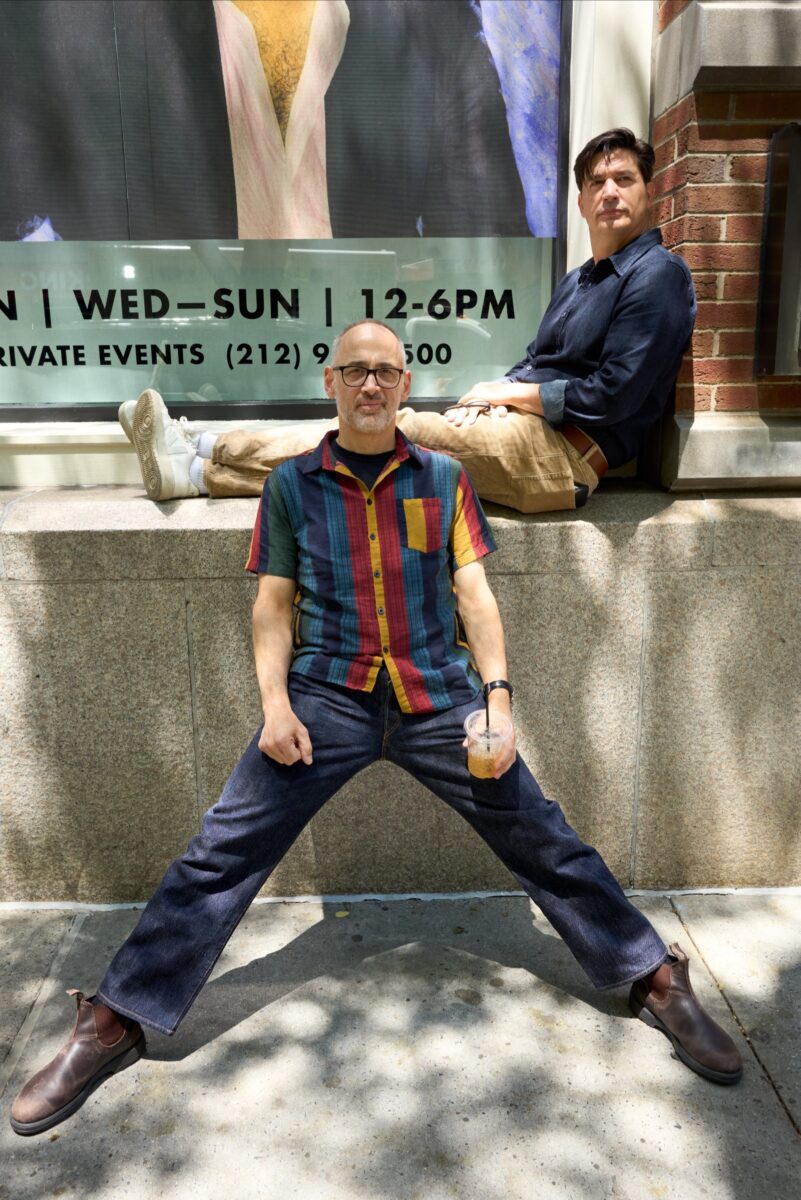
David Wain and Ken Marino at 2026 Tribeca Festival. Photo by Daniel Dickerman.
And as you’re answering that, I find myself thinking that maybe it’s less about a genre-conforming than a certain kind of iconography.
Mmm.
I mean, one of the funniest moments for me—and I’m laughing just as I recount it—is Joe Lo Truglio getting drowned in the soup. It at least suggests a pastiche of the classic mob-murder scene with the fingers rapidly hitting the piano “artfully” counterpointing the violent act.
Right.
It makes me laugh: a funny scenario as is, but even better for the instant recognition.
Right, right. Well, I mean, a lot of times what we used to talk about—even going back to The State—was like: the joke, often, is that we’re just doing the thing. Like, we’re not… sometimes the funniest thing is just doing the trope without any comment on it. Yeah.
Well, playing it straight is often funnier than pratfalls, right? I was rewatching a few episodes of Stella last night to prepare for this.
[Laughs]
I just couldn’t believe how often the jokes on that show, and continuing throughout your work… I don’t know. Words fail me, unfortunately, as I’m sitting in front of you, but it’s just the presentation that is very funny. The look on Bob Feldman’s face when you shoot Michael Ian Black and he realizes he’s pulled off the assassination—there’s not exactly a joke. Anyway, I feel like I’m Chris Farley talking to Paul McCartney, just describing…
No, no, but I think what you’re referring to is a lot of what some people don’t get or don’t like or hate about some of our work, which is: “Where’s the joke?” If you read the early reviews of Wet Hot American Summer or many things we’ve done, some people are just like, “What? Who finds any of this funny? There’s no joke. There’s no comedy here.” And I think for people who love it, though, it’s like: that’s everything.
There’s this amazing quality in the dialogue you and Ken Marino write. This movie is so replete with stuff that’s funny in a not-quite-pinpointable way. Like the mobster at one point saying—and I wrote the line down—“Sometimes even a ghost has to come up for air.”
[Laughs]
Which is not said with any wink to the camera, but it’s also a thought that no human being has probably ever had. Like, that exact… it’s such a terrible metaphor.
It makes no sense at all. I don’t know why I am sort of continually amused by things that don’t… that are like “what?” or, you know, don’t make sense—just wrong. I don’t know. Of course, sitting here and dissecting it is sort of a fool’s game on some level. It’s hard to, you know, take it apart too much, but part of what’s so interesting in post-production especially—and throughout all the process of making a movie like this—is you have to try to intellectualize and sometimes back up your pitch for something to get it done. Or to communicate it to an actor or to a crew like, “This is funny because blah, blah, blah, blah, blah, and here’s the thinking behind it,” or, “Here’s why I think we should go with this cut of a scene and not that one.” And you’re trying to explain it, but at the end of the day all you can ever say is, “It’s because I think it’s funny.”
Can you think of scenes or scenarios that changed from the editing room to the final cut, and what some of them might have been?
Oh, my god, so many. I mean, all of them in some way. That thing you mentioned with the soup, I think the piano… well, certainly the whole way that that played out was very much more figured out in editing. The cameo of Elizabeth Banks in that scene was a much later idea that we did, like, in my living room closer to locking picture.
You shot that completely separately?
Yeah. We shot that. Basically we did one day, later in our post-process, where we picked up a bunch of tiny, tiny little things in my house. One of them was the opening scene, where we just sort of refigured, sort of re-broke how the movie started and rebuilt that in post. Basically, as always, there were just so many things that were changed. We changed the ordering and slashed-out parts of things and connected them differently and, you know, changed jokes in audio and added things, VFX. Just so many, everything was touched in a million ways.
I imagine that process could, handled badly, become very chaotic very quickly and the movie slips from your hands. Did you find that the process was smooth? Or kind of an incremental…
Talking about post-production?
Yeah. The editing, slashing, connecting, re-ordering.
Yeah. Well, it’s very challenging for sure, and we had an incredible editor, John Daigle, we worked with, but to me it’s the only job of the director: to keep an eye on the big picture in those kinds of situations. And yeah: we screened it a lot, very casually, in the living room for, you know, 20 people at a time as often as we could, and you get a zillion notes that are all contradicting each other and going in different directions.
It’s very important to use all of those discussions and tools as just potential ideas that may or may not inform your gut, and to stick with the gut. But, you know, we went down certain rabbit holes and certain ideas and tried this and finally you let go of it. But yeah: sometimes I fool myself into seeing the first rough cut and I’m like, “Oh this is not too… pretty close. We’ll just trim it down.” Then you’re like, “No, no, there’s a whole journey to go on,” and there’s no abbreviating it.
I really thought about this as a film object when John Slattery has his foot slammed in the door over and over. Even as I was laughing really hard, I’m asking myself: are there repeated shots? It almost felt like you could have taken him saying “ow” and just: “ow,” foot slam, repeat that 10 times. Right? And I think that sense—this could be that kind of construction—is part of what makes it funny.
I mean, it’s certainly reminiscent of jokes we’ve done, to do something like that. I don’t think we did it in this one. In a way, that sequence did largely come out the way we sort of had it in our heads when we were shooting it. Then John, in this case, very brilliantly put together his first pass at it, which was close to what it ended up being—just working with that rhythm of it—and I think and we got some extra “ow ow ows” from John Slattery in post. Certainly that scene, in every screening, the audience goes crazy. It’s really fun.
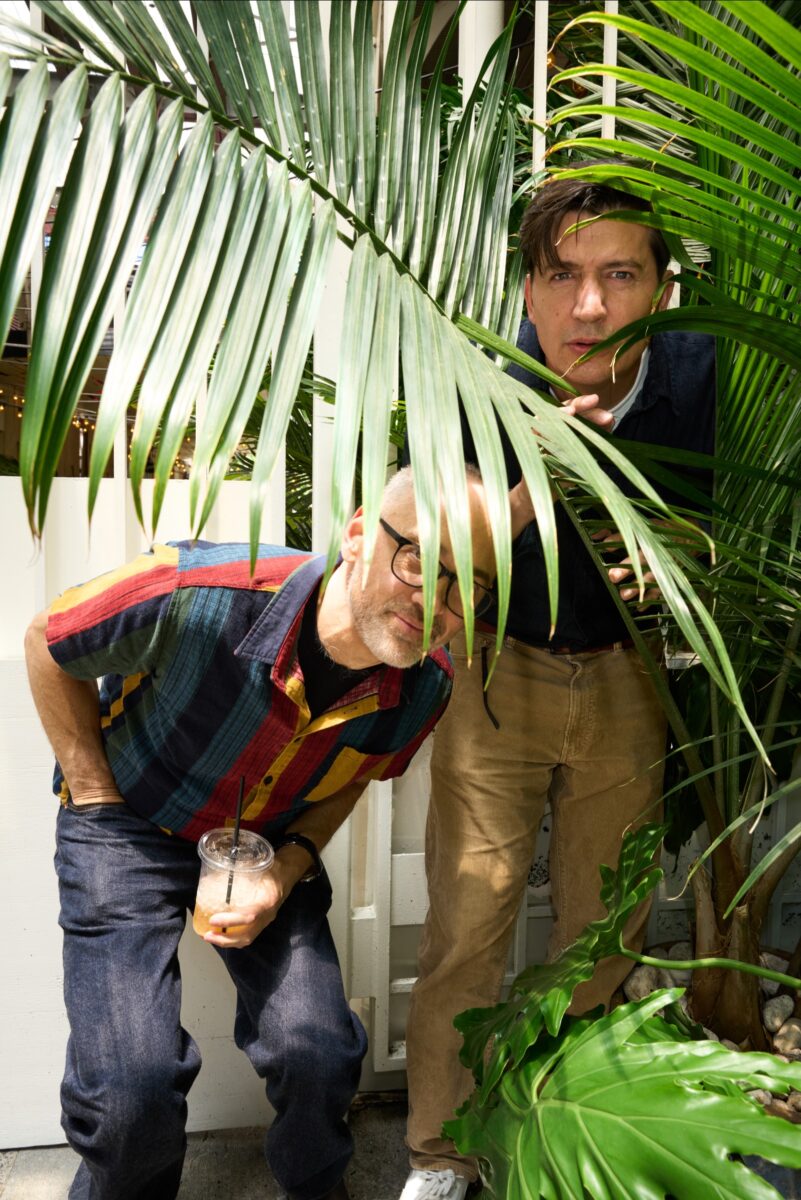
David Wain and Ken Marino at 2026 Tribeca Festival. Photo by Daniel Dickerman.
I looked at They Came Together last night and “you can say that again” is another instance where I’m seeking the edit. The layperson can, will, should laugh, but it does invite that kind of attention to film form, and performance in particular—you’re thinking about the variation that an actor is giving.
Yeah. But that’s why I don’t think, even though some people might put it in the same category, I don’t consider ourselves playing the same game as Scary Movie. Part of what makes it so time-consuming is that part of the formula: just a lot of attention to detail and a lot of thought and a lot of thinking through this very dumb, silly, fun, light material. And we actually had a lot of discussions about a joke in Gail Daughtry where they run down the staircase and the floors change, but it’s obviously the same exact shot over and over, and the same sound and the same music.
That’s something that I think I just was playing; that came out in editing. That was not necessarily the intention. We debated a lot, though, whether that’s too similar to the joke in They Came Together—the idea of repeating the same shots over and over again. Although oftentimes we shamelessly repeat, exactly, jokes from past work, very intentionally, but then other times—depending on what it is—we’re like, “No, let’s not cannibalize what we did before.”
That comparison would have never quite occurred to me. But it’s funny that I made it through a different sequence. It speaks to an internal logic of your work.
Just to say there’s an internal bar that sometimes is crazy. Like, when we were doing The State, Ben Garant was like an encyclopedia of every sketch show that had been done—especially Monty Python and The Young Ones. We would pitch him like, “What about a sketch about XYZ” and he’s like, “Can’t do that. Young Ones, fourth season, episode three.” And we’re like, “Ugh, okay.” But we wouldn’t, and so that’s the incredibly crazy thing about doing comedy as a job: your job, every time, is to sit down and come up with something that’s never been said or done—a joke that’s brand new. Anyway, sorry. That was my little rant.
But that’s how you get, “Sometimes even a ghost has to come up for air.”
Right.
I know a lot of shots on Hollywood Boulevard were stolen. It’s impressive, because sometimes you can really tell when a movie has a stolen shot. This just felt a little bit like: let’s photograph it by situating her in this new environment. Was it difficult to construct those sequences in editing, working from this film grammar of far-away, stolen shots, or was it actually fairly similar?
I would say the “stolen” nature of how we got it wasn’t really particularly the thing that made it challenging. I think that some of those sequences in LA, really those challenges have to do with what to put in at that point in the movie when we still haven’t really gotten to the point of the story yet. So we actually had quite a bit of stuff on the streets of Hollywood Boulevard that we did not put in just for that reason.
In that scene you have Michael Ian Black playing the star-map hawker. It got me thinking about how you have this repertoire of performers—Joe Lo Truglio, Ken Marino; even Jennifer Aniston has kind of been folded into it with her cameo here—but don’t tend to write characters with actors in mind; it’s more about writing the character to be funny and then the actor fits it. At that point, then, how is it determined Michael Ian Black is the one who plays that role and not, say, be a celebrity cameo at the end? It’s not Paul Rudd on Hollywood Boulevard. But either of them would work great if you switch the roles, right?
Sure. I mean, there’s no interesting answer to that. I think it’s just… we just think about it like, “Should we have Mike Black play this?” We did this in more than any movie. We really did write this with no particular actors in mind for each role, and in prep we kind of decided: if in doubt, have someone from The State do it. Because why not? Like, they’re the best and it’s family. A lot of it was truly like, “Hey, Mike Black, can you be on the West Coast this day or this day?” And he’s like, “This day.” “Great, you’ll be the star maps guy.” [Laughs]
A lot of times, it’s, I would say, way more to do with scheduling than you might believe. And I think in some cases we said to some actors, you know, “Do you want to be this the guy at the hotel desk or do you want to be this other thing?” And then they picked it.
I assume, if you guys all have known each other for so long, there’s not so much in the way of ego—”I want to have this role, you can’t have that role.”
I mean, you know, it’s just… yeah. Casting is always challenging and ego is always involved, so you want to be sensitive. But it was important and a nice thing for us to include a lot of the people from The State.
I had read—and keep in mind, this was in a Reddit AMA from 13 years ago, so I’m not holding you to it being true…
Got it. Glad to hear it.
—you had an idea for a Stella movie, and if somebody just gave you money it would happen. I wonder if a) that was the case; b) if so, what the idea for the Stella movie would—or hopefully will—be?
[Laughs] The idea, as I recall, had something to do with: there was a roller rink in a small town and we were in the town, for some reason, and saw that they were going to take down the roller rink, and we decided to spearhead a campaign to save the roller rink. But what we weren’t aware of is that nobody in the town wanted it and what they were going to build is this incredible community center with, like, a pool [Laughs] and we were like, “Nope, we’re going to save the roller rink.” Or something like that. The only other part I remember about it is that somewhere along the line we discovered clean energy. [Laughs] We were like, “Oh, my God, it’s pure energy.” I don’t know. Anyway, bottom line is: we did have a whole thing written out for that and it did not happen.
Okay, well I’m sorry. I cross my fingers but I also know that time only moves forward.
You never know!
Yes, you never know. I can picture the scene with the Craig Wedren soundtrack as very obvious stunt doubles of you guys roller skate.
I… would love it.
Gail Daughtry and the Celebrity Sex Pass opens in theaters on Friday, July 10.