
Since taking his debut feature Winter Brothers to the Locarno Film Festival in 2017, Hlynur Pálmason has gradually made his name as one of Europe’s most eclectic and exciting filmmakers. The Icelandic director’s four features to date have each used his native country’s breathtaking (and often overused) grandeur in novel and exciting ways. For A White White Day, a Cannes Critics’ Week hit in 2019, the sparseness of the countryside and its low-hanging fog helped to strike an ominous chord that befitted the film’s Haneke-lite austerity. Three years later, with Godland, the director weaponized the country’s great plains of volcanic rock to punctuate a tale of a 19th-century Catholic missionary’s descent into madness.
There’s nothing quite so foreboding going on in the director’s latest, The Love That Remains, a gorgeous family scrapbook of a movie that features various members of the director’s own—including his three kids (Ída Mekkín, Þorgils, and Grímur) as well as a patch of their land in Hornafjörður, a town on the country’s Southeastern seaboard. Watching it in Karlovy Vary last year, it struck me as the first time in Pálmason’s work that Iceland’s vistas felt like home.
This time, the gorgeous imagery—which often rushes by you in bursts of vivid colour, and which was shot between 2017 and 2024 and edited by his longtime collaborator Julius Krebs Damsbo—is used to tell the story of a divorced husband (who works on a fishing trawler) and wife (an artist and sculptor) in a film that features a giant chicken and a seemingly sentient suit of armour; but it’s also a love letter to watching your kids grow up. “I had this very strong feeling of time moving very fast,” Pálmason explained to me at the Karlovy Vary film festival last summer, “my children growing up really fast, and of time being really precious.”
We met in June at the Karlovy Vary Film Festival, a month after the film had premiered in Cannes to rapturous reviews. KVIFF was Pálmason’s next stop, and he’d taken the journey with Damsbo in between editing on their next two features. For a short, sweet 15 minutes—edited here for clarity—we talked about filmmaking, family, and knowing when it’s ok to laugh at his movies. Read below ahead of Love‘s U.S. opening beginning this Friday.
The Film Stage: The editing is obviously so pronounced in The Love That Remains and so central to its flow. I know you’ve worked together for quite some time, and I imagine the process must be quite fluid by now, but how did you manage to find the particular rhythm of this film?
Julius Krebs Damsbo: This is our fourth feature together, and we’ve been doing shorts and everything for maybe 13 or 14 years. So there’s no real “trying” to find it anymore. I mean, of course there’s finding a rhythm, but it involves a very non-vocal kind of communication. It’s mostly seeing and being like, “Ah… this needs more work,” and then, “Yes, I agree.” Only a handful of times it’s like, “I like this more,” and then there’s just the question of who feels it most.
Hlynur Pálmason: I think it’s like with everything: it just comes with spending time together and spending time working. We just need to work a lot every day and then it comes together, you know?
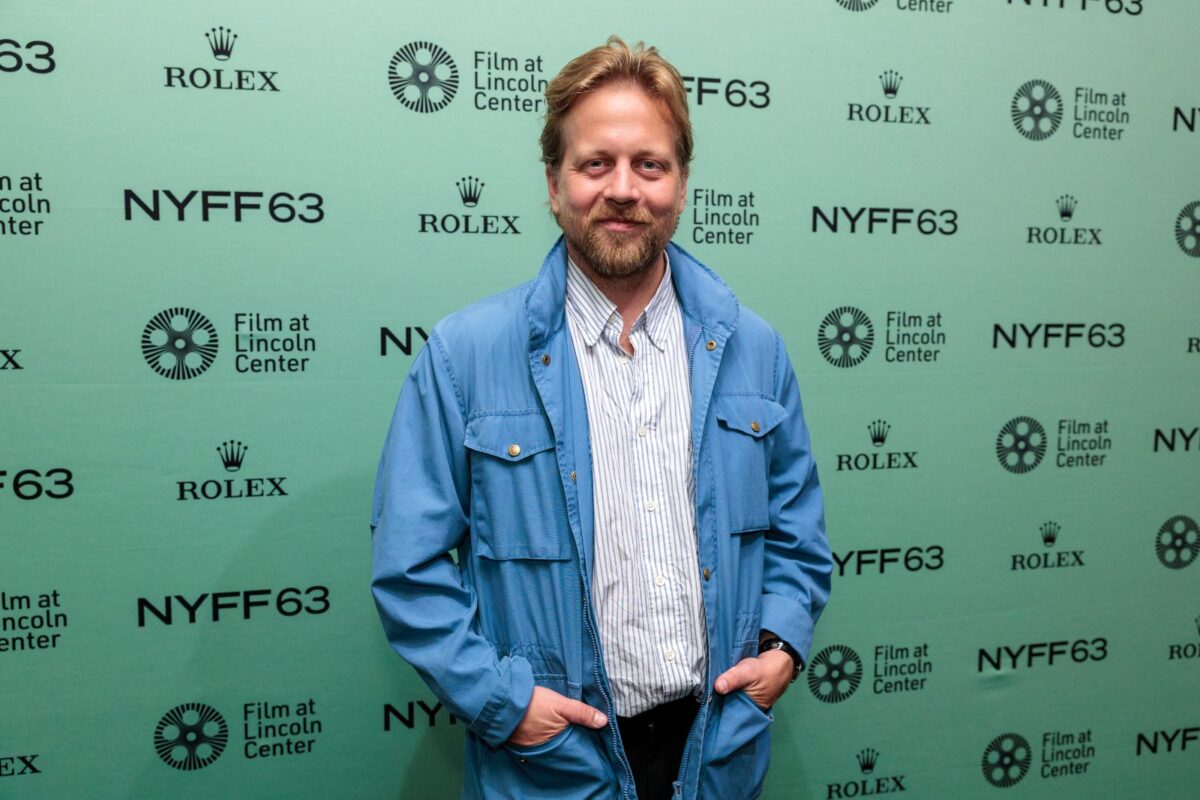
Hlynur Pálmason at the 63rd New York Film Festival. Photo by Richard Jopson, courtesy of Film at Lincoln Center
The music is also so crucial to the film’s tempo. It’s kind of constantly there, just sort of lilting in the background. At what point did that come into the process?
Pálmason: The music came quite late because we weren’t sure. In the beginning, we thought that we would only use music diegetically, but then, when I was looking at the footage—because we’d been shooting for quite a long time—I was sometimes listening to H. Hunt on piano, and there was this connection with the material and that album. It was almost like the atmosphere in the album was the same as in the film. It was very strange.
So we communicated with Harry [Hunt] and asked him if he wanted to collaborate, and he’d already seen Godland, so he was up for it, which made us very happy. We made some extra recordings of clarinet, but that was it. Otherwise we used the whole album. Then we—me and Harry—just allowed Julius to go nuts with the editing process. Basically, Julius put the whole thing together.
It’s been really great to follow your films and your work over the years. Winter Brothers was the first year I attended Locarno, in 2017.
Pálmason: Yeah, exactly. You were there?
Yes, and then for White White Day, we had an interview I think in Cannes that year, and then to see this big swing with Godland in 2022, always exploring these different styles of filmmaking. And now with The Love That Remains, which I think is your most surprising film so far, and your most original, and I think my favorite. Was it a conscious decision for you to want to—I mean, every film is personal, obviously—but to get to do something that is such a personal portrait, almost a family scrapbook?
Pálmason: I think it was just this need I felt. I had this very strong feeling of time moving very fast, my children growing up really fast, and of time being really precious. I was thinking about how you spend your time. What is life really about? In the end, what is the most important thing? Is it how we spend our time and how we create memories? Things like this. And I think I’ve just been thinking a lot about that.
And it happened very gradually. During COVID, we shot a short film called Nest, and while doing that, I started to think about this film. I thought it would be interesting to shoot something where time is moving, and then, while shooting over two or three years, to write what is happening. For example, if you see three kids for two years doing something together, it would be interesting to film that—but while filming that, to write what the parents are doing.
That was sort of the idea. And I was hoping—because I didn’t know—that this story with the kids would somehow connect to the parents. So when the figure, the knight, woke up and went to their home, that moment was the key for me. The key to this feeling of, “Oh, we have a film, we have something that might work.”
When are the earliest bits of footage from?
Pálmason: 2017 was the first shot that we shot, which was the roof being pulled up.
What an incredible image.
Damsbo: Yes, and it’s around the same time as the images of the kids playing outdoors. They’re much smaller there than they are at the end of the film. Time moves fast, you know.
And then when you had the idea of the knight waking up, is that when the idea for a script started coming together?
Pálmason: No, actually. I had already been filming for a year before I found out that he would wake up. And the first impulse actually was a scary one. I thought that, because the kids had been such monsters to the figure, that the figure would have a day of revenge. I thought it would come and kill everybody, the whole family. And I was very happy that it didn’t go that way. But that was the first impulse.
Damsbo: But the film is implying that it could happen…
Pálmason: Yeah, it could happen. And that’s something that we also liked. There’s always this balance when you’re making something. You want it to be playful, intuitive, spontaneous. You want it to be beautiful, you want it to be brutal. You want it to be warm and cold. You don’t want it to be sentimental, but you still want it to be lovely. I think what we always try to do is balance this in the right way so the film feels very honest and truthful. With this one, the hard thing for me was: how far can we push it before it goes overboard?
I think that was something we were always working on, trying to balance that in the right way. Often when you’re making something, you know what you don’t want. You may not know exactly what the film wants, but you have a feeling of what it does not want to be.
Were you surprised by how funny it was in the end…
Pálmason: No, actually.
…I mean, I find Godland quite funny. Maybe in a more fatalistic way.
Pálmason: Yeah, me too, but not everybody does. [Laughs] People are like, “Oh, it’s so stark and depressing,” but I was like, “I think it’s quite funny at certain times.”
Damsbo: For Godland, I think it was good when we were both in the screenings together, because we would be laughing and it would lighten the mood and it got other people laughing, too. It kind of showed that it was okay.
Pálmason: Exactly, to show it’s totally fine. We try not to take ourselves too seriously, I hope. But we definitely had a feeling with this one. For example, when we finished Godland, I was very thorough with the producers. I said, “We have to make The Love That Remains next, before we make On Land Sea,” because I cannot go from one period film to another. I needed something very playful in between.
I knew that sometimes there’s a certain energy building up, and if you don’t capture it, it’s never going to be there. You will never make it. I had this very strong feeling of, “We have to make this now, otherwise the kids will grow too much and we will have lost it.”
What was the most challenging part of the process?
Pálmason: I think it’s challenging to maintain the energy. How do you create a set that is fun, where you can enjoy yourself and do something that is hopefully good, or create moments that feel real and authentic? I think all of these things are hard. It’s finding the right kind of playfulness and energy and having fun while you’re doing it. It’s tricky.
Also, you’re always dealing with normal things, like not having a lot of money and stretching a film over a long period of time, which is really hard financially. Money is always the biggest problem. The second one is probably just having the right temperament.
And working with family members has its benefits, I imagine?
Pálmason: Ups and downs!
They say don’t work with kids. Is it easier when it’s your own kids?
Pálmason: I think so, for me. Because I can push my kids as much as I want. [Laughs] No, but I would not make this film if it wasn’t written for people I know. I like writing about things I know; otherwise, I feel like a fraud.
The Love That Remains opens in limited release on Friday, January 30.