
Jafar Panahi arrives in the United States as both a vector of history and blank slate. His profile would be enough were he only one of Iran’s leading filmmakers, a contemporary and collaborator with the likes of Mohsen Makhmalbaf, Mohammad Rasoulof, and most notably Abbas Kiarostami––more than just a director of his scripts, he is also the Jafar seen in Through the Olive Trees. Since the jail sentence and “filmmaking ban” passed down by the Iranian government in 2009, however, he’s evolved into something of a standard for courage in the very history of cinema, and one of the few living filmmakers it’s safe to call brave. (He has, only furthering one’s admiration for him, denied this label.)
Such circumstances have been discussed at great length, but when Panahi is barely granted the ability to make films––succeed though he has with This Is Not a Film, Closed Curtain, Taxi, 3 Faces, and No Bears––he’s not going to conduct interviews about them. Which makes the roll-out for his Palme d’Or-winning It Was Just an Accident all the more notable: we spoke in New York for the film’s press day, a concept long foreign to him, shortly before his NYFF-adjacent talk with Martin Scorsese and in advance of a bicoastal Q&A tour that begins with the film’s release today.
My thanks to Sheida Dayani for her on-site interpretation.
The Film Stage: I’ve been a great fan of your films for more than a decade and followed them with much interest. You haven’t done interviews about them, given the conditions under which they were made. I wonder if you’ve been thinking differently about this film and its process now that you’ve been talking about it for months.
Jafar Panahi: First of all, I want to say those days were very good days, that I didn’t have to talk about my film.
Sorry.
[Laughs] I had made my film and I had no need to talk about it. But yes, of course––in these talks you always find things that you have not thought about before. Or you would see that, more than the thing you focused on––more than the thing you wanted to bring out––the audience is focusing on something else and seeing something else. For instance, everyone tells me that I wanted to make a film about forgiveness or vengeance, and I keep saying that my issue was not forgiveness or vengeance. Of course they’re part of the work, but they are in order to get the engine going, to get the film to flow.
But my issue and my view was on something else: I am concerned about the future of my country. I wanted to raise a question, and the question is: what happens after? Are we going to keep continuing with violence or are we going to stop it at some point and say that it is enough? As one of the characters says in the film: when is the cycle of violence going to end?
Have you been frustrated with the reactions to it, then? If you haven’t been getting a response you anticipated.
To be honest with you: no. A lot more than what I thought would be accomplished has been accomplished and has come in the audience’s reactions. For instance: I worked a lot on sound and on the element of sound, and I see it has come out well and the audience can relate to it.
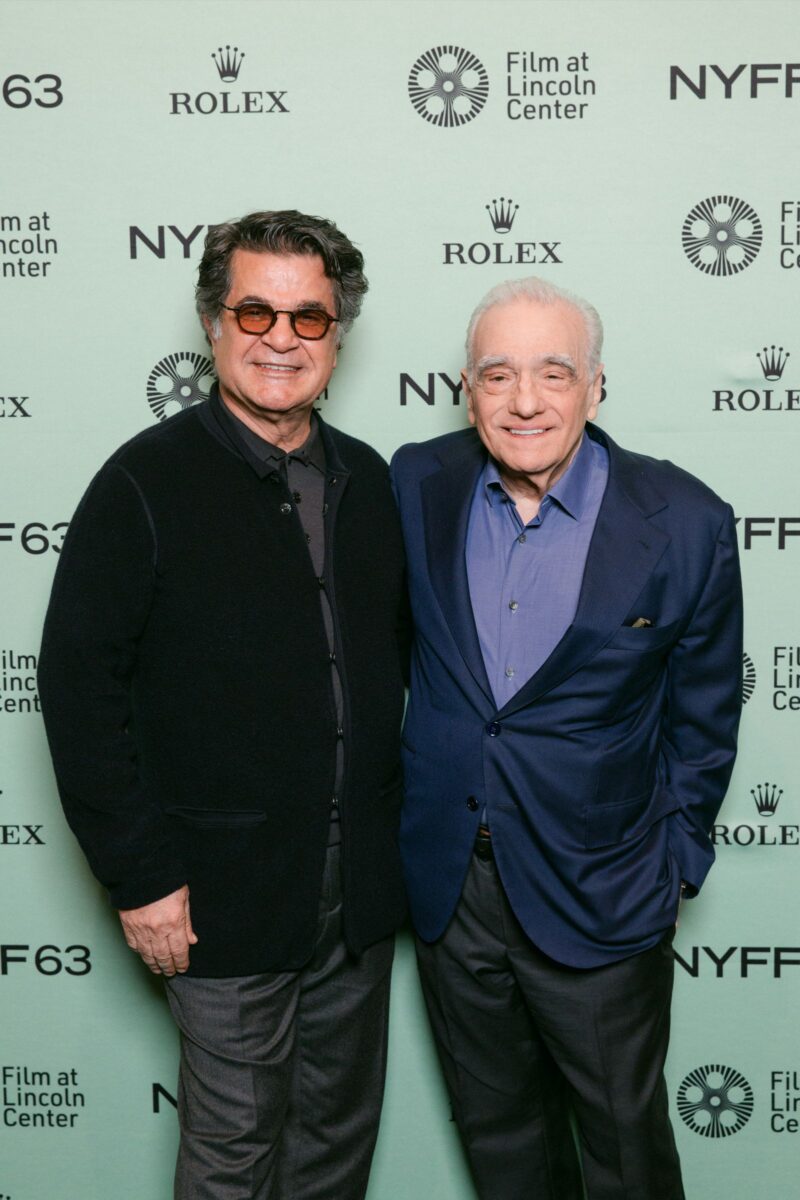
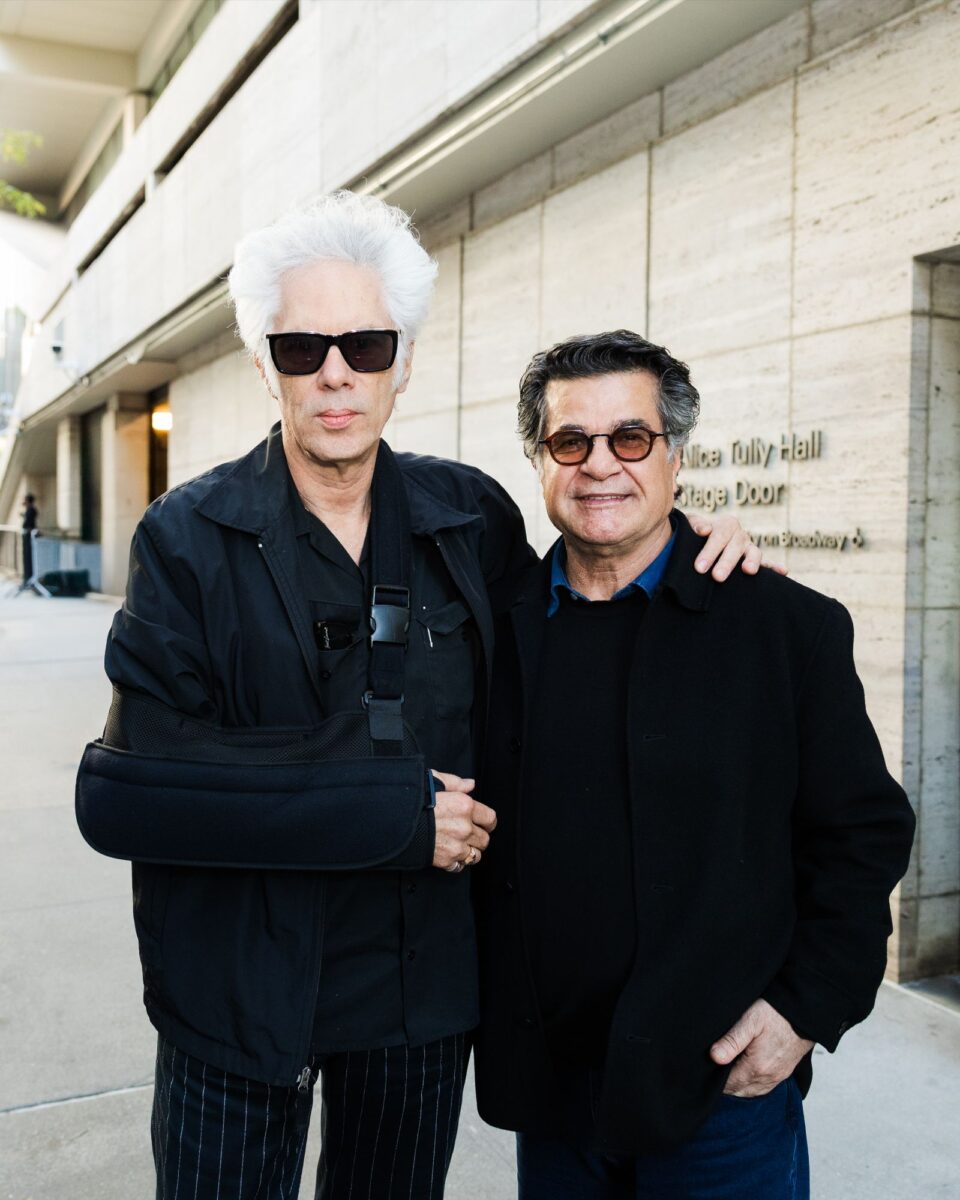
Panahi with Martin Scorsese and Jim Jarmusch. Photos by Arin Sang-urai and Mettie Ostrowski, courtesy of the New York Film Festival.
As an admirer of your films, I was happy when the movie opened on an extended shot of someone driving––I thought, “Yes, here we are.” So I was very surprised that the car stops and you follow the driver as he exits the car; I feel like I’ve never seen that maneuver in one of your films before. Was there an intent to subvert the traditional car-driving scene?
There were a few factors that I had in mind for that scene. Therefore I was not able to shoot that scene outside, on the streets––because if I did that, I would have to bring a bigger car, put this car on it, and bring the camera from certain angles. Because the police would find out I’m shooting the film. So I was forced to shoot that scene in a studio and then create the background for it. It’s the first time I did something like that.
I had to bring that man out of his car because I wanted you to hear the sound of his footsteps. More than having the intention of breaking the tradition in Iranian cinema, I was thinking about the content. First we begin with a shot of three people. Then he comes out, we follow him, and you go back to a shot of two people––meaning, the driver and his daughter. This wouldn’t be happening unless it were two or three smaller shots combined together and you would see it as one continued shot.
I was going to ask how you found such a perfect stretch of road for the scene. You completely fooled me.
[Laughs] So I’m glad that it came out naturally.
Your cinematographer, Amin Jafari, has talked about the extensive use of natural light and available sources––streetlights, car lights. The film looks beautiful and doesn’t betray any limited resources. Do you think the film is better for that very reason? Or were there specific moments in the production you wish you had a fuller toolkit?
Even if we were free to take two trucks of lighting with us, we would still do what we did. Because I believe that we should narrate exactly what we see; we should depict exactly what we see. So all the lights are natural lights, and at some point they might have been amplified. For instance: the sequence of tying Eghbal to the tree is all shot with the natural lights of the car, but in some instances we have amplified it in ways that would not be noticeable. The first film I made with Amin was 3 Faces, and it was there that we decided we’re going to do everything with natural light, in its natural way.
There’s thematic resonance in a soon-to-be-married couple being involved in this severe situation. But I wonder how much your motivation for inventing these characters came down to the visual appeal of a wedding dress, and how much that image was essential to your imagination of the film.
The reality is that I brought the bride for the sake of the groom. Because I wanted to have a representative of what is, in Iran, called “the gray class.” And the gray class means the neutral class, who does not really react to political or social events. I had no other way but to show him getting married to a woman who was formerly a journalist and has served in prison and has a very different world than he.
Just as humor is in every part of this film, the white dress is like a ray of hope throughout––to say that there will be a life afterwards, that there is hope. The same way that we keep talking about a kid who is going to be born, or a kid who brings out foundational, fundamental questions of, “What does it have to do with God?” The responsibility is on us. This sense of responsibility is on us. This waiting for the birth of a child is bringing out the sense of hope and new future. These are all designed instances that I’m hoping have come out as intended.
Yes, I’d say so. I was glad to stay through the credits and see it end on your signature––a nice gesture towards the audience. I wonder what motivates this decision.
I don’t remember which one of my films it was, but I remember saying to my team that even though I have paid a lot of money to make this film happen and I have paid all of it out of my own pocket, if I don’t like the end product, there’s no way I’m going to let it release. Or perhaps I should put it this way: there was a point that I loved Hitchcock, and I learned the alphabet of cinema with his films. In my student years I made a short film for television, and I made it exactly with the alphabet that I had learned from Hitchcock
Then I edited the film, and at the end I realized it’s a catastrophe. It was completely where it had to be, the way it had to be, based on the rules of cinema. But it had no soul. And I felt that I should not release such a film in my own name, even though no one knew me; I was nobody and nobody knew of my past. Back then, films were on negatives. I went to the labs and I stole all the negatives and I destroyed them. And perhaps that’s where it comes from: that I will not put my signature on something I don’t believe in, and when I do put my signature, it means I believe in it and I accept it.
It Was Just an Accident is now in limited release.