
The thing about filmmaker John Sayles is that he has done everything. Do you love Steven Spielberg’s E.T. the Extra-Terrestrial or Tobe Hooper’s Poltergeist? Sayles’ unmade screenplay Night Skies is a piece of the source code for both classics. How about The Big Chill? Sayles’ lovely Return of the Secaucus 7 (which he wrote and directed) investigated the curdling of the baby boomers’ American dream long before Lawrence Kasdan took a crack at it. The man has been essential to the evolution of nearly every genre of American film, in one way or another.
Ahead of TIFF Cinematheque’s retrospective Declarations of Independence: The Cinema of John Sayles (curated by Adam Nayman and beginning this Thursday), we spoke with Sayles about this series and how they selected which films to screen. We also touch on his (hopefully) next film I Passed This Way, working with James Cameron, and which noir classics he’s caught up with recently.
Watch or read below, or listen on The B-Side here.
The Film Stage: When we spoke a couple of years ago, a fun thing we talked about was how there are so many old movies from the ‘30s, ‘40s, and ‘50s that we are always perpetually catching up on. Have you watched any classics recently that stuck out?
John Sayles: I’ve actually watched a lot of pre-code ‘30s movies. They are ones that I may have heard of or not, and I think why I’d never seen them before is that once the Code came in, they didn’t get on TV. So when I was a kid, I would see movies with commercials, and they might be old movies, but these are things that they didn’t even look at. They just knew, “Oh, well, those got banned or expurgated.” So I’ve seen a bunch of those. There are actors you didn’t know of who… that was their big period. There was a guy named Lee Tracy who always played fast-talking, cynical reporters. He was in, like, a dozen movies, and some of them are really, really good. He kind of deep-sixed his own career; apparently he was on Viva Villa! with Wallace Beery playing Villa in Mexico, and he got drunk and urinated over a balcony, possibly onto some military people. They sent him home and sent a new actor in, and he never really quite recovered from that. But he’s quite good in the movies that he’s in, even though he plays the same thing.
I saw a nice French movie called Any Number Can Win with Jean Gabin and Alain Delon that I’d never heard of before, which is a good psychological caper movie where they’re trying to steal a lot of money from a difficult place. An early movie from Frank Capra called American Madness with Walter Huston in it. Black Tuesday, which is a prison-escape movie with Edward G. Robinson and Peter Graves. There were a bunch of post-war Japanese movies. The first one I saw was called Branded to Kill. They star this guy Joe Shishido, who was kind of a muscular guy and somehow he decided that his face was too thin and wanted to have a fuller face like American tough guys, and he had this terrible plastic surgery. So you have this guy who’s always playing kind of a tough guy—very film noir—but he looks like a chipmunk. They’re kind of just fascinating. There were a bunch of movies about the “Sun Tribe” who were this new kind of thing where there was a whole class of kids who were just rich kids. Japan had gone through such tough times and they were kind of into Western rock and roll and stuff like that. They’re kind of juvenile-delinquent movies, but there’s a lot of water-skiing in them. I guess it was just something that this bunch of kids would do because they had money.
There’s a wonderful Burt Lancaster movie called Criss Cross. Dodsworth, again with Walter Huston, is a very, very good movie. Scarlet Street, which is a Fritz Lang movie. A very good movie called Silver Dollar with Edward G. Robinson and an actress named Aline MacMahon. Aline MacMahon was a character actress who was in the very first group that became the Studio—The Actors Studio—with that kind of Russian training. She’s the only one who went on to have a movie career. She’s just wonderful when you see her. There are Jimmy Cagney movies where it’s like everybody else is just doing that thing where you say your lines real fast, just shout them out at each other, and she’s actually got some subtext. She’s a terrific, terrific actor.
There’s a good movie called The Sniper. It’s set in San Francisco and it’s a psychological thing about a guy who hates women and so he’s shooting women out of a window. There’s a nice movie called The Half-Naked Truth with Lee Tracy and Lupe Vélez. These are movies that are pretty formulaic but they’re very snappy. The Half-Naked Truth is 77 minutes long. That’s a fast movie. A really nice movie called Jewel Robbery with William Powell and Kay Francis. Heat Lightning is another one of those Aline MacMahon movies; she plays a former wild girl who’s now running a garage out in the desert trying to keep her little sister away from the bad life that she lived, and the gangster that she used to live with shows up with his gang. Very surprising. There’s a nice movie called Merrily We Go to Hell; Dorothy Arzner directed it with Sylvia Sidney. Very tough kind of movie. And one I really recommend called The Narrow Margin that starred—this is like a B or C-movie—Charles McGraw, who always played tough sergeants and gangsters.
The remake with Gene Hackman is good, too. I think it’s Peter Hyams.
Yeah, that one is good too. Another one of those is the original Nightmare Alley with Tyrone Power, which is pretty crazy. I just saw a thing called Piccadilly, which is a silent movie with Anna May Wong and Charles Laughton. Pretty wild to have it set in London in these kinds of cabarets, and Anna May Wong is just incredible in it. She’s new and young and she’s a dancer. And then there’s one that’s from the ‘50s that most people don’t know called The Lineup. Eli Wallach plays a hitman and it’s set in San Francisco. Just a terrific movie. I think it might be Don Siegel—like, his first movie. I’ve been seeing a lot of them. One thing you have to beware of, though, is that I’ve started to have to list them because the titles are so similar. “Have I seen Roadblock or Crossroads or Back Street?” They all have these film noir titles, and I can’t tell one from the other anymore.
How was it working with Adam Nayman on putting together this series?
Well, it was interesting because they just asked us what we would like to show. And then we find out, “Oh, all of our movies aren’t necessarily available in the format that Toronto can play.” So mostly we were trying to pick movies of ours that don’t get seen enough—they didn’t get seen enough at the time they came out, in some cases—and then a couple of things that I wrote that are well-directed movies. I’ve written a lot of movies for other people. Sometimes I keep my name on them and sometimes I don’t when they come out. If other writers have been on them, you can have that option of, “Oh, yeah, just leave me out of this one.” It’s kind of turned into something that I don’t want to take the rap for. But those are movies that people like to see. I’ve directed 18 movies and I’ve probably written another 25 that got made. So it’s a lot of stuff to choose from.
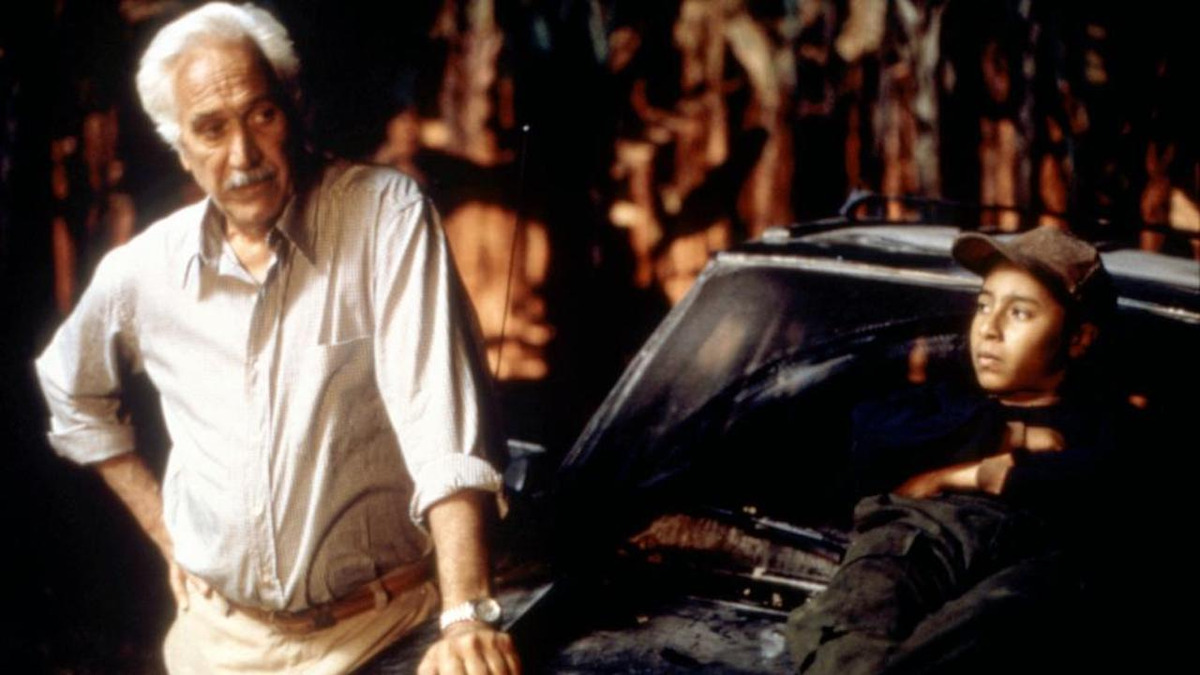
Men with Guns
I love what you chose. Let’s chat briefly about Men with Guns. I know you and Maggie [Renzi] are trying to get these movies back, either owning them or getting the rights consolidated. That would be a great movie to see re-released in some fashion because it’s such a fascinating piece of work. Can you talk a little bit about it?
Yeah, it’s a story that’s based on a couple of things. Many of the events are not things that happened in Mexico; they’re things that happened in Guatemala or El Salvador that I had heard about at the time. I had heard this story from Francisco Goldman, who’s a friend of mine who’s a novelist and who’s Guatemalan. His uncle was a doctor in Guatemala training these kind of “barefoot doctors” to go out and work with the indigenous people. He was from the capital city and he didn’t really understand that his own government was going to say, “If you’re doing anything for the indigenous people, you must be a communist.” And so he started to discover, “What’s happening to my students? They’re disappearing; they’re getting killed.” To me, it’s about that kind of voluntary blindness. He’s a guy who… one of his clients is a general. He just hasn’t spent too much time out in the boondocks and when he gets there, what he learns, if he’s willing to believe it, means that he can never really go back to his former life. Knowledge can be dangerous in that way.
We shot that in Mexico City, in Veracruz State, and in Chiapas right when there was this revolutionary movement going on. So one of the things I remember is that the Mexican police—we had to bring some guns in for one scene—and they said, “By the way, Men with Guns, Hombres Armados—if you try to get through any of our barricades because we have this little revolution going on and all your stuff says Hombres Armados on it, you’re not going to get through.” So during the shooting, the name of the movie was Sera de Cielo (Close to Heaven). So it looked like we were making a Disney movie and things went very smoothly, and then we changed it back.
The other interesting thing is that we needed a lot of indigenous actors. And as my first AD, who was Mexican, said, “You know, if you watched our TV and movies and you were from outer space, you’d think, ‘Oh, I’ve landed in Switzerland.'” There just weren’t indigenous actors who weren’t playing maids. And so we had to find people who were either doing theater or dancing or whatever. Since that time, there’s a lot more indigenous actors, kind of like in the United States. Canada was about 10 years ahead of us. You had a much stronger [process of] coming out of the theater and then getting into movies. So the first couple of times I used an indigenous actor in the States, they would be like Gordon Tootoosis, who was a Canadian.
I was rewatching Silver City, which is also in the series. It was definitely underrated at the time and has kind of continued to get reappraised. It’s obviously a satire of sorts, but to watch it now, it’s almost tame. But then you also have these predictive elements in the film that also feel right on line with what’s happening in America now. Is that a weird thing to reflect on, a movie like that?
Yeah, I’m afraid that this has happened with my novels as well. My last novel has to do with Detroit during Henry Ford’s reign. When I started it, Elon Musk was just a guy who made cars. And then he took that next step of, “Oh, I know how people should live and I’m going to tell them how to live. If they want any help from me, they’re going to live that way.” As life catches up with you, I don’t know how you satirize what’s going on now with the American government. It’s just that you watch the news. Many, many, many people I know, the news is so bad that they have to see it through Stephen Colbert or Jon Stewart or something like that because you can’t take it straight and sleep at night.
In Silver City, there’s still somebody trying to do underground journalism, but that is kind of gone. I mean, journalism is kind of gone. The best journalists I know mostly now they have podcasts and at the bottom of any article they write, they say, “Would you send me some money so I can go report on something else?” because it’s gone. And then the few newspapers or TV shows or whatever that you felt like, “Well, at least they’re trying,” they’ve been bought by people who want the Trump administration to cut them a break or not sue them or something. So that is just starting to happen in Silver City, but it was certainly something that I was aware of. This isn’t going to end; this is a constant battle that we’re going to have.
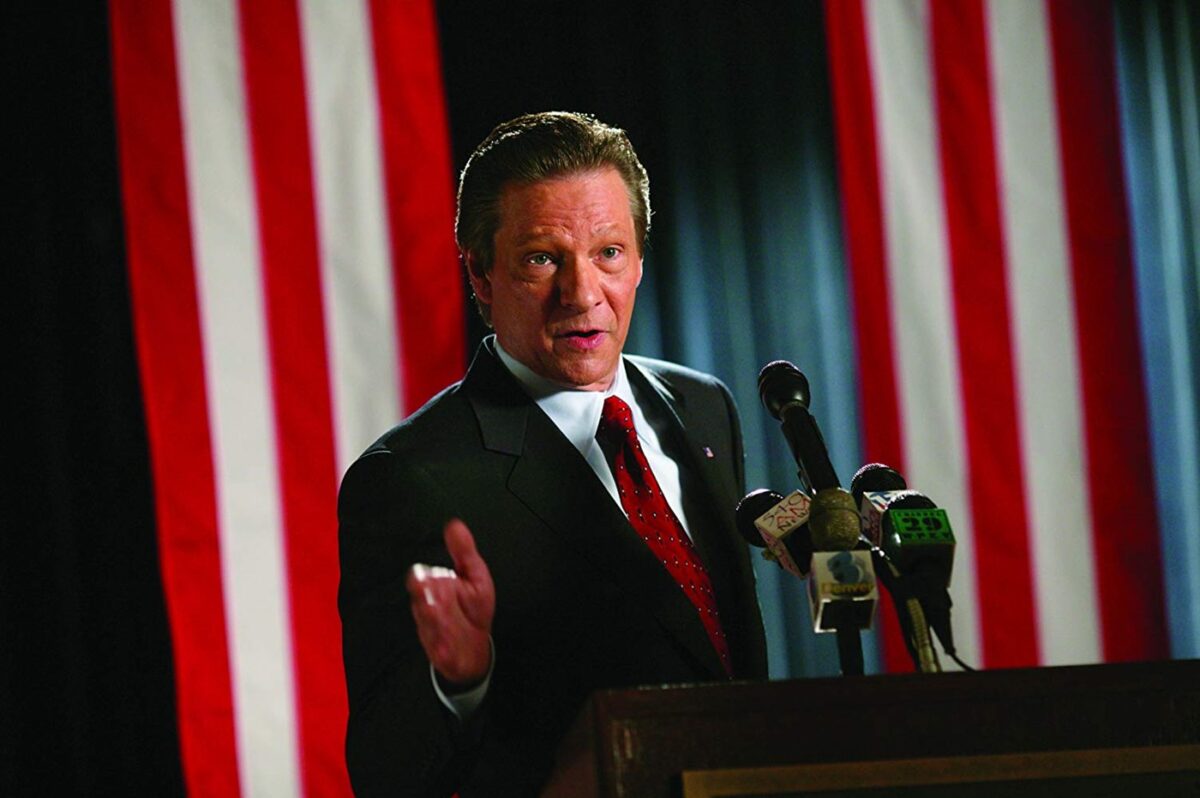
Silver City
Adam Nayman, in his essay, noted that David R. Shumway characterizes you as a “critical realist,” which I think is a good starting point for what you are. I think an underrated thing about your films, though, is that you are often working in familiar genres, but the message and the characters are often just more complicated than maybe you’re going to get in a more standard film. But they are incredibly entertaining films! I always get worried a little bit that when you get into this “artistic filmmaker” thing… your films are not homework. They are entertaining.
We have the same thing with subtitles. It’s something like less than three percent of Americans really want to read any subtitles when they go to the movies. And so that puts a ceiling on how much you can spend on a movie that partly depends [on subtitles]. For instance, our movie Amigo: part of the storytelling is that the audience, because they read subtitles and they don’t speak Tagalog, they know what the Filipino people are thinking, and they see what the Americans are thinking, and they realize here are two trains on the same track speeding toward each other. And there are people I like on both of those trains, but there’s no way they can understand each other. They have no communication with each other. So you don’t use subtitles to show off; you use them because the acting is going to be better, or there is some communication as part of the story.
Baby It’s You is also part of the series. And that was really your first studio movie, right? Do you remember if that was a learning curve?
Yeah, I learned a lot because I was working with people who were less marginal than I was. So my producers had worked out there [in Hollywood] a little bit and that was very helpful. I had Michael Ballhaus as a cinematographer. He’d been shooting Fassbinder’s movies; I think it was his second thing he’d done outside of Germany. So I had a very good crew and very good people working with me. The complication came in the interaction with the studio: they kind of lost confidence in the movie that they had signed off on probably before they even saw a cut of it. And it wasn’t Porky’s and it wasn’t Fast Times at Ridgemont High and that kind of got them scared, and so there was a lot of fighting during the editing.
But before that, it was really fun! It was nice to have a little bit more money. I had really good people I was working with. So we had to kind of stare down the studio to cast the leads that we had because they weren’t stars yet. But once we got them, they did a great job. And it was a movie that… I was fired out of the editing room, and then when the version they came up with tested one point lower than my version, they said, “Oh, what the hell.” I was totally ready to take my name off of it. And they said, “Okay, edit it the way you want.” And then it’s the old joke about: this movie wasn’t released, it escaped. They pretty much put it out and did not let it do well because that would have been embarrassing. Another movie that should have been seen more than it was. An independent filmmaker today could never afford that soundtrack. There were small companies then; now they’ve all been conglomerated. So there’s like two, maybe three places you go and they’re not cutting anybody any deals.
We had talked about Corman when we spoke last time, and a thing you had said you learned from him was that some things you can solve with hard work and some things you have to throw money at. Can you remember from your movies a problem where you had to think, “Is this a hard work thing or a ‘throw some money at’ thing?”
Generally, the hard work is in the screenwriting. So you make an independent film, you have your producers and production manager and everybody, and then they come back and they say, “This scene is going to cost us like a third of the budget.” So then you have to basically go back and you have to say, “Can it be in the daytime instead of night? Can we reschedule so that these four actors only work two weeks instead of three? Can we find another location?”
For instance, in Eight Men Out, there are two shots that are a good example of that. As written, it’s one that Monk Eastman has broken the nose of one of the conspirators and he wants them out of town and he’s at a train station and the train pulls away and we see the guy with the bandages on his nose. We did our due diligence, we were shooting, and we found a train yard that had some beautiful old period trains. None of them were hooked up to a motor that could take them anywhere. So I said, “Okay, we’re going to build a platform that moves.” So we basically built a little platform with a light pole on it and everything, put our actor in it, and then put that platform on rails, and what you see looks like the train pulling away, but because the camera stays over the guy’s shoulder, the train is moving, not the platform. And that was basically just, “Okay, we’re going to figure it out.”
And then in the same little montage, we see, I think, it’s maybe Arnold Rothstein leaving for Europe so he can’t be called as a witness or whatever. We literally shot it in the parking lot. So I said, “All we need is people waving from a boat,” so we made a little boat set on the side of the motel that we’re staying in. And we got a swimming pool—one of those plastic swimming pools—and you put a lot of broken mirror in it and you blast a light down onto it and it makes that kind of water thing on the people. And then you throw confetti on them and you keep it [a few seconds] long. You really have to be realistic about: “Do I need a wide shot here? What’s the scale of this movie? What’s important at this moment?”
There are scenes that just don’t work. You think of The Godfather Part II: if you’re going to do the San Gennaro festival, you gotta go for it. And I think if you look carefully, there’s an African-American woman in the middle of it looking out her window because when production came up and said, “Would you mind [leaving]” she said, “No, I’m watching this. This is right in front of me.” She’s in the movie. But in the swirl of everything, you don’t really notice her. And it would not have worked if you had done it in just little bits like that. It just wouldn’t have been the kind of sequence that it is.
Battle Beyond the Stars you wrote, which is in the series. James Cameron also worked on it as the production designer. You’ve helped him with his scripts over the years—is that true?
No, no, I worked for him once. There was a nice science fiction book called Brother Termite. And it was bulb-headed aliens had been in the White House since the ‘50s and now they were coming out, and there’s a lot of CIA plots and this and that. The nice ones among them want to give us, like, a “golden parachute,” which is everybody’s going to get to be sterile. And they’re going to try to help us solve this sterility problem, but they just don’t know how to help. And the others want to just kill us all right away.
James was going to produce that, not direct that. But it was fun working with him. And the funny thing was: he was prepping to go to Mexico and shoot all the boat stuff for Titanic, and I was prepping to go down and shoot my low-budget movie Men with Guns. We were both in Mexico at the same time. And we even got a couple of refugees from his set, extras who came down and said, “You wouldn’t believe what they’re doing up there in this big swimming pool!”
With the new Spielberg movie coming out (Disclosure Day), I was reminded of your screenplay Night Skies. It’s this incredible, unmade project. Do you recall when a movie like this is coming out?
Well, no. I also worked on one of the Jurassic Park sequels; I think it was 4 or 5. And it was fun! Steven is fun to work for. And that one, I think what happened may have been is that they were hiring me to do something very different with the dinosaurs, because after Jurassic Park III it was like, “Why would anyone go back there if they’re going to be eaten by dinosaurs?” And so I was trying to do one where you didn’t go back to the island. So I wrote Jurassic Park 4 and they were still thinking, “Do we really want to do this? Is this good enough?” And then I think somebody said, “It’s been like eight years since we made one of these. There’s a whole generation who has never been to the island! So let’s just go back to the island.” And they did a very good job of it; it just wasn’t what I was doing.
[Night Skies] was just a nice screenplay. I was able to take a couple ideas from it. Just before he died, I was working with Douglas Trumbull on a science-fiction movie that was kind of an extension of his ideas for Silent Running. It was a lot of fun. Great guy; really fun to work with him. Just got into some bad health and died in the middle of us working on it. And we tried to revive it a little bit after but didn’t get any traction on it. But I’m back in that world of speculative fiction. Not really science fiction. You try to have the science be as good as it can. For instance, I wrote a movie called Them Again! You can make such a better ant movie now! And I gave it to Joe Dante and he hasn’t been able to get it off the ground. But basically I brought in all the new science, CRISPR and all of that.
Are you still on track to make I Passed This Way?
“On track” means we’re still looking for money. We have some independent money interested and twice we’ve had to pull the plug, like, the week before the actors showed up, which I don’t want to do again. So this time around, it’s gotta be: I want the money in ten-dollar bills or ten-euro bills piled up in front of me. And we know the horses we’re going to use and this and that and the other. I’m not alone. There are a lot of filmmakers with a bunch of projects or one project that they’ve been chasing for a long time.
A standalone movie—not part of a series, not part of the Marvel Universe—is a really hard thing to get made now because there are some very good ones made that just don’t get traction and disappear right away. And so investors are very skittish. It took 11 years from when I wrote the screenplay to make Eight Men Out. I used to have these little cards with my dream cast on it and I literally started with Martin Sheen at shortstop and ended up with Charlie Sheen in center field. Eventually, you have to say, “Well, I’m sorry, guys—you’ve aged out.”
Declarations of Independence: The Cinema of John Sayles runs from June 11-18 at TIFF with Sayles in person.