
It could be a result of living abroad, or that a good producer’s work is often defined by their ability to stay quiet, but Rodrigo Teixeira has perhaps become the single greatest shadow player in contemporary cinema. Since 2012, his Brazil-based RT Features has offered a dense vision of what the modern arthouse cinema can offer for target demographics: Oscar winners (I’m Still Here), American indies (Frances Ha, The Witch), crossover arthouse smashes (Call Me By Your Name, The Lighthouse), auteurist favorites (Bergman Island, Kontinental ’25), avant-garde features (The Human Surge, Dracula), producing collaborations with Martin Scorsese (Murina, Port Authority), and one instance of a major-studio blockbuster (Ad Astra).
Teixeira is preparing for his even bigger things this year: James Gray’s Paper Tiger—their third collaboration after Ad Astra and Armageddon Time, starring Adam Driver, Scarlett Johansson, and Miles Teller—is set to debut, Michael Almereyda’s Don DeLillo adaptation Zero K is preparing to shoot, and perhaps most intriguingly, a new film from Brian De Palma will roll cameras. (It’s the director’s first since 2019’s Domino, which really means his first since, at least, 2012’s Passion to be properly supported.) There are at least five other films expected to premiere in 2026. Among the first is Gabe Klinger’s Isabel, which was announced yesterday to be premiering in Berlin’s Panorama, the same section at which Teixeira played Frances Ha and Call Me by Your Name.
Teixeira and I connected during his recent visit to New York, where he’s assisting Gray in Paper Tiger’s final stages of post-production. Seated for an hour-long conversation, he proved remarkably open about these projects, what is leaving American cinema hamstrung, and what he envisions for RT Features in years to come.
The Film Stage: Even if you’re not as busy as the director, you still go to set. Do you find yourself watching films around that time, or do you cut it out?
Rodrigo Teixeira: For sure. When I came here to shoot Paper Tiger, it was so hot, and I liked to go to the movies just to have some good weather and stay well. What I liked at the time was, shooting Paper Tiger here, I saw some commercial films that came to the theaters—I liked to go and see F1 and Jurassic Park, the normal commercials—but I also go to the repertory films. I go to Metrograph; I go to Film Forum. I went to Metrograph, last time, maybe eight or nine times. I saw a lot of films. I saw Wong Kar-wai, I saw two of Vincente Minnelli’s films, I saw Kwaidan, which I like very much. I saw one of the Kubricks. We don’t have any of those films available on Blu-ray or digital, so I saw them there. I saw Inherent Vice on 70mm at Lincoln Center. I saw Apocalypse Now; I saw Heart of Darkness.
I love to see films. In Brazil, I have a projection room in my house. Every night when I’m at home, I see a film. If I don’t go to dinner or come home late from work, I see a film in my house. On the weekend, Sundays, I could see even three films, one after the other. Saturdays, maybe one. I wake up very early and see, sometimes, a film from 6:00 AM to 7:30 AM. It’s something I like.
That’s the best time to watch movies.
I like it very much. For example, Springsteen I saw like that. When I travel, normally I bring a Blu-ray player, and I put some films on my iPad. Or if I’m having a meeting with someone else and they mention a film and I have it in my collection, I put it on. This year, from Portugal to here, I saw thirteen films. The first one was The Taking of Pelham One Two Three, the original one. It was the first film of the year for me.
There’s this great roster of talent RT Features is working with. About a year ago, I’d heard you guys were looking at some filmmakers in a sub-million-dollar range. A lot of the names were people I knew, but they’re not mega-famous. So I guess I’m curious about the balance for you between watching classics like Pelham One Two Three and watching new indie films: how much are you dividing your time, or thinking of them in separate ways?
Because I see a lot of films, I don’t have a division. If you tell me today about the new director, and if I could find his work easily, I will see the film. What I like to see are the classics because I think… let me rephrase: I’m Brazilian. Brazilians are colonized, culturally, by the United States. That’s the truth. We are much more aligned with the United States than any other country in Latin America because we have a monopoly of a media group in Brazil, and this media group was partially owned by Time Warner, when it was Time Warner. Because of that, we are only receiving American films, seeing American films, and that’s something that feeds us. It’s easy for us to understand American culture.
And I prefer, sometimes, to go for the old films because I believe now something has changed: we have a better freedom of speech outside of the United States than in the United States, because you have someone who doesn’t help you have a better freedom of speech. You have a situation where all the major finance groups who finance films, they don’t like to finance certain types of films because they go against the government, and they will not do it—in this period, at least—unless you change the President. You guys are not having more freedom. When I go to the American cinema, I go back to see when America made great films—when they had freedom of speech, when you could criticize the government, when you could criticize situations happening here.
I understand Paul Thomas Anderson making his films, but for me—I was born in the middle of a dictatorship, and I made a film about the dictatorship [I’m Still Here] that won an Academy Award—when I see [One Battle After Another] I understand the white supremacist, the interracial marriage, I understand the Latino’s situation, but I think it was all on the surface, that film. Nothing was really deep; it was surface with, like, comedy. You put Leonardo DiCaprio as a guy who smokes weed and becomes, “Okay, I’m a loser.” You have Benicio del Toro play a sensei—a guy who is not in politics, is kind of a loser. Maybe that happens here, but you don’t go deep. That’s what I’m missing in the United States.
You mention new films. I know the new directors—almost 90% of them—are not doing that, too. But outside of the United States, I think the cinema is being very interesting. If you see this year, you have Sirāt, which talks about something. When you have Sentimental Value, which talks about sentiment, about emotions. When you have It Was Just an Accident. When you have Sound of Falling. When you have the Park Chan-wook, which is a comedy but leaves a message for you. When you have these types of films being made outside of the U.S., you ask: why is this happening outside of the U.S? For one reason: because we have freedom of speech, and you guys do not. And we don’t need Netflix or Amazon to finance ourselves; we have subsidies that help us to do our films. That, for me, is the reason why I go to see the young international filmmakers, or I go back to see old American films: because I don’t think America, right now, is doing great films. For the first time in years, I’m not seeing America doing the best films.

James Gray
Just before recording, you were talking about Paper Tiger. And James Gray is one of the only American directors in a certain budget range making movies about a ground-level, working-class sensibility, and does so authentically. You can feel those movies in your bones.
Agreed.
Would you say Paper Tiger is a movie that gets at something deeper or more political happening in America?
It’s about relationships. It’s about the types of relationships happening in all families. It’s about love, about brotherhood. It’s a love story between two brothers: that’s the film. It’s about something we have in our homes, we have in our families, and that’s because James is so grounded. It’s a letter of love between him and his brother, his father, and his best friend. It’s a letter of love between two brothers. Everyone has a brother or a sister or a best friend who they love so much, and he’s talking about this, and he used a situation—a thriller, a cop situation—to create the drama surrounding these two brothers.
But that’s the story: it’s about brotherhood, and that I love very much. It’s grounded in the America of the ‘80s. No pyrotechnics with a lot of visual effects. Real music, not an excess of music. That makes James Gray very different. The good thing, now, is that we have three actors portraying three brilliant characters. I never saw Scarlett Johansson do what she did in this film. Never. I think she made a work that will be remembered. Adam Driver and Miles Teller are great. Miles Teller is the new James Caan; he looks like James Caan in the ‘70s.
That’s a strong claim. But I’m excited to see it.
And Adam Driver is Adam Driver. He’s one of the best actors of his generation.
It sounds somewhat reminiscent of We Own the Night, a period piece with the two brothers, and also The Yards perhaps.
It’s a mix between three films: We Own the Night, Armageddon Time, and Two Lovers. Very mixed.
In the same vein, Isabel—which I’ve seen a couple of times now—is a Brazilian production. Very ground-level, very small-scale, and feels extremely lived-in. I wonder how much that represents—or if there is—an ideal vision you have for modern Brazilian cinema that you want to support
My company is much more a director-driven company than anything. I love material for sure—material matters for me—but if I found the material, I’m going to go for a director who I respect. Gabe’s film is talking about a contemporary urban situation, which is not the way Brazilian cinema is doing it now. It’s much more like what you would expect from American cinema than Brazilian cinema. And I think that’s the originality, because that story is a Brazilian story directed by a Brazilian who lived most of his life outside of Brazil. He has a foreign point of view of Brazil, and that’s something that matters for him. He’s seeing something in Brazil that we Brazilians don’t see easily! He’s like a foreigner looking for Brazil, but he is a Brazilian—born there to a Brazilian family, but raised in the United States.
It’s a Brazilian film with American sauce—the sauce is American, but the film is Brazilian. When I read the script, I thought it looked like Frances Ha, but instead of a 20-year-old woman, you have an almost-50-year-old woman. It’s Frances Ha for someone who didn’t make nothing until 50 years old [Laughs] and that’s great because a lot of people are trying to find their path at 50. That’s the beauty of this film.
Also, I respect Gabe a lot for one reason: he told me he would do this film for a small amount of money, and “I will deliver.” And he made a film with a small amount of money, which was shot on film with quality, with some technicians who do big films, a good actress, a good group of actors, a good production company, and we will go to Panorama. A lot of Brazilian films that I made that talk about real Brazilian matters were not in Panorama. And that’s important. Gabe delivered the film. I told him yesterday: I respect him. I guarantee his love of cinema made this film happen.

Isabel (Gabe Klinger)
When you say films that talk about “Brazilian matters,” do you mean social issues?
When you go international, people are looking for social issues, economic issues, political issues in Brazilian cinema. If you don’t have that… Gabe’s film is difficult even to classify. It’s a new, Brazilian type of movie. I don’t know other films that do that. You could compare it to American indie films. I’m not comparing it to Brazilian indie films. He’s way ahead of the Brazilian indie films, in my opinion. I think it’s going to open space for other Brazilian filmmakers to do what Gabe is doing.
It looks great. Shot on film in a very raw, natural way. But it’s also a movie cinephiles could show to their parents. It has an angle people love—middle-aged people figuring themselves out—and the wine aspect helps.
People want to see it because they see themselves in it. You told it perfectly: it’s easy to show to my mother. You don’t need to think very much; you need to feel. This film gives you something. I agree with you in everything you say about this film. I’m very proud of this film. I never imagined this film would achieve what it achieved. When the curator called me last Friday to tell me we were in Panorama, I was in Portugal having my lunch. I told my wife, “I’m going to call Gabe.” I called him and I saw he was crying. He was relieved, and he was crying.
I worked very hard with the curators. She became a very good friend. She called me like this: “Sorry you are not in competition, but—I don’t know if you are uncomfortable—we’re going to give you Panorama.” I thought, “What? I went to Panorama with Frances Ha and Call Me by Your Name, two of the films considered some of the best of the century. They weren’t in competition. They were in Panorama.” I have my third film in Panorama, so: fine. I’m happy.
How are you feeling about the state of Brazilian cinema? Lula has talked about the arts. The previous guy, you could say, was the exact opposite. How has it changed in the last couple of years?
I’m going to tell you something: the previous President—who has a name difficult to pronounce—he killed culture in Brazil. He went against all of us. When Lula came in, we knew we would be able to do films, theater, whatever we want again without looking like we are the bad guys. Because we are not; we are artists. But for Lula to fix what the other president made, it’s going to take at least eight years. What this guy destroyed in four is impossible for someone to deliver in four. Because the guy not destroyed, but with him you also had the pandemic, which helped to destroy things during two years. No one will give us that back in four years. Impossible. Lula will need at least two terms to give us back where we were.
But the good thing is: Brazil is trendy again. I’m Still Here came and showed we do great films. We had a prize with Gabriel Mascaro’s film in Berlin. We got four prizes for Kleber Mendonça Filho’s film in Cannes, and Kleber Mendonça showed Brazilian cinema is in the best shape ever. I think Brazil has, right now, one of the best cinemas in the world. In Latin America, I guarantee you, if you take out Guillermo [del Toro], Alfonso [Cuarón], and Alejandro [Iñárritu] from Mexico, Brazil is definitely the other place. I’m working a lot in Latin America, and I know Chile and Argentina have great directors. What Brazil has are great directors and also actors. We have some stuff in each that could become better, but directors and actors I know we have.
Do you think the restrictions put in place around 2019 to 2023 helped your career, when you’re going abroad, making films elsewhere?
To be very transparent: I think everything that happened to me between 2020 and early 2024 changed my way to see the world. With that, you have Donald Trump come for a second mandate. At the same time, you see freedom of speech and more interesting projects outside of the U.S. These people also need someone like me to help them because I know the American system, because I’ve worked here for 15 years. I know everyone; I’ve been there; I know how to navigate this system. But also, I have more pleasure right now doing international films than I have doing American films. Much more pleasure. James Gray is different because he’s someone I consider part of my group of artists—I’m going to do everything he wants—but it’s not easy to find great American projects right now.
The big directors don’t need you. They’re going to go and find a studio to back them up. When they come to you, they’re going to ask for so much money and I’m not going to be able to pay them because I’m not a studio. The other part I like is a director after a failure, when he is discredited by the market—people don’t believe they could deliver something good. They will need me, and I could have access to talk to him, access to have him accept what I have to offer, and access to make their films. Because they will need help. That’s happened. It’s seasonal. This year, one great director will probably need someone to help them do it.
What I’m trying to do, also, is get great directors who are not filming. Because something I’m learning here in the U.S.: even if you have Scorsese, Coppola, and Clint Eastwood doing films, this is still a country that has a problem with the elderly. And that’s something that’s happening all over the world: old people who “are not capable of doing films.” It’s not true. You need to mix old people with young people. It’s like you’re managing a sports team. Production is packaging. Packaging, packaging, packaging. It’s a draft. You find the best young player there, you find the old player there, you put them in the same team, you manage them, and you do the film. It’s the same matrix of sports. You could do that.
That’s what I like most: it’s putting people together to make this stuff happen. I’m doing that with an old American director—you’re going to be the first one who will know—Brian De Palma. I’m going to do a Brian De Palma movie. He’s one of the guys I love. Why not? His mind is sharp. Why could he not do it? Spielberg is doing it, Scorsese is doing it, Coppola is doing it. Why De Palma, no?
De Palma has… maybe there’s five years in the ‘70s where he was beloved and acclaimed. But which one isn’t vindicated by time? Maybe Get to Know Your Rabbit. Otherwise, people come back and, even if it’s not his best, you realize there’s more interesting stuff than a first pass let on.
What this guy does with a camera! The scenes this guy directs… Jesus Christ. He knows how to emulate any film in the world originally. On The Untouchables, everyone talks about the scene at the train station from Eisenstein. No one talks about all the scenes he stole—and that I love—from On the Waterfront. You have, like, three or four scenes from On the Waterfront there. Put the death of Rod Steiger here and put the death of Charles Martin Smith in the elevator: it’s the same. Different angle; it’s the same scene. Same. When Kevin Costner looks at him and when Marlon Brando looks, it’s the same. The feeling is different because it’s a brother situation and here is a friend situation.
When they are in the court—when Marlon Brando wins and the other actor lost in On the Waterfront, he comes to beat Marlon Brando; it’s equal to Robert De Niro coming to beat Kevin Costner. It’s the same scene! I didn’t see anyone talking about that. That is On the Waterfront. This guy is paying homage for the real cinema. We need to respect this guy. I love him. It’s an honor for me to do something with this guy.
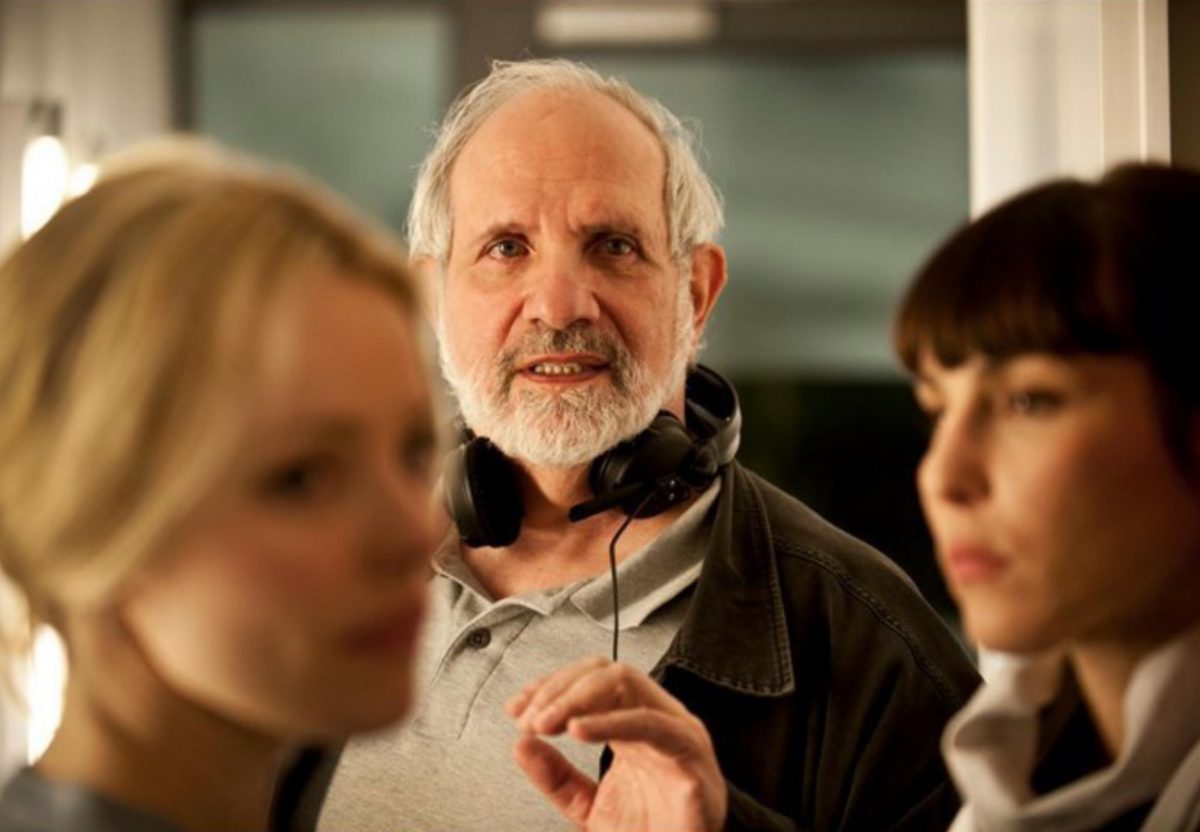
I’ve seen Domino a few times. And I don’t know if he’s told you about the production of that.
Yes.
To hear tell, that was like having one arm tied behind his back.
Yes.
Not enough time, not enough money. But even then, he still does stuff in that movie that’s exciting and funny.
I like that film. I like Passion. I think Passion is a good film.
It really seems he hasn’t had the resources and support lately.
With the resources, we could do it. What I’m offering is… again, you need to understand who your best players are, how you make this player play better. I don’t have the money to bring the best American technicians. Okay? Okay. I’m going to bring the best Brazilian technicians who made I’m Still Here and The Secret Agent. I’m mixing the crews between these two teams and offering them to him. I’m shooting in Portugal, where the conditions are great. The second language of everyone is English; the first language is Portuguese, which I speak. Great for me. A 30% tax rebate—great.
For actors, I told Brian, “Let’s find someone above-the-line who is sellable. We’re going to try a great actor to do it, and let’s find three women who could be American, British, whatever. Since it’s Brian De Palma, this film is going to be selling. We could have a big star. That’s great. But even if we don’t, it will be sold because of you and because of me, because they trust what I’m doing. They know Rodrigo with Brian De Palma—maybe something good. Maybe we’re doing, together, a good project. It’s like when you do a project with Saïd Ben Saïd in France. You know if you do a project with Saïd Ben Saïd, the film at least will be good because you know this producer has great taste. If he’s doing something with this guy, maybe the film is good.”
I think De Palma will do great. I know part of the critics will hate it—because that’s part of the job—but I know part will love it; also that’s part of the job. But who cares? The important thing is finding the right price, so I try to receive some of my money back with some income. That’s the way. I think, in the U.S., it would be impossible because a De Palma film in the U.S. would go for a price impossible to do. And because of that, I’m putting out my hands; I’m not going to put out his hands like that. But I know: I saw the script and I told him, “You have two big scenes. The investment is in these two moments. We need to make sure you get these two great moments. All the rest is people looking, apartments—all the rest is easy. It’s timing, it’s good actors delivering. The scenes we need—movement, space—are the prologue and the epilogue. There are two scenes. That’s where we need to put the money, is in those two scenes.”
Is this project Sweet Vengeance?
Yes. It’s coming back. We’re going to start doing it in May. May is the starting point.
I had heard, somewhat verifiably, that De Palma was done making films.
Someone came, called him, and told, “I’m going to do it.”
But how many artists actually retire? So many of them are on their deathbeds and are still making plans.
All of them. They only stop making plans after they die.
It’s because you can’t turn it off.
It’s impossible. When you do films, it’s impossible. And again: why not do a Brian De Palma movie?
I pay respect to him. I’m a foreigner; I’m not American. I don’t understand why this guy never received a proper homage in the United States, a recognition. Let’s go. This guy directed Orson Welles. Discovered Robert De Niro. Directed the woman who made Suspiria.
Jessica Harper?
Jessica Harper was discovered by him in Phantom of the Paradise. Directed Cliff Robertson. Worked with Bernard Herrmann. Introduced Bernard Herrmann to Scorsese.
Gave Scorsese the Taxi Driver script.
Gave Scorsese the Taxi Driver script. Worked with Margot Kidder before Superman. Worked with John Cassavetes—exploded John Cassavetes. Made one of the best Stephen King films. He’s one of the guys who started working with John Travolta, before everyone, in Carrie. Sissy Spacek, Carrie—okay, she worked with Terrence Malick before, but Carrie was like a huge phenomenon for her. Jack Fisk worked with him. Amy Irving worked with him. Nancy Allen. John Lithgow started with him. Angie Dickinson. Michael Caine. Making some of the best Al Pacino works ever in Scarface and Carlito’s Way. Sean Penn—two great works. Made Michael J. Fox play a serious guy. Killed Sean Connery. Made Kevin Costner become one of the huge stars in the world. Made the first Mission: Impossible, which became one of the best franchises in the world. We forgot what this guy is!
Two great Ryuichi Sakamoto scores.
Yes. Ryuichi Sakamoto scores, Ennio Morricone scores, Pino Donaggio scores—Jesus Christ! Body Double, Blow Out. Jesus Christ, Nicolas Cage in Snake Eyes was a great film—a pure Hitchcock film.
His problem is that he was born American.
That’s the problem. Do New York critics like James?
Yeah.
James is the guy. But he never gets the recognition.
Also another guy whose problem is being born American.
I think, next year, James can be at the New York Film Critics Circle. Scarlett Johansson could be there. The script could be there. The film could be there. It’s impossible for James to compete with Odyssey, if the Academy would like to give a prize for Odyssey, but I don’t think the New York Film Critics Circle would give a prize for Odyssey. Spielberg could be, depending what Spielberg made; we don’t know. I don’t think Dune 3 will pick up this prize. I think James will be the only true American director doing something small but with great actors. Josh Safdie is not doing anything; PTA, nothing; Aronofsky, nothing; Sean Baker, nothing. It’s James Gray.
You’re also producing Michael Almereyda’s Zero K. I’m a huge DeLillo fan; I read that book when it came out ten years ago.
It’s an amazing book.
It’s a great book, definitely one of his better later ones. I heard about Zero K in 2020 and read the script about three years ago—not a short timeline. Almereyda is a pretty different filmmaker from De Palma, except that both aren’t receiving all the support they should. What was it about him that drew you?
First of all, it’s an affordable project. I’m bringing this project to Brazil, and the film became affordable. I think, with the level of price we are doing, I could make money on it, to be honest with you. I understand Michael. I think Michael needs better producers behind him to help him, because I think he makes great stuff. He’s a very clever guy to be close to because he’s a film-lover, and I understand: that’s the beginning of something. I understand I could do something great with him in the future. It’s funny, because Michael is a director for directors; directors respect him very much, all of them. It’s crazy. All the directors like him. And some actors, too. He could cast amazing actors. That’s also a question of relationships. I would like to have relationships with these other actors I’m working with, because in the future… again, I use—metaphorically—sports: you need, sometimes, foreigners to make your team better, or to make your team sell better for audiences.
Let’s talk about Sentimental Value, what they do to open the film. They made part of the film in English. That’s opening the door for the American audiences. You don’t know if that’s an American or a foreign film. They have the best of the best of actors—at least between the 20 greatest actors in the Nordic countries, they have three or four of them working on the film. They need an American actress. They’re not going to afford Zendaya. They bring Elle Fanning, and Elle Fanning brings value for that. Okay, if I bring Peter Sarsgaard, who is a great actor; Andrea Riseborough, who is a great actress; Caleb Landry Jones, and I put them in the film? My friend, I have that.
We don’t need to bring Timothée Chalamet for this film. We don’t need to bring Timothée Chalamet to do Joachim Trier’s film. He can have Mads Mikkelsen to do his films; he doesn’t need Timothée Chalamet. I’m talking about a completely different age, but he could have the Skarsgård sons to do his films who speaks Swedish, Danish, whatever. That’s the way we’re doing films right. That’s the mix. People travel; people work in other countries. Why not an American actor doing a Portuguese film?
I was seeing a film with George C. Scott later on—I don’t know if you know this film from the 70s [The Last Run]. He’s a killer living in Spain. It’s amazing. That film makes The Hit with Terence Stamp look like a film for kids. It’s crazy. And it’s mixing. That was something, in the ‘70s, people did: mix cast. Put a French actor to do an American movie; put an American actor to do an Italian movie. Why not? It’s not real. That’s what Michael Almereyda is doing, and I’m mixing all the great Brazilian crew working with Michael on the film. And I’m happy, because at the end of the day I know I have a good project at hand. I know how to sell it. I know how to put it.
Again: Michael has a great producer with him, Anthony Katagas. But he needs someone who completes Anthony Katagas. I’m never going to do the job of Anthony Katagas—Anthony Katagas, for me, is one of the best producers on the field—but what I have are relationships; I could help Michael to travel, and that makes the film look like Michael Almereyda’s comeback. That I could do. That is not only money, but how we make the film travel and what I receive: access to actors; stay with this guy who is one of the most brilliant cinema-lovers I’ve ever met in my life, a generous person. Why not have this guy close to me? I would love. That’s the way. How old are you?
32.
I’m 49. When you are this age, you understand. I respect Michael, and I like him. The description he gave of James Gray for me is perfect. Perfect. And it was funny, because I used something he told me about James—I was playing a joke with James two days ago—and James looked at me: “Who told you that?” I told him, “That’s my opinion.” “Oh, you are right!” To be honest with you, I learn so much being close to Michael and being close to De Palma. That’s a school for me. I’m 50; I’m learning. Producers, if you’ve lost your curiosity, you’ve lost your capability to do films. And that is what I love: to be close to these guys and learn with them. I will learn from De Palma, I will learn from Michael Almereyda, and I’m going to use that for my other films. I’m doing great young filmmakers at the same time.
You have a number of movies that are filming or in post, most of them not American. You’ve got Sweet Vengeance shooting, Paper Tiger in post, Isabel at Berlin. What does this moment look like for you, with a number of movies in some advanced state? Is it always reading books to option, reading scripts to option?
I’m still developing a lot. Right now, I have five films. I have six films traveling right now. I’m going to have James Gray traveling this year. I’m going to have Domingo Sotomayor’s La Perra traveling this year, which I saw—it’s brilliant. I have Glaxo by Benjamin Naishtat, which I’m seeing—it’s brilliant. I have Wolves, a Lebanese film I made, which I’m seeing—it’s brilliant. None of these films are going to Berlin; we’ll never try because they’re not ready. I have Isabel, which starts in Berlin, and I have Bowels of Hell, which is starting in Rotterdam. Those are the films I already shot.
Okay? And for this year, I’m shooting films that are going to be 2027 films. At least, I know, three of them will be shot; the other ones I’m working. When I have a greenlight, my idea is to shoot at least six or seven this year. It all depends on the script, the packaging, the financing. Three, I have already the money to do it; the other ones I’m working on.
But I think we have a great Argentinian film, a great Lebanese film, a great American film, a great Chilean film, and two great Brazilian films. That’s the scope of RT Features right now. I don’t think my Brazilian films are on an epic scale like Kleber Mendonça and Walter Salles. I am an associate producer on a film directed by my wife [Carolina Jabor], which I think will be the best Brazilian film of the year.
No bias!
There’s no bias. It’s not because she’s my wife. I think it is the best Brazilian film of the year. And also, this year it will be funny. I’m predicting we’re going to have a good year. I think James Gray is coming in the right moment. I don’t think we have great, big films—great American films—coming. James will be at least between the ten great American films of the year, for sure. I’m not seeing other films like him. I believe it’ll be the first time I see James doing something where people look and say, “Okay, he’s in the right place right now.” And I love that.
Can you tell me about your wife’s film?
It’s a book by a French author called Leïla Slimani. In English it’s the name of the character [Adèle] but in French it’s Dans le jardin de l’ogre. It’s about a woman who has sex as a vice—she’s addicted to sex—and she was fucking her life up. It’s like Shame from Steve McQueen, but from a woman’s point of view, and I think the character has more depth than Michael Fassbender in Shame. It’s a great, possible film. I think this film is going to travel; I think this film is going to go far. It’s a great film. I’m an associate producer; the production company is Conspiração Filmes, which is the biggest Brazilian production company in terms of volume. But this film is special. Alice Braga is the main actress; we have great Brazilian actors doing the film. And Leïla Slimani was in the jury of the Cannes competition last year. It’s amazing.