
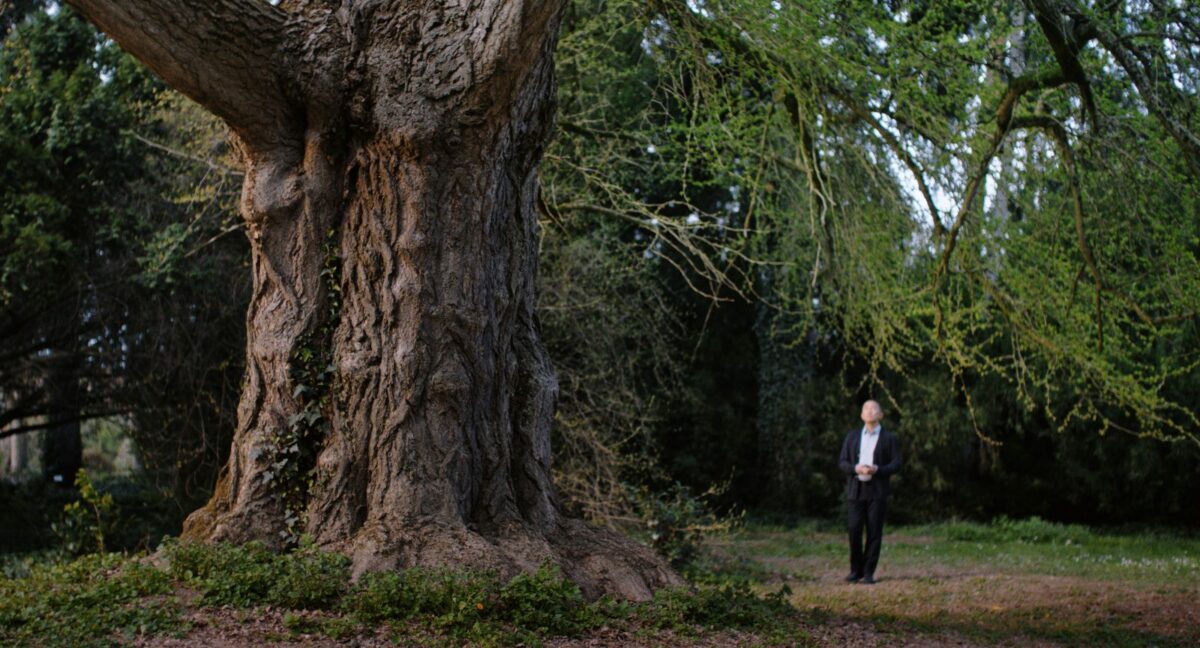
In Silent Friend, characters from three eras interact with the fauna around them. In 1908, Grete (Luna Wedler) tries to study medicine at a time when women were not allowed in college, and photography helps her uncover patterns in nature. In the 1970s, a geranium fascinates Hannes (Enzo Brumm) in ways that change his life. In the present, a scientist (Tony Leung) searches for methods to communicate with a ginkgo tree.
In her previous films, Hungarian writer and director Ildikó Enyedi has toyed with genre expectations, mixing drama and humor with narratives that verge on science fiction as much as documentary. Silent Friend has an open-ended narrative that resists easy explanations. Enyedi challenges contemporary storytelling, refusing to fall back on “if / then” binary plots. Her work has an integrity and intellectual core rarely found in cinema today.
We spoke at the Busan International Film Festival about glimpsing into a tree’s perspective, crafting outsider characters, the century-spanning narrative, an emotional approach to cinematography, and more. Enjoy the conversation ahead of a limited U.S. release beginning this Friday.
The Film Stage: Let’s start with the script. Did you always intend to have different time periods and storylines?
Ildikó Enyedi: Yes, that was always the original intention. Human lifespan is painfully short compared to trees. Our rhythm of life is also radically different. We have quick heartbeats and take around 50 breaths per minute. Trees have one inhale and one exhale per day. One of the aims of this film, maybe the main one, is to get a glimpse into a tree’s perspective, into its own world. Lifespan, perception of time is so basic. I wanted to show that by taking three samples from the long life of a tree.
This is not the first time that the more-than-human has a role in my work. Somehow in all my films, without any real ideological purpose, animals often have important roles. Even plants, in several ones. I made a film in the nineties, Magic Hunter—it was centered around the 600 years’ time of an oak tree.
A ginkgo tree is the star here.
Of course, for ginkgo, you can’t have them so old in Europe because they arrived only at the middle of the 18th century. It is a nearly extinct species. Some examples remained in a tiny corner of China and a tiny corner of Japan. Their situation was a bit like the redwoods. At one time the whole globe was covered with all kinds of ginkgos. The ginkgos of today are living fossils. Their natural enemies have been extinct for millions of years. They are really strong and resistant. They don’t care about smoke. They thrive in the dirtiest pollution. So now you find them everywhere again, around the globe, mostly in urban environments.
In New York I see Asian people collect the fruit from the trees.
I once tried to taste it and it was so disgusting that I gave up. To chew a ginkgo leaf tastes better.
It’s supposed to help memory.
Yes, the leaves contain chemicals to help blood circulation and more. But it’s really a lonely soul. Even in the botanical garden. Actually, the plants surrounding it made this tree nearly extinct because they have a much more simple and effective way of reproduction than the old-fashioned sex life of this tree. Of course, I simplify a bit. The ginkgo can thank us humans that it exists now all over the globe. We found it cute. We fancied it. So we brought it everywhere.
In nature, the ginkgo is an outcast or a loner.
Yes. Very much.
Just like the characters in your movie.
Absolutely. For different reasons, but all three humans in this story are outsiders.
What I found interesting was that, in each story, the outsider had to find a collaborator, someone to help them.
That’s very interesting. In a little parenthesis, I’m working now with fairytale therapy for my next film. In every short, in every folk tale, the hero has a helper. And, they say, the helper is in fact part of yourself—the missing part. So when you analyze a fairy tale, the helper is as important or even more revealing than the hero itself. But thank you. I never thought about it, yeah: in Silent Friend these “facilitators” are all have a meaning.
In each story, the heroes clash with a system.
Yes, that is very true as well. The world we are considering as objective and unchanging is actually defined not only by your senses but also social constructs. That’s why I chose these three moments in history. It’s not such a long time, a bit more than a hundred years. But each one shows a shift in our perception, in how we experience the world. Our everyday feelings, and with it our ideas of how we exist in the world, were radically changed in these moments. Our heroes experience and respond actively to these shifts.
That’s why your film is so exciting: these revelations kept emerging in different periods. You include some biological footage. Did you shoot that or was it from an archive?
Part of the microscopic footage, yes, we shot ourselves. Actually, the mother of our cinematographer, Gergely Pálos, works in a hospital with a very powerful microscope researching human tissues. On a Sunday we just sneaked in and put sections of vegetal tissues, ginkgo leaves under it …
Are you allowed to say that?
Well, let’s hope they don’t read it! But important images of the film also come from an amazing Japanese documentary, The Sea in the Seed, from the early 2000s. This is what you see at the end of the film. How a ginkgo reproduces is so complicated. And it takes several months.
What happens is—again, my apologies to all botanists for the simplification—that the sperm gets into this little pouch and waits there for five or six months until the fruit falls to the earth. That’s when it becomes stinky, or fermented. When it rains, the sperm start to move in this “sea inside the seed.” It sounds so similar to what happens with us, humans, the same sort of journey. That’s what the Japanese filmmakers captured.
What about the characters? Are they based on real people?
Not really. Except Hannes, actually. This shy but so charmingly alive boy in the 1970s is very much my husband, Wilhelm Droste. He is from North Rhine-Westphalia and was a German Studies student in Marburg. That’s how I know this little university town and its botanical garden. I love this garden; I’ve watched its slight changes for more than 35 years. Yeah, my husband is very much a shy and a really sweet guy.
Is there a historical equivalent for Grete?
Well, the year 1908 is exact. That’s when the first female student was accepted into the university. At that time in Germany, a woman couldn’t get a high school diploma, which was an entry requirement for the university. But the real first female student was what we would now call a PhD candidate from Japan. By the way, she also studied biology.
The scene where Tony Leung delivers a lecture seemed very formal to me. A lot of set-ups, a lot of angles, moving shots, stationary shots. Was that all in your script?
I love to think through storyboards. Of course, there are many moments when you just throw them away or when it is nonsense to storyboard a scene. This film has some like that as well. But most of the time, storyboarding is an essential part of thinking about the scene with the cinematographer. I’m awful in drawing, but I draw and redraw my little storyboards myself. Somehow it helps me think. If possible, on real locations. Regarding the scene of the lecture: I saw this darkness and a little island of light looming within it. That was the core of the scene.
We took a very simple, very classic approach of covering every possibility. What was important to me was the light. Well, rather the lack of it. We barely see the students, we just feel them. Tony and these young people are enveloped in this warm, soft darkness full of hidden life. We see shining eyes, hands, profiles, smiles emerging for a second in the darkness and a calm and patient voice of Tony speaking to them—and to the spectators––about something radically new and not so easy to grasp. I wanted the opposite of the standard flamboyant, mesmerizing lecturer professor. He is restrained and offers a sensory experience to their students to help them gain a deeper understanding of his research. He creates a situation and lets the students explore it freely. I was so glad when at one of the Q&As someone told me that the whole film worked for him the same way as this lecture with the wobbling, ambling light ball for the students. This was my intention.
On the other hand, the black-and-white material feels more impressionistic. When Grete leaves her oral exam and is walking down the stairs, you get slow glimpses of details, isolated images she is registering.
We made some essential decisions with the cinematographer. These worked as buoys in the sea. One such decision was how we show humans and their relationship to nature. In the 1908 timeline we are very closely, intimately with Grete, inside Grete. We feel what she feels, we discover new aspects of life simultaneously with her—there is no emotional distance. We translate this approach to lenses, lighting, camera movement, sound design, production design. This emotional symbiosis can be seen in the scene you mentioned as well. She is in shock—we are in shock. The world is a blur around her—it is a blur also for us. In this altered state, she runs out into the botanical garden and sees the everyday plants as she has never ever seen them: sentient beings enjoying life. We hoped the spectator will have the same instant feeling of discovery. We tried to capture a state of soul, a state of mind.
In the ’70s we are close to Hannes: we have a very kind and empathetic approach to him, but we observe him. The proportion between him and the natural environment changed. He is more lost in the vastness of the grass, the canopy of the ginkgo tree. And, in 2020, when this buzzing university campus empties during the COVID lockdown, you see Tony in huge, fixed wide shots, a tiny figure among the giants observing him from the distance, from behind big windowpanes, from above.
Of course, there is a huge work in the sound design to make these changes in the proportions between humans and plants perceivable. But there is at least as much work on finding the way to hide these choices, not to draw attention to our style, not to bring the ego of the authors to the foreground.
These principles, instead of a rigid plan, were important when you work with nature, which doesn’t always work according to plan. You mentioned Grete leaving her examination. When she runs outside the building, I very much wanted her to feel herself on an alien planet. Who are these creepy creatures, these plants? I aimed for something eerie, uncanny.
But spring that year was quite late. The plants I wanted to show wouldn’t be blooming for another two weeks. I was missing the alien element I wanted in the scene. I was so sad we couldn’t get what we needed and looked for another way to find it somehow. We returned to Marburg in the winter to shoot the snowy images in the garden. Around our last day, we were walking down the street and passed a Thai massage parlor. It’s a small German town, that massage parlor is in the sketchiest place possible. In the window was a plant. Very weird. I got so excited. We tried to ask these ladies if we could borrow their plant, but they didn’t speak German or English. They were in a panic. They just gave it to us.
We had the 35mm camera with us, but no lights. We put the plant in the window, used the phone for a little counter light. Until the sun went down, we shot details of this crazy plant. That became the dream Grete had, the first night she’s at the photography studio.
What kind of plant is it?
We don’t know. We tried all sorts of ID apps and flower guidebooks.
You picked the outcast plant.
Absolutely. It’s a sort of succulent, but it doesn’t fit any descriptions I’ve seen. Maybe it had a genetic problem.
I keep returning to when Grete’s leaving the oral exam, walking down the steps. It reminded me of how I feel when I leave a movie theater: I go outside and suddenly the light’s different, and I see things differently. I see little things. I’m not seeing the whole world. I guess it’s the lantern-like consciousness that Tony mentions in his lecture. It’s a great feeling, but it doesn’t last very long. A few moments. I felt like Grete was having a similar experience.
Yes, when you are in shock, the construct you have in your mind—how you perceive space—breaks into pieces. Outside and inside the impulses are just touching each other with intensity.
What was your production schedule? How long were you shooting?
We had a pre-shoot with the old ginkgo. There are three ginkgo trees of different age, the oldest one, with Tony of course. Then from the end of March until the end of June we tried to follow nature.
So that’s like 12 weeks.
Yes. Then we had to catch that autumn moment when the ginkgo turns golden. Ginkgos can lose their leaves in one or two days, a puff and they’re gone. I remember, from my childhood, walking in a park and see a golden puddle under some trees. These were ginkgos. So we were on a hotline with this botanical garden in a little village, not in Marburg, waiting for the leaves to turn yellow enough without falling. Finally we had a winter shoot with a small team.
How long did it take you to edit?
Editing and post-production was about a year.
Are you assembling while you’re shooting?
Not really. I watch the dailies and consult with my editor Károly Szalai, whom I’ve worked with for several films. We put together a little montage—not of scenes, but sort of flavors, moods.
You don’t want an assembly while you’re shooting?
I don’t really like it. I prefer to immerse myself in it together with the editor.
Did you go back and reshoot scenes?
No. Actually, there was one important scene that I decided not to shoot. For the ’70s, I wrote some scenes during the shooting. Really just to capture flavors.
So you’ve been on the festival circuit for a while. How has it been going?
It is exhausting but also fulfilling. I’m just thankful that I can experience people to react to what we worked on. It’s very dense for a short time. Then I disappear again for years. I often compare filming to peasant work because it’s full of very simple chores: plowing and digging and so on. Every element of filmmaking can be disassembled to a series of super-simple acts. But, as in agriculture, it makes all the difference how deep you plow and exactly when… then you hope that something much more complex comes out of it than the series of these simple acts. A piece of tomato, perhaps.
When I see fellow filmmakers at festivals, I knew that they are coming from the fields as well. The harvest is just a brief period.
Silent Friend opens in limited release on Friday, May 8.