
With 18 features and counting to his name—including modern classics like My Sex Life… or How I Got into an Argument and A Christmas Tale—French writer-director Arnaud Desplechin continues to deliver thought-provoking cinema. Be it a police procedural, a documentary on film history, or an impossible love story, he seems to have infinite tales to tell.
Keeping in tonal tradition with his literary style, his newest feature, Two Pianos, follows the tortured life of savant pianist Mathias Vogler (François Civil), who returns home to play alongside his aging mentor Elena (Charlotte Rampling), despite ulterior motives that flesh themselves out through collisions with his troubled romantic past and severe alcoholic tendencies.
Ahead of Two Pianos‘ U.S. release, I sat down with Desplechin to talk about the film’s literary nature, the psyches of his characters, his filmmaking processes, and the transcendent actors he had the privilege of working with.
The Film Stage: Two Pianos plays a lot like a novel—a measured, literary expression of cinema that slowly unfolds with a sense of inner emotion and unspoken details at the center. More unspoken here than in most of your work. Your films are often called literary, but do you think of them that way? And is that literary nature something you try to express in your films on purpose, or is it simply your natural style?
Arnaud Desplechin: I will answer you in two different ways, but the two will be brief, so don’t be afraid. The first one is that I remember a discussion I had with Philippe Garrel. He said, “You failed as a novelist and that’s why your films are great. I failed as a painter and that’s why my films are great.” And I love this way of putting it. He’s an unaccomplished painter, and I’m an unaccomplished writer. Perfect for me.
I remember I was so dedicated to films that at the age of nine or ten years old [I said], “I will never read a serious novel, because I want to make popular films.” The beauty of cinema is the fact that it’s popular; it’s for anyone. It’s not just for cinephiles; it’s for anyone. We had a ritual in my family that when we passed 17, we were supposed to start reading In Search of Lost Time. The Proust, endless seven novels, you know? My siblings read it. I refused to read it. I refused. I said, “No Proust! I want to be John Ford! I’m not interested in Proust!” So yeah: I failed as a writer.
But, on the other hand, I remember it was something like one week before the shooting of La vie des morts, I was watching on TV—we had a small TV, black-and-white in a tiny apartment—and they were showing on national television Les Deux Anglaises et le Continent [Two English Girls], Truffaut’s film with Jean-Pierre Léaud and Kika Markham. I saw the film already and I was not a great fan of the film during these days. So I was curious; I was anxious because I was making my first film. So I thought, “Okay, let’s look at it.” The story being: you have this French guy who is invited to a mansion in the country with two young English women, quite attractive—two sisters, both of them attractive. It’s a period piece. And at one point they’re climbing the staircase, Jean-Pierre Léaud and Stacey Tendeter.
So at one point, he’s attracted to her, and he’s putting his hand on her neck in a very gentle and discreet way. The young woman, who is a puritan, thinks, “Why are you doing such a thing?” And then Jean-Pierre Léaud had this line. He said, “Because you come from Earth and I think I like it.” And I thought, “What an extraordinary line. This is what I want to do for a living.” Not to write, “Do you want a cup of coffee?” It’s when, suddenly, your characters are saying enigmas—lines that are bigger than them, you know? And they say lines like, “Because you come from Earth and I think I like it,” and the actor thinks, “Why am I doing such a fucking poetic line,” you know? It’s about when you are surprised with the grandeur of what you are saying.
What I’m trying to do in my films is to capture these moments where suddenly you remember, on the big screen, how much bigger you are than what society wants to make you believe. Everything in the common life says, “You have a reduced life. You are cheap. You are miserable.” That’s what the realist movies want to prove to you—that this life is boring—and suddenly you pay for your ticket and go into a theater. You look at the faces, which are bigger than you, and you remember how vast you are. That’s what I’m trying to do: to capture these little moments where the characters are bigger than life.
That speaks to my next question, which is about the psyche of the characters in your films, the headspace they exist in. You’re known for writing and presenting very introspective, self-conscious characters. Is that something you’re trying to shepherd? Something you think a lot about? Characters who are critical of themselves?
I think we are all like that. I think we are all like that. In films, you can afford that. In real life, you can’t afford to be introspective to the point that you silence yourself. But in film, you are allowed anything. You know, to tell you one thing, it’s not on purpose. On Deux Pianos, I was so surprised in the editing room, because I realized late in the editing process that all my characters in this film—you know, the loneliness of the young widow Claude, the despair of Elena, the drunkard Mathias, the kid and the shy mother who doesn’t dare to be familiar with her son when he comes back after eight years, even Max—it’s like a contest of solitude, and I didn’t know that. I didn’t know I was doing that.
I’m realizing at the editing table what I’m doing. When I’m writing, I’m just trying to write the kind of lines like the Truffaut line I just mentioned. To me, a good line in a script is a line I don’t understand. I do need to have actors to understand them at last. If the line is obscure enough, I can offer it to an actor who says, “Hm, I think I can do it with that.” Then they do it and I start to understand. So, you know, I can’t say it’s on purpose.
What is your shooting process like in relation to your editing process? Do you shoot as much as you possibly can and then just completely discover or rediscover the film in the edit?
I’m using the app Artemis. Do you know this app? It’s like a viewfinder. I’m not using it with my cellphone. I use it with a tablet, because it’s a large image. So I’m doing some type of storyboard of the film before each scene, and I’m acting each character. François was complaining during the shooting, saying, “Okay, Arnaud. You are offering us the blocking, but you don’t let us have the freedom of finding it.” And I said, “Find whatever you want to find! I’m an open mind!” But it’s so I know how many steps it takes him to go to that chair, etc. So I know everything about the scene beforehand—everything is staged, everything is blocked, everything is shot. After that, when we arrive on set on the very day, I ask the DP—and I was blessed, because it was with Paul Guilhaume, who is a wonderful DP—I say, “Okay, please don’t do my shot list. Do something else.” And after that I go to the actors and I say, “Okay, this is my blocking. Don’t do my blocking. Do something else.” So we try to reinvent something like that.
After that, I can’t say that I’m doing the most shots that I can, but I’m doing different angles. Just to explore. It’s the same rule with how many takes. Sometimes, because of my reputation, an actor I haven’t worked with before is anxious and they ask me, “How many takes do you do?” And that’s a difficult question, because sometimes, yeah, I did 30 takes. Today it might be 27. But sometimes it’s one take. If what I saw explored all the dimensions of the shot, I have to move the position of the camera to see if it means something different shot from this new angle. But if we said everything, then the scene is finished. But if we can still explore a new dimension that we ignored before that we were not aware of, let’s go on. Let’s go on, let’s have fun. And so we try to invent—just try to invent.
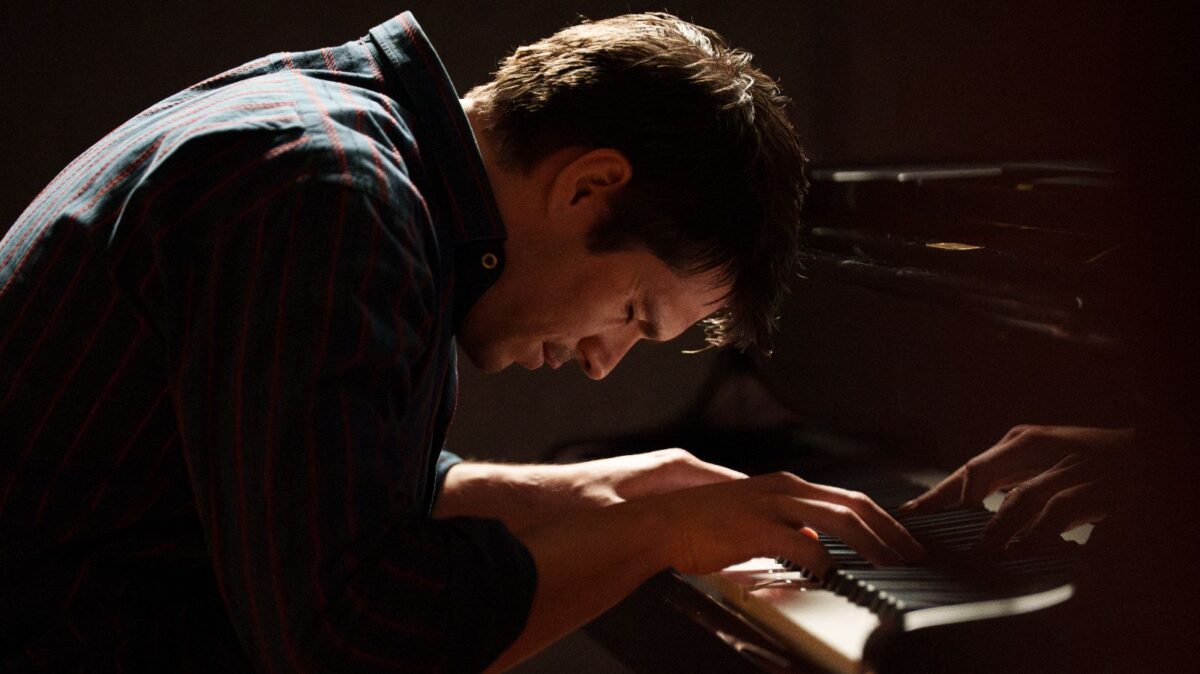
Two Pianos
How do you direct the editing process then? Are you always in the editing room?
Nervous breakdown. Really, really! I’ve been working with Laurence Briaud since La vie des morts, quite a while ago, and she knows. So, I’m lying on the couch—you know, desperate, cursing against all my defaults and failures, etc. etc.—and she’ll say, “Arnaud, let’s move on, let’s move on.” I say, “No, no,” etc. And after that she accepts the fact that I’m challenging her. I remember I was in Italy for a retrospective and each evening she was sending me what she was editing, and I was saying, “Okay, do you think that I shot all of this thing that way for you to edit it in a regular way? Are you kidding me? Are you fucking kidding me? You can’t do such a thing; it’s too classical. You have to have the jump cuts, the nervousness, etc., etc.” I like to share that, because the film is a classic. Do you know the title we were using in the writing process with Kamen Velkovsky? We were calling it An Affair, like An Affair to Remember, the Leo McCarey movie. Because it’s classic. It’s the story of impossible love. That’s it, you know?
And so, each few weeks, I’m visiting my father, who’s so old, and my mother, and I’m bringing DVDs for them to stay awake during the day, to entertain them. It’s such a bore to visit your parents at my age. You can’t imagine the bore it is. So I’m there, bringing them masterpieces, showing them films, etc. and once I remember I was showing a film by the American-Greek director [Elia] Kazan. A Kazan movie. I’m not a Kazan guy. But it’s a film that I love: Wild River. I love that film. So I show it to my father, and my father says, “Mm, not that good.” And I’m like, “Dad, I mean, c’mon. It’s Kazan. You can’t say such a thing.”
The following day I brought a Lars von Trier movie. Which one was it? Melancholia—I don’t remember, but I think it was Melancholia—and then! I’m sitting behind him. It’s not a big apartment. I’m looking at the back of my father who’s looking at the film like this [leans forward, makes big eyes]. And in the evening we had dinner together, and he said, “It’s great! What’s the name of the actress and this director?” I said, “Dad, it’s Lars von Trier.” And he said, “It’s good.” And I say, “But dad, why are you so into Lars von Trier’s work? I mean, what’s happening here?” And he says, “You know, because this camera that’s moving all the time, it brings me some suspense!” I called that very evening. No, I didn’t call. I sent a text to Paul Guilhaume. I said, “In this film, we won’t rent any tracks. We won’t have any kind of dolly, and we won’t rent a tripod either. Everything will be done by hand and you will just plunge into the scene.” He said, “Okay. Fine with me.” Because, you know, I thought that way: the story being a classic, I was trying to break the classicism of it, and I thought perhaps my father would like it.
It doesn’t matter how old we are, how old they are—we’re always trying to impress our parents.
Yeah!
I want to talk about your collaboration with Anne Berest. She seems to be making the screenwriting rounds with some of the best French filmmakers working: you, Audrey Diwan, Rebecca Zlotowski. How did that collaboration come about?
Well, because I loved The Postcard. I loved that book so much. I met her in another life when she was doing some publicity for a theater and we had a long interview together, etc. It was a long moment where we were writing, Kamen Velkovsky and I, and I was a bit lost, so I needed to share that. So she was not properly writing for me, but she was sharing my questions. She brought the detail, you know? She’s Jewish and gentile. And I have to say: Anne just accepted the question I was confronting. Which was that everything started with the fact that it was my first collaboration with Kamen and I was bringing a story that was so important to me. The story of this young widow who in her life, in her prime, was transgressed. Why? Because she’s 18 or 19 years old. She was so young when she had that child. So young. How can you judge someone who’s 18 or 19 years old doing a stupid thing to impress a girlfriend? I can’t judge her.
Now she’s in this cemetery because she lost her husband, and the child that she hates—she hated to have that child, which was not the child of her husband but the child of someone else—she’s telling a terrible joke to in the cemetery. In the loneliness, in the solitude of this moment, I love this woman. And Kamen, who’s proposing another story, which was this story of a musician, a pianist, who’s coming back to his hometown. The day after he arrives, he’s hanging around in the park and he can see himself with the face of the child. Who is this child? I say, “Your story, Kamen, is great. But who is this child?” He said, “It’s the child of the woman in the cemetery.” So we had two stories, and Anne accepted me when I was still balancing the two stories. She heard my anxieties, she welcomed it, etc.
There are a lot of parallels between Mathias and the recurring character of Paul Dédalus throughout your filmography: brilliant but self-destructive, haunted by past relationships, very introspective, existential reflection. How did you separate those characters and what differentiates Mathias from Paul for you?
I would say that Paul is funny. Mathias is frightening. That’s why Claude refused him. That’s why she went to Pierre: Pierre is comfortable. He’s her husband. Mathias is not comfortable at all. He’s suffering too much. He has to wound himself in order to survive, so it’s frightening for a girl—especially a girl of this age when she’s 19 years old. It’s frightening. It’s frightening for his mother. Even for his agent, for Max, it’s a bit frightening. Elena is afraid of nothing, so it’s a different matter. But all the others, you know. So to me, that’s the difference—besides the suicidal aspect—between Paul as a character of comedy and Mathias, who is so silent and menacing in a way.
I remember that wonderful scene when his mother is coming back home and he just destroys himself after realizing the child is his child. And the performance of François was so powerful. Whoa, so powerful. I would like to compare also, if we have to dig on the difference between these two characters—when I met François, I mentioned the character and the performance, because he’s the best actor on Earth, of Daniel Day-Lewis in The Age of Innocence. When you don’t allow yourself to go to the beloved. You can’t allow yourself. Paul? He would’ve jumped at the chance! [Laughs] Mathias, he can’t. He can’t. He just can’t. I remember how shy Daniel Day-Lewis can be in The Age of Innocence and how François is suddenly afraid in front of Claude. That’s another difference.
Do you think of Mathias as autobiographical in any way?
I’m afraid so, yes…
How so?
The story in the train is not far from what I experienced, but the kid was not mine. Lucky me! [Laughs] I survived, you know? But Mathias, he doesn’t survive that well.
Do you plan on telling more stories about Mathias?
No, I don’t think so. But I don’t know, because the collaboration with François was so powerful, so powerful for me. He taught me so much, and he knows it. But I don’t know if he knows it enough. I hope that he will read your paper and that way he will know how much I want to work with him again. He taught me so much. It was surprising, during this long dialogue that they have in the living room of Claude during Shiva. At Claude’s, she’s doing the Shiva after the death of Pierre and he’s visiting and waiting and suddenly they will speak, and he will speak at last. He never spoke and he will speak.
With François, I was proposing the blocking with the sofa and the movement when she will slap him, etc. I proposed that to them and François said, “May I have one minute, please?” And I was like, “Fuck, my blocking doesn’t fit with what he wants to do, etc.,” so I was scared. Then he said, “I’m ready.” I said, “Camera, action!” and he was crying, and he did all the takes crying. Each take, each set-up, he was crying in a very discreet way without sobbing. He was just crying. After that, in the evening, I said, “How did you have this idea?” and he said, “It breaks his heart. I know it. He has a broken heart. He had to cry in this moment.” So he’s frightening, as I was saying, because when he’s standing up you think, “Okay, if he’s slapping Claude, Claude will be pissed at the world,” you know? But he was infinitely vulnerable. And this vulnerability of François was such a gift that I’m dreaming of it. So will it be Mathias or will it be another character? But I would love to film this fragility again once in my life.
You talked about how rewarding it was to work with François. How was your experience working with Charlotte Rampling?
I love that woman. Just one story, one story. So the first time we met I was terrified because of her performance in so many films. She accepted me. She said, “The script is okay. Is it clear enough?” And I said, “No, I guess. I’m afraid I’m an obscure guy.” “Okay, let’s deal with that obscurity,” etc. I improve the material and I send her the new draft. And I have this email from Charlotte Rampling… I don’t dare read it. So I asked my girlfriend, “Please, will you read it? She’ll say that she refuses the film two or three weeks before the shooting. Or she’ll say she didn’t like it. We are dead.” And then she said, “Okay, you can read it.” So I’m reading it, and the letter was the following: “Arnaud! I just got your new draft, which is good. I’m not the kind of actress who is changing a comma. I will respect all your words. But in scene 67, you wrote, ‘Elena says, “I’m scared.” I am Elena. I’ve never been scared once in my life. How do we do it?”
Wow! Wow! An actress saying to me about a character that I wrote, “I am Elena,” is the most precious gift I could ever have. And after that, we had a long session with Charlotte. A wonderful session sharing laughs. She has this English humor, and she was so funny, and we started to explore these lines. Is she saying that she’s scared because she’s lying? That’s the first reason I proposed. Because she wants Mathias to perform. She wants him to go and be the pianist she wants him to be. So she says, “I’m scared. You have to go play for me,” but she’s lying. She’s not scared. So I was saying to Charlotte, “You don’t have to be scared.” She said, “Yeah, interesting interpretation.” And after that we had to move on.
So I showed her a wonderful video of a pianist playing a Mozart concerto for one piano. She’s 80 years old and in the wings, and she doesn’t have the right sheets of music. And she’s there, the conductor is saying he’s ready to start, and you have this shot of her—it’s straight on and she’s looking at the music with such a despair in her eyes, saying, “I can’t play it. I didn’t work on this one. I thought it was another one.” In that moment, she’s five years old. And the conductor is looking at her, still conducting the orchestra and saying, “Everything will be perfectly fine. You will remember all the lines.” But she says, “No. I won’t do it. I won’t play this evening. I won’t play.” Without words! It’s just silently. Like in a great silent movie. She says, “I won’t do it.” And so you have these long intros in these concertos, and here comes her moment. She puts her hand down, and the notes arise and she’s playing the concerto. I showed that video on my cell phone to Charlotte and she told me, “Oh, this I know! It’s not fear. It’s terror. Terror, I understand that. I can play that.”
Two Pianos enters a limited release on Friday, May 1.