
The ten years since Nicolas Winding Refn’s prior theatrical feature was just enough time to activate déjà vu when Her Private Hell debuted at Cannes to a mixed-hostile response. While certain of these reactions (like our own) are well stated and eloquently offered, much else rings perfunctory when few directors still attract stars and financing while so staying on their own island. Even as he innovates and surprises, the constituent parts remain consistent: beautiful actors will glare as an ethereal score (usually by Cliff Martinez, this time from Pino Donaggio) underlines constant dread and—if you ask partisans—some greater concept about the aestheticization of rage (particularly as it’s rooted in genre convention) emerges.
As Her Private Hell prepares a theatrical release, Winding Refn has been speaking about the film to degrees greater than its elusive, parallel-until-they’re-not narrative structures would ever imply is possible. He’s an interview subject as amusing as he is straightforward—best exemplified by him beginning our conversation with an apology that he’d just started lunch.
The Film Stage: If you had low blood sugar and were in a bad mood, this whole thing would just…
Nicolas Winding Refn: It helps everything, trust me, eating well. You are what you eat.
What do you subsist on during long days on set, to keep going?
A lot of water and a lot of coffee. And then make sure, at lunch, that there’s always a lot of cakes for the crew.
Cakes?
Yeah.
Because that makes people happy?
Every day is like a birthday.
Okay, that’s good to know. I guess I don’t associate your movies with the sweet, confectionary nature of cake; sometimes they feel more like bloody steaks. But maybe that speaks to their plurality.
I like candy. And sugar. And everything pink and fluffy.
Yes, and cake satisfies all of those.
But I would always make sure that we have a lot of ice cream breaks on set.
Your sets sound great. No wonder you have so many frequent collaborators.
It’s about making the crew happy.
Well, the movie made me happy. I had expectations, but this still surprised and confounded me. I don’t think I’m speaking out of turn when I suggest you’re a descendant of the great giallo figures, and something I’ve always loved is that your work exists on these two planes—appreciating and appropriating iconography while also subverting it—and the Leather Man strikes such a great balance between respect for and toying with giallo. How do you find a balance between these modes?
I think that what’s great about the Italians is their attention to details, and the fetishization of objects—whether it’s body parts or utensils or fashion and design. And obviously, this almost supernatural component. I mean, the Leather Man was part of my archive of ideas. But when he came in for this movie, I continued to build him as, like, a glam icon. Like, glam rock: something that was part of the world of crystals and jewelry and design. That was kind of like the visuals of him. And then the leather—the sound of leather, the fetish of leather—and still giving him a human dignity because he was a father trapped in the underworld searching for his daughter, who he will never find, so he forgets and therefore he becomes a killing machine. So in a way, he’s pure emotions.
Not knowing Her Private Hell‘s plot, I was surprised how much I had to fight to get my footing with these oscillating perspectives between Sophie and Charles. You and Esti Giordani have written this very elusive script that often switches POVs. How did the two of you find a way towards a rhythmic inclination?
Well, it came in steps. Because one thing was the foundation, where I had these two ideas: one was Private K going to hell, and the other one was a young woman coming to a city that didn’t exist. Which meant that whatever that I wanted to create was artificial, so: an artificial world. Which was very new to me, because I usually work with urban vibes. But they were so opposite ends of the pole that what was going to combine them? Because one was running away from something, one was running towards something. So pulling the archive of the Leather Man and putting him in, like, the center of the triangle. [Draws triangle with hands] And then, you know, Esti and I would work on, “Okay, so how would the narrative work between what is Private K’s storyline, what is the girl’s storyline—how could they potentially connect?”
But when I started shooting, I could see that these two parallel stories had more in common than originally intended. They were not single cells, but they were, in a way, one cell. And so editorially, I began to see that, in a way, Private K was the alter ego of Elle because he’s the father she wished she could have had. But he’s unattainable, and her own father is leaving her and marries her lover, who becomes her stepmom. So during the script phases, we were building a lot of intricate narrative components to how these characters—especially the girls—would interact. But Private K was, in a way, on his own odyssey, and when I saw everything combined, I could suddenly reshuffle the card house, and now I could—rather than what was running in parallel—start to put it on top. Because, shooting in order, I kept on unfolding and unfolding and unfolding.
Which is impressive, because the film feels charted. And I was surprised to learn that you once had a different ending but made a pivot during production. I don’t know if you’re at liberty or have any desire to say what that original ending was.
I think that when you set about, you try to come with a finale that would service both narratives, both odysseys. But once I began to see that they were coming on top, they were intricate, I could actually then create a whole new ending that was more satisfying when it came to it. Because I was no longer servicing two visions; I was servicing a singular [vision] by combining everything.
Right. So the original ending will remain unknown, but I’m fine leaving it that way. Though this is your first theatrical feature in a decade, I don’t necessarily consider it your first film; I guess I think of Too Old to Die Young and Copenhagen Cowboy as such. Certainly they’re “cinematic.”
Yeah, they are long movies—just made on a format that you could make long movies. I agree with that; I think that’s very precise.
You took over this streaming model and told stories that I think, maybe, with some selective editing, could have functioned as feature films. But Her Private Hell doesn’t feel like it could be expanded into a series. It’s very contained and precise to its 80-minute runtime.
Yes.
It seems like that elision was distinctly appealing in coming back to feature-filmmaking.
Yeah, also because I already experimented, or pushed the boundaries of how long I could make it. Too Old to Die Young was, what, a 13-and-a-half-hour movie? Copenhagen Cowboy was a six-hour movie? And you tend to service the length of what it needs to be like, where, with Her Private Hell, I was very interested in this containable, dopamine, moment-to-moment experience—something that was closer to social media than television.
I know you’ve talked about “the scroll.”
Yeah. So the way I wanted to make a social-media narrative into a feature film.
I wish social media was as exciting as this movie, but it’s a nice idea.
[Laughs] Well, I mean, you can be inspired by how people use social media to create identity.
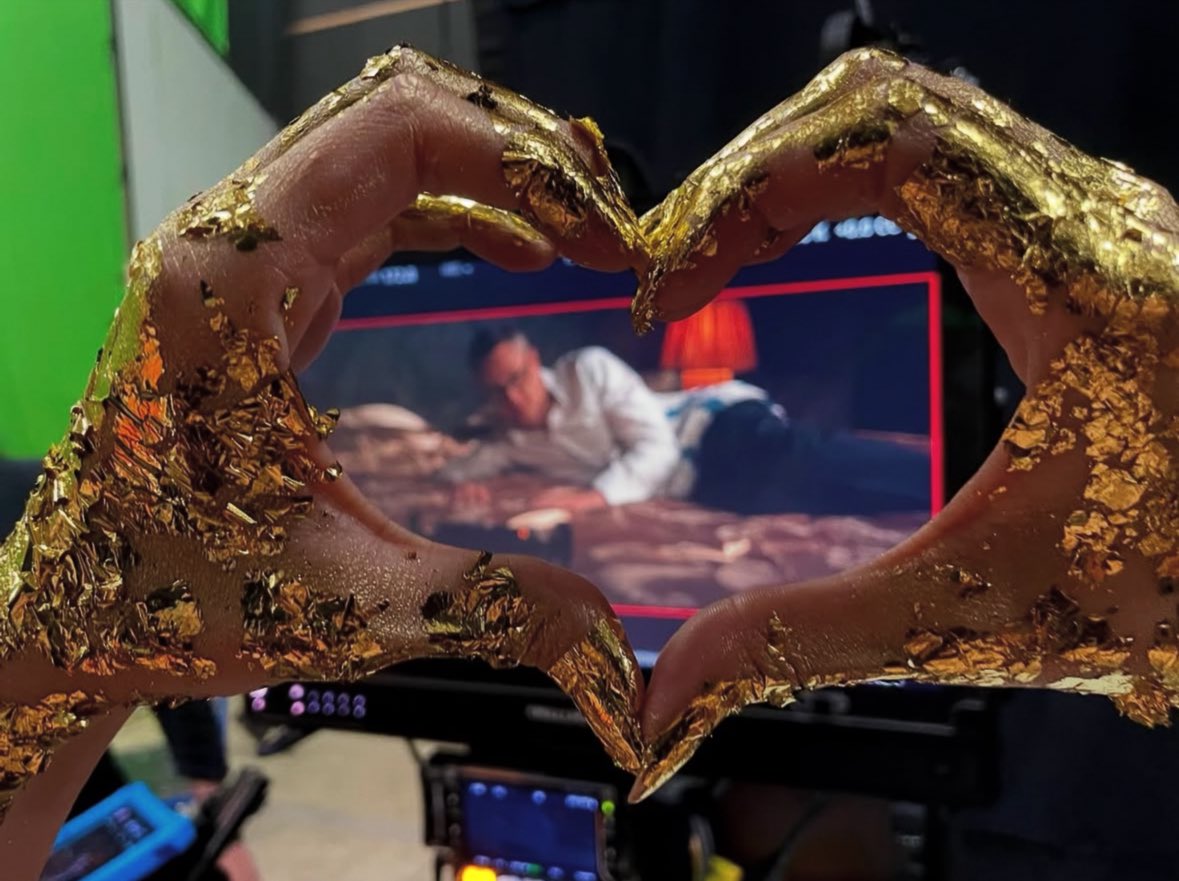
Behind the scenes of Her Private Hell
I think I have a sense—and this is my own fault for having preconceived notions—of what your formal framework is. So I was happy when, early on, you use a zoom, something you haven’t employed much recently. And feel free to correct me here, but I suspect there’s more closeups in this film than you’ve been using in your past, let’s say, 10 years of projects. What about the material encouraged those methods?
I love the zoom. I’ve found it, always, to be enormously effective, because it’s a very simple device. I always say there’s more dynamic in a moving shot, but you’ll remember the static shot stronger. So the zoom is a combination of both, because the camera movement doesn’t distract because the camera really doesn’t move. But the lens does, which is a different experience. So I’ve always loved the zoom lens, and because the film was so much based on pantomime in terms of performance—even though there was dialogue—you always needed to be very focused on their closeups.
And these are such amazing faces. It would seem wrong not to have an emphasis on them.
Oh, yeah. It’d be a shame not to.
There is a kind of love and tenderness there. I really feel that you love your actors—you love looking at them, you want us to look at them. But of course you also make films with such an emphasis on violence and its visceral effects. I noticed that Charles Melton’s fight scene has both a castration—or at least, let’s say, a severe injury to the groin—and an eyeball loss, which brought to mind a moment from Too Old to Die Young and, of course, the end of The Neon Demon. Is that some self-homage, or just an unconscious realization of what you find interesting?
[Laughs] I think the more you can combine sex and violence in one, the more effective it is. Because there is a sexualization in fantasy that makes you want to look. I don’t make documentaries and I don’t try to portray the horrors of the real world because you would automatically look away. Fantasy is the opposite—that’s indulging in all your sins and your desires—and I make genre movies because I like… I don’t want to grow up. I like the naivety and the simplistic components of what the fantasy can offer you: escapism. And it’s almost the power of the fairy tale, you know? It transports you, and on the surface you may dismiss it, but if you look closer, there is layers and layers and layers and layers.
It’s funny you say that. I don’t disagree, but I might challenge that on the basis of the fight between Sophie and Havana—the actual verbal, let’s-have-it-out fight towards the end—making me sit up because it feels closer to Terms of Endearment than a fantasy world. And it’s interesting how you and Esti were able to not shortchange that. You treat it as like these are real emotions coming out of people.
Oh, yeah, I understand your point. But you have to look at the action sequence in variations. Because if everything is the same, then the action becomes stale. So the argument, or the fight, between Havana and Sophie—Elle and Dominique—is a verbal fight; it’s a fight of words where words are used. Charles is all physicality. And that is because it differentiates between the languages of the violence. Because if the violence just circulates about the same DNA, it very quickly becomes, like pornography, just stale. But if you eroticize violence in variations, it always becomes seductive and enjoyable.
I appreciate that you have a deeper read of your own film than I do.
Well, it was hard work. [Laughs]
I wanted to ask about the portraits during the end credits, which I really loved, and again speaks to this kind of affection for your actors that I think runs through this movie. Just simply, I’d love to know who took those and when.
They were taken during production by the design team that I have. And then I wanted this very… almost 1940s presentation of the characters again, but all dressed up, as if they’re dolls. Part of the artificialness of the world of Her Private Hell was my own fascination with playing with dolls, because I built a dollhouse on stage and the actors were almost iconography of dolls. You had Private K in his uniform like an action figure; you had the candy-floss universe as if they were Barbie dolls. Everyone was representative of a certain fetish, so they were, in a way, like dolls all around me that I could place in different settings, and mold them and have them move and say things. And that’s very pleasurable.
Are you familiar at all with the novelist Steve Erickson, who wrote Days Between Stations and Rubicon Beach?
[Shakes head]
Those are books set in post-apocalyptic, dilapidated cities involving competing narratives that tend to interact in a moment of sex or violence. Her Private Hell made me think of him a lot. I’m not going to tell you what to do, but if you need a book to read, let me just suggest Erickson.
Oh, wow. What year is his work?
His first book is from 1985. Latest is more recent.
Something new to explore. What’s the poster behind you?
Romare Bearden. Is that what you’re talking about?
Oh, wow. I love the jazz poster.
It’s great.
Yeah. Good to have those things. I love people that frame objects in their houses. I find it so sad when you come home to people and everything is just a file on a computer. I love when people have their stuff out—books and movies. It tells you something about everyone, you know? It really tells you who they are.
[Turns computer around]
Oh, wow. What else do you have here? Oh, Nabokov. Oh, cool.
Some Bob Dylan, some Raúl Ruiz, some Godard, a little Ozu. Just a… big compendium.
It’s like a shrine of creativity.
If I get even 1% of it then something’s gone well.
Then you’ve had a good day.
Her Private Hell opens on Friday, July 24.