
Scottish writer-director Lynne Ramsay returns to feature filmmaking with Die My Love, eight years after You Were Never Really Here. The psycho-drama stars Jennifer Lawrence and Robert Pattinson as Grace and Jackson, a young couple with a new baby whose move from the city to rural Montana jumpstarts a supreme unraveling from Grace. Working with cinematographer Seamus McGarvey again after 2011’s We Need to Talk about Kevin, Die My Love is less interested in getting to the bottom of why Grace is behaving as she is and more about probing the human condition through a visceral and primal cinematic language, one frequently unafraid to be exhausting. She returns to the vivid Kodak Ektrachrome color reversal film stock she first shot on Morvern Callar, pairing it with the Academy ratio, which aids the portrait-like quality of the character study.
I spoke with Ramsay on Zoom, where she considered why she only adapts impossible novels, how the house dictated the aspect ratio as well as the opening shot, and what shooting reversal film stock meant shooting “day for night,” which lent an appropriate otherworldly feeling to the nighttime sequences.
The Film Stage: You’ve adapted novels in the past, but this one has two other screenwriters. What’s your general adaptation process that you’ve worked out, and how did this one differ?
Lynne Ramsay: If there’s an interesting concept in a book, I’ll springboard off that rather than stick super-close to the source material. It’s quite a surreal book. You didn’t know what was real or unreal, and it jumps from different narrators. Grace was like a wild beast in it, and there was something interesting in how irreverent and unapologetic the character was––I started from there. It was such a hard adaptation, and I’ve already done that with [We Need to Talk About] Kevin. Kevin was wild to adapt because it was very literary and didn’t present itself as a film necessarily––it was in the form of letters. So I took my time to find my way into it.
I was working on a different script at the time, a project called Stone Mattress by Margaret Atwood, which I’m still hoping gets made. Enda Walsh and I talked for about three or four weeks, and he went off and did a draft. I took the ball from there. Alice Birch got involved because we only had four weeks prep for the movie, and I had to change things and just didn’t have the time. There was so much to do––it was the least prep I’ve ever had. I would bounce ideas off her, and she would get it down on paper. Normally, I’ve either just co-wrote or done it myself. It just was the nature of this one.
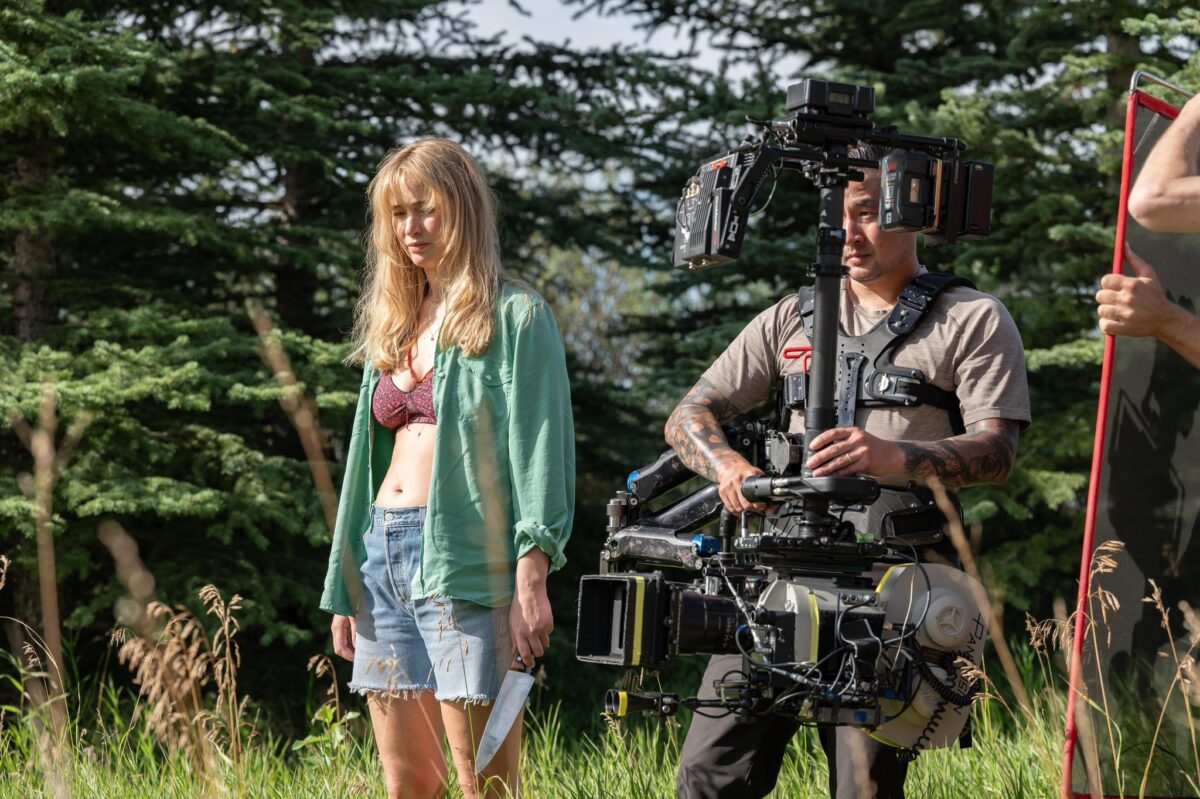
You’ve stated that this is a love story, and so I think it’s helpful to get visions of their pre-baby relationship. The non-linear structure lets you see just how far things have shifted. Was that in the novel, or something you discovered as you were writing?
Quite a lot of that was discovered. The house in the script was like: you go through a forest, you come into a field, you see the house, and they arrive––it was all that stuff. And I said, “Let’s just see it from the house’s point of view.” I had this idea of running this long take and just letting them explode. The house was like a maze with how the doors were positioned, which led to how I structured it. As soon as I saw the house, I thought, “Wouldn’t it be great to see them pre-baby, when they just moved in?”
When I come to a location, the location speaks to you. You learn whatever was in the script is actually not as good as this, or it can be simpler or much more interesting. It’s not the most conventional way to start a film, to not show the exterior before the interior. You get ideas when you let the location speak to you.
Are there things you do on production, whether that’s a small crew, or working with familiar collaborators, so that you have this freedom to change things. How do you create that environment?
I wasn’t so much changing things on the day, although there were a couple of instances where I looked at something that was better than the scene that I thought of and said, “We should do it here and not there.” It’s great when you have those moments. And also, the light is going and you’re like, “Shit, I’m never going to make the day.” Sometimes a brainwave comes and it’s better than what you’d written in the first place. But it was really in prep that those ideas started coming through. I was looking at the location. I was thinking about the beginning. I was thinking about the story evolving with how seeing her pre-baby came into it. There’s this hope in that they’ve inherited the house. It’s a bit crappy, but it’s still theirs in a bonkers way. And I show a bit of their past life where it was all very sexy, before the shit really hits the fan later on.
I find the house quite charming in its run-down state. When he paints it and fixes it at the end, it doesn’t quite feel right.
I don’t think it feels right to Grace. He’s trying really hard to make it nice, and yet, somehow, in a way, she feels like, “Oh God, did I even exist here?” She feels a bit eradicated from her own space.
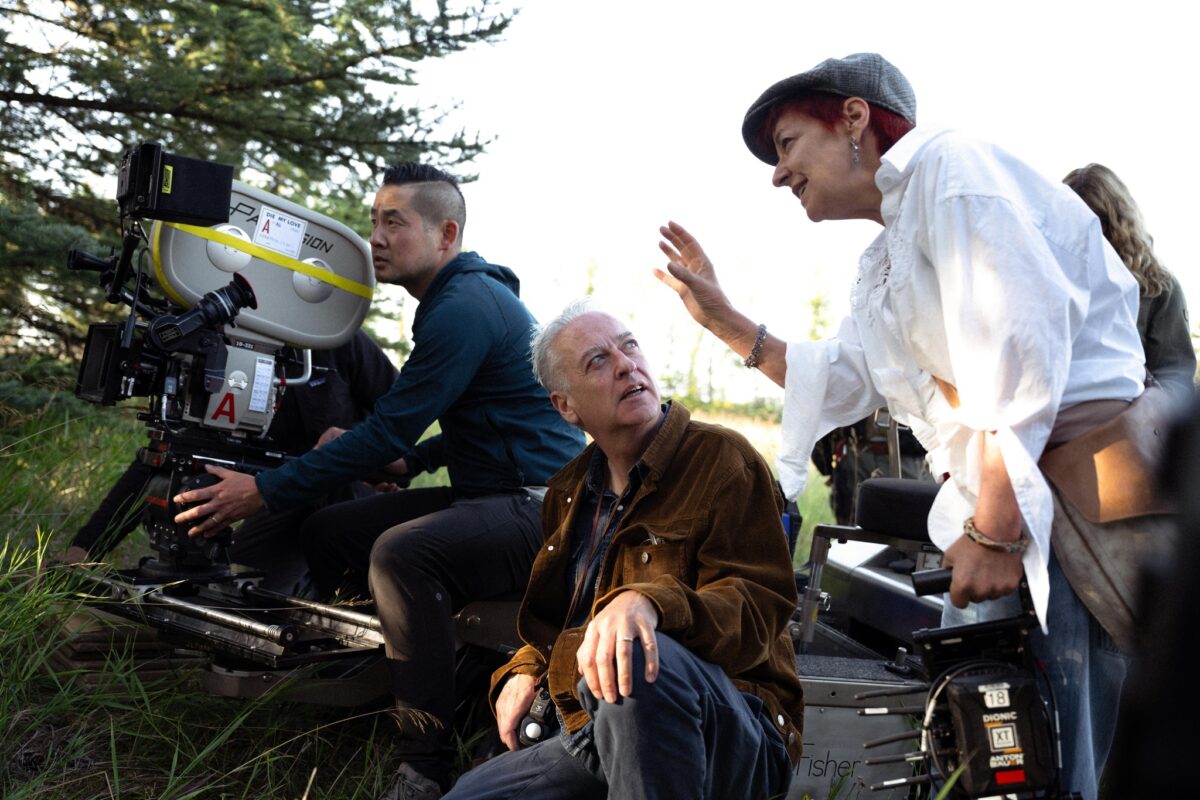
Talk about working with DP Seamus McGarvey again. You shoot on 35mm in the Academy ratio. How did you work with him to develop the look?
Seamus is a good mate. He lives down the road, so I see him often in London. So there’s already a shorthand. Seamus said, “We shot CinemaScope for Kevin. Let’s shoot Scope again.” But when we saw the location, I wanted to see the whole door rather than cut it off. It’s quite a portrait film anyhow, and so it felt like the location dictated the Academy frame. And then I was talking about shooting on reversal film stock with Morvern Callar––seeing a bit of color, a bit of vividness, which makes it hyper-real––and he was like, “Why don’t we shoot it reversal?” I was like, “Shit. Reversal is quite difficult.” It’s not that sensitive so you can’t shoot it at night. We’d have to either shoot digital or conventional film stock at night. But then we experimented with a “day for night” look, and that felt very twilight unreal, like you’re in a dream, which suited it. We ended up shooting conventional film stock for those “day for night” sequences.
The Academy gate was a new language for me. I’ve shot a lot of different aspect ratios, but never this aspect ratio before. I thought, “This really works in the house,” but then when I took it outside, I was like, “Shit, man. I don’t know what we do with this.” But then you find it. Bergman uses it so well in Persona, and it’s used in many, many other classic films. I started finding it. When I worked with Seamus on Kevin, that was the first time I’d worked in CinemaScope, and I remember thinking, “Oh, God, what did I do with this?” But it suited Kevin because Eva and Kevin are always dancing around each other––it was always a Mexican standoff. You can do a two-shot beautifully without getting any close-ups and over-the-shoulders and all that shit. I had 28 days to shoot that film, so it really helped.
The aspect ratio was dictated by the location. And also, Grace as a character feels like she’s in a portrait. Seamus knows I’ve done camera myself. I studied it in film school, and I shot a couple of things in this film. I think he feels he can experiment with me in a way that he can’t with other filmmakers when doing more conventional stuff. We try a lot out. We try to find a language, which was liberating for him.
Die My Love is now in theaters.