
Reflecting on Francis Ford Coppola’s Megalopolis a year later, after all the memes, hyperbolic hitpieces, and even some admiring reviews, it’s likely public opinion has solidified around it being a failure, both financially and artistically. Akin to the drubbing Coppola took on another grand folly, One from the Heart, decades earlier, the film is still probably ripe for rediscovery and reclamation, even if the lack of a home video or streaming release (aside from MUBI’s exclusive run in select territories) already makes it feel like a lost film of sorts.
Megalopolis is probably most satisfyingly seen as an eccentric camp object with moments of great beauty. Even if not the grand masterpiece one hoped a decades-in-the-making passion project from a master would prove, there’s no getting around the fact that there was pretty much nothing else like it at the multiplex last year, or, to be honest, in the releases to come.
But now we have a peek behind the mad vision of Megalopolis thanks to Mike Figgis, the British-born filmmaker who’s still best known for his Academy Award-nominated work on Leaving Las Vegas. A director who used his bout of strong Hollywood clout to immediately experiment as much as possible, Figgis is an unheralded figurehead of digital filmmaking (he even wrote a book on it) who’s a kindred spirit to Coppola in many ways. So that’s why he was the director to make MEGADOC, an account of Megalopolis’ much-publicized 2022 Atlanta shoot, that captures all the chaos between a director who’s always changing his mind to meet his mad vision and an ensemble cast consisting of stars willing to take a chance on something that they’re definitely aware could fail.
We were lucky enough to discuss the making of the film, as well as Figgis’ career in general, over Zoom.
The Film Stage: First off, it’s a real honor to interview you because I’m a big fan. And I don’t know if you’ll be surprised to hear this, but during the pandemic, I actually had a Zoom movie club where we watched your films.
Mike Figgis: [Laughs] Punishment.
Oh no! I think the film we actually got the most out of, or were the most surprised by, was Hotel. We knew nothing about it going in. I saw that it premiered the day after 9/11 at TIFF, which I guess was unfortunate.
I remember I was on my way to the screening. I was in the hotel in Toronto, and I was checking the news when I saw that the Twin Towers were on fire. And as I was watching it, the second plane hit. And I went, “Oh my God.” And I ran down to the lobby, which was full of Americans and film people. I started going up to people and saying, “I don’t know if you’ve heard, the Twin Towers have just been attacked,” and everybody had this kind of exodus from the lobby. And then I stayed in my hotel room for the next 36 hours. People came and went, and we just watched two screens. It’s amazing, yeah, and that was meant to be the opening.
And then we finally had a screening maybe two or three days later. And of course, the opening scene in the film is John Malkovich being eaten in the basement of the hotel, which didn’t go down well at all, as you can imagine. It was not the right film at that point. But I’m glad you liked it. It’s one of my favorite films. I was just in Venice, and I went to the hotel to check it out. You know, it’s been modernized. It’s now a five-star hotel.
I know they also just screened The Loss of Sexual Innocence recently in New York. So I feel like there is a real resurgence of interest in your work.
Yeah, maybe it takes time, as Francis says.
Could you talk generally about your relationship to Francis, how the two of you first met, your friendship over the years, and your artistic kinship?
I physically met him the first time the night of the Oscars for Leaving Las Vegas because the Coppolas were there supporting Nic [Cage]. I sat next to him at dinner, and we had a really good conversation. And I sort of formed a friendship––very tenuous because I only saw him once every couple of years. But we kept in contact. I guest-edited his magazine, Zoetrope. Through its editor, Michael [Ray], I discovered that, three years ago––whenever it was––he was going to go ahead and make Megalopolis. I didn’t know what Megalopolis was. I had no knowledge of his history of trying to make the movie and all that. So I wrote him a nice email and said congratulations. And then, “P.S., if you need a fly on the wall, just please let me know.” And I left it at that, and I didn’t hear anything from him until quite a bit later, and then suddenly I got an email from Francis asking, “Do you have a visa? Could you be here to shoot something?” And I went, “Wow.” So quickly, I organized a visa, and with Tara [Li-An Smith]––who was the producer, also my assistant––we jumped on a plane with two cases of basic equipment and just jumped in.
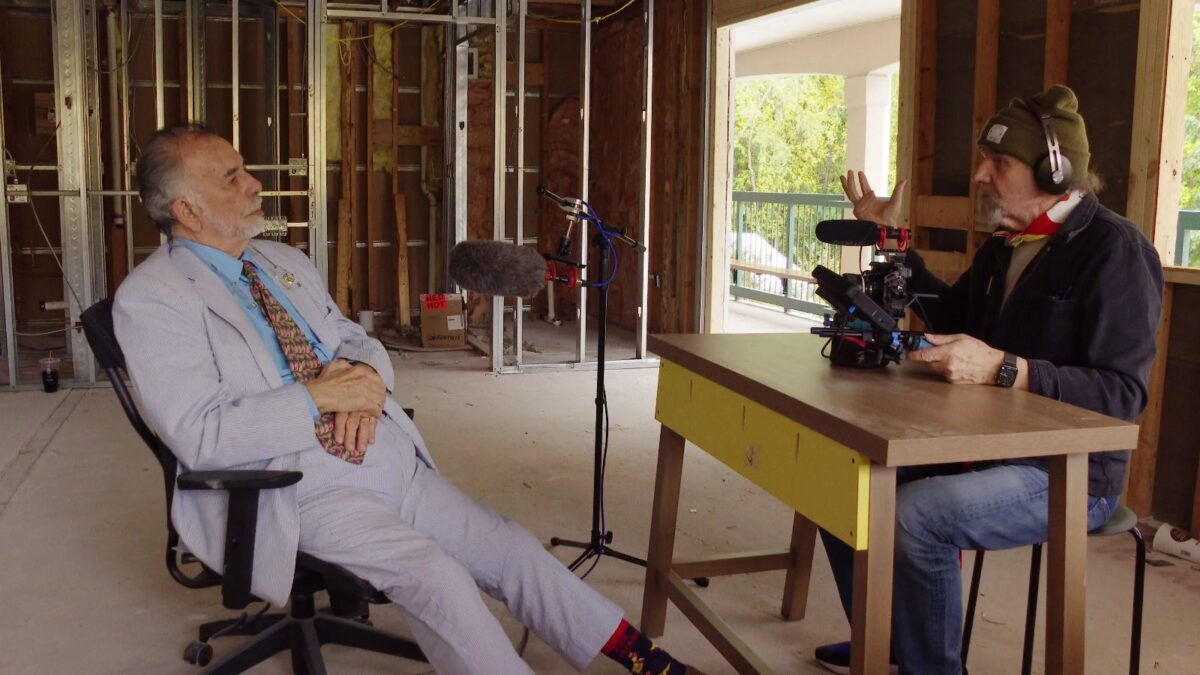
So once we were there, Francis didn’t introduce me or make a big deal about the documentary at all. I was just with a bunch of other people. That opening stuff in the documentary that’s just the actors’ rehearsals, well, I was just this annoying guy with a video camera, and then gradually I started to get to know the actors. The great thing about Francis is: I kind of had access to go pretty much anywhere I wanted, and because the equipment was so small, my choice, I wasn’t a footprint; I mean, I didn’t want to annoy people, and I also didn’t want to telegraph that we were making a film. And then I really started to get to know Francis over the next couple of months as he became more and more entrenched in trying to make the film. Because it was such a big film, and it was so slow in the sense that it took ages to get anything. He was always changing his mind and wanting to try something different. That always took a couple of hours.
So there were all these periods where both the actors and Francis were kind of just hanging out, waiting for stuff, lighting, or whatever, right? It was here that I established a friendly relationship with some of the key actors, and certainly with Francis, and on the basis that we just chatted. It was all very casual. The only formal elements of the documentary were when I set up a room with more professional microphones where I could interview people. So if there was going to be a hiatus for a couple of hours, I’d say, “Is it possible to interview Aubrey [Plaza] or grab Shia [LaBeouf]?” And that was it. It was all done in a very casual, organic way. I had no idea what the film was going to be about, so I was kind of looking for things. I thought this was all fascinating, but is there going to be a through line that’s going to glue it together as a film? That started to emerge about a quarter of the way in, obviously, such as when there’s a lot of tension with the art department and all that sort of stuff.
I sensed there was some direct influence of you on Coppola, because I don’t think this ended up happening, but I remember when Twixt was coming out, he was pitching this idea of doing live remix screenings, which were very akin to what you did with Timecode back in 2000. So I was kind of curious if Francis was someone who said, “I’m very influenced by you”?
Well, it was very funny because I had been talking to him about real-time filmmaking, and I said, “Yeah, I think it’s fascinating. So when I did Timecode…” He went, “Oh, you did Timecode?” He didn’t know I directed it. He’d seen it and he liked it. So the next day, when he was talking to the actors, he referenced it and he said––this being the first time I was introduced to them––“Mike, he’s a really good filmmaker, he did that great film, Timeline” and I went, “Timecode?” And they all went, “What?” They hadn’t seen Timecode. So they were like, “What’s he talking about, real-time filmmaking?” So then I had some interesting conversations with the actors about how I did it and all of that.
But I had a lot of good conversations with Francis because he has a lifetime fascination with real-time filmmaking. He’d made a real-time film as an experiment with a bunch of students, I think at NYU or somewhere like that. But he’d used, like, 20 cameras and this incredible set, and it was also a single screen, of course. And he talked a lot about the golden age of American television, where dramas would be shot live and it would be a lot like a play performance. And of course that tied into his whole concept of theatrical performance as opposed to making a film in bits and pieces. So he likes theatre. He comes from an opera and theatre background.
And that started to remind me of one of the key issues philosophically in his approach versus the, let’s say, Marvel Universe approach. In a sense, Megalopolis is his attempt to say, “Can these two very disparate elements, could they interestingly fuse?” I think he came away with the idea that, no, that’s not really possible because of the weight of technology dominating his idea of fluid performance and things like that. So that’s what I see. I don’t think I consciously thought, “There’s the movie,” you know, but I started to pick on those things. Okay, try and see what the art department [is thinking]? How are they dealing with, from a cultural point of view, how are they dealing with the genre of Francis?
From my point of view it’s very interesting because, as a filmmaker, you’ve just referenced two of my more experimental films, like The Loss of Sexual Innocence and Hotel, in both instances where I tried to, again, move away from a big crew, linear narrative structure, and all of those things. Francis, I think––like many frustrated filmmakers, actually––was trying to escape from the tyranny of the three-act structure and the Robert McKee Bible of “this is how you make a good movie.” So on that level, it became more and more fascinating for me as a reflection on my own philosophy as well.
Two films we’ve mentioned, Timecode and Hotel, you worked with ensemble casts full of big stars. Did you relate to Francis when he was making this film in terms of the actors? You really see this in the rehearsal process, as there are all these disparate personalities, people with different kinds of acting styles, acting backgrounds, different ages, different star levels, and it’s about trying to kind of mesh them all together.
I related to it in the sense of being very sympathetic to the frustration he was experiencing. And I, in a way, frustrated because I thought to myself, “There’s an easier way of doing this, Francis, but in my opinion, you’ve become the prisoner of your own budget.” The more money you spend, the slower it’s going to get. And the more money you spend, the actor’s attitude is going to be in line with that Hollywood philosophy of, “You’re paying a lot of money, therefore I belong in this status group of: I get special treatment, I want a trailer, and so on.” So on Timecode, the deal was: everybody got the same money and there were no trailers.
I said this from the very beginning to the actors: “You will drive yourself to work, you will do your own makeup, you will wear your own clothes, and you will go and get your own lunch. I’ll reimburse you for all those things, but there is no service industry to look after you.” There were some exceptions on Hotel, because there were a few prima donna kind of Italian actors, but on Timecode, I found an incremental increase in cheerfulness; they seemed to really like this philosophy. I mean, Salma Hayek was in the toilet doing other people’s makeup because she’s a really good makeup artist, so people are helping each other, and they enjoy getting their own lunch and then taking responsibility for their own clothes and things like that. And the key thing was that I wasn’t paying a lot of money to any of them.
And so my sympathies with Francis were that I, in my heart, feel that what he wanted to do and what he continues to want to do would be much better served out of the framework of the Hollywood system, or even the Francis Ford Coppola version of that. But he says so in the film. At a certain point he says, “Cinema is the one art that kills its babies; it’s like formaldehyde, and cinema becomes a dead beautiful object.” And I think he was being ironic in terms of being aware that this is the situation he was now in himself.
I’m also curious because you said, going into the making of the film, that you weren’t really aware of the history of the project, but throughout the documentary you see, for example, the initial table read and screen tests with people like Ryan Gosling and Uma Thurman from the early 2000s. So I was kind of curious: were you given access to the archives, and did you get a sense of how that script and idea had changed over the years?
The big challenge for me on the edit was that, because I originally worked with a really very gifted editor, Joe Bishensky, who’s based in LA, was that he was in LA and I was either in Atlanta or in London, so the distance was not helping us. And he initially really focused on the archives because they were fascinating to him. And of course, they are fascinating to us. Like, wow, there’s Robert De Niro, there’s Uma Thurman and Ryan Gosling, and Paul Newman, but he’s not in the film because we couldn’t use that clip.
But I felt that they were really fascinating, but the balance was wrong. So when I did a second edit myself, I reduced the footprint of the archives to what I felt was interesting in terms of the counterpoint. And I felt, obviously, I’d shot everything. I was much more interested in my own footage and telling that story. But I mean––what a great privilege to have access to that, as a counterpoint.
The film concludes with the Cannes premiere from last year, and I feel there’s a melancholy note to it. I think there’s this melancholy idea for a filmmaker of maybe seeing your dream to completion in some ways, and what that means to let it go out into the world. Is that what you were trying to communicate and something you relate to as a filmmaker?
Totally. I mean, I say something, I think, towards the end of the documentary. I said, with a shot of driving in the rain where I’m like, “Oh, at breakfast people are already talking about their next gig.” So up until that point, it’s been this really huge, solid family, and it sounds like we’re going to be there forever, right? And then there’s this point where obviously everyone’s trying to continue working, so they’re already talking about their next gig. And you have the feeling, “Oh, it’s like the holiday is coming to an end.” And then you have this really lonely period for Francis where he’s basically just editing all that. He’s stuck with the ghost of everything he’s shot, and he’s juggling it and so on. And that’s a long, extended period, and he’s dealing with all the issues of, “How do I make this function as a narrative?” That’s everybody’s chore when you’ve made a film.
And then finally, yes, it goes to Cannes and the film has already started to be met with some pretty hostile responses, as well as some very lovely ones too. But it’s almost like the knives are a little bit out at that point. I didn’t plan it that way, but that’s how it read to me. And the last interview with Francis was in the hotel in Cannes afterwards, where he said, “I made the film I wanted to make. Who cares if I die broke, you know? The most important thing is to keep trying things.” I think it was a beautiful, melancholic, and philosophical moment of someone who’s an artist that sticks to their guns.
It’s interesting thinking of the terms of how directors are allowed to experiment now versus then. I mean, he had to self-finance. But if I’m correct, this is the story behind Timecode, right? Sony had a new digital camera, and they wanted to finance these tiny little films to showcase the new technology?
No, the truth is much more interesting. So I did a film called Miss Julie and I shot it on 16 on two cameras. So I shot second camera. And so often we’re shooting, and I deliberately wanted the actors to know the whole script before we started shooting, as if we were doing a play. So I wanted to do long takes. It’s basically a two-hander. So I wanted the two main actors to be off-the-book before we started shooting, as if we’re going to do a complete performance. And I discovered that the camera I was using, they also made a special magazine, which meant you could shoot for, like, 18 minutes without a break, as opposed to the standard nine or ten minutes on 35, right? So we could do extended takes, and that meant that, by doing overlaps on the scenes, by the time we were three minutes in, the actors were in full flow, and then they could run for another 10 minutes if they wanted to.
The problem with that is that with a low-budget movie, I shot one long take, and [cinematographer] Benoit Delhomme had shot another long take, and then we needed to see what we’d shot. So let’s say we’d shot a 15- or 18-minute take. I then had to look at his footage and he had to look at mine. So we’re talking about 15, that’s become almost an hour per take, right? And I said, “Why don’t we just synchronize the two playback video-assist machines, more or less sync them on the clap, and then just watch them together?” And I watched that and I thought, “Wow, I love this kind of split-screen, two-cameras-on-the-same-thing look, you’re getting a lot more information.” And so I thought, “I’d like to do an experiment now with these new video cameras and shoot a one-hour or 90-minute feature in one day in London, budgeted at £5,000, something like that. And then I’d do the premiere that night as almost like a good joke.
I had a deal at Sony, and I was very good friends with John Kelly, who was running the studio at the time. And we used to have lunch once a month to talk about jazz. He asked me what I was up to and I told him that I was doing this crazy experimental film in London. He said, “Why don’t you do it at Sony? I mean, we make all that shit, you know.” He felt that it definitely could herald in the digital era in a good way––commercially as well as intellectually, or whatever. He asked if I could do it for six million. And I went, “Yeah, I guess so.” I mean, I know that’s low-budget, but it was a lot bigger than $5,000, right? So he said, “I’ll green light it. It sounds interesting. Just come and do it.” So ironically, Sony didn’t initially jump at the opportunity. So I asked if I could talk to the engineers and if they could redesign the cameras for me. It was because I wanted to put special handles and big monitors on, so we could all see what we were doing. They were kind of underwhelmed by wanting to work on this in that aspect.
To the extent that, a couple of years ago, one of my DPs wanted to look at the original tapes of Timecode for something that we were talking about. And he rang me up and he said, “I’ve got bad news, Mike. They threw the tapes out.” I went, “What are you talking about?” He said, “They had a clear out.” They just threw them out. For fuck’s sake, you know. So their lack of interest at that point in the digital breakthrough, you know, was almost zero. So no: the truth is very different.
Well, I think that’s all we have time for, but thank you so much, Mike, and good luck with the film going forward. And I hope to see another feature from you soon.
Yeah, I think you will.
MEGADOC opens on Friday, September 19.