
Full disclosure: Blue Heron goes such lengths proving itself one of 2026’s greatest films (plus 2025’s, if we wish to be sticklers about premiere dates) that a decade of friendship with writer-director Sophy Romvari requires no disclosure. Knowing the Canadian director is likely not unique to those who encounter her on a long press tour that began with an award-winning debut at Locarno. But while anybody can be active on social media or attend an industry mixer, Romvari has long stood above the fray of young, visible filmmakers for sheer force of talent. It’s doubly impressive that she’d established such reputation and respect through shorts, which—all due respect to those keeping that unique form alive—is hardly the domain of consistent interest or admiration (or comprehensive Criterion Channel retrospectives less than 10 years into one’s career).
Blue Heron, if anything, comes freighted with complicated hope: Romvari now steps into feature filmmaking, a domain whose increased capacity for failure and rejection you do not need me to explain. Perhaps it’s the perspective of a longtime admirer that leaves me all the more dazzled by this film, which one might take as an expansion-of-sorts of 2020’s Still Processing that—nevertheless, lo and behold—marks a full-bore expedition into narrative cinema photographed, performed, edited, and sound-mixed to degrees for which I wasn’t prepared. (This does not start conveying an emotional wreckage that oscillates between anybody-can-understand suffering and deep, terrible specifics.) Those who’ve never heard of Romvari will imagine a major filmmaker has arrived; those who’ve suspected her mastery for years now have confirmation.
Romvari and I sat in Criterion’s office for a conversation that I fear only approaches Blue Heron’s achievement.
The Film Stage: You’re doing your closet video later.
Sophy Romvari: Momentarily.
How are you feeling about that?
I’m excited, but I’m also a little nervous because there are so many ways it could go. I’m trying to not think about it too much. Don’t want to be prepared.
So you haven’t had movies in your head that you’re going to have comments ready for?
I looked at the collection just to know what’s in there. Because there were some films I thought would be and then they weren’t, so it was just helpful for me. I wasn’t thinking about licensing, so I was like, “Oh, I’ll grab a Minelli.” But they don’t have those MGM films—probably for licensing issues, I assume. So now I’m not going to be in there like, “Oh, you don’t have that?” [Laughs]
They can edit that out. Anyway, I saw the movie here last week, which was nice. I think I maybe had an opportunity or two to ask for a screener link, but I was kind of insistent on some theatrical setting. Partly because I think I’ve watched literally all of your movies on a laptop.
And that makes sense.
Weren’t people saying for a while your genre of movie was “women alone on their laptop”? I admired your films as a man alone on my laptop watching a woman alone on her laptop, but I just could sense that this was—if you don’t mind me saying, because I don’t want to denigrate anything—a step up.
Sure. Absolutely.
I couldn’t tell if it was sort of a gag that the first line of dialogue is about memory as the logo for the company Memory appears. Even as the word disappears, its imprint is still emblazoned on the screen. I assume it was written initially without a production company attached, but…?
Correct. Yeah, no, it was just one of those beautiful coincidences, and I love the name of their company being Memory—it’s fortuitous for what the themes of the film are. And that is how their logo works: it has this burn-in effect and then it just fades. So I did fight for that logo to be the last in the EP rollout so that it would be synced-up with her talking about memory. So you picked up on all the pieces. [Laughs]
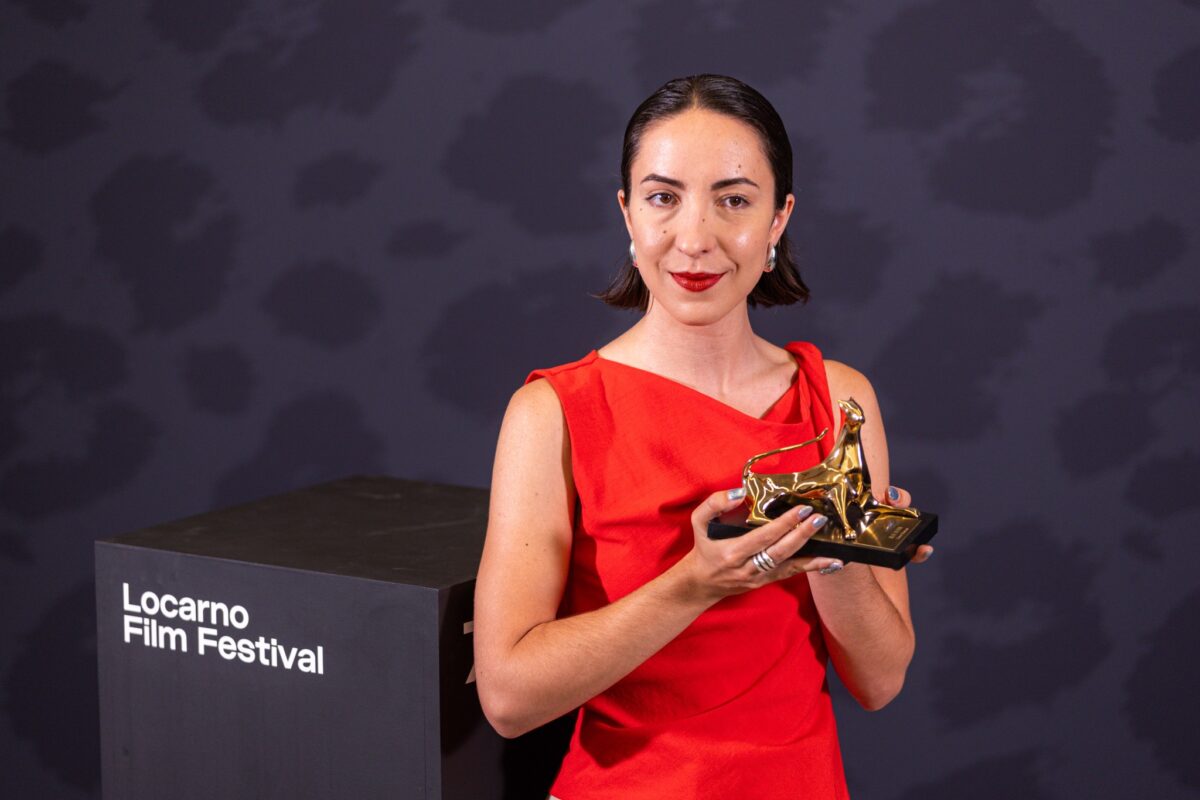
Sophy Romvari at 2025 Locarno Film Festival
I feel like you’ve heard enough about this, but the locations are really stunning. Just days before seeing Blue Heron, I saw Ozu’s Late Autumn again, so I was kind of connecting the exterior shots to Ozu—how uses them to reset, palette-cleanse while also elaborating further upon the characters’ headspace. They seem like they’re interceding in this unique way.
Yeah, the geography of Vancouver—and specifically Vancouver Island, which is where all the exterior shots were taken—was very important for me to depict, because I feel it’s a unique geography and it’s something that I think I had not for some reason. For whatever reason, I don’t think I’ve seen it in a film—at least not as itself. Vancouver Island—the combination of mountain, ocean, forest, all being within a stone’s throw—is very uniquely beautiful. And also, my parents being immigrants from Hungary, they grew up in an essentially landlocked country. There’s the Danube, but they were really drawn to the ocean. And I think the film taking place on an island and also the ocean itself—the vastness of it in contrast with what’s happening emotionally—just all really bodes well for the metaphor of what the characters are dealing with.
So it’s not just showing pretty images; it’s also trying to juxtapose that with the internal dysfunction and turmoil. And it also happens to be a joy to shoot in those locations. [Laughs] But Vancouver Island, because it’s not overrun with independent filmmakers trying to make films, they were very happy hosts to have us there, and the beaches are not swarming with people either. It was important to me that there were no extras in the film, because I wanted it to feel solidified in this memory form, and you don’t think you have extras in your memories [Laughs] generally. So I wanted it to feel that when they were going on an outing, that they were the only family there, and it was actually much easier to do that on Vancouver Island than it would be in any other location.
And the structure of these shots, in terms of when and how it was decided they were going to be interspersed with the action—was that from the early stages? Was that in editing? Where was that kind of figured out?
So the film is very scripted in terms of the chronology. Obviously, the bifurcation is quite distinct and that was determined in the script. There was a few moving parts in the first half because it’s all vignettes and it’s all quite elliptical, where we realized in the edit, “Maybe this sequence could go here.” But sequence-wise, most scenes are maximum, like, three shots, I think. It’s quite efficient because we were using this long zoom lens and we were doing a lot of very efficient master shots. It made it so that there wasn’t that many options, to be honest. I intentionally wanted it to feel very succinct, because you’re also dealing with a repetition of action.
There’s usually build-up of tension and then that tension gets… doesn’t resolve, but it releases, and then again a build-up of tension, then it releases. And I think that repetition was necessary to show sort of the monotony that at least the children are experiencing within the home. So that was all structured into the master shots being the guiding force towards how the narrative was moving forward. And then you have, every once in a while, an insert shot, but for the most part there’s not much coverage. It’s generally quite master-focused.
For acclimation, I found it very clever how a certain psychiatric language and dialogue establishes the Jeremy character. How were you writing it? Are you writing it in a purposefully academic way? Are you trying to narrativize that sort of language to make it more cinematic and, for want of a better word, exciting?
I think, because that was actually quite true to my experience of my understanding of my brother—which the film is quite evidently based around—so much of my understanding of him was through the lens of psychology and psychiatry and social workers and adults basically trying to understand him. I felt it was important to give the audience the same sort of narrow scope of understanding and then, by the end, trying to acknowledge that this is just a sliver of who this person was, and trying to acknowledge that part of the grief the film is grappling with is not knowing that person and not being able to access that person or understand that person. Which I think is true and real for many people: not being able to understand someone’s behavior or actions and acknowledging that trying to psychoanalyze will not necessarily bring you any closer to knowing someone or understanding someone, and it’s certainly not remembering them.
I was honestly transfixed by Edik Beddoes’ performance as Jeremy, which is maybe a funny word to use for something that is so real and so sad and so difficult. I was surprised how his presence had this menacing, almost thriller-like quality. I think an audience member who saw this movie without knowing what it’s about would be forgiven for thinking that it was taking some We Need to Talk About Kevin or Elephant direction.
Mmm-hmm.
I’m thinking especially of the scene where he’s bouncing the basketball against the house—these moments where I’m almost waiting for a violent outburst. I wonder how much you’re consciously playing up that tension à la those cinematic precepts.
It’s a good question, because I didn’t want to show gratuitous images, really, and I wanted it to feel like you were understanding Sasha’s point of view in retrospect. So there’s so many things that I don’t really have a clear grasp on, memory-wise, and when you’re trying to write scenes based off memory, it wouldn’t be a very interesting film if I just based it off things I actually remembered. I think some things become more cinematic by virtue of amplifying the tension, and some in the opposite direction, I think. What I mean by that is: sometimes I would speak with my parents about memories that I had, and it turned out my memory was actually much more mundane compared to what had actually happened.
And in many ways this film, I would say, is a really subdued version of what my brother was actually like. This character, this actor, he was street-cast. He had never acted before, but he had this really interesting presence that I could tell right away. I saw, like, a 10-second video clip of him talking that my street-casting company that we worked with just captured, and I saw something that was, like you said, kind of cinematic and had this captivating quality. But I think if I tried to push him as a performer to the extremes that actually were realistic, it would have been a much cornier movie, I think. So I kind of leaned into what he was giving me, which was this very internalized performance and this very internalized character. But in reality, my brother was much more extreme, much more bombastic, much more bizarre. You get little hints of it. Like, I asked him to smile at the end of the scene on the roof because I wanted to imply, efficiently, that this was intentional, that he was not there to commit suicide—he was there to fuck with them, basically.
And I think that that is part of the psychology of this character, that it’s nuanced because it’s like: why is he behaving in this way? And when you see a smile, it kind of forces you to wonder: is this intentional? Is he performing? So I tried to find little efficient ways to do that with the limitations, you know, that we had. But I did want there to be a bit of a menacing quality that doesn’t dehumanize or, like, turn him into a caricature, because that’s also very easy to do as a troubled teen.
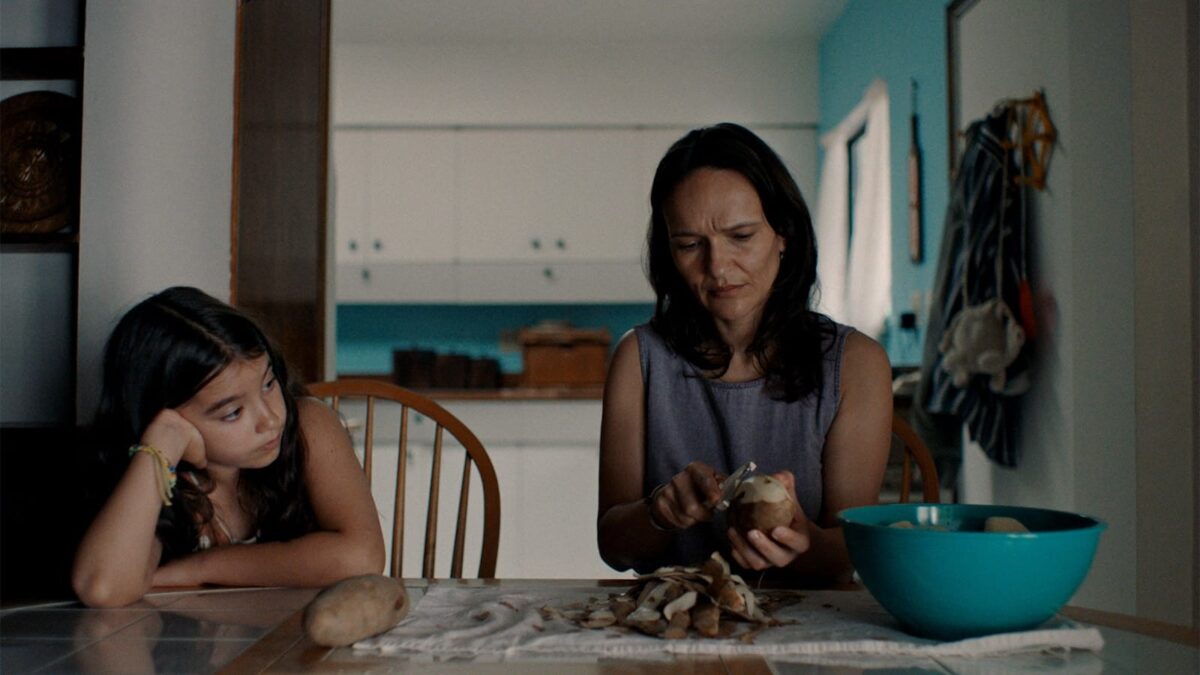
Blue Heron
This gets at something that I was thinking about—how the movie kind of simultaneously exists on two planes. One is a very literal, direct, incident-based storytelling; the other is a more symbolic, metaphorical series of events. What most made me think about it was that scene, which starts with the mom making the… I think they’re latkes, right?
Yes.
The very Jeanne Dielman thing of seeing them actually peeling the potatoes, grating them, then the brother on the roof. But then it gets to a more metaphorical level with the latkes burning and the smoke filling the house—a very rich image, a very rich evocation of the kind of seeping dread this family’s experiencing, and even connects to the later fear that the brother would burn down the house. So I wonder: A) how much that was intended, that dichotomy; B) how, if so, you found the means to evoke incidents and metaphor simultaneously.
I think you’re picking up on something that is a very difficult line to toe, and it’s hard to tell, as a filmmaker, which side of the line you’re going to land on until it’s actually engaged with as a viewer. And I think, ideally, they’re both working simultaneously because it’s a visual medium, so you want people to be picking up on the subtext of what they’re watching. But the potato-peeling, which is, yeah, a shameless Jeanne Dielman homage. [Laughs]
If it’s an homage then it’s not shameless.
Yeah. Yes, sure. Thank you. What I like about evoking that specific image from Jeanne Dielman is: to take that very iconic image and then put a child in the shot does rupture that entire movie, because if there was a child in Jeanne Dielman [Laughs] it would be a very different film. Also, I wanted to show a mother who is… there’s a lot of ways I wanted to show the things you learn or pick up from your parents, especially between a mother and daughter—the things that you inherit, but also you pass the torch onto a child, and she’s learning to absorb her mother’s stress, also, in that moment. But I really did want to create a sense of: you start most scenes with this mundane, bored summer reality—which is true for most of our summers, I would imagine—and then by the end of it, it is in some way disrupted by Jeremy’s behavior.
That comes through in his actions without him directly involving himself in whatever the situation is. But he’s a distraction. So he has a really big impact without ever actually really interacting with Sasha. But the attention is always taken away from the other children because of his behavior. So, for example, when she falls in the pool and she has this near-drowning incident, that was, again, a kind of efficient way that I could communicate that something like this could happen to her and she knows well enough to not tell her parents about it because she doesn’t want to cause more problems. So she lies about it, and it’s never really acknowledged. It’s just, “Yeah, we were playing in the sprinklers.” We know that she’s aware enough of her surroundings that she should not be taking up more space because the space is already filled.
The performance style is so important for acclimating to the environment. I was thinking about this a lot at the start of the second part, when you have the adult Sasha filming these social workers. It seems there’s this changeover in performance style from a slightly memory-based, oneiric quality to a very grounded present where I genuinely wasn’t sure if they were actors or real social workers you had hired. How much did you want to continue the feeling of the first part, and how much do you want to kind of wrest us away from the sensation that the performances gave?
I think it’s very important that you feel ripped away. And I think that’s also why I decided to have a bifurcated structure instead of a cross-cutting structure, because I think the cross-cutting would be a more gentle entry into adulthood, and I wanted it to be a very harsh acknowledgment of coming of age and having to acknowledge the reality that you are now left with these pieces that you’re trying to put together. I think when you cross-cut, you kind of cradle that a little bit—you’re given the opportunity to juxtapose these two timelines and images in a way that softens it—and I wanted the harshness of removing the audience, but also the character, from the comfort of nostalgia.
Then now you’re in this present day where there’s digital, there’s computers, there’s iPhones, there’s all these terrible things that we are now accustomed to, and you’re in the reality, so you can’t live in that past anymore. You can’t continue to… even though there was chaos and dysfunction, there is a comfort to it, I think—you’re watching these nostalgic scenes play out—and so now you’re no longer there, but you’re still trying to understand it in retrospect.
So yeah: the harshness was very intentional, and I wasn’t sure how that would play because, you know, I think maybe the more expected structure would be to cross-cut, but I was… that was the main thing that excited me about the structure. I’m like, “What’s the point of making this movie?” Because I didn’t want to just tell a story; I didn’t want to just tell people that I had a brother like this. It’s like: I wanted to show, using the form, that this is the experience of having been left with just these pieces and having to try to put them together. And then trying to acknowledge the limitations, also, of the form, because by the end of the film you basically have a character who has to say, “Well, I tried, I tried to remember him, but I can’t. I don’t. It’s gone. He’s gone. There’s no recreating.”
I think the fallacy of fiction is: you can’t recreate a person; you can’t recreate a reality. It’s just: they’re gone and you have to acknowledge that, and the film, by the end, is just sort of that. It’s just, “Well, I tried. This is my best attempt. It is a fictional reality, but the reality is that I can’t change anything through the act of filmmaking, through the act of narrativizing my own life. But the attempt is still there and it’s still worthwhile.” But it is a bit of a cold reality, I think.
As you’re saying this, I can’t tell if you’re speaking from the perspective of Sasha or yourself.
Good. [Laughs] Yeah, I mean, I do feel the delineation is interesting, because I feel Sasha as a stand-in for myself is… when I watch the film, I’m not thinking of myself. I’m not thinking, “Oh, that’s me on the screen.” I’m thinking, “That’s a character who represents an experience that is very similar to mine.” And that’s sort of the intention, I think, because I grew up with parents who are also very cinephilic and they watch a lot of movies. I remember my mom often saying that she felt there was never really a film that captured her experience as a mother. And you know, we would watch movies like We Need to Talk About Kevin and these other films—there’s so many of them.
So I think it was implanted in me at an early age, before I was even planning to be a filmmaker, that this film should exist—that there should be a film that represents that experience from a nuanced perspective and from the specificity of my experience, but also, more broadly speaking, just that experience of having a family member that is the gravitational force, you know, within a dynamic, and how to show that cinematically. Also because I’m showing it from the sibling’s perspective who’s not technically not even the protagonist in the story at all.
And so that was kind of a challenging thing to figure out in the script is: how do I root this in her point of view even though this isn’t really happening to her? It’s more happening to Jeremy. Which feels existentially interesting for me as a person who’s like, “Okay, I have to acknowledge that I really was on the side and the observer, but that has now led me down this path of filmmaking, I think.” Because I tried to show both the things that the character and myself inherits from her mother, but also her father, and both of those things are… it is, in many ways, also a film about how someone can become a filmmaker, I think.
Absolutely.
Like, interesting family dynamics blended with a father who is constantly documenting you—kind of the marriage of those two things allows me to be someone who wants to document, wants to create visual memories. To me, when I watch now I’m like: it feels obvious why I became a filmmaker. [Laughs]
This is maybe the only movie I can think of that evokes a weird kind of… I don’t know if it’s sadness or tragedy—or if the point is that it’s not sadness and tragedy; it’s just customary—but how bad things can happen to you in your home, during your childhood, while a TV is playing.
[Laughs]
How the sound of a TV from another room can just be this mortifying soundtrack.
Oh, that’s so funny. Yeah, I think I am someone who likes there to be sounds in the other room, in general, in my life. Like, I have now taken to playing a little AM/FM radio, and I just basically turn it on in the morning; I just turn it on right away and it just plays throughout the whole day. It’s just classical, but it gives me a sense of comfort, even if there’s something happening chaotically, you know, within my own mind or within the world. It’s like having a soundtrack to life. That was a big part of the sound—the music choices were all kind of born of my dad’s taste.
And I realized, when I looked back at my childhood home videos that my dad had taken, there was always music playing in the background. Which felt like score. Unintentional, but it felt like score. So that was sort of where that formal decision of: the music that is the soundtrack for the film is almost never non-diegetic. It’s always coming from some source, and then that creates the soundscape for the world. Which was very… expensive. [Laughs]
Last thing I’ll say: Best Supporting Actor, Hector. I was very happy seeing him.
I know. I mean, his brother had a whole movie, so he deserved at least a cameo.
Was he always in the script?
Was he in the script? I think I just was trying to shoehorn him in, basically. I think that’s probably the most Sophy scene in the movie, is when Hector is eating breakfast and she’s making her own breakfast. Or the bathtub as well. I do that a lot: watch movies in the bathtub.
Blue Heron enters a limited release on Friday, April 17.