
Enjoying much-deserved appreciation for his formally bold return to the 28 Days Later franchise, Danny Boyle also had another reason to celebrate last year: the 10th anniversary of Steve Jobs, his Aaron Sorkin collaboration that found a unique structural conceit to explore three key periods in the complicated life of the late tech genius.
In celebration of the anniversary, B.C. Wallin has edited the first book dedicated to the film with the STEVE JOBS MONOGRAPH. “The idea of the book is that to appreciate a film as greater than the sum of its parts, we should understand and appreciate each of the parts that make it up — in this case: Production, Jobs, Sorkin, Boyle, Camera, Performance, Music, Edit, Aftermath, with essays by writers with credits across RogerEbert.com, Polygon, Bright Wall/Dark Room, and NPR,” notes Wallin.
With the book now available, we’re pleased to exclusively feature Sarah Jae Leiber’s essay on Performance. Read the essay below and pick up the book here.
I have a Computer Dad who was always Doing Something On The Computer while I was growing up. I’d stand behind him as he fiddled with Photoshop, creating branding for his fantasy baseball team, or downloaded the latest power pop albums from shady websites that always looked like bigger-deal hacker domains to my eyes, or read inappropriate-for-me movie reviews on Ain’t It Cool News, certain that someday I would grow up and be Doing Something On The Computer while my own child looked on. In my fantasy, I would never be Doing Something on my own — I would share whatever was going on with that child, and teach them to navigate the expansive internet as a fellow traveler. I became Very Online Very Young as a means of continuing the family business.
Steve Jobs had a daughter named Lisa, played by three actresses (Makenzie Moss, Ripley Sobo, and Perla Haney-Jardine) at three ages over the course of Danny Boyle’s and Aaron Sorkin’s Steve Jobs. Lisa had a Computer Dad who was always Doing Something On The Computer, though it seems to me that she never really got to be in the inner sanctum of her dad’s Computer Doing. She never got to stand over his shoulder and wonder what was going on. She barely got to stand in the same room as him.
I went to acting school, probably as a byproduct of growing up in a house where I had to fight the computer or the TV for my parents’ attention. Part of my early acting training was status exercises. We learned that performers can play high or low status to affect the dynamic of the scene, depending on how their character would approach interaction with the people around them. A high-status player like a king or queen might “raise self to lower partner,” forcing their scene partner into a lower-status mode by nature of their raw power. A low-status player like a royal servant might “raise partner to lower self” in the event that the king or queen they serve needs to be coddled into the status quo. Status is basically a performance of self-esteem, wielded for good and evil.
As Jobs, Michael Fassbender is always playing high status, and he is, most of the time, raising self to lower scene partner. Like a king. Mere mortals are the ones who oscillate between presumed authority and supplication, changing the way they interact with people to suit what they need to get out of conversations. As genius creator-god, Jobs never stoops, never spooks, and never allows his colleagues, friends, or family to believe he even has a low status mode.
That’s what makes Jobs’ interactions with Lisa so juicy and so distinct from his other relationships in the film. We see Jobs berate others into submission, belittling coworkers and co-creators and other adults whose status could theoretically match or mirror his. But Jobs doesn’t stop raising self to lower scene partner when the scene partner is a child — his child. It gives away the game. When Jobs lowers Lisa to raise himself, he looks pathetic, not powerful. Steve Jobs is not a genius creator-god; for most of the movie, he can’t even admit to having created his own daughter, because looking an imperfect human invention in the face is significantly harder than putting her name on a product.
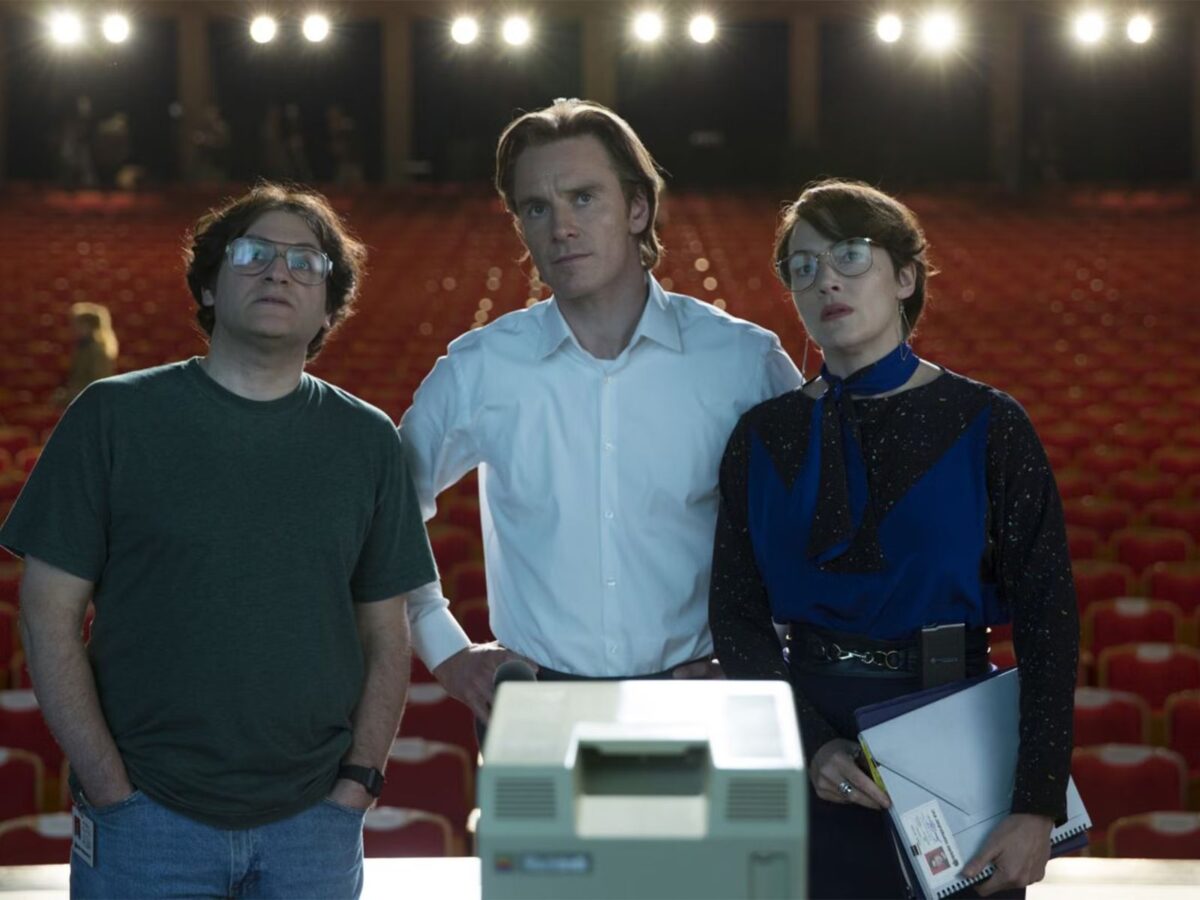
Fassbender’s Jobs doesn’t have time for anyone who is not operating exactly on his level. Sorkin’s famous walk-and-talks slot right into the propulsive force of Jobs’ will; we spend most of this movie in hallways and green rooms in the moments before giant product launches, watching Jobs’ lackeys make the impossible possible. Jobs is particularly curt, abrasive, and self-mythmaking in interactions with people like Andy Hertzfeld (Michael Stuhlbarg) and Steve Wozniak (Seth Rogen), people he sees as grunts, not creative visionaries; with other computer people, perhaps to mask his lack of practical knowledge, it is especially important for Fassbender-as-Jobs to raise self by lowering scene partner.
Kate Winslet is a particularly adept status chameleon in this movie, playing Joanna Hoffman as someone who can quickly adapt to changing circumstances. As a marketing executive, Hoffman’s eye for detail and narrative is supplemented by her skill as a people person and manager of personalities. She is Jobs’ work wife, with all the tired eyes and hurried apologies for his behavior that entails. She’ll even iron his shirts for him. Winslet dovetails between playing professional and playing nurturer, changing tactics on a dime if the last one has stopped working.
Winslet-as-Hoffman wields her high status as a much more pliable tool than Fassbender-as-Jobs ever does; Hoffman knows how to use status to make other people feel good, and she sees actual utility in that. Early on, when Jobs is manipulating his employees toward committing some degree of fraud while in the same breath denying paternity of his five-year-old daughter to her face, Hoffman gets down on Lisa’s level and asks her if she’ll help her make the computer say hello. This lowering of self to raise scene partner’s status is incredibly humanizing. In contrast to what Fassbender is doing this early on in Act I of the film, it is practically parenting.
It is easy for children to play low status against adults; they are inherently powerless against elders, politically and socially and performance-wise. Lisa’s sweet, quiet, observational nature at this point in her life makes it particularly heartbreaking to watch Jobs refuse to lower himself to meet her at her level as he walks around like he’s made of brain and no heart. Late in this first interaction, though, Jobs has Lisa demonstrate her value, putting his hand over hers to show her how to wield the controls. He is using her, of course; Lisa is a means to an end here, a way to prove to the public that using his computer is so easy a bastard can do it. But Lisa discovers MacPaint and disarms him, using his product fluently to create something meaningful on her first try.
In this moment, Lisa is raising herself to lower her scene partner in a way that’s about equivalence more than it is about control; Jobs is not yet interested in raising Lisa up, but this does level him to the point where he agrees to start paying Lisa and her mother a livable wage in child support. Status play is about how we influence and impact the people around us — Lisa, let into her Computer Dad’s inner sanctum for the first time, finds part of her power in his acknowledgement. When she asks him, “Can you teach me more things? On the computer?” we can tell this is the closest she’s come to being embraced by her father.
Part of status play is the acknowledgement that sometimes your raising and lowering tactics do not work on the scene partner. You can attempt to lower somebody by raising yourself, but their self-esteem and power in the character plays a factor in how your try is received. There are not many people who can successfully lower Fassbender’s Jobs; a notable exception is Jeff Daniels as John Sculley, who holds the power of the purse that allows Jobs to take the kind of risks he needs to innovate. In Daniels-as-Sculley’s hands, we can see desperation in Fassbender-Jobs; we can also see the desire to please and the terror in disappointment.
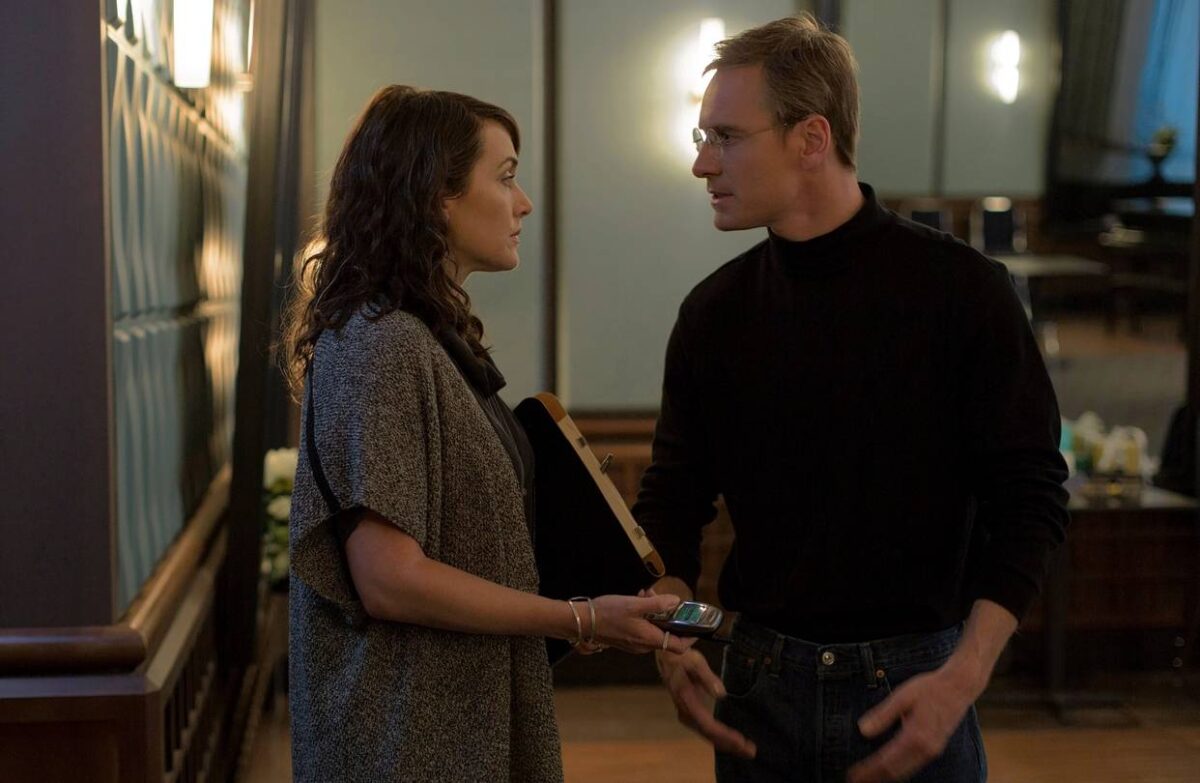
Steve Jobs is about chaotic family units — Jobs runs Apple like a fucked-up family, with toxic dynamics that trick people into staying. Daniels-as-Sculley plays the role of Jobs’ father, who both giveth and taketh away his blessing and his support. When Jobs feels betrayed by Sculley, he becomes single-mindedly interested in making Sculley feel just as small. Status is a push and pull, even in the most extreme of cases.
Sculley’s stern, tough love contrasts with Jobs’ relationship with Lisa, which is both stern and tough, but contains no love that lowers the self for the majority of the film. In Act II, when Lisa is a bright and inquisitive fourth grader (Sobo) trying desperately to keep up with her dad (Sorkin’s pitter-patter dialogue is an asset here), Jobs asks her why she keeps asking him the same questions, unaware that those questions are Lisa lowering herself to raise up her father. She asks questions because she wants her father to explain the answers to her, and she wants her father to explain the answers to her because she wants him to care about the things she knows. She wants her Computer Dad to teach her how to be interesting enough to be paid attention to.
Steve Jobs was a victim of the broken American adoption system, given up at birth and bounced around between two families before he was adopted by people his birth mother did not initially approve of. In acting-speak, this is the given circumstance of Jobs’ life that contextualizes all of his extreme behavior — at least, that is how Sorkin writes it. Jobs’ drive comes from his feelings of physical and emotional abandonment, and his high status masks an inherent mistrust that he will be taken care of regardless of how well he performs. Jobs raises self to lower scene partner as a survival tactic, needing to be good enough to annihilate a subconscious fear of being left alone.
It takes colossal failure to humble Jobs, and it takes rebuilding himself to meet his daughter at her level. By the time Lisa is in college in Act III (and played by Haney-Jardine), she has given up trying to be nice and compliant to catch her dad’s ear. She has learned to raise self by lowering partner, refusing to let Jobs look away from the chaos he has caused in her and her mother’s lives. “I’m not impressed with your story, Dad,” Lisa says. “It’s that you knew and you didn’t do anything about it and that makes you an unconscionable coward.” Jobs withholds Lisa’s college tuition when she allows her mother to sell the house he bought them, and is generally cruel when things do not shake out his way or make him look like a demigod with an unfortunate daughter. We learn alongside Jobs that Lisa has had a wide cadre of people at her disposal who have been consistently interested in her success. Jobs’ coworkers, who are the closest thing he has to a real family, have taken care of Lisa’s emotions and her physical needs in lieu of her father’s attention; Hoffman has especially stepped in to help Lisa handle her emotions, and Hertzfeld is even paying her college tuition.
Instead of destroying him, for the first and only time in his relationship with Lisa, this revelation – coupled with Lisa’s verbal acuity, wielded to hurt him deeply and specifically – simply lowers Jobs’ status. He follows her up to the roof and confirms to her that the Lisa computer was named after her. He sees the Walkman on her hip and tells her he wants to put a thousand songs in her pocket. He tells her he doesn’t know why he has been a bad father to her, other than the fact that he’s “poorly made.” And he shows her the printout of that first piece of art Lisa made on MacPaint back when she was five, that he’s kept with him all of these years. At the end of Steve Jobs, Fassbender tips his hand into humanity by lowering himself to raise his scene partner — the kind of subversion that recontextualizes and makes richer everything we have already seen. Lowering himself allows him to see his daughter for the first time. In response, Lisa changes her tactic, too.
Sarah Jae Leiber is a southpaw from Philadelphia with a soft spot for Milo Ventimiglia, just like Rocky Balboa. Criticism: NPR, Polygon, Bitch, Bright Wall/Dark Room, Jewish Women’s Archive. Her plays have been performed at McCarter, Theatre Row, Muhlenberg College, Actors Theatre of Louisville, The Tank, and more.
STEVE JOBS MONOGRAPH is now available.