
Excavating her past in deeply moving ways, Spanish filmmaker Carla Simón has completed her family trilogy with Romería, following her debut Summer 1993 and Golden Bear winner Alcarràs. When a teenager visits the Atlantic coast of Spain to meet her paternal grandparents, she begins piecing together the mysteries of her past.
Rory O’Connor said in his Cannes review last year, “Continuing in the low-key register of her Golden Bear winner Alcarràs, Carla Simón returns with Romería, another tale of intergenerational dissonance. A film about the stories families choose to tell and the ones they bury deep inside, it unfurls on Spain’s Atlantic coast, where 18-year-old orphan Marina (Llúcia Garcia) hopes to reunite with her paternal family. It’s also a story about displacement and yearning for lost roots, themes that cut close to the bone for a director whose parents died of AIDS when she was still a child, and who reunited with her father’s family in the town of Vigo, Galicia, where the film is set, at the same age. Simón has always been an autobiographical filmmaker; Romería might be her most personal work yet.”
Ahead of a U.S. release beginning this Friday from Janus Films, I spoke with Simón about the sense of freedom after concluding her family trilogy, recreating the past, being inspired by an Antonioni classic, working with Hélène Louvart for the first time, and more.
The Film Stage: You’ve discussed the personal place Romería comes from. Can you talk about the moment you knew you wanted to translate your experience into a script and what the process entailed?
Carla Simón: Well, if I think about the very beginning, I would have to go back to when I was writing my first film, Summer 1993. That was the moment when I became conscious of my lack of memory regarding my parents. It was very frustrating because I realized they were not there for me to ask. Obviously I could get some stories from other people, but they were not very reliable; memory is not something you can trust entirely, especially when it comes to family memories that, in my case, are stained by the taboo and stigma of AIDS and heroin.
At that time, I wanted to try to put my mom in the script, even if she was not present in Summer 1993. I wanted to get to know her to be able to portray her in her absence. I collected some letters she wrote to her friends and family and went to the places where she wrote them. I shot empty spaces with the idea that spaces remain while people pass. I made a kind of short film—it was my voice reading her letters—but I had the feeling that the images I captured were not fair enough to the poetry my mom wrote. Through those letters, I could hear her and understand how she was living her youth, what she paid attention to, and her relationships to drugs, friends, and work. It was a generational portrait that I felt had a lot of value.
I eventually made Alcarràs, but the idea of going back to these letters to make a film about memory was already there. While I kept making films, I realized that, through cinema, I could create the images that I was lacking about my parents. Film has this magical side where you can “resuscitate” people and make them alive again.
I love this surprising, almost time-travel element to the film. While someone could get a sense of nostalgia from reading a story or looking at writings, your process shows how painful it can actually be to live in those moments through cinema. Can you talk about your approach to the “film-in-a-film” conceit and recreating the past in this way?
I like the idea of this film-within-the-film because it allowed me to talk about memory. Marina is on a quest to understand her past. She asks many people and eventually concludes that memory isn’t something you can trust because everyone’s version is different. She tries to put the pieces together, but they don’t fit. In the end, we don’t remember the fact; we remember the last time we remembered that fact. Memory really evolves and transforms in our minds.
Once she understands that, she allows herself to imagine a possible story to fill those gaps, which is what I allow myself to do with the movie. For me, the important thing about this trip into her imagination was finding the right tone. I didn’t want to go into a sordid “trip into hell” to talk about heroin. I don’t want heroin to be the only thing that defines my parents; they were so much more than that. At the same time, I didn’t want to be too romantic about that era. It was the transition into democracy for Spain, which was a happy time that everyone wished for, but it also had this other side—the heroin crisis. A lot of heroin came into the country. The government didn’t do much to stop it; there was a theory that while young people were into drugs, they weren’t into politics. So that’s why the government didn’t do much. A lot of people died, and it’s very hard for us to talk about it.
Usually it’s seen from my grandparents’ generation, who tend to judge their children and keep it a secret and put it under the table so nobody knows too much. I feel they have the impression that these young people chose that life, whereas I feel they were victims of something. It was the right moment to try to shine some light on them from the perspective of the next generation. I’m grateful because they were the ones who broke with the old Catholic, conservative values of the Franco dictatorship and brought in more progressive ideas. Celebrating that generation was important to me, to show this playful youth that was in the present.
You’ve mentioned two movies, Barbet Schroeder’s More and Antonioni’s Zabriskie Point, that were influences. I’m curious when you saw those films and what they meant to you.
More is a film I saw while I was already investigating Romería. I watched a lot of films about heroin as a way to investigate—as a daughter of people who used heroin, you always have the question: “What was that like? Why was it good?”
I had seen the Antonioni film before, and the sex scene in the desert stayed in my mind, as did the idea of free love that I related to my parents. All of those movements arrived in Spain much later, after Franco died, so we had a late awareness of them. Another favorite is Bergman’s Summer with Monika, which I saw a long time ago. The portrayal of the couple on the island stayed with me because of how playful it was, and the characters are so powerful. When I started imagining the love story between my parents, I went back to those films because they were very young. Usually my films are fed by reality, but in this case, this part of the story, it made sense it was fed by cinema because it was something I was inventing.
I really love the motif of water. The main character’s name is Marina, her father’s a sailor, and there’s a lot of time spent on the water. The underwater photography is also amazing. Can you talk about the theme of water and whether it represents rebirth or something else?
It is something I relate to my parents. I only have a few pictures of them together, and almost all of them are on a sailing boat because my father loved sailing. It felt very organic to shoot in Vigo, in Galicia. That’s the city where my father was born and where he and my mother lived their love story. It’s a small city, but in the ’80s it had a lot going on in terms of cultural movements, music, and rock bands.
The sea is everywhere there. It’s a strange geography, which is actually why the drugs came through there—the coast is very difficult to control because the sea goes so far into the land. So I relate the water to my parents, which is why I named the character Marina.
Speaking of the underwater photography: I believe it’s your first time working with Hélène Louvart. You tried to work with her earlier and it finally worked out. Can you talk about your collaboration with her, specifically the underwater shots and the different formats, like the character filming herself?
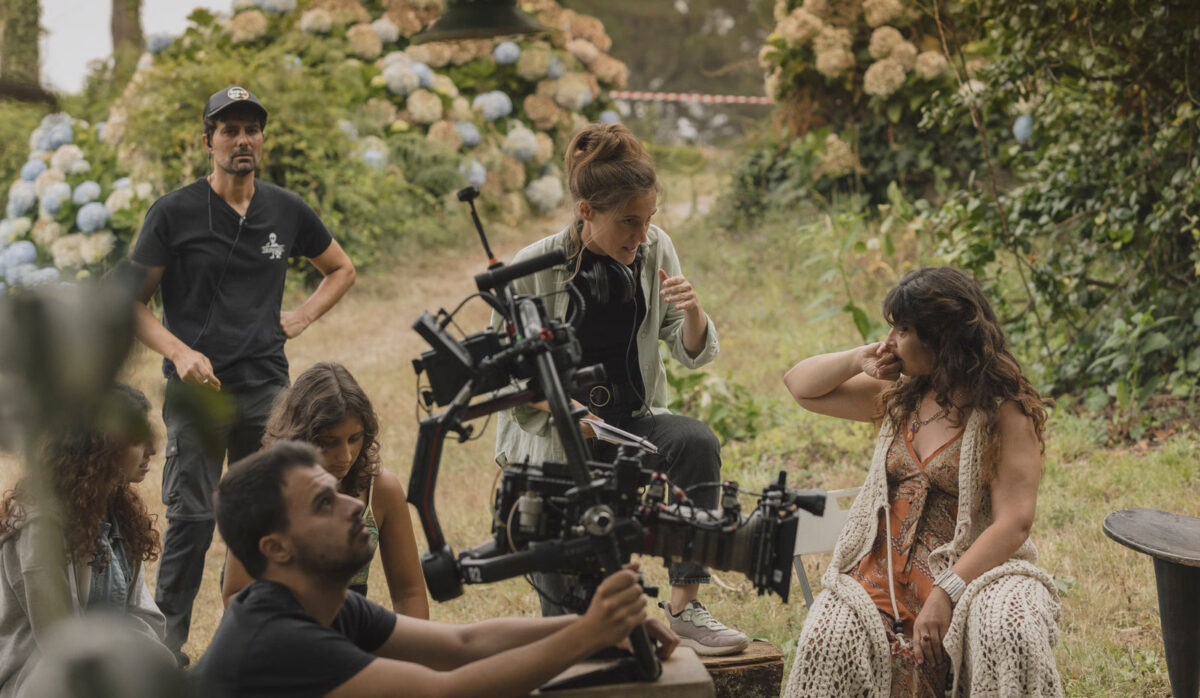
It was beautiful to work with her; we’d wanted to work together for a long time. We had many conversations because there were different layers in the film. For the “family” layer, I was coming from two films where the camera was almost another member of the family, very much on the inside. But in this story, Marina is an outsider. I felt we couldn’t use a handheld camera close to the characters; we needed distance and calmness.
Hélène was great at finding that balance—keeping distance from the family but staying close to Marina, while still leaving room for the actors to improvise. Then we wanted a contrast with the “imagined” part, which had to be more playful, handheld, and closer to the characters. I felt much freer when we shot that part. For the video-camera segments, Hélène and I rewatched some films I shot as a teenager to study how an 18-year-old girl would shoot. It became very natural to imitate that style to show Marina doing research and trying to connect with her parents.
I love the scene where she dumps the leaves in the swimming pool. It’s a small but important act of rebellion. How did you come up with that breaking point of sorts?
People always ask me, “Did you do that?” No, my grandparents didn’t even have a swimming pool! That is all fiction. But when you write a character and have empathy for them, you make them grow. Marina needed to do something to show her family who she is. She is a character who observes all the time, and that part is real. When I made my own trip, I was in the role of the observer. You are with a family you are supposed to be part of, but you don’t feel it. It’s difficult to find your place in their chaos, so you end up just watching. As a filmmaker, I watch all the time, but for Marina, I wanted to find a moment where she became more active toward the family.
You’ve described your first three films as a loose trilogy about family dynamics. After finishing this film, did you feel a sense of closure? And how does that feel as you move toward new projects, like the flamenco musical?
Romería made me feel very free. I have three big families—my adoptive family and two branches of my biological family—and I’ve explored all three with these films. Writing and cinema has this amazing power to give you the chance to put yourself in the skin of others and understand their choices, opinions, and thoughts. I’ve done that with my family somehow now and I feel like I’m free from that. Romería also helped me to take the truth about my family, but use cinema to invent, and it’s okay to do that and have a narrative at the end.
With these three films, I feel I’ve constructed my narrative and my past; the family memory I was lacking is now told. It was also funny that we premiered Romería right when my second daughter was born. Now that I have my own family, I find myself looking more toward the future. And yes: I’m working on this flamenco musical which has nothing to do with my own story, but that’s what film is for—exploring worlds you wouldn’t otherwise know.
In your research, was there anything you dug up that you decided not to incorporate? Your films have a mysterious feeling where the viewer gets some of the picture, but not all of it. As a writer-director, do you ever discover things and think, “I’ll keep this to myself because it’s more interesting if the viewer doesn’t know everything”?
I try not to put any limits on myself when I’m writing. If I do, I don’t feel free. I write everything, and then it eventually shapes into something that I feel comfortable with, and my family.
In Summer 1993, I kept the real family structure. I was six when I got there. I had a sister, and this couple was my biological mom’s brother; the family configuration was true. But by Alcarràs, I changed a lot because those events didn’t happen to my family in that exact way. My family tree was different; we invented some characters, and I also co-wrote the script, so some characters came from my family and others from my co-writer.
With Romería, I was speaking about the branch of my family that I know the least, so I had to use a lot of fiction. My family can recognize certain things, but there is so much invention—I never had the specific paperwork issues Marina has, and I had no doubt about the year my father died. The result is that my family can watch the films and, while it might be painful, they don’t feel offended or exposed. There is enough distance for them.
Romería begins a limited release on Friday, June 26.