
Alex Cox has (reportedly) made his final film: a Western adaptation of Nikolai Gogol’s classic novel Dead Souls. The book follows a drifter in Tsarist Russia who travels from town to town collecting the names of serfs who’ve died since the last census was taken and are thus considered taxable property—i.e. “dead souls.” Cox trades out the 19th-century Russian setting for the American Southwest around the same time and opts to play the main character himself.
The film was crowdfunded via Kickstarter (I contributed back in 2024) and went through a strange production journey. Portions were shot in the Almería desert in Spain at locations built for Sergio Leone’s For a Few Dollars More (1965). The remainder was filmed in Arizona. Shooting ultimately wrapped in November of 2024, and Cox spent many months editing the film, working with his visual effects team to complete the project and sending out periodic updates to his patrons (according to one, the final product will contain a puppet flashback scene). The film has already played at a few festivals and will start its theatrical release in the U.S. on July 2 in Seattle.
Having read Dead Souls, it’s not surprising that it would appeal to Cox. For one thing, there’s a very self-referential quality to the writing. The narrator often speaks directly to the reader about the novel itself, calling to mind some of Cox’s well-known postmodern touches: the generic food labels of Repo Man (1984), the intentional anachronisms of Walker (1987), Malcolm McLaren’s finger guns and Sid Vicious’ fantasy of shooting the audience in Sid and Nancy (1986). Reimagining a classic of Russian literature as a Spaghetti Western is a suitably offbeat and imaginative choice for Cox, and he’s not the first punk to embrace this particular novel—it inspired a Joy Division song of the same name.
Cox is a big fan of Spaghetti Westerns—he attended Oxford University, Bristol University, and UCLA and reportedly wrote his thesis on the genre. His film Straight to Hell (1987) is an homage to the gunslinging movies of the 1960s. Dead Souls contains many nods to Sergio Leone in particular. In addition to being shot at locations built for For a Few Dollars More (which Cox tells me is his all-time favorite Western), it includes a title sequence done in the style of Leone’s title designer, Iginio Lardani.
Cox is a middle-child of film history, born too late to be a “movie brat” yet too early to join the ’90s indie explosion. His films are characterized by a singular vision and unique set of obsessions: ruminations on politics, examinations of the appeal of punk music, use of older stars (Harry Dean Stanton, Dennis Hopper, Derek Jacobi), subversion of genre tropes, and a dark, satirical sense of humor.
In our conversation, he discussed his remarkable, one-of-a-kind career and answered questions about Dead Souls’ financing, distribution, and physical production.
The Film Stage: What made you want to adapt Dead Souls as a Western specifically? Why not a sci-fi or a crime film?
Alex Cox: The book lends itself to becoming a Western. Chichikov travels immense distances in a wagon across the open plain. He fetches up in small towns full of suspicious and gullible eccentrics. The ending of the first and only complete volume has the mysterious hero racing blindly through the night in his coach, uncertain of his destination, entirely exhilarated. This sounds like a Western to me.
Is it going to be an “acid Western” like Walker?
What is an acid Western? I think of a film like Zachariah or Greaser’s Palace, where the plot is not a major element and the filmmaker perhaps attempts to recreate an LSD experience. Whereas Walker has a very dense plot and is largely based on real events and individuals. Taking place in Nicaragua and Mexico in the 1850s, it isn’t really a Western. Its genre, I think, is the biopic. This can be a great form: a recent example is Konchalovsky’s remarkable biography of Konchalovsky’s remarkable biography of Michaelangelo, Sin. Dead Souls is more of a Western, though not necessarily acidic.
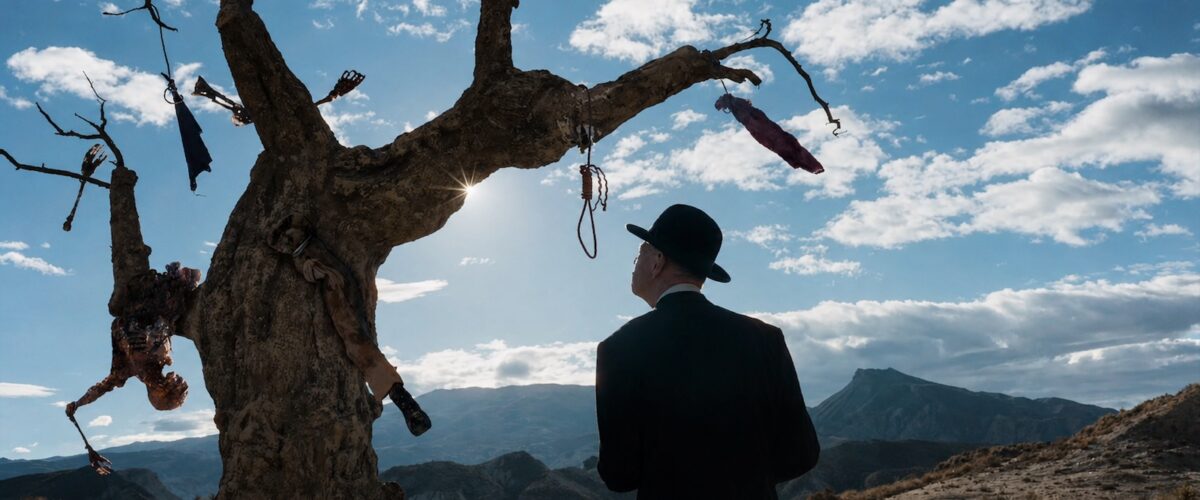
Dead Souls
How did you deal with the historical research for the movie?
I enjoyed following the career of Johnny Behan from Tombstone via Yuma Jail to the Chinese Exclusion office in Texas. He is usually depicted as a bad guy who defied Wyatt Earp, but he was a much more complex and successful character. This film is the third time Jesse Lee Pacheco has played Behan!
How do you translate the institution of the Russian serf system to a more contemporary American context?
The Tsar freed some 23 million serfs in 1861. Abraham Lincoln issued his Emancipation Proclamation in 1863, but slavery didn’t end until the conclusion of the Civil War: there were even slaves in the northern border states until that time. And unpaid labour continued to be enforced by the prison system, so in a way, slavery never went away in the U.S. Dead Souls is the story of a man who pays for lists of names: the names of dead serfs.
My film takes place in the southwest U.S. in 1890. In theory, there are no more slaves. But there is a definite exploited class, consisting of what the white Americans called “Mexicans”—even though many of them had lived in the southwest for generations—“Indians,” and Chinese. The film’s protagonist pays for lists of names of dead Mexicans. Why does he do this? What is the advantage to him in knowing the names and personal details of a despised underclass? You must watch the film to find out.
Dead Souls was left unfinished at the time of Gogol’s death (it ends in mid-sentence). Did that present a challenge? Were you forced to simply write your own ending?
I’ve read that Gogol intended to write a trilogy. Volume one was about bad people; volume two was to be about good people; and volume three would be about paradise. As we know, he only published the first volume, though fragments of the second volume, which he burned twice, also survived. In the book, it isn’t entirely clear why Chichikov does what he does. Clearly he plans to get some social or financial advantage. So the screenwriters’ challenge is to decide what the protagonist really wants, to properly conclude the film. Fortunately, some of the fragments of volume two are really good, and provide additional inspiration.
Did you make pretty much the movie you wanted to make?
Yes. Originally I wanted to shoot the entire film in the Almería desert. But there was a glut of production there, and we ended up shooting one week in Spain and two in Arizona, at the Mescal Western town. The visual effects were done by Phil Tippett’s team in San Francisco. I’m very pleased with the way it all turned out.
Is there anything in particular that you remember about shooting this that stands out?
Zander Schloss designing his own costume. Working for our Arizona DP Chance [Falkner] as he directed the Streets of Laredo scene: I was his AD and the necessary skills are quite different. Filming the immortal deserts of Tabernas with Ignacio. Mescal and El Paso. Every day at sunset.
I think of you as similar to people like Francis Ford Coppola and Steven Soderbergh: industry innovators who develop creative tactics for shooting on a budget and raising money outside the studio system. Is that done mostly out of necessity, or is it a conscious choice to give you more creative freedom?
Now, I bet you know the answer to that question. What do you think happened after I made Walker for a Hollywood studio?
Do you storyboard your films?
I storyboard the VFX sequences. Otherwise, we go to the set, have a rehearsal, and the DP figures out how best to shoot the scene.
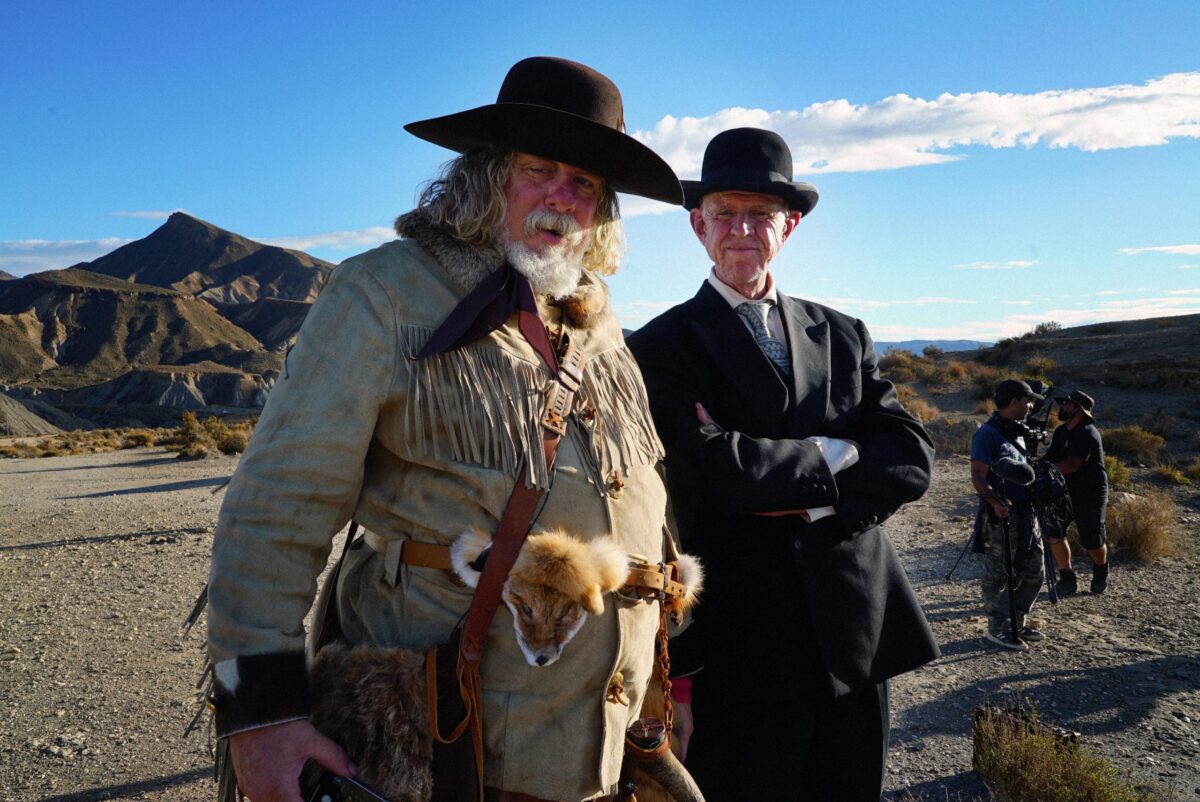
Behind the scenes of Dead Souls
I know you worked with Rudy Wurlitzer. Have you read his novel Nog? Do you feel it has any relevance to your work?
I’ve read all of Rudy’s books. Nog was okay, though there wasn’t enough of the octopus in it for me. My favorite of his novels is Slow Fade. It’s an amazing book about his relationships with Peckinpah and the dharma trail. And the screenplay is every bit as good. That would have been a wonderful film to make. A pity Bertolucci and Jeremy Thomas didn’t jump on it after they did Little Buddha. Of course, Slow Fade isn’t a feel-good story. None of Rudy’s great work is. And let me throw in a shameless plug for the fact that two screenplays we wrote—Body Parts and Out of Control—are to be published as one of those books with two covers. Like the Two Dollar Radio edition of Flats and Quake. Read one, turn the book upside down, and read the other!
Which current films interest you? Are there any that you’ve watched recently that have piqued your interest?
I greatly enjoyed Flow. I thought it was wonderful. Beautiful, surprising, astonishing, and entirely animal-centric. I would like to see more films like that.
You’re known as a bit of a cult filmmaker. What’s your relationship with your audience like?
Film is not the theatre. If you direct or act in a play, you have direct communication with the audience—every night, and twice on Saturdays. When you make a film, you let it go. You can never attend all the screenings, and there is no need to—the film is finished and making its way. Whereas a play, thanks to the immediacy of the audience and its clear reactions, can constantly evolve.
Is making films after 45 years still as interesting to you as it was in the beginning?
Yes! The same problems overcome by the same group of stalwarts, though their faces change.
Abel Ferrara once said that being a filmmaker is like being the Pope. You work until you drop. With this film coming out under the headline “Alex Cox’s final film,” are you feeling introspective at all? Are you looking backwards?
Certainly there’s no incentive for a filmmaker to retire. Everyone has another project they would love to make. Why not pursue it? I called the Kickstarter campaign “my last movie.” Is it? We shall see. I try to look backwards and forwards at the same time.
Dead Souls screens at Seattle’s The Grand Illusion on July 2 with Alex Cox in person.