
Over the past half-century, production designer Jack Fisk has collaborated with a who’s who of writer-directors, including Terrence Malick, David Lynch, Brian De Palma, Paul Thomas Anderson, and Alejandro González Iñárritu. A few years ago, when he recreated 1920s Fairfax, Oklahoma for Martin Scorsese’s Killers of the Flower Moon, it came as a bit of a shock that the two hadn’t worked together until then. (Anderson recommended Fisk to Scorsese after his standout period work on The Master and There Will Be Blood.) Fisk has a reputation for never taking the easy way out, understanding that every little detail rooted in authenticity carries untold benefits, whether that’s helping the performers get deeper into character or getting an audience to further believe in the world. For Malick’s The New World, Fisk and team constructed the 17th-century Jamestown fort without the aid of modern technology. In lieu of tape measures, Fisk instructed his crew to find a stick.
For Josh Safdie’s Marty Supreme, Fisk lends that trademark attention to detail and meticulous research toward crafting a vision of 1950s New York City. In typical Safdie fashion, the narrative sends ping pong champion Marty Mauser (Timothée Chalamet) on a non-stop journey all over the city and surrounding area, from the famed Orchard Street on the Lower East Side to the much quieter Upper Manhattan, and over to rural New Jersey. His journey is booked internationally, opening in London and ending in Tokyo. I spoke with Fisk on how he approached differentiating the host of locations visually, his research process which includes looking at personal journals and street photography from the era, and his distaste for period pieces that are too pristine.
The Film Stage: You’ve worked with a lot of repeat collaborators over the years, but your last three films have all been with new directors. What are you looking for when you meet with a director to potentially work on a project?
Jack Fisk: I’m looking for passion. Most of the directors I work with are also scriptwriters, so they’ve been involved a long time, and they have a story to tell. I first got a call from Josh Safdie when I was in Oklahoma working with Martin Scorsese on Killers, and he was excited about it already. Three years later he calls me back and goes, “I got the money. Let’s go.” He loves New York. He loves his life here, and he was so invested in telling Marty’s story. Marty has the same drive that Josh has for filmmaking. Marty had it for table tennis. He wants to be great. We all have those dreams when we’re young. And some of us are able to go through, some of us aren’t, but it’s got to appear selfish and sometimes obnoxious to the people around us, if you’re that driven. At the same time, you admire it because you go, “Oh, I wish I had done that,” or “I felt that.” There’s a kinship. Josh is like that in his filmmaking. He’s a lot like Marty, and he’s having success. He’s winning tournaments. I think that was part of the passion of him telling his story—he identified with Marty’s drive.
I’m getting older now, and it’s harder to find the old directors that are still making films every year, and I’m excited to find young directors that remind me of them. In the ’70s, when I started out, it was a great time in filmmaking, because the studios were in the toilet, and they’d made Easy Rider and suddenly young filmmakers were being given a chance. They had a voice and were making interesting movies, and it all grew from there. That’s when I met Terrence Malick and Brian De Palma. David Lynch and I went to high school together in Virginia and we moved out to L.A. in a U-Haul truck together. I fell into this charmed life of production design. I’d always liked to build when I was a kid; I’d build forts and environments. I’m moving my room around, redecorating it every week. So it seemed like a natural fit. I didn’t ever think about films until I got to Los Angeles. But then, when I started working on them, I couldn’t imagine a job that I could like better. Driving to work in the morning, there’s no place else I want to be going.
Did it surprise you that you had never done production design on a movie set in New York before? What is your relationship to the city?
I came here to go to school at Cooper Union in ’64 and ’65. I was living on Tompkins Square, so it was kind of the Lower East Side, but not quite as far down as Orchard Street. It’s much different now than it was in the ’60s. The ’60s were closer to the ’50s because it hadn’t evolved as fast. Every time I visit the city, there’s such a jolt of energy: the art that’s here, the people, the music. When I was going to Cooper Union, right across the street was the Five Spot Café where Thelonious Monk was playing regularly. Andy Warhol had the factory just half a block down on St Mark’s. Fillmore East was having all these rock stars. The art galleries and museums were top-notch. It was an exciting place to be.
So I’ve always wanted to work here but never got much of a chance. In 1974 I came up with Brian De Palma to shoot a little bit of Phantom of the Paradise. We ended up shooting a prison scene at the Pressman Toy company in Brooklyn, because it was the most depressing place I’d ever been, while the actual prisons looked kind of nice. People are watching TV and lounging and wearing orange jumpsuits, and it seemed too nice for Phantom.
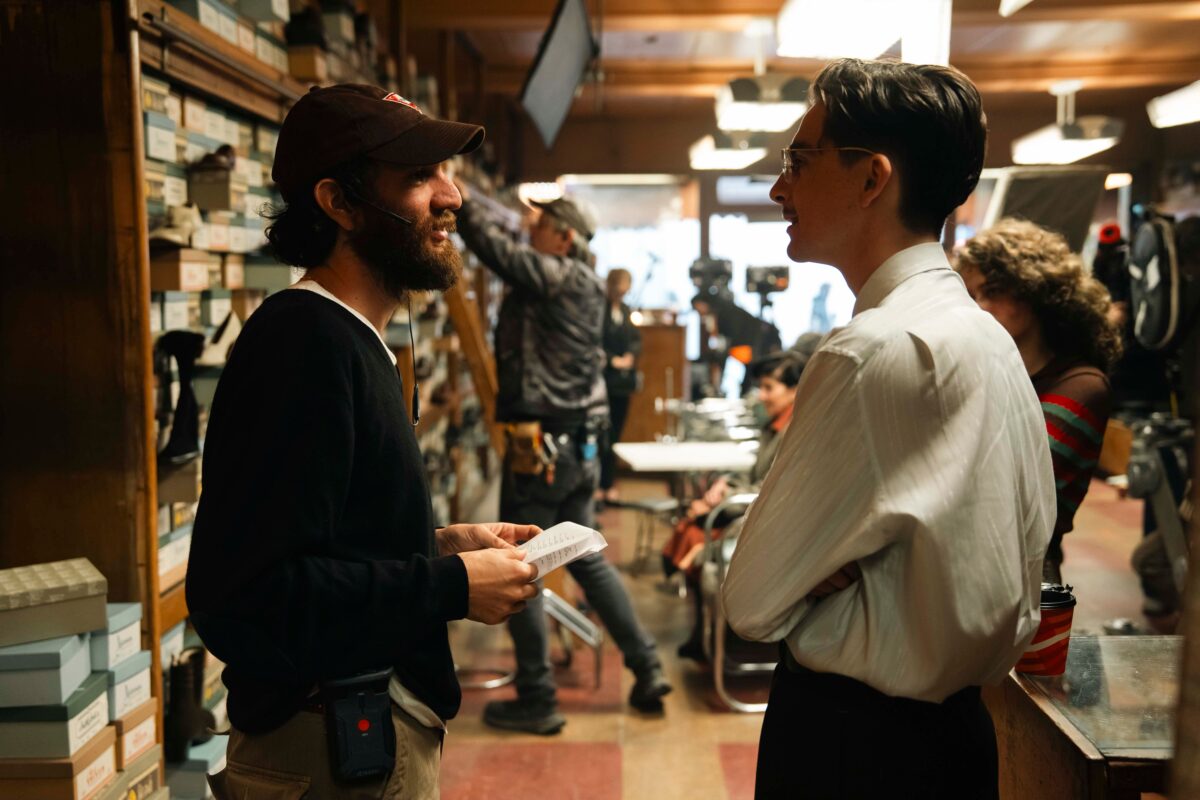
Josh described you as a spiritual leader on set, and said you’re cutting carrots and tossing them on the ground, which isn’t seen on camera.
I try to get the art department out of the art department and onto the sets in the streets. And when you’re shooting locations, it’s on the street. We transformed Orchard Street. We rented a building to build the shoe store in, but right next to it was a modern hotel, so we had to figure out a way to cover that up. We built modular storefronts that we could pile up like Monopoly figures on the sidewalk, and dress the windows and then put dressing on the sidewalk in front of those, and then added period cars. But it all looks so clean. Trash became important, because if you do everything too perfectly, it starts to look like a period film. When people are living, things get messy, and when we see a mess, there’s a familiarity. It looks more like a documentary, like you’re really in that space at that time. So I was throwing trash on the street—it was so much fun.
There’s a story from Badlands where Terrence Malick asks you to cut a hole in this billboard, and from then on out, you knew he preferred sets that you could see through. Were there any similar moments with Josh, either where he wanted something that clued you into the type of production design that he liked?
Overall, it was his love of reality of the New York that he grew up with. Sometimes the New York he grew up with is in the ’80s, and we were shooting the ’50s, but it was still the same thing. He was on the ground. He went and looked at all the locations, even locations that were just ideas for locations. He put together a beautiful book of photographs for inspiration. Some of them we collected together. He recorded a color video at the Museum of Modern Art that was made in the 1950s on Orchard Street, and that became a little Bible for us, because it was real. On Sundays in New York in the ’50s, Orchard Street was the most popular place you could be. It was like going to an amusement park—everybody was out shopping. It was the only place allowed to be open, down in the Jewish areas, because it wasn’t their holy holiday. So everybody went there for fun and shopping. We wanted to capture that craziness, the mass of people in tight areas.
Were these photos that he had taken or ones that he collected from other photographers?
A lot came from street photographers from the era. His wife, Sara Rossein, was a producer on the film, but she also was into research. She found blueprints to the building that Lawrence’s Table Tennis Parlor was in, which guided us in finding a location and building a representation of Lawrence’s real place. If we’re able to put Marty into a real environment, it helps tell his story.
How was designing the tenement apartment that Marty lives in, with the shared bathroom down the hallway? The movie bounces between these working-class environments, and then Kay (Gwyneth Paltrow) and her husband, Milton Rockwell’s (Kevin O’Leary) wealthy world.
If you’re putting together a film, especially one like this, you want to find locations that are contrasting to the one before it. Kay’s home was the complete opposite of Marty’s home. The ping pong parlor was an industrial space where he trained and worked. The farmhouse out in New Jersey was a real rural fantasy compared to New York City. The bowling alley was gaudy and lively, unlike New York. Putting these elements together, when you look at a photograph of each one on a board, you see a journey. We did that on The Revenant, too, when Leo was doing his 600-mile trip, trying to find locations that are distinct from the one before it, so you really have a feeling that they traveled. We did a lot of this without leaving New York. We shot the farmhouse in New Jersey. We built the gas station in upstate New York near the bowling alley, so we could shoot them at the same time. But we never went to France. We shot Egypt on a beach in New York.
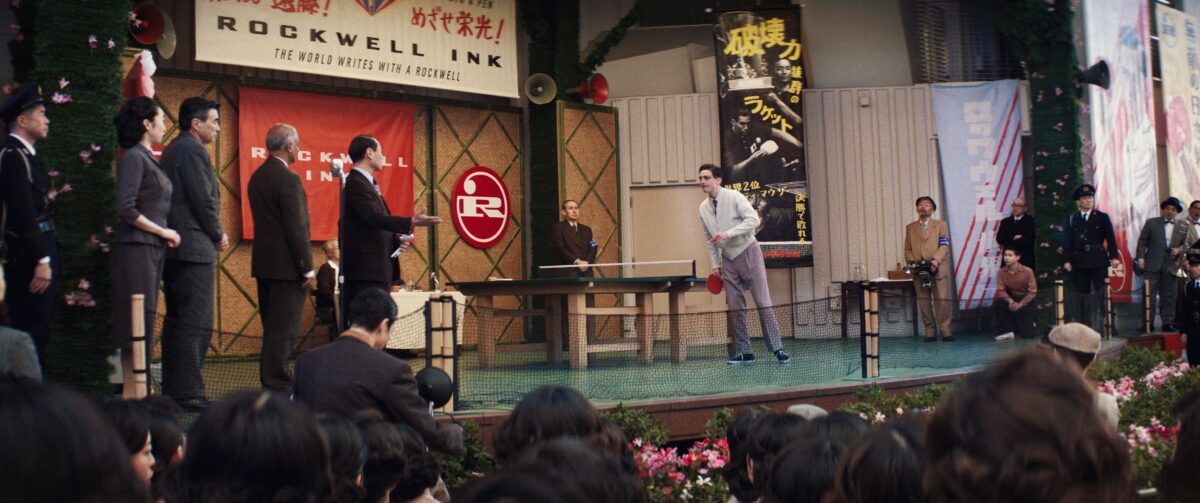
We did get to go at the end to Japan, as a reward. We were thinking of shooting that in New York, and we found a venue near Buffalo, but they said, “Maybe you can get 50 Japanese extras,” which was not enough. The studio said, “Well, get the film done, and we’ll send you to Japan.” Josh, who speaks Japanese, really wanted to go there. We shot there for about a week, and it went like clockwork. It was such a gift.
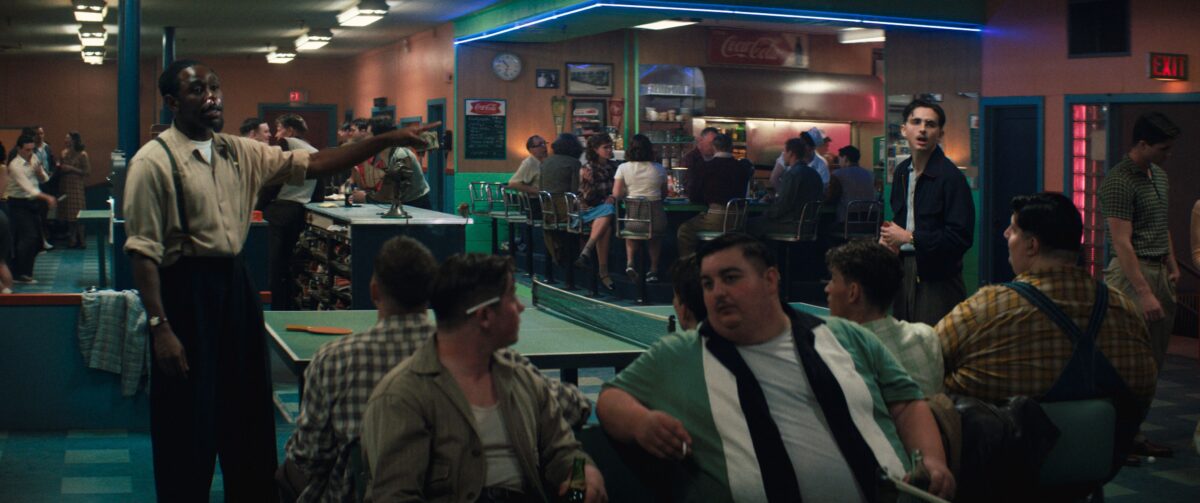
You describe the bowling alley as gaudy, and on my second watch, I noticed the colors on the walls don’t match. That space is such a stark contrast to the New York worlds.
The person in the small-town building that has a bowling alley doesn’t have the same art education or sophistication as someone who studies that all the time. They were making an entertainment palace of that period. So the colors didn’t necessarily work right, but you saw an attempt to, “Oh, this is a place where I’m supposed to be having fun.” The problem I find, sometimes, with films is that they’re too well designed. Things aren’t perfect in real life. It has more effect if it’s more human.
Sometimes you watch a period piece, and if it’s set in 1991, every car is from 1991, and all the design trends are from 1991, and the clothes feel like they just came out of wardrobe.
And they’re perfectly clean, and their fingernails are manicured and the haircuts the same length the whole time, their shirts are not dirty, their shoes aren’t scuffed. For me, it pulls me out of the story.
You’re renowned for your research. What’s that process like? Are you going through archives, looking up things at the library?
For research, I go everywhere. I try to avoid theatrical films for research, but I use documentaries as much as possible. Sometimes I’ll look at films or listen to music just to see what they were listening to at the time. I love reading personal journals. Marty Reisman wrote a book, The Money Player—all those things help get you into the period.
After 1865 there’s so many photographs taken, and a lot of them are higher-definition than photographs today because they were using 4×5 and 8×10 cameras. So you find a lot of detail, and then some of it compares to people in the same environment today, how they really live. People work; they get dirty. I read a bunch of books on health. People would bathe maybe once a week in the ’50s. You saw how hard it was: you had to go down the hall, and the water is never hot enough because everybody was taking showers on Saturday. You look at the diet of people, what clothes were available. And then you try to make them look like they’re really living in that period. Looking at the research, people would paint their rooms bright just to cheer them up. It was one decorative avenue they had to improve their life. So I tried to keep the drab away in that area.
One of the locations we had trouble finding was a hospital. We ended up shooting at a convent in New York, which didn’t look anything like a hospital, but with paint, set dressing, and some lighting fixtures, we were able to make it seem similar to the hospitals here in the ’40s. By the time we found it, we only had a weekend to prep it. I remember Josh going, “I just hate this location, and I’ve never shot in a location I didn’t like.” I felt horrible. I said, “Josh, there’s no alternative. We’re shooting this on Monday, and we’ve got to prep.”
So we worked over the weekend and got it done. They came to shoot on a Monday, and it looked completely different. I asked him after, “How did it go? I know you didn’t like the set.” And he goes, “It was my most favorite location ever.” For me, that was such a reward. Very seldom we can’t get in sync, but we just ran out of time. Josh is great that way: he’s not so proud that he won’t admit he’s made a mistake or that he didn’t see it, but at the same time, he pushes you to do so much better.
You research for months or weeks, however much time you have, and then you have to let go of the research so you’re not duplicating photographs. But you make decisions based on this subconscious knowledge of the time and the character. That guides you. Otherwise you become a prisoner trying to recreate stuff. The gut is a powerful tool.
You’ve worked with some great cinematographers over the years, like Emmanuel Lubezki and Roger Deakins. How was working with Darius Khondji for the first time?
Darius came over here from France, when we were doing the initial work, and went with us to look at almost every location. I’ve found if the cinematographer is a part of choosing locations, life is a lot easier because he knows what his problems are going to be when lighting it, and you know what you’re going to have to provide for him. It’s a slow process. The film grows, bit by bit. You see something at one location that inspires him, and you understand what he gets excited about, and he sees what you get excited about.
Josh, Darius, and I would go into a location, and when we left, we all felt good because we knew what we needed to do. We were making a documentary. That’s how we approached it. We wanted everything to be real. Sometimes Darius would say, “We can’t see that.” And I would go, “You can see that. It was in the period.” I was like the period police. They were so protective and didn’t want me to be embarrassed, and something to be in there that wasn’t right.
Terrence Malick would always say, “Don’t be afraid. If you don’t like it, we’re not going to use it.” He would say that to me. He would say it to Chivo. It encouraged us to take chances, and he was true to his word. There was a vent in a shot over Brad Pitt’s head in The Tree of Life. I said, “That’s not right for the period, that central air up there.” So he digitally took it out. It cost money, but he didn’t care. He was true to his word.
And it got us all relaxed enough that we would take chances and try things. It’s the same on this film. When Kay is at her hotel in London, Marty tells her to look out the window: “Do you see that bowl of fruit?” That was the Indonesian Embassy in New York. They let us in there for an hour to shoot, and I had to make it look like an English kitchen. I had found online a picture of an old English stove, a kitchen wall we printed up on the plotter so it was like eight feet by eight feet, in pieces, and then we just went and hung it on the wall, and that became the set. It’s one of those things that you’re taking chances, and it’s always great when they work out. I’ve done that outside windows of real buildings, where the building across the way looks too plain, and you hang a picture of a window there. We’re working in two-dimensional film—it fools the eye, and it’s great for the budget.
Marty Supreme is now in theaters nationwide.