
There are some others making films like Mark Jenkin. His Bolex-shot, creaky-sounding cinema isn’t the greatest system shock to those who’ve attended (one might say endured) a festival’s experimental-shorts program. But nobody is making them at Mark Jenkin’s scale, nor equaling his level of ambition for duration or narrative structure; anybody with even a passing interest in movies that look like they’ve been dragged over pavement, dropped in water, and given questionable means to dry out should be grateful that his cinema exists, and moreover that there’s so much of it.
Rose of Nevada compromises none of Jenkin’s textures, but could be said to represent a scaling-up if only for starring George MacKay (of 1917, The Beast, and occasional rumors for tentpole films) and Callum Turner (recent collaborator of George Clooney and Tom Hanks who’s very rumored for a certain British-centric character). It’s especially remarkable, then, how quickly they fit into Jenkin’s rough-hewn world and glom onto an out-of-time narrative (concocted with the director’s partner and frequent onscreen collaborator Mary Woodvine). It evinces an ambition all too rare in actors handsome enough to grace magazine covers—the English in mind, one almost recalls a young Terence Stamp.
Jenkin and I spoke over Zoom about these and other matters.
The Film Stage: No earthly reason for you to remember this, but we did the Q&A when Enys Men opened in New York.
Mark Jenkin: It was the opening night, yeah. I remember it very well. We had the amazing marquee outside.
The Village East. It’s a great marquee for a filmmaker to get a photo of.
Yeah. I think I took several photos on my iPhone and then I took some 35mm stills as well, which I think was my main background picture on Instagram for a long time.
The Q&A was actually right after what we discovered is our shared birthday.
28th of March, yeah.
I was thinking about that. I don’t believe in astrology and I’m not going to force any reading of it onto you, but this film is set in 1993, which I later discovered you’ve said is a very important year for you—you were 17 and shot your first roll of film with your first camera. 1993 is also the year I was born. So it’s all coming together.
Wow. Wow.
I think it’s just a happy coincidence, but I’m happy to have it.
Well, I was at a screening in Wales in Cardiff on the preview tour in April, and a guy I know who’s a musician—I don’t think I’d seen him since the last preview tour of Enys Men—and I chatted with him just before the screening. And then during the film, I kind of popped in a couple of times just to keep an eye on, you know, how it was playing and just judge the energy in the room occasionally. And when I walked in on the scene halfway through—where they go into the supermarket, and it goes to the CCTV security camera footage—I heard this guy go “fuck!” in the audience. It turned out afterwards it was my friend Tad, who was watching it and noticed the timestamp—whatever it is; something-of-August 1993—and that was the day he was born, was the day the security camera came up.
Wow, okay.
And he’s a very quiet bloke, so shouting “Fuck!” in a full movie theater is very out-of-comment, very out-of-character for him. But yeah, maybe that’s it; maybe there are a few of those links in there. I mean, I don’t believe in any of that, but I am kind of obsessed with numbers and dates and time and all that kind of stuff. The reason it’s set in 1993 is because it was always going to be 30 years before the contemporary timeline. So when I started writing it, it was actually during the pandemic and they were going to go back to 1990. By the time I’d done the second draft, it was 2021 and they were going to go back to 1991. By the time I locked the script in 2023, it meant they went back to 1993, and it wasn’t until in a Q&A that I realized 1993 was—I was, like you say, 17—the first time I ever shot a roll of Super 8, where my film career really started. So again: I don’t believe in it, but there’s some beautiful coincidences there that you kind of can’t ignore.
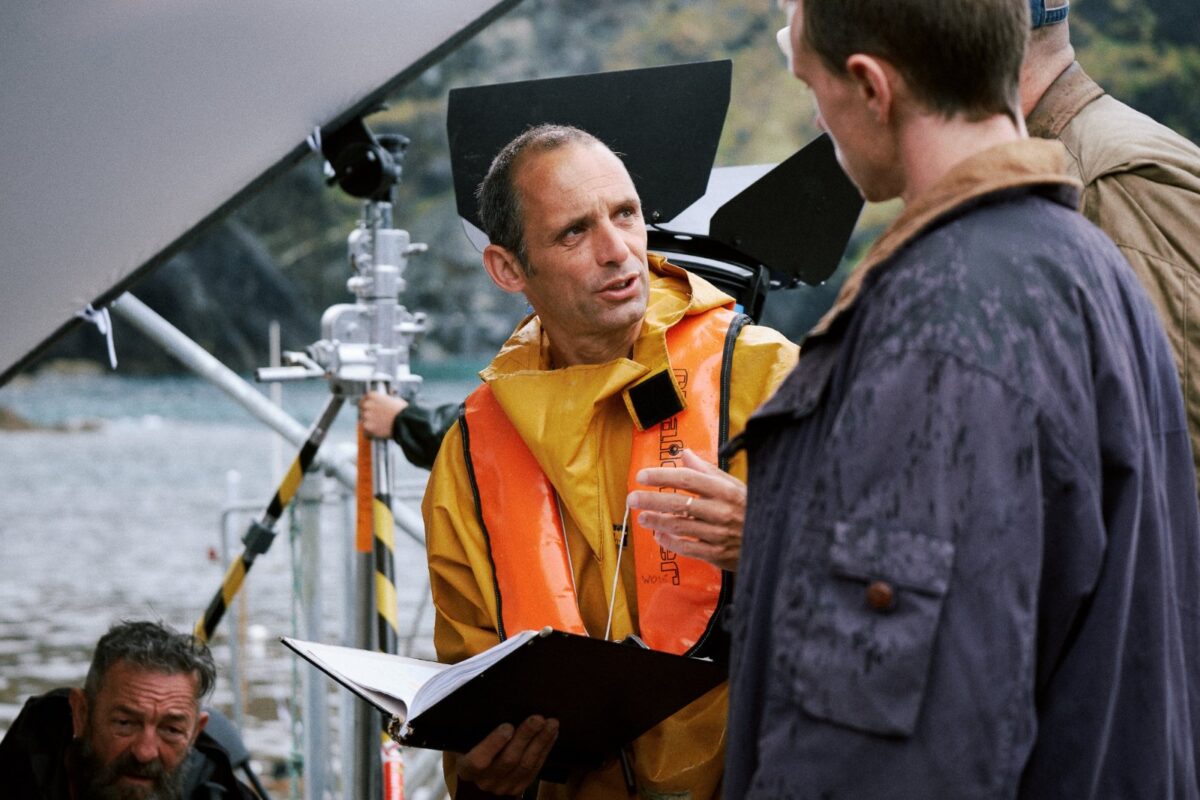
For a movie that is about going back and the fallibility of fixed time as a concept, a lot of it resonated. I’m not bullshitting you when I say that I was not just into it and enveloped by it, but really grateful for it. I said to somebody after seeing it is that it has a texture and personality, a character, that you usually only get from a six-minute short in an experimental program, and that tends to be—to be so blunt—one of the only shorts that I’m actually happy to see.
[Laughs]
So to have a two-hour version of that with these wonderful actors and an enveloping narrative on top of it… well, this is the epitome of more of a comment than a question, but I’m just throwing that out.
Yeah, well, I really appreciate you saying that because I always feel the same when I’m watching short-film programs: it’s quite often something that’s formally interesting that happens, but because it’s a short film… you know, I love short films, but it’s contained within a short film. And quite often they’re the types of short films where you think, “Well, this couldn’t be a feature film, and it also clearly isn’t a short film that’s being made in a career as a stepping stone to doing a feature film.” I think that I ended up doing short films on film at a time where I was trying to get other feature films into development that were done in a more conventional way, and the fact that I was making the short films was a result of not getting these feature films into development.
But then I started getting this amazing response to the short films because of the texture and the atmosphere that was within them. But all the time thinking, “Well, that’s great, but I’m still not getting anywhere with these feature films.” And then I had that lightbulb moment when I went, “Well, what if I did a feature film like I do my short films?” Because is it the fact they’re short films that they’re popular? Or is it the formal approach to those short films that are popular? Because if it’s the latter, then this could be really interesting for doing a feature film in this way. And I haven’t really looked back since then.
There’s the Abbas Kiarostami quote about appreciating movies that let him fall asleep. Your films haven’t made me fall asleep, but I’m truly lulled into a semi-conscious, almost meditative state. I wonder how much you—the person who is putting actual, hard physical labor into making these movies—likes the idea of that response. It may sound like I’m calling your movies “boring,” but it’s the opposite: during a boring movie, I’m tapping my feet and scratching myself, like, “Please let this end.”
Yeah, yeah. I understand. Because I think sleep is the ultimate resigning yourself to it, and allowing yourself to sort of be embraced by it, which I think, you know, that’s a positive thing. I just came back from Paris because Bait has finally come out in France seven years later. I hadn’t watched it since New Directors—so, like, March 2019, April 2019’s the last time I’d seen the film. That was incredible, because I never thought I’d be able to watch my films like an audience member can watch my films. But with that gap in time, there were bits of it that I’d forgotten, and I’d forgotten where the story… goes. You know? I think it was the closest to feeling that I’d just given myself into this film and I thought, “I’m not sure where this is going.”
Fabrice from the French distributor, before the screening, I said, “Are you going to come and watch it?” because he’d only watched it a couple of days before. He said, “Yeah, I’m going to watch it because I’m quite tired, and I’m going to just let it wash over me, and if I go to sleep, I go to sleep.” And he had the confidence to say that to me, knowing that I wouldn’t be offended because he kind of knows that it is that kind of positive thing.
I mean, I can speak about that in regard to other films, I suppose. I also did a double bill of Bait and The Lighthouse in Paris, and I told the audience when I did the introduction, I said, “The first time I saw The Lighthouse, I traveled back from France to the UK to see it at the London Film Festival,” because I was told I could get a ticket. So I got an overnight boat across the channel, and then I had to get the train up to London and kind of ran across London, got to the theater just as it was starting. I had a sea bag with me and I put it down between my legs, sat down in my seat in the middle of a theater, and it started and I fell asleep. And then I woke up, and then I didn’t know where… some bits I didn’t know whether I was dreaming it, some, you know, and sometimes the dreams were more disturbing than the film and vice-versa. And I kind of felt bad about that, and then I went to Belgium the next day for a festival, and it was showing there, and I made sure I saw it properly. And I said to the audience in Paris, “I think the best way to see it was the first way I saw it. I’ll never have that kind of immersive experience again.”
Now, to say that to Rob Eggers—you know, “Oh, I fell asleep during your film and it was amazing” [Laughs]—is a difficult thing to say. As you can see, I haven’t got a straight answer for your question. But I do think if the outside world disappears when you’re watching a film, I think that’s kind of incredible if you can stop thinking about things like, you know, what you did earlier or what you’ve got to do later or who you’ve got to ring or whatever—or even little things like wondering how much of the film is left. Which is easier to do if the structure is more unconventional.
Sometimes you can watch a very conventional film and you might not be enjoying it and you go, “Oh, God, that’s the end of the first act, isn’t it?” because it’s so on-the-nose and you go “fuck,” and then it feels like two weeks later and you’re going, “Oh, Jesus, that’s the midpoint.” And it’s so formally structured that you know exactly where you are. Something that’s more free-flowing than that and a bit more abstract, I think you’re kind of forced to give into it, and the idea of the film ever ending might disappear. So yeah, I’m not… I think if I read on Letterboxd, “Oh, I fell asleep after two minutes because the film was so boring,” that’s very different to what you were saying.
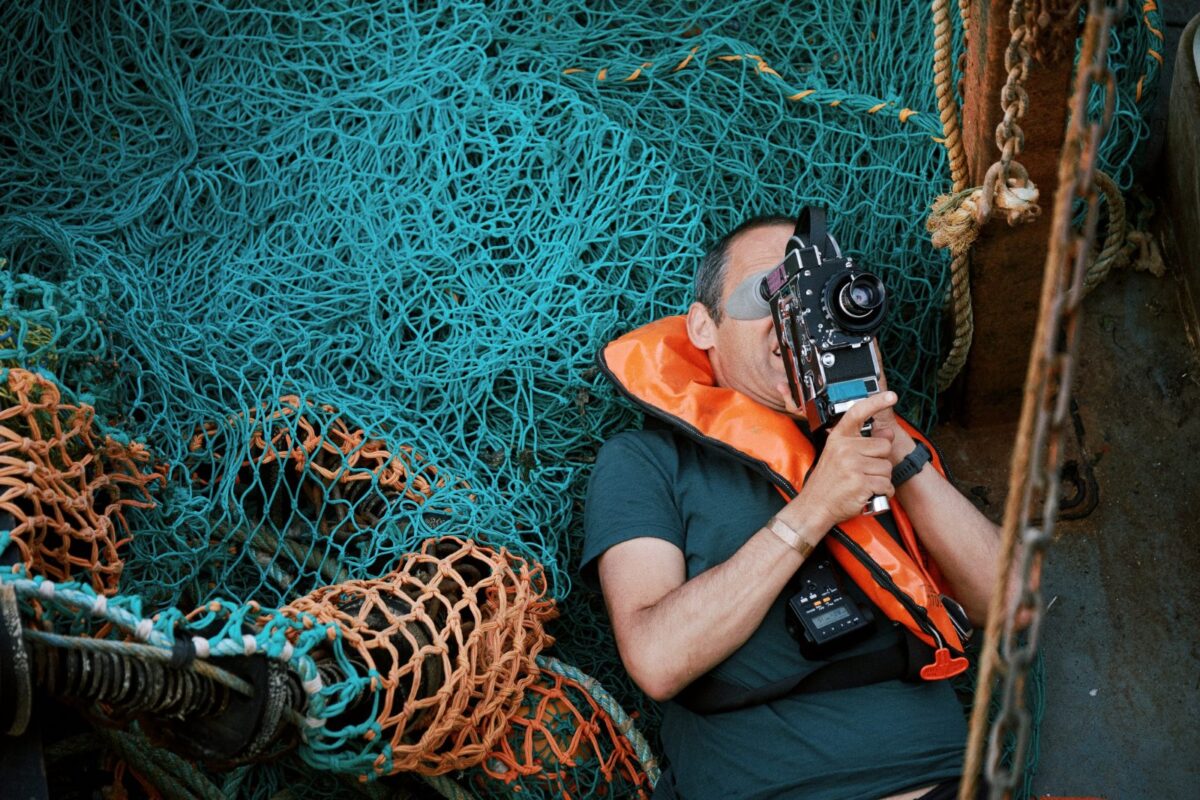
I think that there’s an easy, maybe not-so-vivid, description of this film as “dreamlike.” If you wanted to dig deeper, you might say it comes from the Bolex. I’m just so enchanted with what effect the Bolex conveys. And I know that the camera has a maximum take limit of about 27 seconds, right?
Yeah, yeah.
You’re working with these two actors who are wonderful, but have also been on some very big productions. In the case of George, his breakout role was 1917, which is all about the takes being very long, right? What were some of their reactions to the limited takes? How do you think it affected them as actors in that window of time that they could actually perform?
Well, I think the truth is: George doing 1917 and George doing Rose of Nevada, I think the experience is probably more similar on those two films, even though they’re extremes, than on other films. Because the formal element is so key. It’s almost like the starting point: this is what we’re doing; this is the time; this is how you work; these are the constraints; they are unbreakable constraints and the creativity comes within those brackets, really. For 1917, it was: the camera’s going to run for 10 minutes, 20 minutes, whatever it was. We’re going to wait—we might wait days—for the consistent cloud cover that we need. And then with Rose of Nevada, it was like, “Right, the camera’s going to run for a maximum of 27 seconds.” Most shots in a conventional film are going to get nowhere near 27 seconds, so it’s not really a massive issue until you get to a dialogue scene. And my films don’t tend to have huge dialogue scenes of dialogue flying backwards and forwards, but in the instances where it does, that’s when it becomes a real formal limitation on the way that the actors work.
That was the thing I was most wary of with George and Callum: to say, “Look, when we run a dialogue scene”—I only shoot one camera unless it’s the stunt where I might run more than one camera—but I’ll say, “George, right, there’s going to be a close-up on you. We’re going to run this three pages of dialogue. We’ll run it as a scene and we’ll rehearse it as a scene; we’ll run it through. I’ll look at you through the viewfinder during the rehearsal and we’ll run it from start to finish. When we actually shoot it, it’ll be in 27-second blocks. So we’ll run it. I’ll call action on the moment I’m running the camera, because I don’t record any sync sound either, so we don’t need to run it for a clapperboard and pre-roll or anything like that.” So it was like, “I press the shutter on action. So on action, you go, camera’ll be rolling straight away, and we’ll run until it just runs out and you’ll hear it stop. At that point, we’ll go again, you jump back a line, and then we’ll go again.”
And we’ll repeat that till we’ve got the scene. Then we’ll do it again because I want two takes. So I won’t do two takes of the first 27 seconds of the scene, then two takes. But also what I might do is—because I’m editing in my head as I go along—I might go, “Right, that first 27 seconds will be on a wide, the second 27 seconds will be on a mid, the next 27 seconds will be on a close-up, and then maybe an extreme close-up for the very last line that we capture.” Then we reset and we do that again, you know, so I have to reset each shot each time. And that’s to help them. I mean, it sounds nuts to say that I’m helping the actors in any way [Laughs] but rather than just doing the first half twice—you know, the first bit twice and then resetting and do the second bit twice, where they’ve got no real flow—I do try and give them as much flow as I can.
Plus they get a second go at it to nuance it, you know, to tweak it, to think about it. And again: that’s bracketed. There’s only a certain amount you can change the performance within the re-voicing or the voicing. But also, I know that if I want them to change the way they’re going to deliver a line that will be more of a change than the shot can handle, when I’m editing, I might think, “Actually, that line would sound better if they’re laughing as they’re saying it. That won’t work with a close-up of them.” I’ll have the pile of a bin full of cutaways of inanimate objects or other spurious action that I’m filming all the time to cut away to cover; then they can voiceover a non-sync shot.
But the joy of working with those two was that they were both up for whatever, you know? They both knew my films. They weren’t wandering in and on day one, you know, they see me walk out with a clockwork camera and no sound department, and they go, “What the fuck is this?” They go call their agent. They were both keen to work on something different. Because they’re “proper,” as we say here—they’re in it for the right reasons. First off, they’re artists; they’re actors. Callum’s a total cineaste. He’s seen everything. If he hasn’t seen it—if you mention something he hasn’t seen—by the time you see him next time, he’s watched it and he knows more about it than you know about it. And George is similar. Looking at George’s filmography, I just look at that filmography and go, “Well, one of my films isn’t going to stand out on that filmography because, you know, everything he’s done has been a challenge.” He could have gone a much more mainstream, movie-star route—certainly off the back of 1917—but he made choices based on his gut instinct rather than his head, which is the same way that I cast them.
When I met those guys, I didn’t meet anybody else; I just met those two. I met George first because I was going to cast him in the role that Callum ended up playing, because I thought George was a bit old; I’d always imagined the character of Nick to be a bit younger. But when I met George, I thought, “No, he’s Nick. He’s the lead. He’s the rabbit caught in the headlights here.” And then I met Callum and I just knew—my gut said—“Go for both of them.” Didn’t think about it too much. Just thought, “Right, yeah, I get on with them both, they both knew my work.” They both seemed to be going into it with their eyes wide open. They’ve sort of talked publicly about how challenging they found it, but in very much a positive way. I think separately they’ve both said that when they came down to Cornwall, they sort of felt like new boyfriends at the wedding who are coming along as sort of meeting [Laughs] everybody who already sort of knew each other. So I think that, you know, from top to bottom, everything was new for them.
You could come make a film in Cornwall that’s being made by a production company from outside of Cornwall who’s coming into Cornwall and you wouldn’t know anybody but them; nobody else would know anybody else. Like half my crew are related to me, and most of the others are really close friends and collaborators. But I think, again, that was part of attraction for them: “What’s this guy doing down in Cornwall? They seem to be making films down there away from everyone and the last two have kind of been quite critically acclaimed and successful at the box office in, you know, the context of the size of the film.” So they were very keen to kind of get involved.
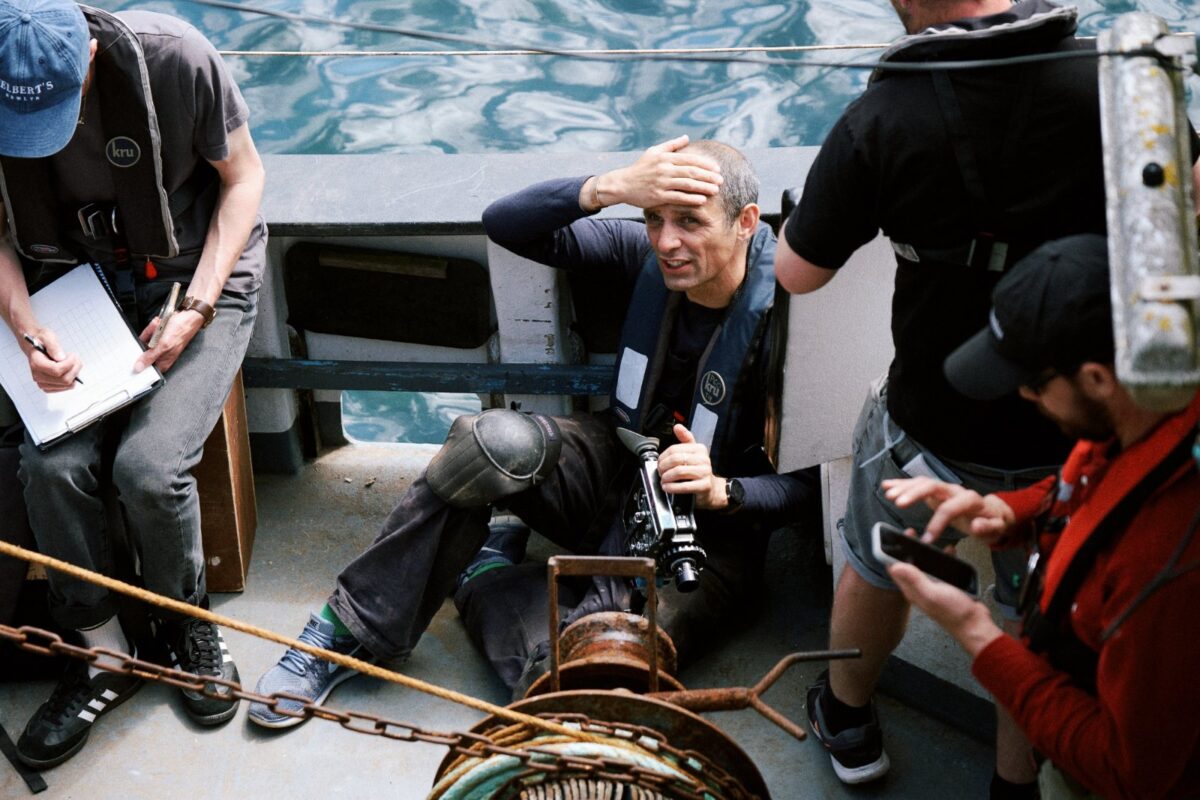
They definitely show their worth in the film with their physical presences, with these amazingly expressive faces—or sometimes the lack of expression. But you also worked with them a second time recording the sound, dialogue, breathing, and grunts. Did you find that when you get into that post stage for this very important element, your working relationship with them changed, or a sort of approach to the material—a philosophy about the material—changed when introducing sound?
Yeah, I think I get closer to knowing what the film’s about during the edit. So by the time they get in, I’m much clearer about what we’re doing. And also the way that I work with the sound is much kind of calmer, more linear, more controlled, and paradoxically much more experimental, because I’ve got control. You know, the shoot in a lot of instances is, “Right, we’re just going to… it’s day one. Here we go. See you at the wrap party. Everybody just hold on tight—this is going to be fucking crazy.” When you get into the sound, for the first instances, it’s just me. I tend to voice most of the characters myself when I start editing so I can start cutting stuff together and getting rhythm within scenes. I’m also adding all the atmoses—I do quite a lot of the rough foley in my studio while I’m editing—and I also work on the score. Then we switch to another studio of my supervising sound editor, Ian Wilson, which is in the next town, and that’s when… I carry on working myself in my studio, but we kind of work in parallel, because when the actors come down, they come and work with him in his studio.
So I think we wrapped in towards the end of August. I had an edit by the end of September—so maybe like four weeks to put a rough working edit together—then George came down and did his dialogue. And it was good. It was just by luck that George was the person who came down first, because we worked around people’s schedules, because obviously a lot of people went off and did other jobs. George had a break in his schedule, so he said, “I’ll come down.” He just did a day-and-a-half voicing it. He voiced all of his stuff, and it’s his story, really. But he’s not the person with the most dialogue in the film. So we recorded all of his stuff, and that kind of sets the tone for the film.
When I did Bait with Edward Rowe, I got all of Ed’s dialogue in before I did anybody else’s because I wanted his tone; I wanted his voice to set the tone of the film. Just through luck, George came down first and he set that tone. And then the others came in one by one. In some ways, we worked longer with the other actors than we did with George. And then Callum was the one who we didn’t have; we didn’t have Callum for a long, long time. He was busy: he was on a movie, and then he was on a TV series and had a short break around Christmas, and he came down just before Christmas for a day and did his dialogue.
And this mad thing happened. It was basically finished: everybody’s voices were in; all of the actors’ voices were in; most of the atmoses and the foley, at least the rough foley, had been done; most of my score was in the film. The only voice it was missing was Callum’s, and I voiced Callum’s lines. So I voiced them and I pitch-shifted them down a little bit so that it didn’t sound like me anymore, but also Callum’s got a much lower voice than me, so it kind of fit it. And I thought, “Well, that’s the film finished.” It’s not finished because my voice is never going to go out on the final film, but I thought, “Somebody could watch that film today, and then Callum will come down, do his voicing, and they’ll watch the film, and you wouldn’t really be able to tell the difference between the two.” Because everything else was done. Callum came in and he was in for a day, day-and-a-half, and he did his dialogue, and then we watched the film back, and it was a totally different film. Just by dropping his voice in changed everything. It changed George’s performance. It changed the pace of the film. It was, like, insane.
And I’ve got no idea how that works. I don’t know why that would happen, you know? That’s that magic of film: you think you’re 99% done and you think you’ve got 1% left to do, and when you do that 1%, you realize, “No, we were nowhere near 90% done. That last bit, the film was not working at all, and then 1%, and it totally works. That’s just that magic of film that I don’t understand, and I’m glad I don’t understand: you bring all of these disparate things together and it creates one whole. In the same way that sometimes you can have the best script and the best director and the best cast and the best composer, and you go make the film and you watch it and it’s utter shit. And it’s like… why?! There’s no explanation what happened. It just doesn’t gel at that point and fuse into one thing.
I think that just that one bit of Callum coming in… and he didn’t do anything that he didn’t do on the shoot. It wasn’t like he came in with an idea and gone, “Oh, I’ve got this thought that’s going to change the film.” He came in and did what he had to do, but it was at that point everything that was sort of circling around each other just went [Claps] and then it was like: that was it.
I like what you’re saying about these combining into a single piece. Part of what’s fun about watching all of your movies is that I feel like I’m getting these complete experiences, but I can also tap into a very particular element and have a whole experience with just that. All of your movies have really amazing soundscapes, but I found myself thinking about it more in Rose of Nevada for some reason. Maybe it’s because of the time-travel conceit, which is reality-bending, but I was asking myself how much the soundscape that you’ve constructed—the seagulls, waves, ships hitting against the port—is going for strict realism and naturalism and an evocation of the natural world. Or is there something outside of those boundaries happening with it?
Yeah, I like abstraction—sonic abstraction—in cinema, but I think it only works if it’s really in a bed of reality. I mean, if it was all abstract, then the abstract would become reality and you would stop noticing it. Everything to do with film is rhythm. Film is just rhythm. And I’m stealing that from Kent Jones when he was introducing Late Fame at the New York Film Festival: in the Q&A he said, “Film is about rhythm,” and I went, “Oh, yeah. I’m going to have that. That’s exactly right.” And it is that thing: you lull an audience, or the audience gives into the form of the film.
So for example: if I describe to people, “This is a 16mm, post-synced, Academy-ratio film shot on a clockwork Bolex,” they might go, “That sounds great.” A lot of people would go, “That sounds weird. I don’t want to watch that.” But, like, by two minutes in it’s not weird anymore, because in the context of the film, it’s 100% normal. And that’s why I then do things with the visual form to upset that. Most of the time it’s quite straightforward, but there’s moments in the film where, you know, there might be an upside-down image—something as simple as that—or an image playing backwards or something.
There’s a shot of George in the film where he turns and he kind of glances at the camera and blinks. It’s after the storm sequence, and I love that shot because there’s something really weird about it, or otherworldly, or unrealistic and abstract and creepy. But I don’t think anybody would really know what it was because it was taken from some rushes where George is getting ready to do a take and he’s looking down the barrel—because I’m focusing the lens—and I obviously say, “Okay, action,” and he’s looking down the lens, he blinks, and he looks away. And I think it was shot at high-frame-rate, so it’s slow-motion as well, so if I play that backwards, suddenly he turns around and looks at the lens and blinks. And a backwards blink is a very weird thing, because it doesn’t look natural but it doesn’t look unnatural.
I think there’s very few times you can do something with an image where an audience can go, “Oh, I can’t make sense of that.” Because I’m looking at you now. If there was something in the background that would kind of creep me out here, I could make sense of it. Because it’s there and I can look at it, and the instant might be, “Oh, what’s that?” and then I can look at it and go, “Ah, right, okay.” Doesn’t mean it wouldn’t be creepy anymore or anything, but I can kind of recognize it and I can deconstruct it and I can understand why it might be freaking me out or why it isn’t normal. With the audio, with the sound, you can do that in a way that you never work out why it’s weird or abstract, because you never recognize it—I mean, literally never see it—and you don’t go, “Hold on, what’s that sound?”
So like in Enys Men, the big thing that I did in that film was that inside the cottage, there were always clocks—there was always a clock running—but the clock never ran the same way twice. You know, sometimes it was slightly fast, sometimes it was slightly slow, sometimes it was running backwards, sometimes it would sort of stop at different times. But you would never watch that film going, “Oh, hold on…” You’d get a sense that something wasn’t quite right on an unconscious, subconscious level, but you’d never be able to go, “Oh, I know why I’m feeling a little bit uneasy: it’s because that clock’s running 10% slower than the last time I was watching this scene.” So I love that idea of being able to play with the audience by manipulating the sound. And sometimes it will be really obvious things—you know, like taking all the sound out except for an effect.
Like in Rose of Nevada, a moment where the boat owner takes the photo—you know, the hero photo in the film as the boat comes in and the boat kind of knocks against the quayside. It’s all natural sound up until that point. As it knocks against the quayside, that’s the cue for all sound to fall away. So you go into silence, but then you hear him click the shutter of this cheap plastic camera which suddenly goes off like a bomb because it’s, like, in this silent background. I just love the endless ways that you can play with the sound. And again: it’s the best time to do that sort of experimenting because you do it largely on your own. I largely do it in the studio on my own so I can take risks, and I’m not afraid of them failing because if they fail, I’ll never show them to anybody. But also: they’re so cheap. You’re not on set with a hundred people that you’re feeding and housing, and racing against daylight or the tide. I’m just in my studio. It’s not weather-dependent. There’s always a cup of tea nearby. There’s always an armchair that I can sit in and put my feet up if I’m want a rest. So it’s the perfect playground for experimenting.
That’s why I love the workflow of having no location sound: when I go into the studio, into that environment of experimentation, I’ve just got a blank page. I don’t walk in on day one and go, “That sound we recorded there is a bit knackered and we’ve got to amend it.” I just go, “Right, well, one: I’ve got to start working because we’ve got nothing. “So it’s not a sort of, “Right, what shall I do?” It’s like, “Right, you just got to start working.” But also: everything you put into the film is there through choice. There’s no accidents. The accidents come through the experimentation, but there’s no accidental sound in there to start with.
My creative mindset is like: experiment straight away. Because, also, making realistic sound—creating believable, realistic soundscapes—is quite hard to do. So sometimes I’ll look at it and go, “I’m not going to be able to create that sound realistically, so instead of falling short on realism, why don’t I lean into surrealism or abstraction straight away?” But it does need to be surrounded by elements of realism for that still to be sort of shocking or effective or communicative.
One might say there’s no accidents in experimentation—or even if there are, it’s on a completely different matrix than accidents in planning. I mean, maybe. I know George had asked you to interview him in-character as Nick. What did you, having invented this person and directing this actor, find yourself asking Nick, the Cornish fisherman who’s been thrown out of time? What did you want to know about him?
Nothing from his point of view once he’d gone back in time. It was the backstory; it was setting up what his motivation was before he goes back in time. So kind of who he was. I’ve got this theory that I probably talked about when we chatted about Enys Men: every character that I write in a script is just me. It can’t help but be me. Even if I’m writing a 100-year-old American woman. I’ve never met a 100-year-old American woman, but if I wrote her in a script, it would just be me; it’d be that version of that character that I can write. So the important bit, the sort of alchemy, is when the actor comes and gets involved and takes on that character. Because I need them to fill that character out so that not everybody in the film is just a version of me and I need as much input from them as possible. In order to get the input from them, I’ll put very little on the page in terms of who the character is.
So I’ve got two rules: I never mention anything about backstory in the script or in the character breakdowns—unless it comes up in dialogue or unless it’s signified in some sort of action within the film—and I’ll never put any adjectives or adverbs within the script so nobody will be given any kind of motivation for action within the script, or ascribed any motivations or emotions or feelings. So… what I’d like to do—and only if the actors want to do it—I do it with all the actors, really, and certainly if I ever audition actors, which I tend not to, I would give them a rough outline of a character and then I’d interview them in character. And with George, it was more about: who are you? You know: how long have you lived in the village? How did you meet your wife?
We created a whole backstory around George’s character. I can’t quite remember what it was, but probably that him and his wife were childhood sweethearts—they met when they were at primary school, their parents knew each other before they were even born—and all this kind of stuff. But what it was great to develop with George was the idea that he was a character like a lot of Cornish men who won’t say a lot; they won’t offer an opinion on something. And it’s become more and more obvious to me now, those characters, because everybody’s expected to have an opinion. Everybody thinks they should offer an opinion on everything that’s happened, however ill-informed or totally uninformed it is. But the Cornish male archetype is somebody who will just watch: he’ll just sit back and he’ll observe and he won’t say anything. He’ll take it all in. So he’s listening the whole time and he’s very rarely saying anything.
And that came from what I’d call hot-seating with a character. It’s like: sit in the hot seat and we’re going to chat. George loves doing it and I love doing it. And there’s just one rule: there’s no wrong answers—nothing the actor is going to say is going to end up in the film—and if I feel they’re going down a wrong route with the character and I feel that it might inform something they do in the film, I might say afterwards, “George, now, when you said that you did this, this, and this.” [Laughs] If he had admitted to, like, a murder or something in the hot seat, I’d say, “Scratch that one from the record because I don’t want your performance to be sort of underscored by the fact you’re an undiscovered serial killer.” But in that moment, you can be anything; you can do anything. It’s always fun. It’s so childlike. It is dress-up and make-believe in its purest form. When you get to the film you have to stick to the script, so you’re back to the constraints, but when you’re doing a hot-seating like that, you can really expand and play and find out where that character is.
I’m writing something at the moment, and the temptation for me at the moment is to get an actor and hot-seat the actor based on this character that I’m writing. I think there’s a time when maybe I’ll do that, and normally it’s when we’re actually shooting the film. But if I’m stuck while I’m writing it, I think there’ll be a moment where I do go, “Right, I’m going to hand over part of the control to somebody else for a minute.” It could well be my partner Mary, who is… it’s quite handy that I live with an experienced actor. So I might say, “Right, here’s a rough outline of who this character is. I’m just going to ask you a couple of questions about your life and then that might feed into that character in the script.”
This is maybe a superficial comment, but: she’s awesome. Such a great screen presence, but knowing that you guys concocted the story together… I love her as an actor, and then my admiration just kind of went up knowing that. But you don’t need me to tell you that your wife is awesome.
[Laughs] No, no, but she needs me to tell her that later on that you said it. She’s in London working at the moment, but when I speak to her I’ll say, you know… [Laughs]
Please stress that I do mean it.
Yeah. I will.
Rose of Nevada enters a limited release on Friday, June 19.