
Isabelle Huppert’s performance in Ulrike Ottinger’s The Blood Countess, a vampire fantasia set in Vienna (and co-starring no less of a local icon than Conchita Wurst) that marks the 158th credit of her remarkable career, got me thinking. Sitting face to face at the Luxembourg Film Festival on a recent Saturday afternoon, I couldn’t quite grasp how an actress who so regularly stalks the catwalks in the crimson reds of Balenciaga, and whose onscreen characters are about as unlikely to wince at the sight of there own blood (as in Paul Verhoeven’s Elle and Michael Haneke’s The Piano Teacher) as they are at someone else’s, had never been cast as a vampire before.
“Yeah, I was very happy!” Huppert explains, eyes wide and leaning forward in a silk scarf embroidered with that fashion house’s name, and with a great deal more warmth than I’d spent the day steeling myself to expect from our conversation. Back at the Thessaloniki Film Festival last November, I’d watched with increasing levels of fascination as Huppert pleasantly flummoxed one moderator after the next across a generous series of Q&As and public appearances, less through any kind of cruelty or discourtesy than an almost subconsciously aloof refusal to offer up anything more than a five-word answer.
It’s true, where most stars on the “contributions to cinema” circuit usually only show up to smile for a few cameras, tell a few stories and walk a few carpets, Huppert not only went above and beyond with how many appearances she happily sat through (however contrarily), she also took an active role in how her retrospective was planned—even going so far as to consult on the films selected and the program notes. I left the city with the sense of someone aware of both her own legacy and increasingly apparent role as one of the great champions of the medium itself—regardless of whether she chooses to throw an interviewer an anecdote every now and then.
Luckily for us, the actress had arrived at the Hotel Le Place d’Armes in a gregarious mood, as happy to joke and laugh at herself one moment as she was to offer up an impassioned dedication to a favored collaborator the next. Over 20 minutes (which I’ve slightly edited here for clarity), Huppert talked about Ottinger and vampires, wigs and costumes, why she’d love to work with Mia Hansen-Løve again, and how she recently enjoyed collaborating with Asghar Farhadi, whose new film, Parallel Tales, looks a safe bet to be announced in this week’s Cannes press conference.
The Film Stage: I was surprised to learn this was your first time playing a vampire. Were you watching any vampire movies to research for the role?
Isabelle Huppert: Yeah, I was very happy! But no, not so much. I’m not a vampire… uh… spectator. Which was good, because I was approaching the film with a certain naivety, I would say. But I could tell when I was doing the movie, and when I was telling [people] that I was going to do it, that they were kind of excited and struck. I could tell, I don’t know, how it really stirs something in people’s minds. So I was, you know, inspired by this—by people’s excitement about me, or us, doing the movie.
You often say that acting on stage and acting in front of a camera are not so different, but this film has an added layer of theatricality. How did that play into the performance and the character in this film?
Well, it gives a kind of freedom in a way, because it takes you away from the sentimentalism, or stops you from being too psychological. You know exactly what kind of music you are, and that makes the actors very free in a way, because you don’t have to handle a character too seriously, I would say. In a way, it doesn’t really matter, you know? It’s more like a tale, so it gives us great freedom. And that was Ulrike’s idea for the project: that you can do whatever you want, in a way.
Looking back over your work, I think this and Madame Hyde are maybe the only two supernatural roles you’ve played.
In a way, yes! And it’s funny, because we shot some of Madame Hyde here in Luxembourg, I think. I’m confused because I did two movies with Serge Bozon, Tip Top and Madame Hyde, but I think we shot maybe one, or maybe both of them here. But I like the comparison, because Serge Bozon’s universe is definitely not realistic and definitely very inventive, and he sets stories in a completely imaginary reality. Which is also the case for this film.
In both of these movies, there’s a kind of joyfulness or playfulness in your performances. You seem to be enjoying yourself. Is there a reason why you haven’t taken on more roles like this?
Well, I’ve done quite a few films like this—maybe not exactly like this; not all movies can have all this—but this one is really very special. But that’s Ulrike Ottinger. It reflects what she is. And it’s this kind of film, where you don’t really speak about who the character is. I mean, honestly, who cares? Certainly not me. [Laughs] I didn’t care, because I could tell from the start where we were heading. It’s something completely timeless. You don’t know what period of time you are in, but you understand that she’s taking people somewhere with her. And you know what I like best in the film? Is when she disappears. I think that was so brilliant. All of a sudden, she doesn’t exist anymore.

The Blood Countess
The dialogue was also contributed by Elfriede Jelinek, with whom you’ve worked on two other films, Malina and The Piano Teacher, which are both quite character-focused. How do you see it in comparison? Because it’s obviously less of a dialogue-based role.
Well, I can see that she’s Austrian, for sure. And I think it has a lot to do with a certain Austrian way of expression. You know, you have Elfriede Jelinek and you have people like Thomas Bernhard: they have a way of navigating between things that are very hard and very funny and very insolent, which also gives so much freedom because you can have a lot of distance with what you say. You can be funny but very hard and very silly and, yeah, that’s certainly what she contributed to it, by working on that script with Ulrike, for sure.
I mean, speaking of dialogue, in both films you work multilingually. You use different languages, and your co-actors are using different languages. How is it working that way?
I think that, in this way, Ulrike gives the best possible answer to what could be a kind of setback at the beginning, because I speak French and I’m surrounded mainly by German-speaking actors—Birgit [Minichmayr] and Sophie Rois and Lars Eidinger—and initially, before we started doing the film, I told Ulrike, “But what is going to be the language?” Because sometimes when you put all these people from different nationalities together it turns out to be quite fake and you can feel the… co-production. You know what I mean?
[Laughs] Oh, very much so.
But then she gave me a few lines. People think that I speak several languages, which is partially true but partially not so true because, in fact, if you watch carefully, I say a few lines in German, and Birgit also speaks sometimes in French, and Lars speaks sometimes in French too, but enough to blur it, to give a meaning to this multiplicity of languages, like we were also blurring borders.
You don’t say, “Well, you have a French actress and then you have German-speaking actors.” No, it really brings a nice dimension to the film, because I also speak Russian, I have even one line in Hungarian, which is normal because Erzsébet Báthory was Hungarian, originally.
There was a lot of talk in the buildup about how this project was first conceived in 1998. I’m curious how these long-term projects motivate you in the long run. How are you able to stay attached?
I came in much, much later. Maybe 1998 was the time when she really started thinking about it, but I came in like, maybe, 10 years ago or something. But at some point she wanted me to play the maid, and then it shifted to [the Countess] herself, which was fine. But the maid is a great role also!
How did she approach you with the role?
I don’t remember exactly when we met. Well, she probably sent me the script or whatever, but then there was this retrospective of her films in Beaubourg, so this is how I met her more, especially through her films. Because she did a multitude of films, and she’s a character. She’s more than a filmmaker; she’s an artist and she has a whole world around her.
Berlinale 2026
I was at the premiere in Berlin and you could really get the sense of that, just seeing the people involved and how she brought them up on stage. There was a warmth to it.
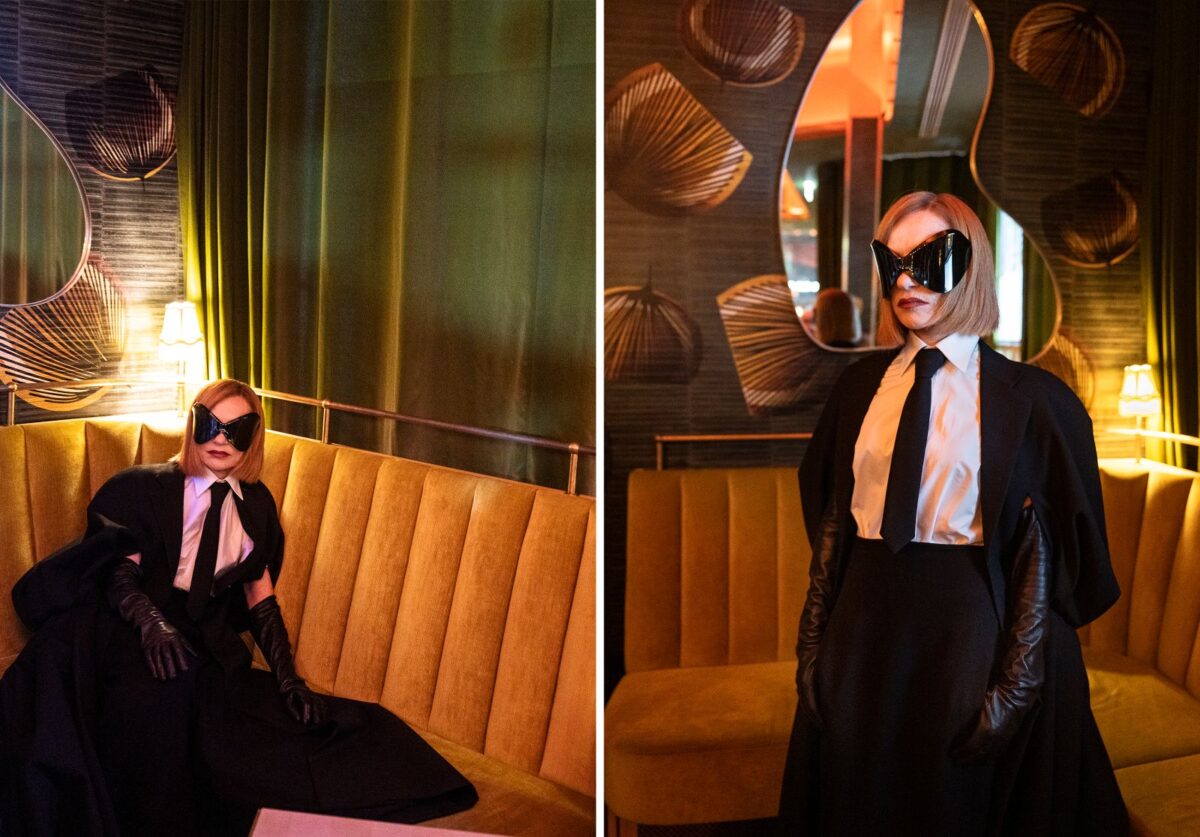
Yeah, exactly. And I think, also, what was really defining for us was the environment where we were shooting—this decor, where we were, all these places in Vienna… they gave us a certain direction, in a way. And the costumes of course, and the hair. It gives you a certain attitude.
Did I read somewhere that you enter characters through wigs? Was that the case for this film?
No!
No? Okay.
No, I’m not an American actress. [Laughs] They have wigs, I have my own hair most of the time, but in this case, not exactly. I don’t even remember. Maybe more hair? I mean, because it’s not really my color. Again, it depends what kind of movies you do.
What excites you the most when you choose a project? Because you’ve worked with very experienced filmmakers but also seem very open to working with relative newcomers. How do you choose?
Well, when you decide to do a movie, experience doesn’t mean anything in a way. You can be the most experienced filmmaker, but I think, at the end of the day—whether you’ve done many movies before or whether you’ve never done one movie before—on the first day of shooting everybody’s the same, in a way, because it’s all about the present moment. Experience doesn’t mean anything. There is nothing you can really anticipate in any way. So for me, it’s exactly the same.
And I think it has to be the same, otherwise it would mean that you have more trust with someone more experienced, like Michael Haneke or Paul Verhoeven, and less [with another filmmaker], and it’s all about trust. You need that total trust. It’s like a seal you make with someone, no matter who he is.
Speaking of which, I’m really surprised that you and Mia Hansen-Løve haven’t worked together since Things to Come. That film was phenomenal, but you seemed so relaxed in the role.
Oh, I would love to!
You just seemed so at ease with her style. The combination really worked perfectly.
I love that film, Things to Come. She is actually about to do a movie, about Mary Shelley, I think. No, I would love to work with her again. She’s highly talented and this film in particular I think is a great film. I’m glad you mentioned it. Absolutely.
And now you have a film with Asghar Farhadi coming up, Parallel Tales. Is there anything that you can talk about with this one?
Ah, well, it’s a little bit early. All I can say is that I really enjoyed working with him a lot. That was really, really great and I loved my role. I’m a writer in the film, with all that that implies, you know? It’s all about imagination and the power of imagination and it’s a wonderful role. I haven’t seen the film yet, but I’m very curious.
We’ll hopefully see it in Cannes.
Yes. [Laughs] Everybody is expecting.
And to be representing an Iranian film at the moment? This will be quite significant.
Certainly, more than ever. It means a lot. Absolutely.