
Note: This interview was originally published as part of our 2025 festival coverage. The film opens in theaters on March 20.
Few films of late have better pitched themselves than Palestine 36, which assumes the form of a respectable historic drama—international co-funding, some notable actors to polish that process, and a sturdy, not-too-flashy visual palette—to detail Palestine’s troubled pre-Zionist history with strong criticism and flashes of brutal violence. That its echoes into today take very little to perceive is not from writer-director Annemarie Jacir hijacking very recent history for dramatic gain, but an unintended, unfortunate direct reflection: Palestine 36 had to delay a production set to begin on October 14, 2023, and even as it moved forward, the film faced obstacles as a direct result of war and genocide in Gaza. Jacir’s project emerging at all is a monument to tenacity; the film proving any good under such conditions doubly impresses.
I had the pleasure of speaking with Jacir at the 2025 Tokyo International Film Festival, where Palestine 36 bested some valuable competition to earn their Grand Prix. It’s one of three features (alongside All That’s Left of You and The Voice of Hind Rajab) submitted by Palestine for this year’s Best International Feature, and has since been shortlisted. As Palestine 36 begins making appearances in U.S. theaters, our full conversation is shared below.
The Film Stage: Where are you traveling from?
Annemarie Jacir: I live in Palestine, but I’m coming from Los Angeles. I was at the AFI Festival, and then I had a screening in New York, and then flew here from New York yesterday. But I’m normally not in the U.S.
Sometimes it’s nice to be able to say that.
And I’m really mixed up with my time. I went from Palestine to L.A. to New York to here.
You’ve covered the entire span of the globe, but in a backwards way.
Yeah, in a backwards way. But then I was surprised because I was like, “I just left California for the AFI Film Festival and I have to go back,” but we don’t go back—you go up, kind of. [Laughs]
Where was the screening in New York?
At the MoMA. At MoMA, I was told to say. I kept saying “the MoMA” and they said, “You don’t say ‘the MoMA.’ You say ‘MoMA.’” It was for AMPAS voters. It was one of their screenings because it’s the Palestinian Oscar entry.
One should be on their best behavior in front of the AMPAS voters, right?
Yeah, exactly. [Laughs] It was casual. A lot of people came out and I convinced them to let some friends in. “Only voters allowed.” I’m like, “I know, but my friends haven’t seen my film.”
I also feel like you would want your friends present—they’re more predisposed to like it, and then it creates a good energy in the room.
Gives a good vibe. I think that’s true; the audience does give a vibe.
This is your fourth movie that’s been submitted by Palestine for the Oscars. For an International Feature that represents your country, and especially a film like this to represent the country, what is your feeling is about that? Positivity or pressure?
For me, it’s not pressure. I think it’s positive. I feel it’s particularly meaningful this year more than any other year. It’s always been, like, one or two or three films the committee chooses from, and this year there was, like, ten films, which has never happened before. But I think especially because of how difficult this film was to make—and how many years it took, and everything that was happening around us politically—they say everything is a labor of love, but this was really such a labor of love, and it was unbelievable that we got to the finish line with it.
I mean, we had to stop and start production so many times. Everything just kept getting worse and worse—we had no idea—and because it was so big. You know, it wasn’t like something we’d done—one of my other features like Wajib, which is basically two men in a car. This was a huge thing. So it feels like when we got chosen, it felt really good. This is why I’m making my films. I hope my audience is wider, but it’s for us. It’s very important.
I had read that production was going to start on something like October 10, 2023?
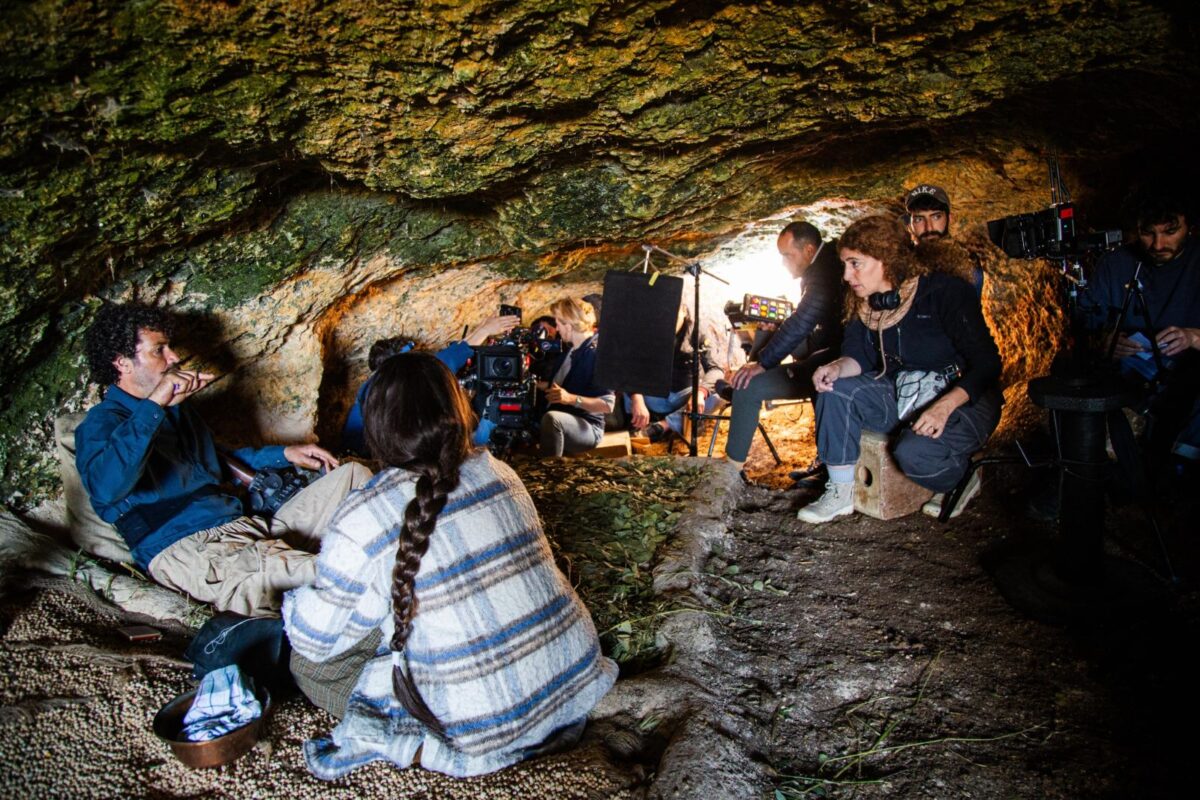
October 14th. We went ten months into preparation for this film because it was so huge. Nobody works on this scale in Palestine, and it was a period piece and it was big. We went really early because we had to find the village, and we restored the village—we planted crops, we built the military vehicles, we built the weapons. Like, everything had to be created from zero. The costumes. I mean, all of it. We had this village we restored and planted crops in because Palestinians don’t plant those crops anymore. So when everything fell apart and we had to evacuate the team—it was completely shut down; the West Bank was completely under lockdown—we were not able to film anymore, and we just kept waiting and seeing. “Okay, maybe let’s just wait. Let’s just see what happens.” And it became clear that things were descending into darkness.
It was suddenly, “Okay, what do we do?” Every single day was a nightmare. It was a nightmare, emotionally, for the team to continue working. We’re not in Gaza, but we’re close to Gaza. Those are our friends, our family, our colleagues. It’s us. So I think the film was made with a lot of broken hearts, but also, like, this is what we can do. We have to do it. And people in Gaza are doing it: they’re living their lives and doing things. Gazans are… I don’t know if you saw the films last year, the short films that were from Gaza. We have no right to complain and stop anything.
Well, I had read that—I think you’re alluding to this—you built a setting for the film and then it turns out it had been taken over by settlers?
Yeah, that was the village.
That’s—I don’t use this word lightly—such a crazy collision of material and a production that are separated by almost 90 years. Yet it just… past is present.
Absolutely. I mean, even my initial writing of this story was that I was very fascinated by that before October. This was, like, eight years I’ve been working on this. The fact that… has anything ever really ended? It’s just been constant. But that the whole system was set up at that point, in terms of collective punishment, in terms of the torture, in terms of blowing up houses. Human shields: that scene when the brother is tied to the car so they can get out of there? When we shot that scene, that same day in Nablus, the Israeli army tied a kid to a car. It was in June of this summer. I don’t know if you remember reading about it; it was all over the press. We were shooting that scene and this scene was happening live. So it was always like: where is the past? Where is the present?
One of the most striking shots in the movie is seeing, from a little bit of a distance, some kind of structure being raised by settlers into which you do this axial cut. In a certain sense of the word, it’s a beautiful image—how it’s composed and lit—but watching that shot, I was asking myself if there was a specific visual precedent. If there was an archival image that you had seen, or footage of that exact sort of thing happening, or if you were imagining it based on things that had happened.
Yeah, I saw a lot of that in the archives. And that was sort of the system; there was even a word for it in Hebrew: “stock and blockade.” You build the tower first and you build a wooden barrier—it’s like a tower and a barrier—and that’s how the beginning of the settlement starts. So that’s what they called them, even. That was their name for them: “the tower and the barrier.” I saw a lot of them in the archives, and there is one moment in the archives where you see archival footage and you see the tower being pulled up. And then there’s our footage, what we shot and what we built of the tower being pulled up. So you see it twice, and once is ours in the film and once is archive.
But we were constantly going back and forth with archives. Sometimes my editor and I were like, “It’s incredible.” Especially when I colorized it. It looks like something we shot, which I wanted colorized for that reason—that it wasn’t something of the past. You’re not watching the film and then suddenly something’s in black-and-white, so we’re going backwards in time or we’re remembering, “Oh, remember this actually happened?” No, I wanted it to be integrated with the forward movement of the film, and colorizing it, I think, really did that. It made it alive and current.
I was impressed by the cuts from the archival material to the narrative film. I can tell that there’s a change—partly because of the aspect ratio—but it was impressive in the carryover. I wonder if there’s a bit of a self-imposed challenge of, “This is the real thing and it’s in color, so when we cut to my own material, the period detail has to be very sharp.” You kind of don’t leave room to wiggle out of it.
I mean, it’s funny, because I work in fiction and I love fiction. I love the freedom of fiction. But I’m completely obsessed with the authenticity of everything. The clothes have to be the real thing. This has to be the way this is—all of those details have to be exact—and that’s why we had to build all those vehicles, because there were some World War II vehicles for rent. After World War II, things looked really different than World War I. So I wanted everything to be correct. I wanted it to look like an archive because, like you said, the aspect ratio—you’re aware that it’s an archive because the aspect ratio is always different. But it moves seamlessly, in a way, but it’s still archive; it’s not our footage.
And so the color kept that present, but I also think it opens up the frame because I don’t have a big, huge budget that I could put 500 people on the street and get everybody in costume and all the vehicles. I mean, that shot alone. So there was something about using those archives, also, that opened up the world of the characters—that this is what their world looked like—and that’s something I could never create, you know, if I had the budget. [Laughs] Maybe I could, but still, what’s beautiful about it is that it’s real, also. And that little girl who jumps across the screen or skips this way, or that woman walking that way. I think a lot about what happened to those people, that in ten years is the Nakba, it’s 1948. Like, what happened to this whole world? Did they stay? Did that person stay? Did that person become a refugee? It’s interesting to get lost in, I think.
There’s an impressive accumulation of encyclopedic detail: social custom and cuisine and the sense of play—like when they’re playing soccer—or even the different modes of transport we see. I think I was so impressed because I felt I was being imparted with this knowledge, but it wasn’t as if you put up a title card like, “This is the game of soccer” or “This is bread that they’re eating.”
Right. Even in that picnic scene, the little boy, Kareem, is eating Jaffa Cakes. Those were British inventions, Jaffa Cakes. They’re a British thing that was inspired by the oranges of Jaffa, and so they’re eating that. Nobody would ever know that. Nobody knows that in the film. It’s just, for me, part of the whole general thing, but never to say it—like you said, to say that “this is this” and “this is that.” It’s even why I’m weary about… some people have said, “Why don’t you have a bunch of titles in the beginning of the film explaining the history?” I’m like, “Because I don’t want to do that.”
If someone’s interested—that’s what I do when I watch movies: I see a period film or something about the Tudors, or something—I go back and I spend all night Googling and reading about it. If someone can do that, they can read about it, but it’s not a history lesson. I want someone to also just enter the film and be involved in the world of the film, and there is a lot of information in the film without having to also spell out all of that.
The film’s title is almost a skeleton key.
Mmm.
I’ve seen other interviews where you talk about how 1948 is the defining year, but it’s often seen as the beginning of the story. So just by calling the film Palestine 36, it’s kind of immediately telling you there was this thing a dozen years before, right?
Right. Although it’s Palestine 36, not 1936, which I feel like is too obvious; Palestine 36 leaves a bit of openness. But that wasn’t my original title. I had a different title, and then I changed it and I was like, “I just don’t feel like philosophizing and being, like, poetic right now. Just… this is what it is.” [Laughs] Being simple sometimes.
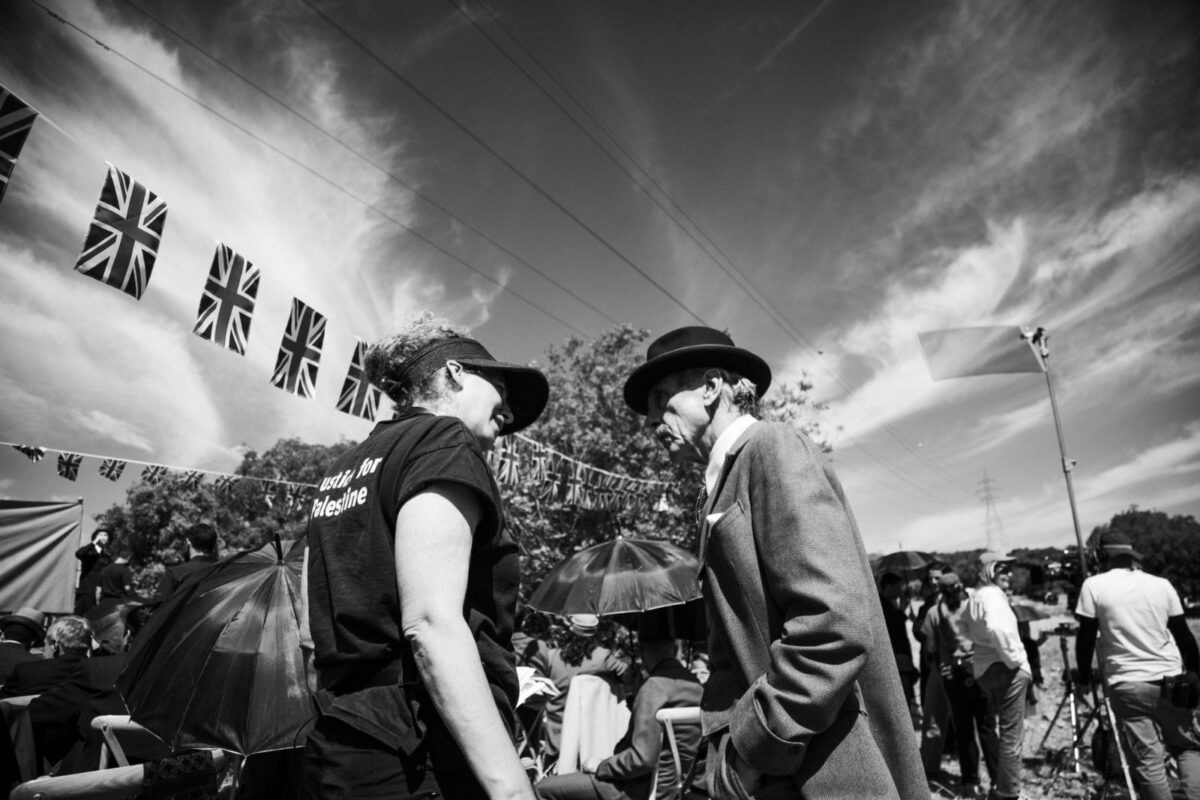
I think you allow yourself to embrace those poetics in the chapter titles. It’s an interesting color to add to the film because the first one is called “The Year You Were Born.” I was expecting some straight-and-narrow historicizing, so I appreciate how it creates a slight friction in a way of, “What exactly are we going into here?” So I feel like you managed to still do it.
And they don’t say “Chapter One,” “Chapter Two” because there are five of them, and they’re each associated with the main character units. Like, that one for me is Yusuf, “The Year You Were Born.” And then there’s Khalid at the port, and there’s Rabab and Afra—the mother and daughter—and there’s the father and son, and there’s the couple in Jerusalem and the negotiations with friends. I feel like those are very loosely associated with those five main threads of the film, but in a way that, yeah, it is a bit obscure, I guess. Evocative, maybe.
Again, there is the more didactic version that is like: this, this, this. So that interplay of historical texture with some poetics, I thought it was cool.
Well, thank you. [Laughs]
There’s an interesting thing, too, about the two most famous actors being Jeremy Irons and Liam Cunningham—at least the ones Western viewers will recognize the most. And it created an interesting dynamic, having the white English actors be the most famous actors in the movie while also occupying this kind of omnipotent, villainous, ominous role. Was there any thinking behind what effect these performers being more famous than the main cast would have on the film?
Well, there’s the other two actors who are sort of up-and-coming: Billy Howle and Rob Aramayo—you know, Wingate and Thomas—which are probably at the same level as the Palestinian cast that’s acted before; then there’s the cast that’s first-time onscreen. But for me, Jeremy’s presence… he’s just an amazing actor. And I got to be on a jury with him and we became friends, and then I was like, “He’d be a great High Commissioner.” Then he has an Irish wife who was like, “You better do this film, Jeremy, because you owe it to them.” You know, she was [Laughs] very spirited. So he said yes, and it was great.
They’re small roles. I mean, Liam Cunningham’s role is one scene. But what was, I think, the hook for him, and what I liked also: I love when he says, “We don’t want another Ireland on our hands,” and it’s Liam Cunningham who’s saying it. I think he also enjoyed that because Tegart, he’s based on a real character—both of them are based on real historical figures—and Charles Tegart came up with the concept of the wall and these fortresses all over Palestine, which still exist today. But it’s fortresses and then this wall. When I read about it I was like, “Oh, my God, we talk about the wall now that the Israelis built and this whole concept was already there.” So I think Liam liked the fact that that guy was Irish, too, because it’s not so black-and-white that it’s an Irish person responsible for that. They were part of the empire, you know?
It’s like Amir’s character in the film: it wasn’t just like the Palestinians were the victims of this thing. There are people like Amir, the husband of Hulud, who participates in it. I liked that about their characters—that it’s not so easy to place people. Thomas is conflicted also. Thomas comes there with one idea—he was based on, also, a figure who was a secretary of the High Commissioner and he wrote diaries. I read his diaries, and he came there really thinking he was doing something good and positive. He had good intentions, and they were good intentions, and then he saw that it was a failing project or that it was something else. So he eventually—the real guy—quit and became a Marxist, actually. [Laughs]
The whole cast is really strong. You have the scene where Amir comes clean about being part of this Zionist organization: “They’re paying our salary.” It’s very easy to imagine the more histrionic version where they start yelling at each other and every line of dialogue is a thesis statement, but it just never comes to that. When you’re casting, how do you find the actors that have both presence of their own and chemistry with each other?
I love that scene also because of his performance in it—that he’s lying and that we know he’s lying, and the way it comes out. I think there’s a real subtlety to it because they love each other, and I think for him… we talked about this a lot when we worked on it. It’s like, for him as an actor, “I have a very clear point of view about what he does, but I’m against it.” And it was the same with Wingate: how do you find what is inside of it that you relate to? One thing we talked about with Amir’s character is that he has no idea that, in ten years, there’s the Nakba. That’s how these things start. It’s like, “Okay, well, I’ll just do this, and maybe I’ll promote myself a little bit,” and it’s not with this big scheme in mind. It’s this small thing and then he realizes, in the dinner, he fucked up and he believed it. He believed something was going to happen and now it’s like, “Okay, it’s not what I thought.”
So I think they’re really human; it’s a really human thing. Wingate, also, was even trickier, because Wingate was unhinged and very violent. But it’s not interesting to have the classic bad guy with no shades of anything to him. He was sure he was on some kind of divine mission from God. He really felt that, and the real Wingate was so much worse than the film shows that I actually scaled down on him, because I think, otherwise, it would just be this villainous bad guy—too much.
There is a lot of violence in the film. There’s even action—particularly in the last third—but it’s never exciting, and there’s no satisfaction in any killing. What were ideas for staging something in an effective, visually compelling way, but not necessarily making it gripping? There’s that classic line about how there’s no such thing as an anti-war film because if you depict it, then you are making it exciting. But here I think you manage to depict it in a way that’s not…
Celebrating, maybe?
Yeah.
I hope so. That’s what I want. Kareem, the little boy at the end, it’s really such a tragedy. Somebody at a screening said, “Oh, it’s so understandable what he does.” But it’s also so tragic for me, his complete loss of innocence and this lesson from his father: “you have to endure.” He can’t endure. He just is consumed by what he’s seen and he takes revenge. People are formed by their history. I find it very heartbreaking, his story and how it ends.
To kind of go back to what we were saying at the beginning here: this is Palestine’s entry for the Oscars. I think the film has some really good ideas and possible effects. What, if anything, do you hope Palestine 36 would achieve in a larger, non-cinematic, even global sense? And have you felt like your work has left any kind of impact on these issues that you care about?
The Oscar thing, what’s interesting about it is that there are a lot of films—and there always have been—about Palestine. But this is by Palestinians. The main producer is Palestinian; written and directed by a Palestinian; the production designer, the costume designer. All the heads, the creative heads, were Palestinian, and we live in Palestine. I think that’s important. It’s a resilience that—especially with what happened—the film was born, despite everything. For me, on a global sense, that says something about resilience and creativity. And I think that, now that I’m traveling with the film, the number of people who have said to me, “Oh, we’ve got to get this in schools.” I love that because I wasn’t thinking about it like that, but I’m like, “Nobody knows this story.”
We had co-production, British co-producers, I had British cast come onboard, I had BBC Films and BFI, and I got a lot of love from the UK. It was a British co-production, and it’s one of only two countries where there’s an official co-production agreement. There’s one between France and Palestine. I don’t think there’s any other country that has a co-production agreement. I could be wrong. There might be one more, but I think those are the only two. So I thought, “Okay, look: the British, they’re coming to terms with their colonial past and they want to talk about it.” And the actors were like, “No, not at all. We never learned any of this. To this day we don’t learn. None of this is in the school.” So I think that, yeah, that is what it can do: it can have an impact, have a change of perspective.
Maybe it’s leading by example—this largely Palestinian creative team making the film under these circumstances. The making of the film then becomes its own story in its strange, sadly pertinent way. And what you’re saying resonates with me, too, because I’m American, so the number of things that I am not taught is more than I am… taught.
Yeah. [Laughs]
And the number of Americans who are well-meaning, decent people who just never learn it.
You’re not a bad person. You just haven’t learned it. You haven’t seen it. You haven’t ever been exposed to that story. Yeah, I think you’re right. I did live in the U.S. for a few years. I lived in Texas for a couple of years, and people would say, “Texans? How did you do that?” I’m like, “They’re the most lovely people, actually.” I had a really great experience. They were really open. They asked me questions. “What is Palestine? Tell me about it.” They didn’t pretend they knew about it. They actually asked and they didn’t know, and it really came from that place of, “Tell me. I don’t know anything about this.”
I had to watch some pretty bad historical films in school. I’ll say that this would serve as a better one. None of them had Jeremy Irons.
Right. [Laughs] What did you watch?
Newsies. Have you ever seen that movie?
No.
It’s a Disney musical about kids who sold newspapers. Swing Kids, which is about kids who love jazz music in Nazy Germany. I had to watch it, I think, three times, so I still remember it. Sometimes they would show stuff and I’d think, “You’re just filling time. There’s no educational value to this.” Have you ever seen the clip where Jeremy Irons is really angry about not being able to smoke in Central Park?
Oh, no.
It’s incredible. He’s doing this full… I mean, that’s just his voice, but the way he talks is so naturally dynamic.
Well, he’s a real alpha male. I mean, when I was working with him and we were prepping for that one scene where it’s all the guys—Wingate and Thomas, they’re all in the room—it was like, we’re sitting around a table like this for the first meeting. And it was me and Jeremy talking, talking. None of the guys said anything! None of them were speaking, and then Jeremy went to the bathroom and they were like, “Oh, my god, he’s so intimidating! So intimidating! Jeremy Irons! How are you even talking to him?” I was like, “Wow, I just saw alpha male in effect, right?” But he’s really lovely, it’s not like he’s… but he’s just Jeremy.
Palestine 36 will open in theaters in 2026.