
Paris-based filmmakers Dennis Cooper and Zac Farley make their return with Room Temperature. Despite both hailing from California, this is their third collaboration yet first production to be shot in the United States. Set against the glare of the High Desert, the film is an off-center family drama turned ghost story that follows the making of a haunted house.
Taking a tour of the home renovation for the first time, school janitor Paul meets the assemblage of people that form Cooper and Farley’s would-be family, including their fey and inexplicably French live-in friend, Extra. As Extra invites Paul to join him in the backyard, which is set to become a scary swamp, he recites the lines he is scripted to deliver once the home haunt is finally ready, “This house has evil vibes, and I’m scared to do it alone.”
Accusations of evil vibes have followed Dennis Cooper’s great literary work for most of his career, from the George Miles cycle of novels to his beloved blog, which was notoriously restored by Google after being deleted in 2016 on the grounds of policy violations. Thankfully, Cooper is not alone. Since finding a co-conspirator and close friend in visual artist Zac Farley, the two have worked together—first on the 2015 short film anthology Like Cattle Towards Glow, and again on their moribund 2018 debut feature Permanent Green Light.
John Waters named Room Temperature one of his top 10 films of 2025, saying, “A purposely tedious and tender poetic head-scratcher of a film focusing on a family setting up their neighborhood home for a Halloween horror house. Just when you begin hating this film, you’ll suddenly realize—huh? I love it. It’s weird, creepy, and maybe … just maybe, great.”
In anticipation of a New York premiere taking place at the Roxy Cinema this Friday, December 12, I spoke to the “terrible esthetes” about their forever love of home haunts.
The Film Stage: I understand you both have a love of haunted houses, and that this was the impetus for making your film. Can you tell me a little bit about this shared fascination?
Zac Farley: Home haunts are when people turn their houses into haunted houses for Halloween. Dennis has been going to visit them for far longer than I have. We were so bummed this year not to be able to go. We usually turn it into a kind of marathon where we try to go to as many of them as we possibly can. And we really study them. We totally consider them as this outsider art form.
Dennis Cooper: It’s like going to look at art for us, really. They’re kind of like a theater experience. We have to crawl through things, and then there’s a little scene, a kind of scary scene. I made them in my house when I was a kid, so I’ve been a lifelong fan of them, and then just watched it kind of grow into this phenomenon. Back then, when I was a kid, you’d make them, and then people who went trick-or-treating would go through them. It wasn’t like it is now, where they’re advertised and people wait in lines for hours to get into them.
We wanted to make a film about a haunted house, but then we decided to make a film about a haunted house that is really disappointing. So we didn’t actually get to do all the kinds of exciting things we had thought we could do because it had to be a failure.
The film documents the process of transforming a family home into a haunted house, and, in many ways, it helped me to imagine what it must look like to make a film. How did the making of the haunted house resemble the making of your movie?
Farley: When people make home haunts, they gather their friends and neighbors and organize themselves into a little art collective and build something. They rehearse it and then put on the thing, and then all disband at the end and break it down. And that’s it. Often they’re thoroughly disappointed. So in all of those ways, it’s very similar to making a film. Especially at the budget level. With our films, they’re fairly DIY operations.
At some point someone in the film describes the house as being all that the family have. It’s true that you work with what’s immediately available to you. You have to actually find the plastic alligators that are going to be in the swamp. They have to actually exist.
Farley: Those plastic alligators are, in terms of props, the biggest expense of the film. Those things cost about $65 each. When making the film, that just seemed like an ungodly amount of money for what they were going to be, for how depressing they were supposed to be.
There’s a lot of talk in the movie about whether the house is going to be scary enough, how it could be made more scary, and so on. Although Room Temperature is not a typical work of horror, it is surely a work about horror.
Cooper: Well, we never get scared, so we’re not the best judge.
Why do you think that is?
Cooper: Because we’re terrible esthetes, and we look at everything wondering, “How do they make this? How can we employ this in our own work?” The whole idea was not to make things scary––it was to present the mechanics of what would be scary. No one seems even remotely scared in the film. They’re all kind of bemused at most. The film has this false start: at the beginning you see the house, and it’s playing this crazy music, and the lights are going on and off, and it looks like it’s going to be really scary. But then by the time he actually gets inside the house, it just turns out to be a really shitty haunted house.
Thinking about the establishing scene, I wanted to talk about the atmosphere of the film. The initial darkness and smoke of those early moments is quickly replaced by the glare of the desert. There’s a coldness to your previous film [Permanent Green Light] but this project is quite different, at least in terms of light. How did you land on shooting in this part of California?
Farley: Where we shot is in the High Desert, three hours east of Los Angeles. There’s Joshua Tree National Park and then there’s the biggest military base in the US, a place called 29 Palms. I had encountered that area when I was going to school in Los Angeles. There are a lot of artists working out there. All the people who live out there are basically people who have been pushed away from other places—they’re outcasts or really extreme drug washouts or they’re hippies. It’s just the kind of space that invites these alternative ways of living. It made it possible both for us to imagine this family actually doing this thing, but also for us to shoot a film where we would be having 40 people around a house all night with big lights and loud speaker systems doing weird stuff without having the police show up all the time.
Cooper: It actually wasn’t hot at all, but it looks like it could be hot because it’s the desert, and this kind of brought this warmth to the film, and it changed the tone a bit, which we thought was really nice. We wanted the family to seem kind of removed from the world in a way. There’s no moral center there or anything; nobody calls the police when Extra disappears. They’re not hooked up to the world. They’re really out there on their own.
Farley: Making the haunt has to be their entire world. Anything else is a distraction. It’s a totalizing art project. There isn’t any room to do anything else.
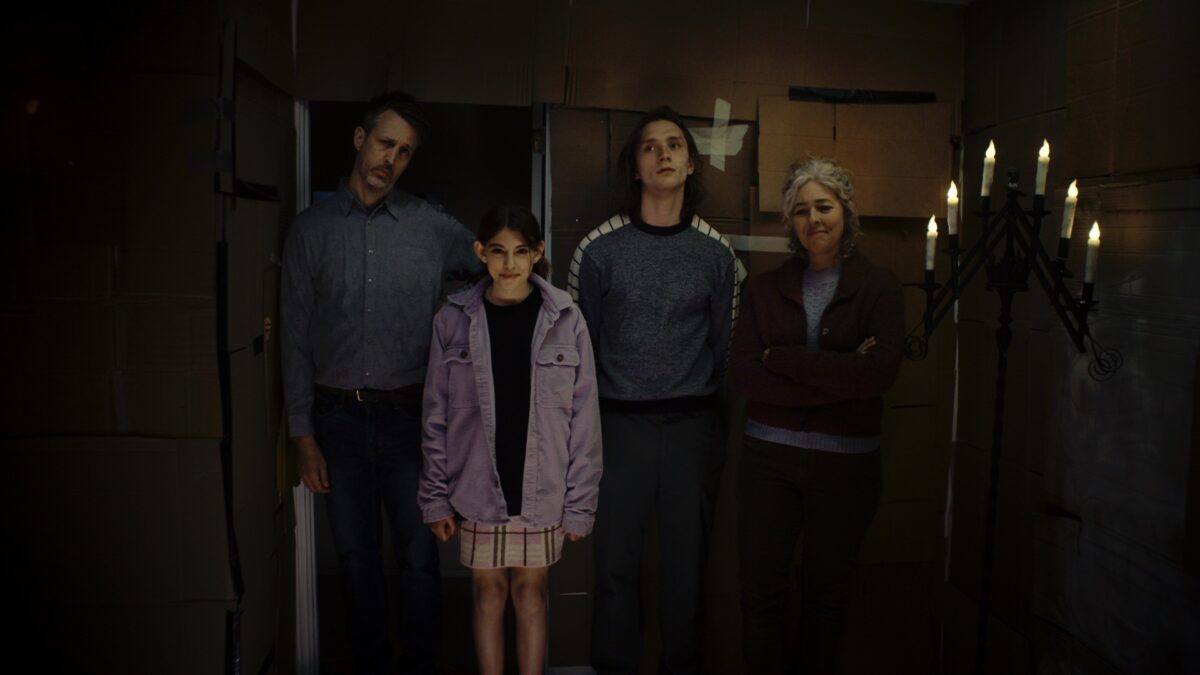
You imagine a family as people with all of these different aspirations or things that they’re working towards, that their lives all fork out from one point. But in this film, it’s the opposite—they’re all pointed in at the same thing.
Farley: One of the things that really excites us about home haunts is their capacity to kind of welcome anything. There’s people participating in the making of them that have very different interests or desires for what the house could be like. Sometimes you’ll go in and there’s a very precise and well-produced introduction video that explains to you the entire narrative of the haunt you’re about to walk through. But then you go into the next room, and it’s obvious that some kid was really obsessed with fog machines and made a room where you cannot see a thing, and that doesn’t really have anything to do thematically with the rest of the haunt. They’re very malleable forms.
Let’s talk about Extra. He’s been with the family for many years, and still somehow the Father can’t remember his name. He provokes a violence in others that he doesn’t understand. He manages to feel completely mysterious and still totally available to us.
Farley: Extra is our ambition for the film. He’s both the kind of starting point and the key, the warm center of the film.
Cooper: The character had to be sweet and sympathetic, but also very removed. And he could easily become very annoying, too.
Farley: We had this goal to make a character that would be just as powerful in his absence as he would be in his presence. I don’t know if you’ve ever met someone like him—somebody who talks all the time and is always really attentive and excited but actually when you’re paying attention to them, there’s very little to hold on to. I think both Dennis and I are really fascinated by people like that.
Room Temperature screens on Friday, December 12 at NYC’s Roxy Cinema with the directors in person.