
A biography told with startling focus and immediacy, The Testament of Ann Lee documents the life of the founder of the Shakers in the 18th century. Alternating between brutal violence and ecstatic epiphanies, it’s a movie that commands attention.
Written by Mona Fastvold and Brady Corbet, who collaborated on The Brutalist, and directed by Fastvold, the film stars Amanda Seyfried in a fearless performance as a woman drawn to spiritualism no matter how harsh the consequences.
Cinematographer William Rexer worked with Fastvold and Seyfried on The Crowded Room and Long Bright River. Along with shooting music videos, he worked on The Get Down with director Baz Luhrmann. The song-and-dance sequences in Testament take place in an entirely different realm of cinema.
Rexer and costume designer Malgorzata Karpiuk introduced the film in a special screening at this year’s EnergaCAMERIMAGE in Toruń. Their Q&A stretched past midnight, after which we talked in an alcove overlooking the Copernicus Hotel swimming pool. Read our conversation below ahead of Testament‘s Christmas Day release.
The Film Stage: This film is such a massive achievement. When did you start working on it?
William Rexer: Right from The Crowded Room, Mona and I started talking about it. Then she and Brady did The Brutalist. While they were cutting that, I worked on Long Bright River with Mona and Amanda. So over a year of discussion, then two months of prep—which is very unusual for a film of this size. Then 34 days of shooting.
You’re kidding—you shot in Sweden, the U.S., and Hungary in 34 days?
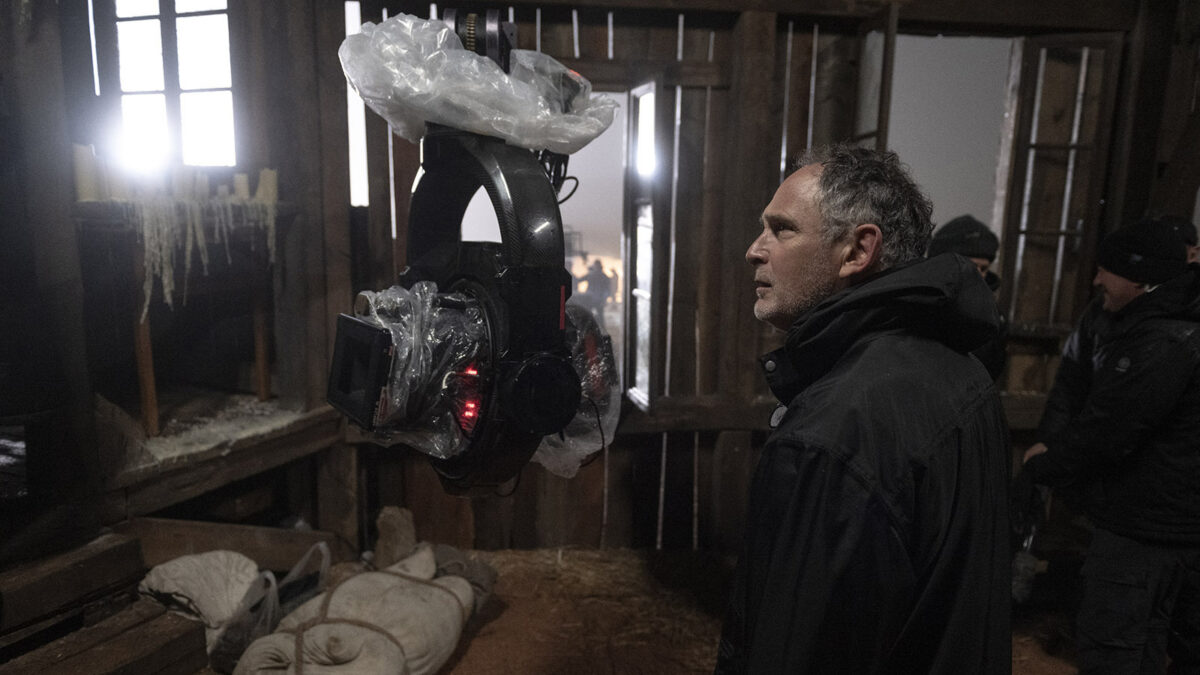
The majority was in Budapest. The way we did it was about eight months before production we shot for two days in upstate New York and around Pittsfield, Massachusetts. It snowed on the second day, which we ended up using. That circular barn where Amanda dances, the children running in the snow: that was all part of the test shoot. We worked with a four-person crew, and then we cut a little teaser together which Mona used to raise money. It was a test to see whether there was a potential audience out there. Could she raise money for this?
Also, we were testing both the style and format of the film. Mona had talked about using 16mm for the first half of the film to provide a sort of neorealist feel. Once Amanda entered the film as the mature Ann Lee, switching to VistaVision. We talked about it, but you’re in tight and close during so much of the film, and that’s never going to happen with a VistaVision camera. Plus, Mona wanted to record live audio, live singing, and it just didn’t make sense with a large-format camera.
You’ll have to go into detail about those songs, but first: did you know much about the Shakers? Because the period details and the sense of how the sect operated in this film are phenomenal.
Almost nothing. I knew about the Quakers, but not the Shakers until Mona started talking about them. Sam Bader, our production designer, and I, we like to dive deep. We took at least six trips to Pittsfield and surroundings. We did our homework by talking with the folks at the Shaker Museum.
Once the Shakers reach America, the forests, farms, and horizons really look like that area.
It was mostly Hungary. There are three shots we took in the Hudson Valley when William [Lewis Pullman] is walking through the landscape, preaching outside these small buildings. Those shots were with a three-person crew.
How much was built and how many were locations?
The building where they’re farming, the main structure, is just a façade. The interiors were actually shot in a barn down the hill. The next room over is in a Shaker village in Massachusetts. The room where William is having his feet nursed is in Hungary. The big dance at the end is in a barn in Hungary. Sam repurposed it by knocking out the walls. So there’s a lot of trickery involved here.
How long did it take for the climactic dance sequence in the barn?
We probably had four hours.
I’m amazed that you could get an intricately choreographed dance with dozens of people shot in half a day.
We didn’t have a lot of time. The whole boat sequence, where they’re crossing the Atlantic during the storm, we did in two-and-a-half days.
You used these matte paintings for the docked ships that are like memories.
That was the goal. For the three ships in the harbor, one is real, but with painted sails, the other two are painted. The water is real. It’s so much fun playing with the elements to get the right balance. I even had Máté Ternyik, the colorist, put a little rocking motion in so it didn’t feel so stable. Since it’s a matte, we had to do the rocking with effects. Inside the ship, we did everything in-camera. Mona would be calling out to the cast, “Lean to the left, lean to the right.”
Once you nixed VistaVision, what camera package did you decide on?
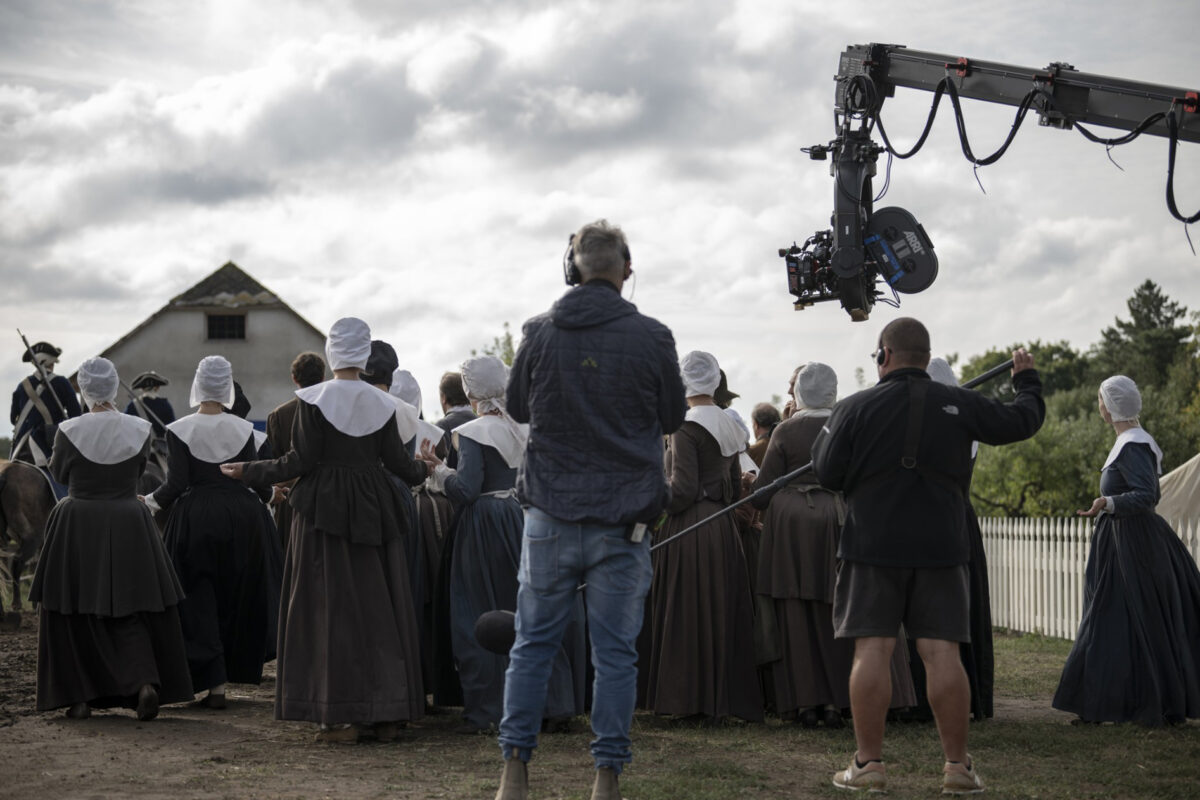
We had an Arricam LT and an Arricam ST. We used an Arricam 435 high-speed camera for things like the horses charging the fire. For lenses, we had Sigma Cine 18–135—uncoated Sigma Classics which I like for their flare—a Nikkor 200 T-2, and an Angénieux 25–250 HR. We used that as a long lens to shoot people walking to work, things like that. Oh, and a Tokina 11–16, an architectural lens.
For the interiors: Kodak 5219 500-T that I rated at 320. Some interior / exterior stuff was 250-D, and almost all the exterior was 250-D.
I’ve been circling around the dance sequences, incredibly intricate routines that spread through several rooms. How could you possibly shoot them so quickly?
We worked out almost all the choreography beforehand in New York in a rehearsal space with Mona and Celia [choreographer Celia Rowlson-Hall]. They would go through the dances and I would take my phone with Artemis for the lensing, and we would work through what was going to happen.
I’d record the rehearsals, Mona and I would review them, Celia would give me notes, and we’d come back another day and do it again. We’d tape out the spaces based on Sam’s plans. Like, we mapped out the boat in Sweden on the floor of the rehearsal hall, so once it was rehearsed we knew what every shot was going to be before we got there.
I’d scotch tape the first and last frames of every sequence to a wall in Mona’s office. That way we could judge them as a whole. “We have too many medium close-ups here. Let’s balance them out a little.”
Watch Celia Rowlson-Hall’s music video for Cameron Winter’ “Love Takes Miles,” featuring Lucas Hedges
I want to go deeper into “Beautiful Treasures,” the funeral song. I think I saw four set-ups: a wide shot, an overhead shot, another angle…
I called it the “long way angle.”
…but then there are these incredible handheld shots where you are in the midst of the dancers, moving with them and around them.
One problem with shooting is that I was using an iPhone during rehearsals. I could be up against the wall and it would still fit. But with an Arri, all of a sudden there wasn’t enough room. I have an architectural lens made by Tokina, the 11–16, that doesn’t distort in a typical wide-angle way. So I could be on an 11mm lens and have people moving around without crazy distortion.
We used it for the top shot as well. We didn’t have a crane. Instead, we rigged off the wooden ceiling beams. We wanted that angle to show the shapes of the dancers becoming like an organism. As for shooting within the dancers: the camera needed to become a believer, to be the eyes of a viewer who believed, to participate in the dance. That was important for every dance sequence, for the camera to be a believer who joins in.
Every time we were rehearsing, I would get in there with my phone held out to represent the size I would be occupying. I would become a believer. Sam Ellison, my operator, would see exactly what I was doing and where I would be. The dancers would be working with me. They knew through rehearsals where I would be, whether it’s Amanda’s first dance or the funeral dance. They knew what had to happen. Celia’s assistant quite often would dance right behind us so that she could free people up, move people as we were coming around.
Did you need many takes?
We never had many takes because we didn’t have that much film. But in rehearsals, I might roll on my phone five times until we knew where the camera had to be. Then we would bring in the film camera and Sam would jump in and do exactly what I was just doing.
You had to follow the tempo of the music as well.
It also affected how you cut the dances. Sofía [Subercaseaux] did a great job with the editing. Daniel [Blumberg] was always present at all the rehearsals. He would play music for the dramatic scenes as well. We all became accustomed to a rhythm and tone being set for every scene. It just seeped into you. Literally he was sitting with a keyboard, playing the score while we were rehearsing, and then obviously stop when we’d start to roll. The whole crew would be getting into the rhythm.
He was present every single day. Daniel, Celia, Gosha, Sam Bader, and Sam Ellison—they were there for the tech scouts and the rehearsals. We were a group. On weekends we would go to the baths together and we’d all be talking about the movie. We just became one. It was a mirror of the sect—we were all believers in Mona.
Were you involved in the grading?
Yes. Máté Ternyik was the colorist for our dailies. He did The Brutalist as well. Every day we had a dialogue about what we shot. Then he did the final grade as well. The majority of his job there was to get the visual effects and plate shots to blend in and feel natural. Once we had a DCP, I went to FotoKem, where we did a 70mm film print.
Will the release be on 70mm?
They made twelve 70mm prints and a few 35m prints. So it will be 70, 35, or DCP depending on your theater. Personally, I’d really love for you to see it in 70mm.
The Testament of Ann Lee opens in theaters on Thursday, December 25.