
As I noted in our round-up of the best cinematography of 2025, “If we were giving an award for the most varied cinematography of the year, it would surely go to Darius Khondji, who has lensed a trio of vastly different projects. From capturing the comic sci-fi wonders of Bong Joon Ho’s Mickey 17 to approaching the western with bracing immediacy in Ari Aster’s Eddington to, in his finest achievement of the year, shooting the frenzied journey of Josh Safdie’s Marty Supreme with a sense of kinetic grace, the Iranian-French cinematographer proves he is one of the greatest artists working in the medium today.”
Ahead of Marty Supreme‘s release, beginning this Friday in NY/LA and going wide on Christmas Day, I spoke with the legendary cinematographer about reteaming with Josh Safdie after Uncut Gems, the experience of capturing a vast ensemble (including Abel Ferrara!), Timothée Chalamet’s dedication, how he shot the ending, his prolific year, and why cinema is vibrantly alive.
The Film Stage: After working with Josh Safdie on Uncut Gems, for this project, what kind of things did you talk about that might have carried over, and what things were different?
Darius Khondji: We talked a lot about the actors and about the characters. Obviously, I read the script. I loved the script when I read it in Paris. It was very electrifying. I’m not usually the kind of script-reader who reads very quickly, but this one I read really all at once, very quickly. I was very taken by the story.
So I called Ronnie [Bronstein] and Josh, and then we started talking. We often talk a lot about the actors and the characters. This time he talked to me about the fact that it was a period piece and how to adapt a period piece set in the ’50s. Obviously, ‘50s in New York is extremely difficult now to do that in.
Early on, he talked to me about the music. He said the world of the sound and the music in the film would be more ’80s and more contemporary, and it would have a different feel. Knowing Dan [Lopatin] and his music in Uncut Gems already, I knew a little bit where they were going.
Then we talked about images of the ’50s and how to do it. We wanted to go back to what we love, shooting with the old anamorphic style—very classic anamorphic style with old lenses. And we mostly shot with very long lenses––more than even in Uncut Gems. At the screening yesterday, it was incredible seeing how he stuck to that. We stuck to that all the time. We’re literally right in the face. The story is told by faces.
We did tests on film that were going to be in this direction. It was a very exciting approach to doing a period piece. I don’t think of “period” in a movie; it’s timeless. It’s not necessarily a time. I loved that working with Josh brings such a level of modernity to the film naturally—by the characters, the dialogue, and the music and the sound. It couples with the images that are period, that look vintage with the old glass, the anamorphic, the painting look. It couples together in an incredible way; it gives it a lot of strength. I was very happy with the result. I color-corrected it, but I finally saw the film only recently in a screening, and I realized how powerful it was.
I believe there are more than 150 speaking parts, and there’s a lot of overlapping dialogue. From a cinematographer’s point of view, does that add a level of excitement or difficulty when trying to capture everything happening at once?
I love this. No, it was very exciting. The overlapping is very exciting. We shot most of the film with two cameras together. It was very exciting to have this overlap. The way we shoot with Josh is really exceptional. I don’t recall anyone I’ve ever worked with working anywhere close to the way he works. He works with an urgency, an obsession that is just very special. You need to go right to the end of things. He will never let go of a scene that he thinks is incomplete.
The fact that we worked—except for Timothée, Gwyneth [Paltrow], and a couple of other actors—with all non-actors. You can see more than 100 different people who are just non-actors. Sometimes we took more time with them, but he always ended up getting what he really wanted with Ronnie. That was fantastic for me. You have a director who doesn’t give up. It’s the best.
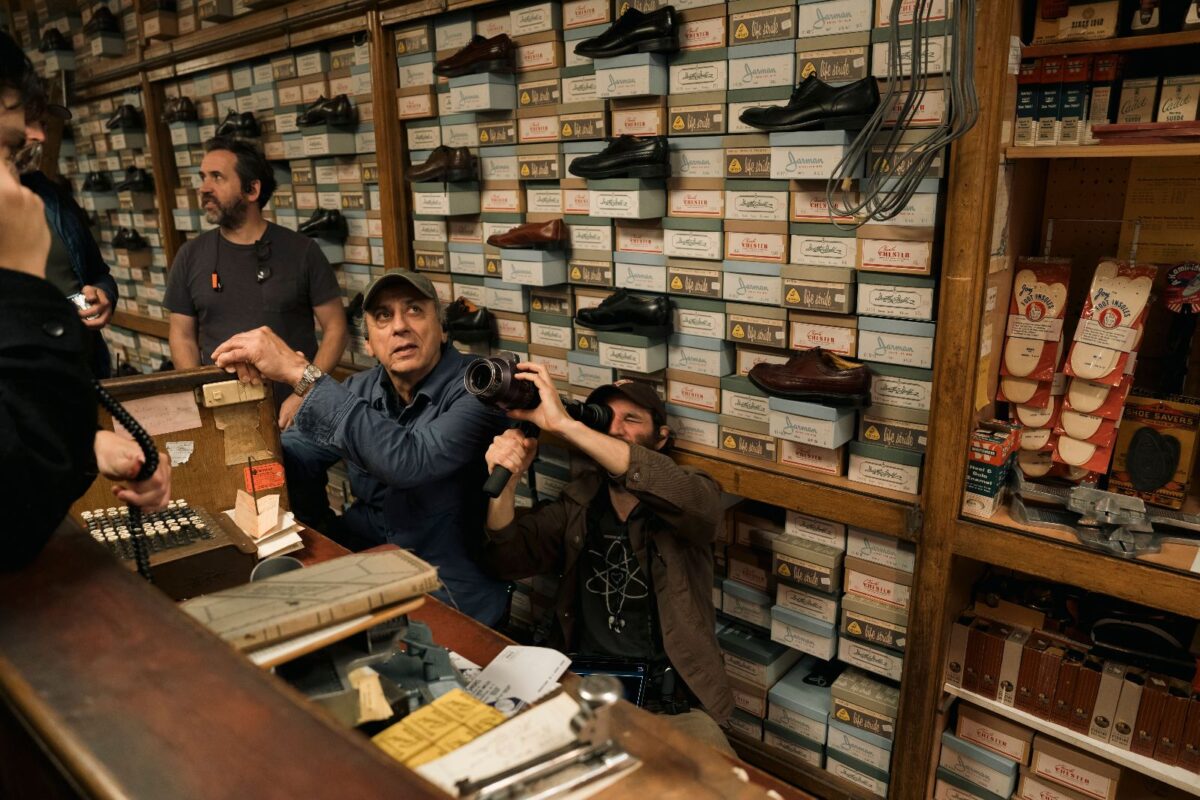
Behind the scenes of Marty Supreme
What was it like working with Abel Ferrara? I just finished reading his memoir, which was incredible. He’s such a character in the film.
I want to read his memoir. It’s incredible you asked this, because I was just thinking, when I was describing all these faces, the face of Abel came to my mind. It was amazing. It was literally intimidating because I’m a cinephile. I love movies, and I always imagined Abel being such a crazy, destructive bad guy. He could easily be like that in your fantasies. When you see him, he’s the nicest person. Really calm and nice. I mean, he’s calm, but he’s very intense and focused. But he’s a very sweet, very nice, and very polite person. He’s not at all like the characters in his movies.
Timothée Chalamet obviously gives such an incredible performance. As a producer on the film as well, I’m curious if he spoke to you at all about the cinematography or if that was mostly with Josh? What did he bring to the table? He seems so incredibly dedicated to this project.
Yeah, he was incredibly dedicated, focused on the film. It was also somehow a bit intimidating for me because it was almost like a method actor, but not the usual method actor I’ve known. He has a different way of doing things. He’s very intense and the result is incredible. What Josh got from Timothée is, for me, mind-blowing. I forgot about all his other performances after this. It’s funny, because normally I don’t see my films many times, but I’ve seen this twice, and I want to see it once or twice more. Just because of [Timothée’s] interpretation. It’s very special. It’s as good an interpretation by an actor as can be. It’s on a wavelength that’s very high-frequency for me. It’s just very exciting.
You gave an interview earlier this year where you mentioned this movie is about “everything but ping pong.” Obviously, it has a lot going on—it’s not just a ping pong movie—but there are still these incredible sporting sequences that are captured with more intensity than I’ve seen in most other sports movie. Can you talk about approaching those sequences, but also the idea that the film is about much more than ping pong?
Yeah, you’re completely right, Jordan. But the only thing is that: I don’t see it like this. For me, it is a great ping pong sports film. We have amazing players around that, if you see their faces, you realize are some of the best players today. But at the same time, what’s really bigger than life are the actors. The faces that they brought together are so amazing that the ping pong is a vehicle. It’s like a big boat traveling, going from Europe to America, and discovering a new continent. The ping pong is the vehicle going from the beginning to the end, but the actors are the real flowers of this garden. I watched the movie yesterday, and I found the ping pong very exciting—the semifinals and finals. Everything is done in a wonderful way. But for me, it is really a movie of the characters, and the ping pong is one of the characters.
I love the montage of all the tricks they’re doing, the globetrotting. You can imagine how much work must have gone into getting those quick few seconds of shots.
It’s amazing. Just little pieces we had to do very quickly. You make me want to watch the movie again. I’m going to watch it again tomorrow night.
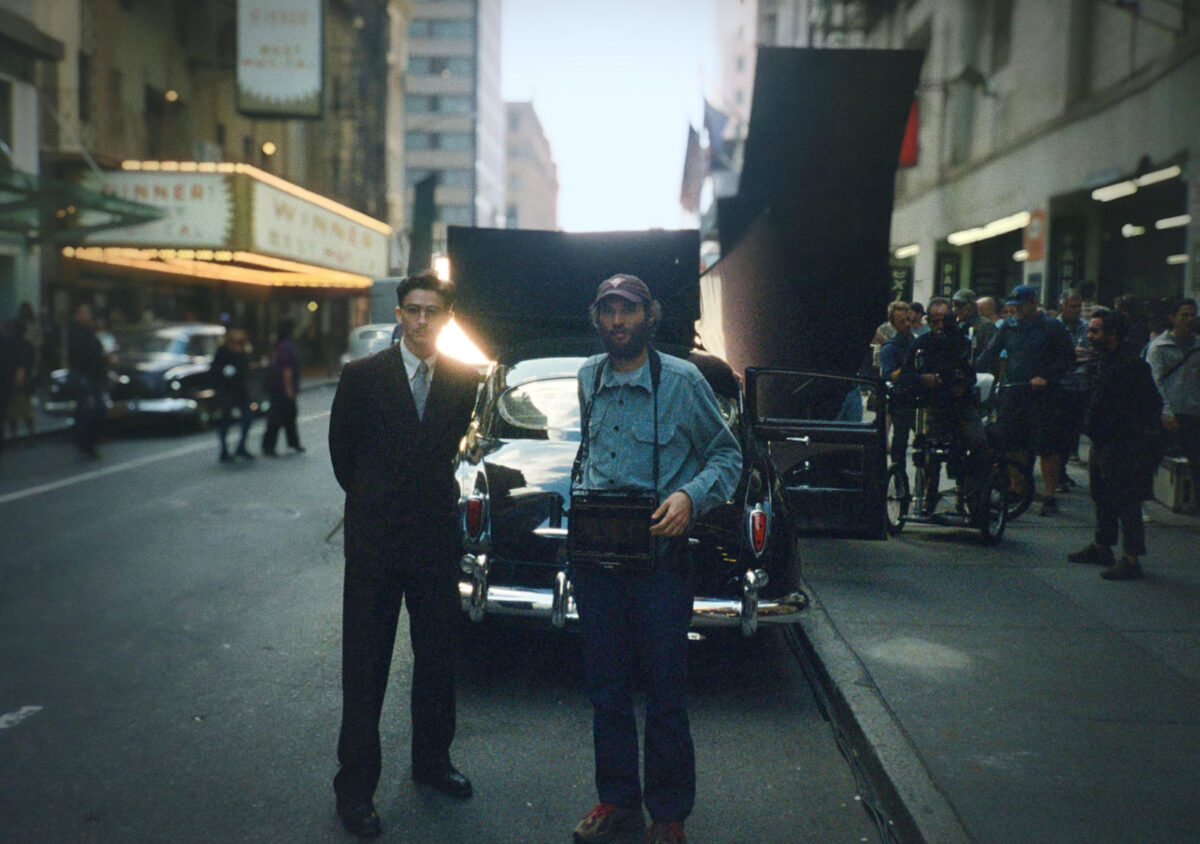
Behind the scenes of Marty Supreme
I won’t spoil the ending, but the movie moves at such a clip that when it actually slows down, it really surprises you. The ending hit me so hard; I didn’t expect that at all. From a cinematography point of view, the whole movie is very kinetic, but there are these striking moments where you have to slow down. Can you talk about that approach for the ending?
The ending was… even though I knew we were going to shoot a scene like this, we were all in tears. We were, emotionally, very taken by this moment. It’s very interesting you ask this, because when I watched the film yesterday with some friends who worked on the film, they all had tears. And I was with a friend of mine who was not on the film—a father with children—and he was crying also. It’s just a very moving thing.
We just had to do it very carefully. We had to be almost not there. The actors almost didn’t want to see us there. So we almost hid the camera and filmed it as if we were in a store of marvels. I don’t have the English words to say it, but we were incredibly careful not to be invasive, because we are in such a different emotional moment in the film. It really works so beautifully in the film.
You went across the world to shoot—Japan, for instance. Was it the same crew the whole time? What were those logistics like?
We brought the key crew members on the film—very few of them—and we did it with a Japanese crew that was excellent. I was really afraid of how it was going to be in Japan because I had no idea how we’d be able to communicate. Since I’m an extreme cinephile, I watch movies all the time, and I love Japanese cinema, but I didn’t know what to expect. But the crew was amazing. We arrived, and immediately everybody was great.
We just brought the very key people in my camera crew because we had to do these days of shooting very quickly and get out. We prepped it for a week and then we shot. It was great to shoot in Japan. It was my first time there, and I would love to do a movie there.
I wanted to ask about Jack Fisk’s production design and Miyako Bellizzi’s costume design. You could see other filmmakers wanting to bask in that craft, but it’s clear your camera is always so fixed on the faces and the movement. You’re immersed in the world rather than luxuriating in the design. Were there any shots where you felt, “We want to keep more focus on the characters than the actual design”?
Jack, Miyako, and Josh talked about the sets and costumes, and we made them to give this mood around the actors, to make them live a life of the time in the ’50s, to create this incredible textural look. Jack was just amazing to work with. It was almost like a new film for him, a new creation. He was never jaded, always open, and always reacting like a very young filmmaker. It was an incredible partnership with Jack and Miyako.
They were creating this world of imagery, sets, and costumes around them. But what Josh wanted to do was to be inside the actors. But because of the long lens, everything we see had to be very real, very accurate. We were not interested in seeing large wide shots to see the location. All we wanted was to follow the actors—sometimes an intermittent wide shot if we were traveling from one place to another, like a car in a landscape. But otherwise, we all worked on creating this mood regardless of where the camera was going to be and Josh could put the camera where he wanted.
The sets, we didn’t design them thinking, “Ah, we should design in a wide shot because we are going to see everything.” No. [Jack] designed in almost every direction; it was incredible, period-accurate, and beautiful. But we shot it really with the urgency, the way we shot Uncut Gems. Regardless of the beauty of the costumes and sets, we shot for the result. I think that’s why the film is so powerful.
I had heard there’s going to be 35mm and 70mm prints. Are you working on that?
Yeah, we’re working on it. We’re doing tests going back to film. We have a beautiful 4K DCP that we created in New York with Yvan Lucas’ Company 3. He’s my color-timer; he’s the one responsible for the simplicity and beauty of the color. We did that together in New York. But now we’re doing tests on film as well. We shot on film, but we want to go back to 70mm and 35mm.
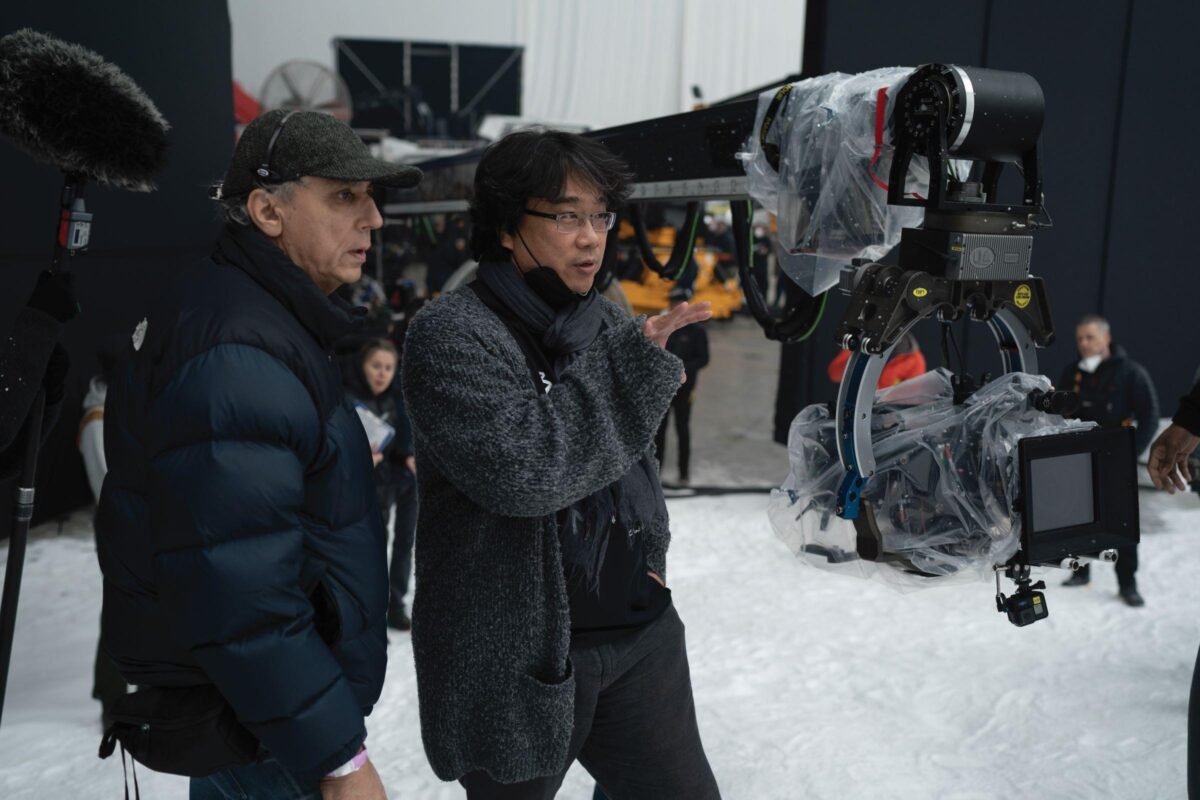
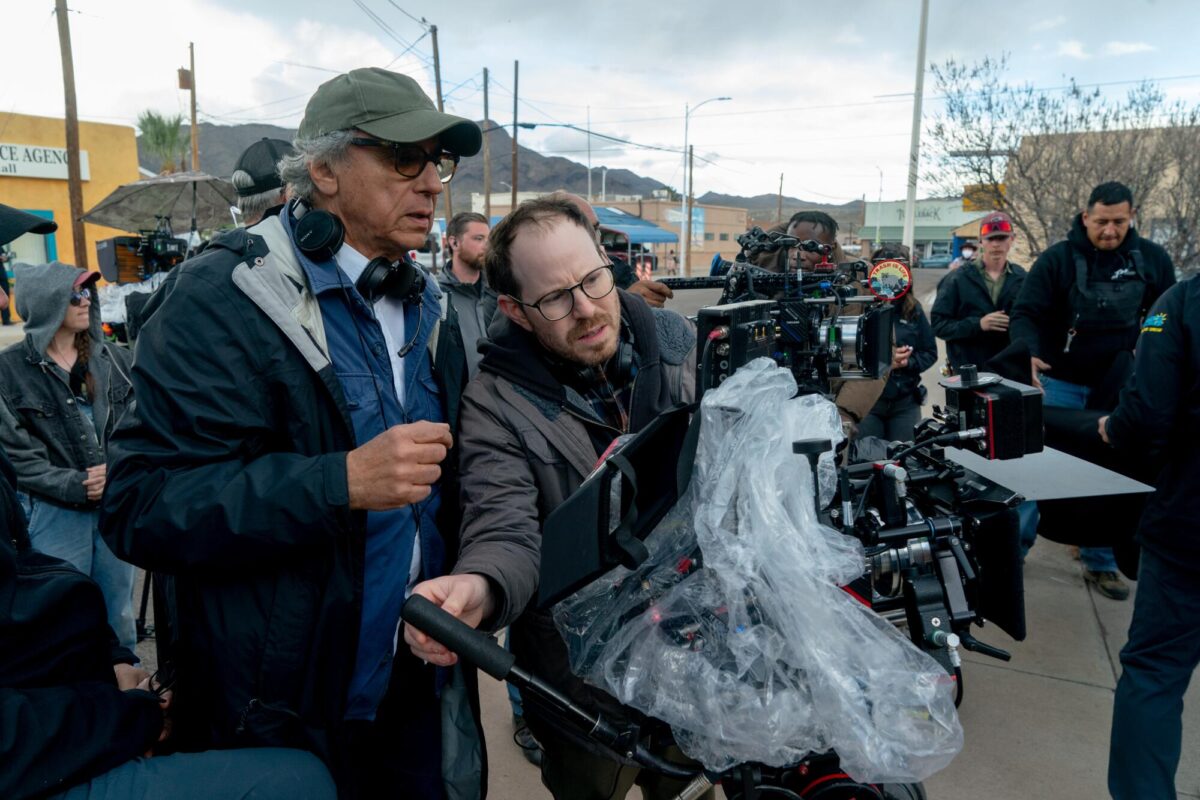
Behind the scenes of Mickey 17 and Eddington
You’ve shot three films back-to-back with Mickey 17, Eddington, and this, which are all so different. What has been your experience doing all these projects?
Bong [Joon Ho] is an incredible artist, and Ari [Aster]. I’ve just been very lucky. I never believed in sayings about luck, but it’s true. I’ve been very lucky to work with directors like this—real film directors with very strong personalities. Just before doing the movie with Josh, I did Eddington with Ari. It was an incredible experience. He is one of the greatest young filmmakers of modern cinema.
Mickey 17 on stage was a very different experience. One was entirely on-stage; we created the world inside the spaceship and the planet. And then Eddington was all outside, on-location in the desert, a lot at night. It was incredible. And then I came to Marty. I was just very, very lucky. That’s why it’s difficult to do another film after.
I was going to ask: you haven’t announced anything new. Are you taking a break, or are there more projects coming soon?
I’m looking for the right film at the moment. My break is visiting museums and art galleries. I always find time to take a break. My break is shooting movies.
[Both laugh]
It’s true. You talk about these three movies. It’s all about passion.
You mentioned how much of a cinephile you are. Is there any other recent cinematography or films this year that have really impressed you?
I love Sinners. Sinners was amazing. I also loved One Battle [After Another]—I thought that was a great movie. I also saw Kathryn Bigelow’s film, which I liked very much. There are a lot of good films. I haven’t seen Bugonia yet, which I really want to see. I haven’t seen The Smashing Machine, which I really want to see. And If I Had Legs I Would Kick You—these are movies I really want to see. Kleber Mendonça Filho’s The Secret Agent, I want to see very much. There are a lot of good movies this year. I have such a great hope in modern cinema because of Marty and Eddington and all these films we just mentioned. I’m very hopeful now in cinema. Cinema is not dead; it’s just alive. It’s a newborn.
Marty Supreme opens on 70mm in NY and LA this Friday, December 19, and expands wide on Thursday, December 25.