
With The Testament of Ann Lee, writer-director Mona Fastvold and team continue the big swing Herzogian mindset present on last year’s The Brutalist, which she also co-wrote and co-produced with partner Brady Corbet. Whether shooting in Hungary for cheaper set builds or prioritizing sheep over human extras, Fastvold, Corbet, and producer Andrew Morrison ensure nearly every dollar in the budget is accounted for and rendered on screen. In Ann Lee, this is illustrated early with a bravura boat sequence that moves the narrative across the Atlantic from 18th-century Manchester to an America on the brink of independence. The team’s hunt for a period-appropriate ship led them all over, and they discovered it eventually, docked in Sweden.
In the film, Amanda Seyfried stars as “Mother” Ann Lee, a pious Quaker who founds the offshoot Shaker movement, which is built on song and dance, craftsman furniture, and a commitment to celibacy—the latter tenet manifests much to the surprise and dismay of Lee’s blacksmith husband Abraham (Christopher Abbott). As Ann Lee’s closest friend, Mary Partington’s (Thomasin McKenzie) narration leads the audience through historical and more fantastical story beats. Traditional Shaker hymns are reimagined into elaborate musical set pieces by composer Daniel Blumberg (The Brutalist, The World to Come) and choreographer Celia Rowlson-Hall (Ma).
Ahead of Ann Lee‘s Christmas Day release, I spoke with Fastvold about the tactility of matte-painted backdrops and handcrafted title cards, the duality of the film’s voice-over, and what elements aspiring filmmakers should refuse to compromise on.
The Film Stage: On The World to Come, you talked about drowning the film with wall-to-wall voiceover. With Ann Lee, how have you further refined this idea, using everything from voice-over to music and singing to create an overwhelming experience for audiences?
Mona Fastvold: Sound is everything. It’s all around you and envelops you—you can’t escape it. With The World to Come, the soundscape, the voiceover, it’s so interior. It’s Abigail’s experience. It was about finding the right microphones to create this ASMR kind of landscape where certain sounds are heightened because they’re her experience, whether it’s the sound of a hand being stroked or the fire crackling. That film is a memory. In The Testament of Ann Lee, even though we have moments which have to be intimate and direct and raw with Ann Lee’s character, the voice-over is in conversation with the story a bit more.
There is this duality between saying “I am empathizing with this character” through the camera work, through the frankness of the actors, through seeing her sexuality, her giving birth—all these things. But at the same time, we have to have a bit of a distance because she is a religious figure. I could not worship Ann Lee, and I don’t want to judge her either. I want there to be a duality in that voiceover, but I wanted it to be with a lot of love. So it is her best friend who tells this story as an unreliable narrator, saying this could have happened or that could have happened, we do not know. This is a fable. But it’s told with the warmth and intimacy of that friendship.
The sound design is the most complicated mix I’ve ever experienced. It was just weeks and weeks of finding the musicality in the mix. Daniel Blumberg, our composer, me, Steve Single, our mixer, and then Andy [Neil], our effects mixer—we all worked closely together to create an intoxicating sonic world. There’s never any separation between the diegetic world and the musical world. Parts of the music is part of an effect, and an effect is part of a musical track. I could have worked on it forever. I worked until it was pencils-down. Now you have four weeks to make a 70mm print for Venice, and if you don’t stop now then you won’t be done.
Other musicals have scenes with dialogue, and when the music starts there’s a conscious shift.
The world dies out, and here comes a song. That was just completely wrong for this film, because it wasn’t supposed to be these performative moments that were separated from the film in that way. There were supposed to be these moments of heightened emotional experience, of faith, prayer—it’s all internalized. It couldn’t be separated.
It’s a smaller element, but the title cards and illustrations throughout are incredible. How did you develop those?
They’re inspired by the Spirit drawings, which are present in the film as flashes. If you ever have the chance to check them out, there’s an incredible collection at the Hancock Shaker Village. As various shakers would receive the Spirit working through them, they would create these pieces of art through drawing or painting. They’re so beautiful. We hand-painted and shot them on film, as we did with all of the credits in the film. I worked closely with my production designer, our scenic painter, and Sebastian Pardo, who also did the credits for The Brutalist. We all worked together developing the cards, which were part of the storytelling, so that was a big part during production as well.
Sebastian, also a talented documentary producer/distributor.
Yeah, he’s a renaissance man—he’s incredible.
At the AFI Fest screening, you gave advice to filmmakers making something original—to not compromise on their vision. Of course, the creation of any art requires some level of compromise, so how do you decide what you’re not going to budge on, while also getting the project made?
Choose the tool that’s the correct tool to tell the story. So if that is celluloid, 35mm, or large-format 60mm, or if it’s digital, your freaking iPhone—whatever the best way to tell the story—that you don’t ever compromise on. Can you imagine if you set out to paint an oil painting but you were like, “Oh no, I could only draw it with a pencil.” You have to stick to your guns with the tool that is how you’re creating your art. That’s really important, and there’s always a way. Digital isn’t free either, by the way.
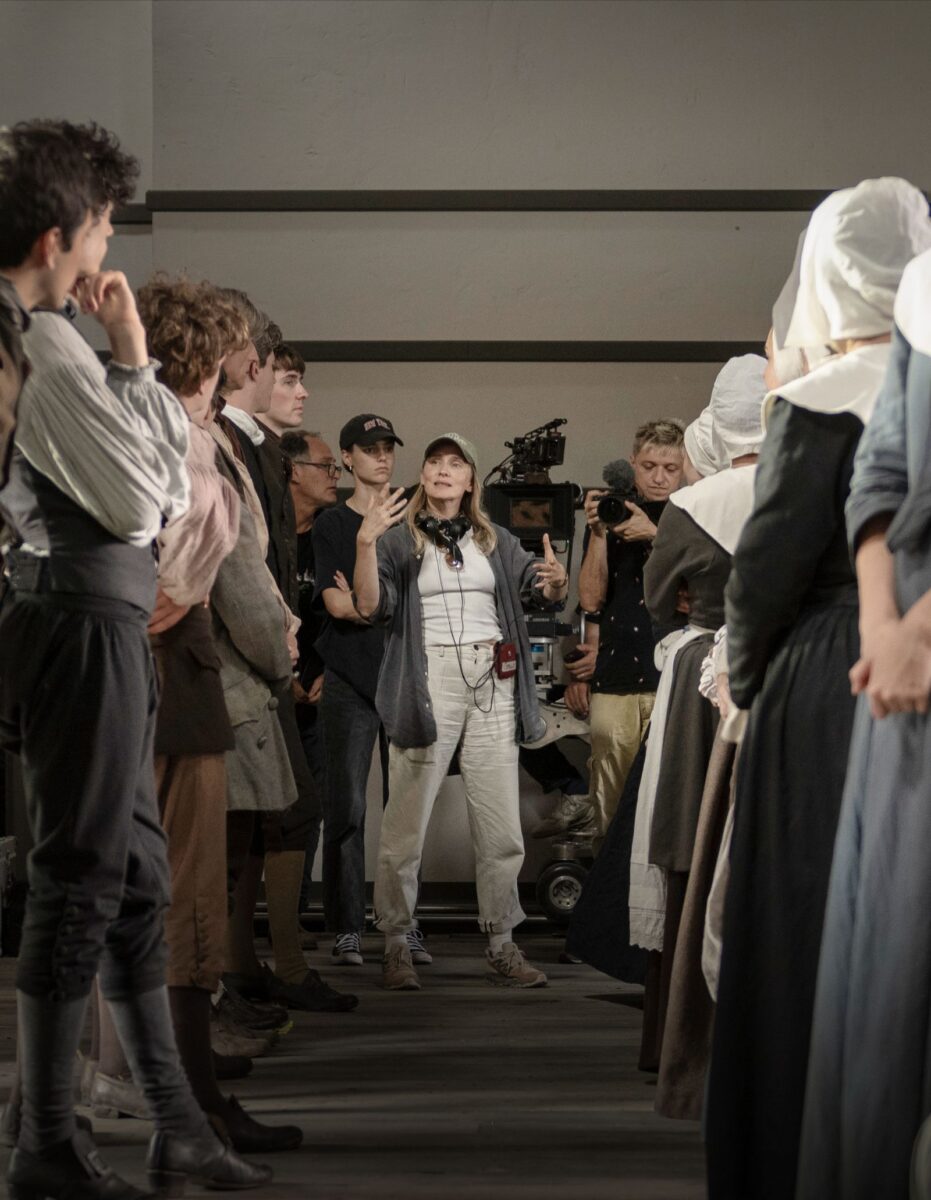
Where you compromise is never on the script. It’s ridiculous when people say, “You have to cut 15 pages.” It doesn’t work like that. I can shoot a very long dialogue scene very quickly if I’m planning to cover it in a specific way. It can be done in half a day. And I can shoot a movement piece for three days.
It’s all about making a very specific plan and deciding where you’re spending your money, and then getting really creative on how to find a solution to execute the screenplay that you wrote. When you’re sitting and writing that screenplay and you’re deciding on how to tell that story, you’re doing that in peace. You’re doing that without thinking about all of the constraints and all of the difficulties. You have to stick to that plan because that is your recipe. If you’re baking a cake and all of a sudden you decide to freestyle because you run out of sugar, it’s not going to taste good. You have to trust that when you sat there in your room and you wrote this thing—you actually had a solid plan, so it’s never compromised on that.
What you can do is say, “All right, I’m going to shoot this in an economical way where I will only build a section of this set. I will not shoot 360 here. I will spend a lot of money on building a house and burning it down, and then for three other days I’m going to have just the core crew, a very small group of people.” Or I can say, “All right, I cannot afford an additional 25 extras, but I can afford 25 sheep.” And in the end, the 25 sheep are more beautiful in that shot. I want this image to feel alive, but I can’t afford to make it feel alive by having 25 costumes, paying and feeding them—all that’s expensive. But these animals can give that same feeling of something being alive. So I’m not compromising on the intent of it; I’m just finding a different solution.
We know what shooting an actual house burning down on film looks like compared to using CGI fire. So you can make the case that the money is better-spent there.
But also: CGI is really expensive. All of my VFX are grounded in something real. We had a traditional matte painter, Leigh Took, who hand-painted all of our set extensions. And then I worked together with the VFX team in marrying that to our plates that we were shooting, or the sets that we were shooting. We would do tiny things—like adding a bird or a glimmer in a window or something—but it was always grounded as something real and organic. The whole film is completely organic in that way, which is much less expensive than doing a full CGI build of something, which is expensive, time-consuming, and challenging. To me, that’s not a compromise. I like returning to old cinematic traditions and then blending them with new ones.
All those little elements lend the film a very tactile feeling. While audiences might not pick up on hand-painted, photographed title cards, for instance, it creates this overall feeling.
You feel it. If you’re watching something that has square pixels versus round pixels, it’s going to affect your eyes and your mind in a different way. Comping in a real bird into a painting versus a CG build of a city with a CG bird, you’re going to perceive it in a different way. It’s going to be a different experience. Maybe that CG feeling for another story is exciting, where it feels like a crazy modern fairy tale. But for this film, it’s not the right feeling. This film should feel grounded and natural and real and organic and tactile. And you should feel the craftsmanship of things that are made by hand. That is the feeling that I want you to have while watching the movie.
How important is it to have a producing team that’s on your side with these things, so that you’re also not fighting them?
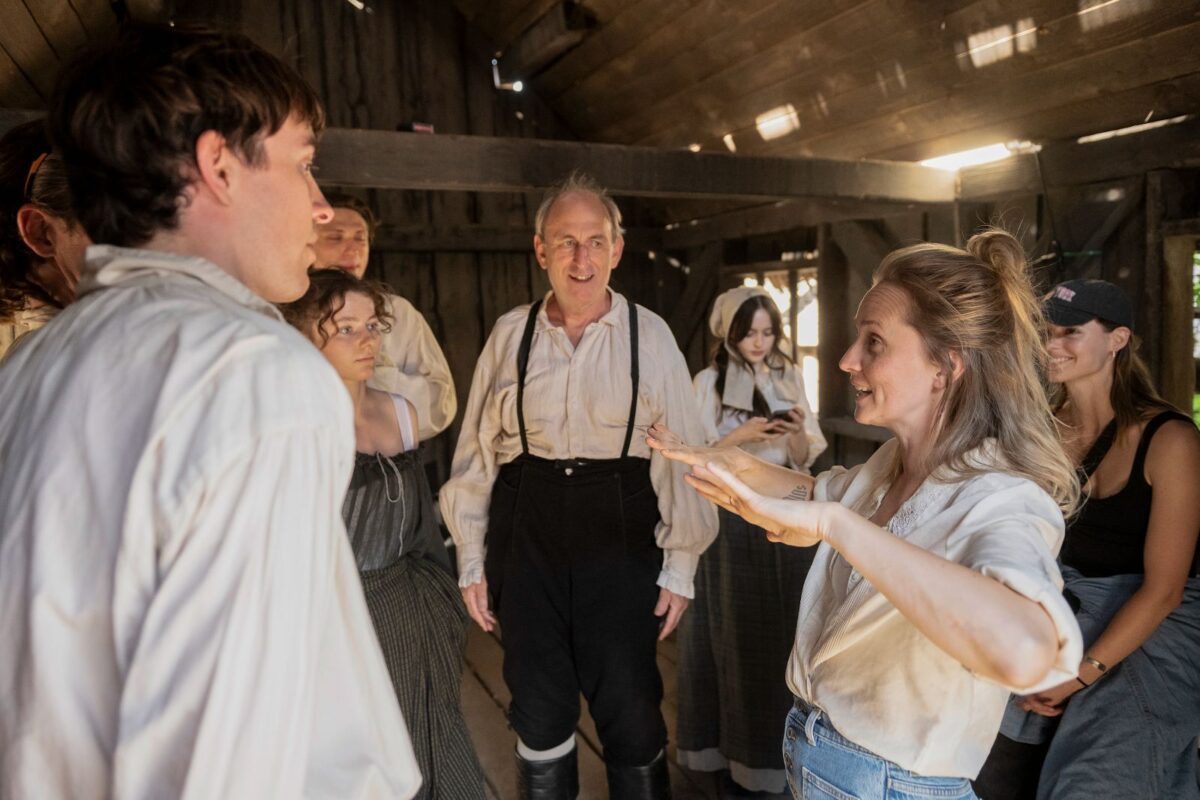
No one on our team ever says, “No, you can’t do that.” Instead it’s, “How are we going to figure this out? We will search the entire world to find a tall ship that you can shoot on, and we will figure out a way to shoot it.” Andrew Morrison and Brady Corbet are just relentless in that journey with me, and I’m the same way when I’m working with Brady as well. At times when you’re directing and you’re bringing all these people together—and you’re holding their anxieties and their fears, and you’re trying to keep that strength in that storm that it is to make a film—you can get really tired.
Sometimes when you’re in it, it feels tempting to just say, “Ugh, let’s cut the boat.” It’s so important to have partners who then say, “No, we’re pushing forward. It is important. It was important to you three months ago, it’s as important right now. We’re going to push through and we’re not going to compromise on anything. Actually, we’re going to make it even bigger. We’re going to build an entire little set that we really can’t afford. We’re going to flood it and that’s what we’re going to do, because we want it to be epic.” That’s the reason why we’re making these films, because we want them to feel impossible to make. We want you to feel that magic.
The Testament of Ann Lee opens in theaters on Thursday, December 25.