
Nearly 30 years into his feature filmmaking career, French writer-director François Ozon has done it all: screwball comedies, murder mystery musicals, erotic dramas, thrillers, political films, and more. Now, for the first time, he’s adapted a crucial literary and philosophical work in Albert Camus’ The Stranger–starring Benjamin Voisin as the ever-elusive and tragically nonchalant Meursault–which has garnered significant attention in France, collecting major awards like the Lumière for Best Picture, Best Actor, and Best Cinematography.
Camus’ classic all but avoids cinematic interpretation, which left Ozon with a markedly strange feat in figuring out how to translate the removed existentialism of its infamous main character to the screen. As a result, Ozon’s veteran experience is on full display, proving why the celebrated French director has long since become quintessential for anyone diving into the contemporary French cinema scene. Ahead of this Friday’s U.S. release, we sat down with Ozon to talk about how he approached adapting and directing the film, the philosophy at its core, and the changes he made to the story for the modern viewer.
The Film Stage: You’ve adapted several books or plays into films, but this is your first Albert Camus adaptation. What drew you to adapting The Stranger and Camus in general?
François Ozon: If you had asked me two years ago, “Would you adapt The Stranger?” I would’ve said, “No. Never.” Because it’s a masterpiece of French literature and everybody in France has read the book. So there are so many potential directors, because a reader is a director. When you read a book, you have the experience of mise-en-scène in your head. You can imagine the actors, the scenes. So it was absolutely not my goal to adapt this book, and especially a masterpiece. Each time I had made an adaptation, very often it was books or plays which were not very famous and nobody knew, so I felt totally free to make what I wanted. But actually, the idea of the adaptation came from a failure.
I wanted to make another film with Benjamin Voisin, which was a portrait of a young man today in France, in front of the absurdity of the world today, who commits suicide in the film. And we didn’t find the money. Nobody wanted to see this story. It was too hard, too sad. But some people who enjoyed my script said, “Oh, it reminds me of The Stranger.” So I decided to read the book, because I hadn’t read it since I was a French student in college. And I realized the book was still so powerful in modernity and so much better than my script. I asked Benjamin if he felt able to interpret Meursault with the iconic nature of the French character in literature. He was very excited, and I was very excited—we were excited to go forward together. And that’s how I came upon the adaptation.
That’s a quick turnaround from two years ago to now. How do you go about turning something that’s so abstract and philosophical into cinema?
I was excited about that, because I love slowness in cinema and I love observation in cinema. It’s true that it was a real gamble to put into images the abstraction and non-action of the novel. But it really excited me to create a cinematic translation of this book. One possibility, of course, would have been to use voiceover the whole time, since the novel is basically an inner monologue. But actually, what I became interested in was to make a practically silent film, especially for the first part of the film. I told myself at one point, “It could have almost no dialogue.” And that was a challenge that really interested me when it came to the mise-en-scène.
Would you describe yourself as an existentialist?
If being an existentialist means asking yourself questions about the meaning of things, about the absurdity of the world, then yes. It’s true that when you make films you’re always asking yourself questions about your experience. You’re always asking yourself questions. So, in that sense, I would say: yes, I am an existentialist.
How do you relate to the existentialism of Meursault and the absurdity of life as he experiences it? Is his behavior or outlook an extreme for you or would you go that far with it?
I think we have all, at some point in our lives, been Meursault. That is to say that we all live this experience at some point in our personal lives: of being detached from the world, of not being a player in our own lives. Meursault is like the walking dead in the film. He’s like a zombie. Yet, at the end, his anger finally explodes—in the scene with the priest—against all that religion represents, and in that moment Meursault is truly alive. Camus’ message is not nihilism—it’s revolt—and I don’t think I would’ve made this film if it didn’t have the scene with the priest at the end where Meursault blows up and expresses everything that is in him.
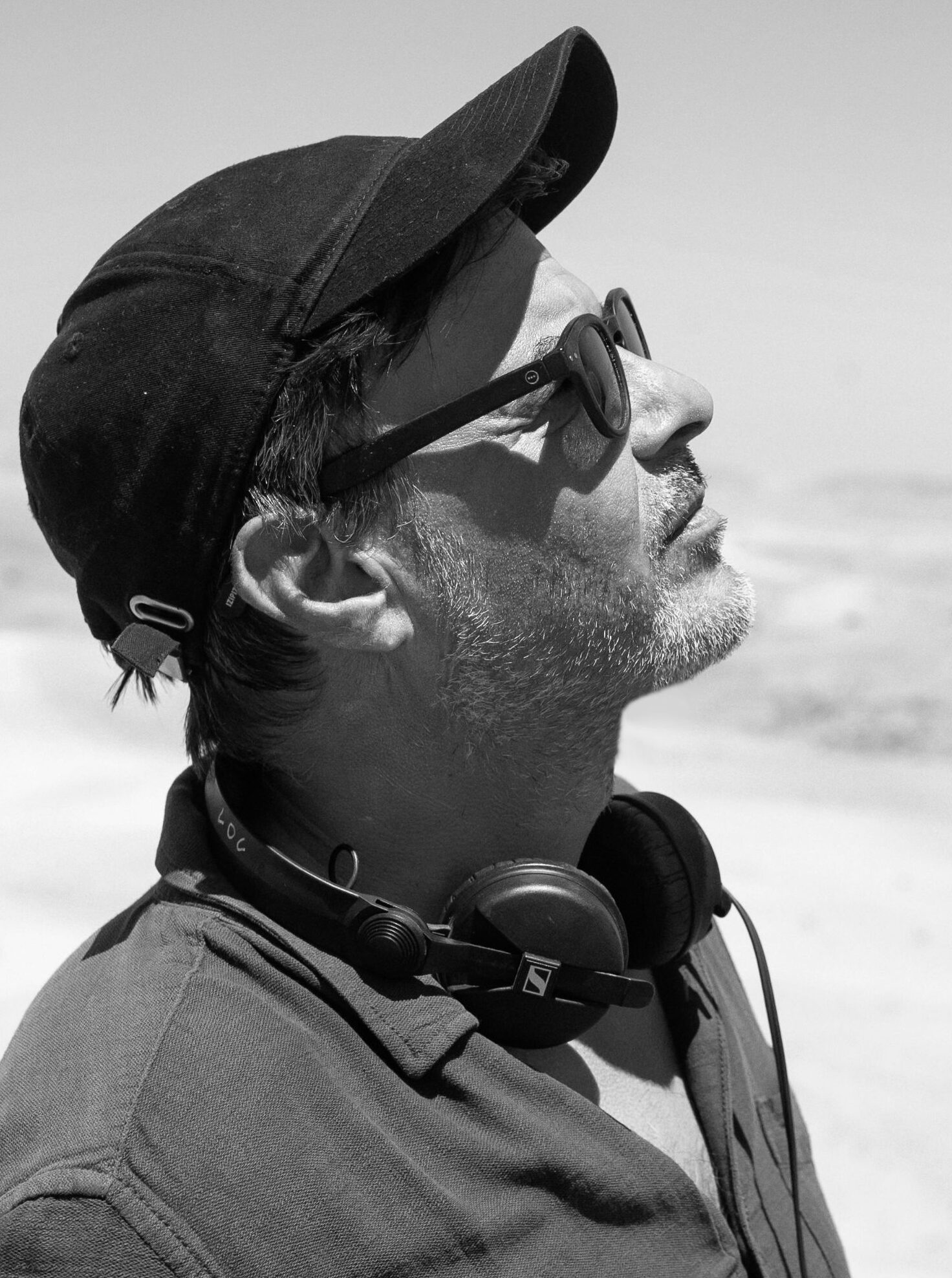
François Ozon. Photo by Leonidas Arvanitis.
How do you approach a film differently, both as a writer and director, when the story is so concerned with history or historical framing? Like Frantz, for example. And, especially in this case, a history that’s so difficult to stomach?
Yes, it was very important for me, before the adaptation, to understand the context—the historical and political context of the late ’30s, because Camus wrote the book in ‘39 and the book was released in France in ‘42. And I needed to understand what Algeria was at this time. And, actually, it was France—Algeria was part of France. It was two French departments, and that colonialism is still a big problem for the French, you know? It’s not like you in America with Vietnam. You have many films about the relationship between America and Vietnam. In France, there are not so many films about Algeria and French colonialism. It was important to have all this political context and to understand.
So I met with many historians who explained to me the situation, because I didn’t know much about what happened. And I’m sure Camus was aware of this situation. He doesn’t need to describe that in his book, because it was the reality of the French. But for me, and for the audience of today, it was very important to have this context. That’s why I made so many changes from the book—especially the last scene—and the fact that I gave a name to the Arab, who has no name in the book. For me, it was obvious that in a version for today we needed these elements to understand better what Camus wanted to make with his book.
That is one of the things that really sticks out in your version compared to the book or Luchino Visconti’s film: how prominent the theme of colonialism and white French indifference toward Arab people is. Was that a hyper-conscious choice from the beginning, to make that a more prominent theme and explore it in a way the book didn’t?
It came after the reading of the book. I was shocked by the fact that the Arab had no name, and I needed to understand why Camus made this choice, not to give a name, you know? And it was the result of the colonialism of his time. An Arab was an Arab. They were not people. They were Arabs, and it was the situation of the Arab community: they didn’t have a status. They were considered the indigenous people. That’s why I decided to start the film with the line, “I killed an Arab.” Because that’s the line that is important for me today when I read the book. It’s not, “My mother died today.” It’s a sentence that is very famous in French literature. But for me, the important one was this one, when he arrives in prison in front of all the prisoners and he says very honestly, “I killed an Arab.” I think it’s more powerful for an audience today to start with this line.
Were there other French films (or non-French films) about French Algeria and the relationship between the French and the indigenous Algerians that you took inspiration from? Like you said, there aren’t many of them, but I think of Haneke’s Caché. What other films did you look to or think about while adapting and / or directing?
Caché is a good example of the unconscious of French culture. It’s funny that it’s from an Austrian director, a film about the unconscious of the French. But there are not so many others. Very often, there is something influential in the background. But it’s not very developed.
I realized the success of the film in France came from the Algerian community. They came to see my film, and it was very touching for me. For example, one day after a Q&A, an old Algerian woman thanked me because she said, “For me, the book was impossible to accept, to read. Because, as an Arab woman, I didn’t exist in the book. With your film, it helps me understand Camus better and reconciles me with my story in the book.”
Did you give much thought or attention to Visconti’s ‘67 adaptation?
I discovered Visconti’s film during the adaptation. The film is not very well-known in France; it was not a success. So I watched the film and I was interested, especially because Visconti had the opportunity to shoot in Algeria, which was not my case. It’s impossible today for a French director to shoot in Algeria. I shot in Morocco, so I saw in his film the real sets of the story, so it was interesting for the set designer and for me. And I read many interviews with Visconti saying he was not happy with his film. He didn’t have the freedom to make the adaptation he wanted, because Camus’ widow was on the set and she asked him to follow the book exactly, page by page. Actually, I think Visconti wanted to make another film, but he didn’t have a choice. And he was not happy with the casting, especially with the casting of Mastroianni. His first choice was Alain Delon, which would have been so much better for the part of Meursault, I think.
The cinematography is stunning—both the camerawork and specific aesthetic of the black-and-white. How did you and Manuel Dacosse decide to go that route? And did you know it was going to be in black-and-white while you were writing it?
It was quite obvious for me to shoot in black-and-white, because our colonial memory is in black-and-white—all the documents, etc. are in black-and-white. And it’s quite paradoxical to make the film in black-and-white, because the book is full of colors. When you read the book, there are descriptions of Marie’s red dress, a beautiful blue sky, the sea—everything is full of color—but for me, it was a way to enter the world of Meursault. To watch the world in black-and-white creates a kind of distance.
Today we are not so used to films in black-and-white, so to see the world in black-and-white like Meursault was a way to better understand the kind of distance between him and the world. And with Manu Dacosse, the DP, we knew with the white that we could work much better on the idea of being dazzled by the light, the sun. It was all stronger in black-and-white. It’s never easy to decide to make a film in black-and-white, because the financiers and the producers say the film won’t be a primetime movie—”people don’t like black-and-white,” all these kinds of things. But for me, it was important—it was a radical choice—but for the film, I think it’s so much better.
Actually, we shot in color, but I saw all the rushes in black-and-white. It’s funny, because with the laboratory, they sent me a copy of the whole film in color, and it’s amazing because it’s a totally different movie. Maybe I will release it one day! It’s a totally different feeling. You have the feeling of being in a Hollywood movie, you know? Of the ‘40s or ‘50s, in technicolor, like a Douglas Sirk movie. It’s a different experience.
Were you concerned about how Meursault would alienate audiences? You talked about how financiers don’t like black-and-white because it won’t be as big of a picture, people will be reluctant to watch it, etc. Was his level of emotionlessness and alienation something you were concerned about in terms of pushing viewers away or making viewers hate the lead?
Of course. I ask these kinds of questions. But Meursault is bigger than me. Meursault is so famous in French literature that I was not afraid to follow him and depict him how he is. I didn’t want to make a feel-good movie, like an American movie, or try to make him very nice or easy to understand. Of course we try to understand him, but I think his distance with the world is interesting. I’ve been to a lot of Q&As with young people, and I was describing Meursault like a serial killer or a psychopath, and some young people said, “…but I am Meursault. I am the same.” So young people can relate to this character.
And, actually, Meursault is very honest. He doesn’t play the social game. He doesn’t want to lie. He’s always close to the truth. And he’s condemned not because he killed an Arab but because he doesn’t cry. He’s a very complex character, and I wanted to keep this complexity. I didn’t want to make something easy, because actually it’s not easy. Actually, I’m not sure I even understand this character! He’s a kind of enigma, and I consider the audience clever enough to follow him and to try to understand him as I did.
I realized that Meursault actually inspired many French directors. I’m sure someone like Jean-Pierre Melville, when he did Le Samouraï with Alain Delon, knew the book. Robert Bresson, when he made a film like Pickpocket. Actually, Robert Bresson was a good inspiration for me, especially for the acting. I asked Benjamin Voisin, the actor, to watch Bresson movies, because the actors don’t act in Bresson films. They are just there. They’re considered more like models than actors. Benjamin is a brilliant actor and he’s acting all the time, so I asked him to watch Bresson and not to act. It’s difficult to ask an actor not to act! [Laughs]
You’ve made so many different kinds of films. Is there a type of film you’d like to make that you haven’t made yet? Or a genre you’d really like to return to?
I don’t have a career plan. I’m interested not so much in genre but in story. The genre comes in a second phase. First I have my story, and then I have to ask myself what form I’m going to give it, and that is what genre is best going to serve it. Because the same story could be a comedy, a psychological drama, a thriller, or a horror film. So it’s the story that comes first, and then I have to find the right way to tell it. But I’m not scared to experiment. What’s most important to me in cinema is to not repeat myself. I like to try something new, to experiment with every film. My next movie will be a story of today.
What is that story about?
It’s about a young boy, a twelve-year-old boy, and it’s about what it’s like to construct yourself as a man in the world today, with all that dictates about masculinity, consent, and so on. So it’s really: what is it like to construct yourself to become yourself as a man today. Indeed, it’s very different from The Stranger. But, you know, I’m open to everything. As I mentioned, two or three years ago I would have never considered making The Stranger and yet I did it. So life brings surprises along all the time, and I find that very exciting.
The Stranger opens in limited release on Friday, April 3.