
Short though we may be on novel ways to make movies, Pete Ohs has perhaps cracked something new. Seeing each film he makes as a “table of bubbles”—a beautiful, fragile thing that can’t support the burden of anything ideological or physical—he’s worked closely with actors, inevitably credited as co-writers, to shape a narrative project as it’s actively in motion. Yet the films don’t seem improvised, half-formed, or inert; they instead coast on the unpredictability of which its characters are capable and seem susceptible to almost any potential narrative event. Ohs followed last year’s delightful (and still-undistributed) The True Beauty of Being Bitten By a Tick with Erupcja, which follows the same model but has perhaps seen a slight uptick in profile for being led (and co-produced and co-written) by Charli XCX.
This, however, is not the locus of the film, a two-hander between Bethany (XCX) and Lena (Lena Góra), friends whose bizarre, nearly supernatural connection yields difficulty when Bethany arrives in Lena’s Warsaw with a fiancé (Will Madden’s Rob). Figuring out just how these two relate to each other and where a reunion takes them (such as Jeremy O. Harris’ ex-pat artist Claude) is some of the most fun I’ve had with a film this year, which doesn’t negate the discomfort of its lead character’s selfishness, nor the fear that all of this could careen in the wrong direction.
That never does is a testament to Ohs and his team of actor-writers, but he’s rather practical about the whole thing in conversation, ultimately comparing his process to more traditional filmmaking modes—a roundabout way to the same destination. We spoke as Erupcja was preparing to make its U.S. debut at New Directors/New Films just ahead of a theatrical release that begins this Friday.
The Film Stage: Sometimes—sometimes being a lot of the time—a movie has a kind of preconstructed, preconceived narrative around it. You’ve been very good at being transparent about this “table of bubbles” idea with which you make movies. I think that there was something about this movie being shot in a foreign country, foreign language, huge pop star, where all of those things—to be totally transparent, having established I think the movie is great—going into it I was a little like: what is this thing going to be?
Pete Ohs: Yeah, totally! [Laughs]
Like, is this going to be a real movie? And then pretty much from the first scene it’s clear that it’s like a real movie.
Right. That’s also so many versions of “not-real movie” it could be. Is this Crossroads with Britney Spears? Is this just some, like, improv slop that’s just a mess of junk? What is this thing?
Yeah. If it were Crossroads it would be reclaimed in 20 years by the Letterboxd crowd, so you’d win out in the long run.
Right! In the long run.
But I think you’re getting off on a good foot. Maybe that’s a way of asking how much you think about or are aware of or concerned with a kind of pre-established narrative that might exist around a movie, or how much that doesn’t even enter your consideration because, ultimately, the film is the film and the film speaks for itself.
With these movies, and it’s connected to the “table of bubbles” thing, but so much of it is set up in a way that we needn’t and shouldn’t and the point is to not think about all that stuff. Certainly the point is to be aware, to be engaged, to hopefully, potentially make something with some sort of value—some sort of interesting piece of art. But because it’s not a traditional movie where the production, where the budget is at a size such that it needs to be anything to justify its existence, it’s okay—in my opinion and the opinions of my collaborators and producers—that we don’t need to worry about it, about what it’s going to become. And that becomes just a really interesting—for me, for us—sandbox to play in, an interesting place for creativity to be exercised. For me, because what I’m actually prioritizing with myself and with these actors is what our experience is, it, every time, becomes a really beautiful, life-affirming two weeks spent on Earth.
Yes. Sure.
And something I’m happy to do again. So in that way, we succeed, and then once the movie becomes whatever it is, we deal with that later.
We deal with that here in this room.
Right! Make sense of it. But also because the filmmaking process is… I approach it very holistically, and I try to be really aware, as a human, that as the thing sort of starts to solidify, you’re able to keep making choices that continue to inform what it is and thus how it’s going to exist in the world. In the movie there’s all these color blocks, which is a fun stylistic choice, and that happens for lots of different reasons, but there’s no Brat-green color block. Like, intentionally aware of: we’re making a thing that exists within the context of now. We could do it and it will mean something; we could not do it and it would mean something. If we’re making Crossroads, we’re probably using Brat-green a bunch more.
You know, we’re, like, really intentionally trying to tie it to the star that is Charli, but the spirit of this movie is not that. It’s Charli wanting to just be a collaborator and artist who’s getting to experience acting and filmmaking, and it’s not a product that we’re trying to position to maximize our return. Thus—hopefully, in my opinion—how I experience it, maybe it maintains some sort of artistic integrity [Laughs] and hopefully that’s what you feel. You’re like, “Oh this is a real movie.” Regardless of whether it’s a good movie, at least it is a movie that is doing what it’s going to do and not trying to manipulate the market.
Well, it’s a testament that I love the color blocks and I found them working as this palette-cleanser, interstitial structural device, and not for one second did I consider the idea that Brat-green would appear. I was really shocked reading about the post-production and final construction of the movie, which to me felt so complete and workable, presentable as is. And there’s a thing I think I wrote it down: you said, “I was entering with nothing at all.” Conscious of other films where maybe you had a bit more going in. So what is “nothing at all”? What did you actually enter with that let you say on day one, “We’re setting up the camera here, you’re gonna say this”?
For the movie, what we basically entered with was the awareness that one character spoke Polish, one character didn’t, and that volcanoes were involved somehow. That’s sort of what I brought to the actors, and through little bits of conversations, we get some basics that at least, again, create some sort of framework. Like, “Okay, your character is going to work at a flower shop.” We don’t know how that’s fully going to get used, but that at least helps us know that we should ask around and be like, “What’s a flower shop we could film at? The two of you”—like, Bethany and Rob— “are these British tourists.” Okay, Rob well knows he needs to practice his British accent. Some things that let you be ready to play, but you don’t really know what it’s gonna be. The day before everyone arrived, I was just like, “How does this movie start?” And I went on a walk in the morning and I came back and I was entering the building that I was living in and I saw the reflection in the window and I saw the little keypad that I always get a kick out of because it’s, like, so specific for me to Poland.
Right.
And I just saw this reflection and I was like: “Right. Here’s my first scene.” You know, for these characters arriving: them doing the keypad and you have a little bit of, “What’s the tension? What’s the drama?” It’s like, “Oh, they have the keypad wrong.” They have to do a little couple-bickering moment about who remembers the keypad number. And then you’re like, “Okay, great, I at least know what the first scene is.” So it’s like that’s almost what I have as far as what we’re going to shoot. The other way in which I mean “entering this movie with nothing” was that I had gone through a really intense personal thing where, a month-and-a-half prior, my father had passed away. It’s a crazy thing to experience that, you know, is part of life and when that happened I didn’t know what to do. I didn’t know if we should shoot a movie. I didn’t know if that was the right thing for me, if it was the right thing for anyone.
What I eventually decided to do was not decide anything. Previous Pete thought this was a good idea. “I’m just going to keep operating from that place and not decide to not do it. I’m just going to let the ball kind of continue rolling.” But I was so lost in grief that I was like, “I actually don’t have anything. All I really have is my faith in the process.” Not in religious terms, but just in this filmmaking thing that I’ve been doing every year that I have muscle memory for, that I’m like: it’s a system I have set up; just trust it and let go.
And that’s what happened, and once the movie starts getting made, once the ball starts rolling, I fall into those patterns of making that is this rhythm of writing scenes, of doing the mental gymnastics of storytelling and character development and turns and “how does this scene connect to this,” and all that kind of stuff. Then the same thing happens that always happens, which is: a movie starts coming into focus. And it was okay for me to have no clue what I was doing and where we were going [Laughs] and that, thankfully, these collaborators both brought ideas, brought support, and also brought enough trust in this process to go with me on this journey and get to the end of it.
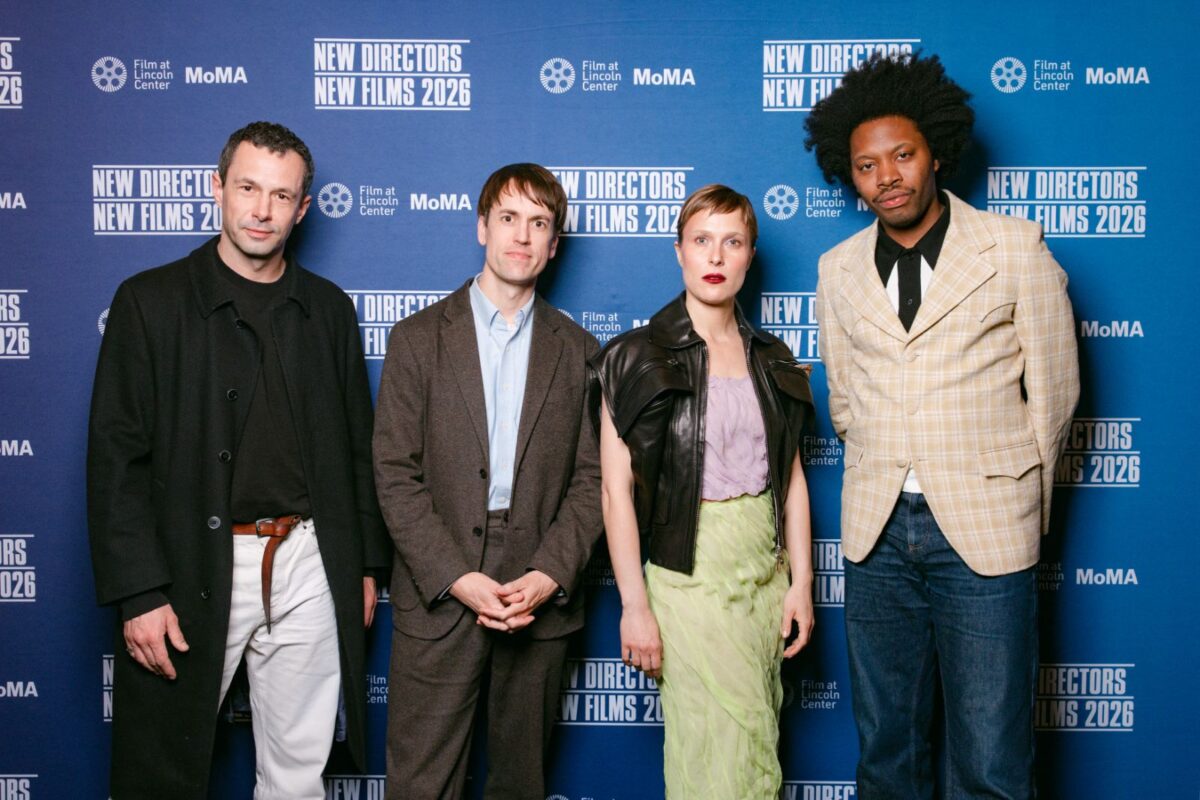
Erupcja premiere at New Directors/New Films. Photo by Arin Sang-urai, courtesy of Film at Lincoln Center.
That’s all very well said, and gets at why I like the movie so much: it felt like there was this constant process of discovery. Even though it’s not a plot-heavy movie, it activated a similar part of my mind that an incident- and intrigue-heavy movie would. Part of it is that certain of the relationships aren’t so over-explicated, but it’s about the kind of feeling between the actors in the room. You can tell she’s kind of bored with him; you can tell that he’s a little over-eager; but then with the girls, I was asking myself: are they romantically involved? Is there something else going on? And I wonder what kind of energies you were picking up from the actors in the rooms that helped you decide it would be this way, and how you decided certain things would be directly explicated in dialogue or voiceover, and how certain things would not be.
Everything is coming from a place of intuition and generally not overthinking, because there isn’t time to overthink. You just have to keep following what feels good and knowing that this is a multi-stage process, and there’s going to be opportunities later to make sense of it or to inject more ideas to, again, make something work in a way that you didn’t realize it could at the time. The other thing about making movies: not every movie can get made this way, nor should it. I think the fact that it’s a movie about characters that, I guess, don’t really know themselves that much, do not express their emotions that much—or aren’t that good at it—also lends itself to a movie that doesn’t have any dialogue written yet. You know, if this is a character who’s so fully formed within themselves as a human, then they should be talking more. But we are intuitively and consciously creating a story with characters who are not in that place, and thus it doesn’t feel wrong for them to be a little more reserved in this situation.
Similarly, Charli is a stranger to all of us. She is just meeting her co-star, her romantic partners. So the hard thing would be to say, “You are deeply, madly in love and you have known each other since you were eight years old. Go.” But if you set yourself up for success, you say, “You know what? There is distance between you. You’re not fully letting him in.” [Laughs] Work with that and find the way in which that continues to be interesting. But again: leaning into what you already have, which is an MO of the whole production model. It’s like, “What are your resources? What is within grasp?” And make the most of what that is. Then, similarly with Lena and Charli, we know that we want these characters to have some sort of past. We don’t yet know what that is. I don’t like defining things until you have to.
But so what happened was just: we shot the movie in order. Those two characters don’t actually interact until, like, the fourth day of the shoot. So those first few days are, like, every night Charli and Lena are sitting on the balcony, smoking cigarettes, talking. And I’m like, “These experiences are your characters’ past.” Like, I don’t care what you’re building. You should. Whatever it is is the truth that we’ll hold onto. I’m not trying to control it, but these are the memories of Nell and Bethany, and we know that the memories are from the distant past. That means they’re gonna change. Some of them are gonna feel more present, some of them are gonna be remembered incorrectly.
So the fogginess of memories is also us playing to our strength, to the fact that, no, we didn’t sit down and write extensive character backgrounds of everything they did, because not only did we not do that—they didn’t. You haven’t done that. But also, that’s not necessarily how memory needs to work. So that also fits within the themes of the story that we are moving through. And I think, again, sort of having an awareness about what you’re working with and what it is and what it can’t be and not trying to force it allows it to still end up being something that feels good, feels correct.
You’re talking about these very immediate, present-tense things of the characters—how they’re actually interacting on screen—but then you have this voiceover. What most surprised me was discovering that that was not part of the film for a long time. Voiceover is notoriously very tricky, and if it goes badly, it goes very badly.
Yeah. [Laughs]
But here it goes so well, and it feels like the spine of the movie. There’s, I think, the inclination to say it’s very French New Wave, and I think you had said Jules and Jim was an inspiration. But it also feels very novelistic to me. This is my roundabout way of asking what some of the thinking was, outside of the Jules and Jim thing, with what you do tell, what you don’t tell, the kind of tone that you’re trying to strike—the sort of ominpotent, Jupiterian thing that it has.
Yeah. I love operating from a place of intuition. I love the journey of discovery of moving towards the unknown. So yes: we did not know there was going to be voiceover. I knew there could be. I knew that’s a thing you can do at some point. But who knows if that’s going to be the correct thing at any point? And as I’m putting the movie together, I’m like, “Every movie sucks until it doesn’t.” [Laughs] Like, you do your first rough cut and it’s bad. You do some work and you think it starts to get better but, like: no. You have to be honest. You’re like, “No, it still sucks.” Sometimes they suck for a really long time.
There’s this saying I like: there’s nothing better than your dailies, nothing worse than your first cut.
Yeah, yeah, yeah. But there’s a long list of things to do and so you just: “Be patient, keep doing the things, keep injecting more ideas. Now there’s some more sound stuff. Now it’s getting tight and it’s not quite as long. It’s getting better, it’s getting better. It still sucks. It hasn’t crossed the suck threshold quite yet. [Laughs] But it is getting better.” But, like, time and energy are limited resources, so you’re not sure you’re gonna get there. You just don’t know. So in the journey of trying to see if we’re going to get there, seeing if we’re going to find it, we’re experimenting with different things. I feel that something’s missing. I’m like, “The movie’s not in its final form yet. What if we tried some voiceover?”
Okay, what if we tried some voiceover? We’ve opened ourselves up to the idea of voiceover. Who’s talking? And we did an experiment where it was going to be Bethany, Charli’s character, reciting poetry that she had written when she was 16 years old. And in my mind of trying to justify this I’m like, “Right, there’s a poetry element in the movie. There’s this thing about when they met when they’re 16. There’s the romanticizing of emotions, of Shakespeare—this idea that she might write poetry like this that could exist in this universe.” And so I write a bunch of poetry as a 16-year-old. I have Charli read it, just record it on her phone. I put it all on there and you’re like, “No, that’s not good.” [Laughs] You know, like: that did not work.
But you still are aware that something is missing. Then eventually this Jules and Jim idea comes, and what happened after seeing a minute of Jules and Jim—being like, “Oh right, that kind of voiceover, that could be cool”—is: I went over and got on my computer and I typed a line of voiceover and I used the Polish Google Translate, and it has a voice in there. I just pressed play and I heard that and I was like, “Oh, that’s cool. That’s interesting.”
Sure. Yeah.
And put that in there and put some music in there and like, “Okay, this feels good, intuitively. This feels interesting. This feels like continuing to explore it.” And just naturally that voice is detached, which also is similar to what the Jules and Jim thing is, too. But I’m also now experiencing, “Right, this is sort of like a detached voice entity.” And you’re starting to understand, “Okay, who is it that’s talking?” Because at another moment of voiceover brainstorm we’re like, “Should it be Lord Byron? Like, should the voiceover be Lord Byron narrating this movie? That could be cool.” But that’s not where I arrived—I arrived at this other thing that was feeling good—and so once you’re starting to write it, you have to make rules about: what is the perspective of this character? It’s omniscient. How omniscient?
And you start thinking about—or I started thinking about—the narrators of books, and I read enough and thought about it enough to know that there are different kinds of narrators. There are narrators who exist in the minds of the characters, who know every emotion and thought they’re thinking. And then there’s ones who are actually quite removed, and just intuitively for this, it was feeling correct that this narrator is not explaining everything these characters are feeling—that he’s actually just giving facts—and so with each little moment of voiceover I’m like, “What facts can he share?” And intuitively this is feeling good. As I then would analyze “why is that feeling good,” I’m reflecting on how a point of this story is exploring characters who are not that good at communicating. And if all of a sudden we introduce a narrator who, from minute one of the movie, could tell us everything that they’re feeling, then there’s not a point to the rest of the movie. “Okay, so right, so that’s not what he has access to. He has access to this other thing.”
But then what excited me was: this is an opportunity for me—the filmmaker, the artist—to interject ideas, to make small moments feel more meaningful, to put my humor, my sense of humor into this. Because I don’t take life seriously. I don’t think it’s healthy to. Like you need to have a sense of humor. I take life seriously, but you need to have a sense of humor. And so without the voiceover, the movie very easily becomes melodramatic in a way that’s not cool. It’s like, “Oh, it thinks this is real. It’s treating all this like it’s really that significant.”
The voiceover became this really useful tool that was making me feel good and so much relief that I finally found that way to subvert the thing that I had made, and that just became really exciting for each opportunity of another window of voiceover I could put in there. It’s like, “Oh, great, another opportunity to to put a joke in that I find funny—like, an inside joke essentially.” But as also a way of just letting the audience know that I know this isn’t that serious. [Laughs] You know? Like, that’s almost the point. They are acting like they are the center of the universe. They are acting like they cause volcanoes to erupt. They are delusional. The film is not delusional.
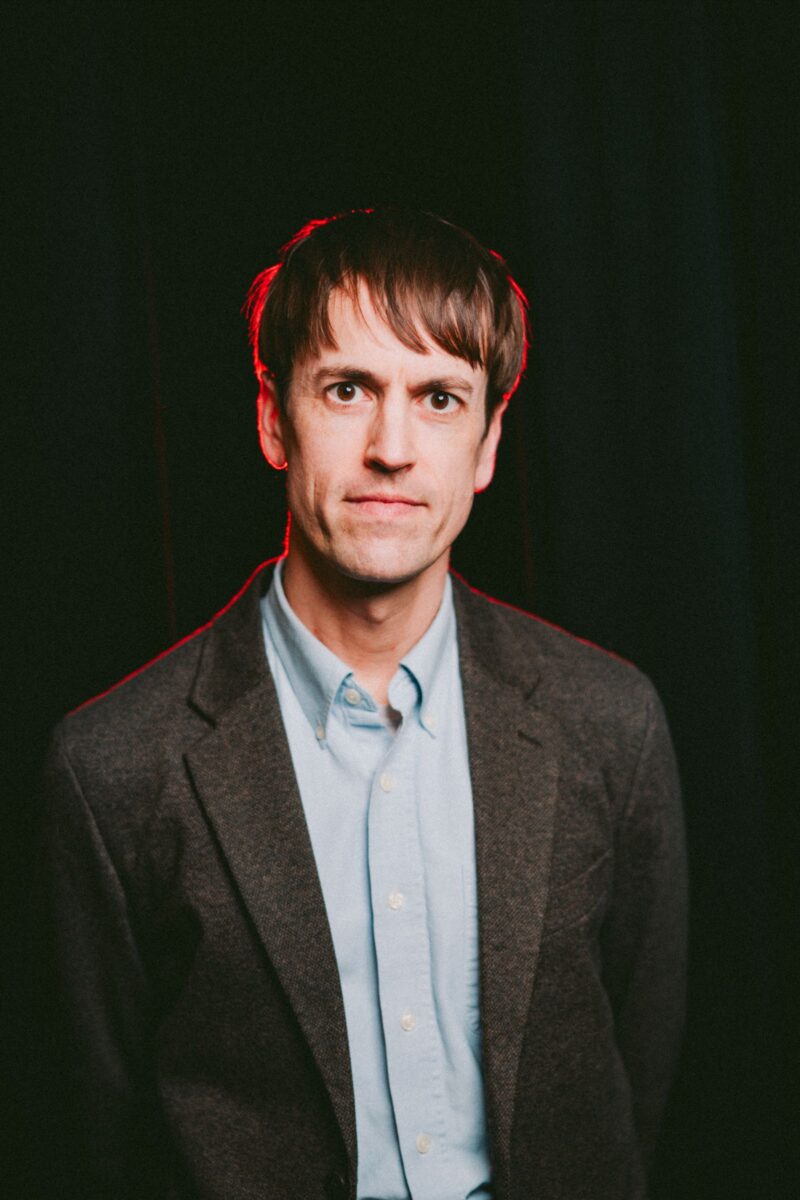
Erupcja premiere at New Directors/New Films. Photo by Arin Sang-urai, courtesy of Film at Lincoln Center.
There’s this complication, which is that you’ve made a movie about someone who is pretty selfish and reckless—I think she treats her boyfriend pretty terribly in the last act of the movie—but you also don’t hate her. But you also don’t hate her because you’re saying, “Oh, you know, she had a rough childhood” or something. You know what I mean? What was it, between what you had kind of constructed and Charli XCX’s performance that helped bring that out?
I mean, I extremely value empathy [Laughs] as a thing that we should encourage amongst all of our fellow humans, and in making something, I am having empathy for all these characters. I’m trying to not judge—I’m just trying to understand—and I know that Charli very much was also coming from that place. I mean, I’m writing these movies with the actors. That doesn’t just mean “what happens next?” It’s also like, “Who are these people?” So these are conversations we are having where she’s putting herself in her character’s shoes—she’s imagining other people she knows and loves and who have done good and bad things. And it’s a game we are playing of trying to understand why humans are the way they are. Why do they do what they do?
Thus I do think it allows us… because, like, that’s always what our intention is. It’s the way we’re always engaging it. We’re not trying to define; we’re just trying to understand. That we do end up with a movie that isn’t saying this person is good or bad. It’s actually just setting up some scenarios, trying to have these characters act in real ways—the ways in which we’ve seen people behave or people we know behave—and make sure that it tracks, that there’s a logic to it. Then hopefully, within our own experience, by the end of it we understand a little more about them and each other. So that was happening during the shoot because it’s so alive—it’s so active, these conversations—and then, in the edit, I’m putting the movie together and I’m sharing cuts with Charli, and she’s a producer on the movie, she’s giving notes; she’s a collaborator.
Yes, of course.
And she’s also doing a really good job as an artist of being objective, of not having notes that are like vanity-based but are just like, “I feel like we don’t dislike Bethany enough. I also feel like Rob is kind of too annoying.” Like, all these subtle things that you can further tweak to eventually settle into that correct balance of being able to understand all these characters and the way they’re acting. If Rob is too annoying, you’re like, “This is nonsense. She should leave him right away.” Like, he needs to present some sort of value; they need to have some sort of connection so that these events that we can’t change… like, “This is what happens in the story. So she can’t be too mean, she can’t be too nice.” And you just try to like thread that needle as you go through.
But that literally is just what filmmaking always is: adjusting the performances so that it’s telling the story that you’re trying to tell. So despite the fact that we’re there without a script, it’s like we’re still just doing what filmmaking is. We’re still just doing the thing you always have to do and make sure that somehow it feels truthful to these characters that you’ve created.
The Rob character seems like quite a sweet, loving guy, which is part of what makes the turn kind of difficult. But it’s also like: they’re just not on the same page.
I know.
And it’s funny, too, because as I say that out loud, it seems so simple. Like: just write something where one guy is nice, and the girl isn’t bad but they’re not on the same page. But then watching it it feels much more alchemical. Which, to me, is why the movie is exciting.
Mmm. I do so much on these movies. It looks like I’m just doing everything. I’m totally not. Not only are there various people at various stages of production and post-production also contributing, but the actors are not just writers. They’re also, like, production designers, they’re also set decorators—they are so involved in the balancing of performance and nuance that are these choices that they are making in order to create these characters that didn’t exist. Like, I’m not doing that, you know. I’m editing it to help it be its best version, but these are things that they are thankfully bringing to these characters.
I’m curious about Charli’s notes. Also, I feel kind of stupid just calling her “Charli” but “XCX” also sounds funny. But you know who I’m talking about. She obviously has quite a prodigious background in music. It seems like this film thing is kind of new for her. I wonder what about the nature of her notes was… I guess everybody’s notes are ultimately unique, but was there anything about them that seemed unique in the sphere of: she’s coming at this having spent time in a different medium, now fresh to this one?
I know. I don’t know if it’s that I’m also sort of medium-agnostic in that, like, I used to be in a band, I make music, I did the score of my first movie. It’s all just creativity; it’s all just making things. Such that it’s not that I felt like I was getting notes from a musician. I just felt like I was getting notes from a creative person who has thoughts and ideas. And she does watch a lot of movies, and she also doesn’t have a big ego. She understands it’s a journey and it’s all about asking the right questions at the right time. Give me one second to try to really remember her literal notes, because I like your question. [Pause] I mean, unfortunately it’s not that her notes felt like it was a musician. Her notes were very big-picture.
I see.
They were good notes. Sometimes when a note is too specific—like, “We should do this”—it’s like, “Ah, that’s actually not helpful.” But it’s this observation about the movie, understanding where we’re at in the edit, her questions just being about: “Are we… is this right?” You know, not saying that it is or isn’t, but kind of questioning, “Are we pushing?” Maybe that’s the way in which it was musical: it probably felt like when you’re in the mix of a song. And it’s not about, “We need to re-record or rewrite this, like, synth line.” It’s just like, “Is it too loud? Are we doing too much too soon? What if we saved that for later, and then it would have more impact in another spot?” I guess that is the way in which there might be a similarity with the way she gave notes on the movie and the way she might give notes on a song as well.
I’ll just quickly add, as someone who has spent a lot of time in Poland, I feel like you captured it very well: a country in the Western world—you get cell phone signals—but at the same time, when I’m there I just kind of feel like I woke up in another world altogether. I think you captured that well, particularly from the boyfriend’s perspective.
Yeah, cool. That’s great. A thing very much for me is how much Polish cinema has been about World War II. And it just felt so good to be like… because if you go there and experience it, it is the specific modern culture that it is. And it just felt fun to make something present in that place.
Even if she’s kind of pulling a ruse, I think Bethany’s point about it being a city of love is not totally wrong.
It’s not totally wrong!
Erupcja enters a limited release on Friday, April 17.