
Exit Elena, Stinking Heaven, and Thirst Street didn’t do much to prepare one for Nathan Silver’s mainstream ascendance. That last year’s Between the Temples pulled the über-difficult trick of maintaining sensibilities in the guise of a movie your parents would enjoy still doesn’t square with Jimmy Fallon pretending to know Silver’s work—except for him having forged a working relationship with Carol Kane, who’s spent decades as a sui generis screen presence embraced by the larger public. Said relationship reached some new height with Carol & Joy, a not-quite-short short film wherein Silver visits the shared apartment of Kane and her mother (who you’ve ascertained is named Joy) as the latter shares stories of her 98 years.
You are probably better off making a four-hour film on said subject than one running 39 minutes, but Carol & Joy found out-of-the-gate success: a Telluride premiere, Natalie Portman taking on executive-producing duties, a hometown debut at the New York Film Festival, acquisition by Janus Films, and streaming on the Criterion Channel all occurred within something like 90 days. Needless to say I was happy hearing Silver explain this project’s path.
The Film Stage: The movie has that thing to it—which is what I assumed was your intent—of dropping into the apartment.
Nathan Silver: Absolutely.
Because you have the knock at the door, you kind of are seeing the place—you, the viewer—for the first time. One of the things about it that’s cool is that you had this… genuine hit, I would say, with Between the Temples. I don’t know what the final numbers on it are.
[Laughs] Numbers be damned.
But everybody seemed to come away from it happy. From Sundance to a nice theatrical run to the New York Film Critics Circle ceremony where Carol Kane is given her award by John Turturro.
Yes, he’s friends with Carol, because they worked together and they’ve known each other forever.
Any film production is a complicated, moving mechanism, so this short film seems like it has a much more humble origin; it has a much more humble kind of life to it. But there is also quite a different ecosystem of attention and distribution between a feature film with that amazing cast and this short that runs the in-many-eyes-undesirable length of, like, 40 minutes, which is the classic—what are you even supposed to do with this thing?
Yeah. [Laughs]
So I wonder what expectations you did or didn’t have about it as it was being made.
Well, the initial intention was to make a short that was gonna be 10 minutes long. I mean, we knew that we were limited by the number of rolls of film that we had—you know, we had budgetary limitations, obviously. Dweck came onboard early in the process and they provided us with a budget to make, basically, a 10-minute film. So we went into it with that idea, and we shot the initial discussion on, I believe, it was a Saturday, then went back Sunday to pick up some other tidbits, and then we went back a month later to get her piano partner and her together. I think after the first day of the shoot we were like, “Maybe this is a slightly longer film we’re gonna see in the edit,” because the way she talks, the way she elaborates, it couldn’t be confined to something so short.
Then when giving it over to John [Magary] to edit it, I think he immediately knew that it wasn’t 10 minutes. Like, I don’t know how we condense this if it’s like one story—if we were to just follow one story through to its logical end, we could hurt the breadth of her life or her and Carol’s relationship. We couldn’t get to what the movie should be, which is basically going to that apartment for a visit. I mean, maybe some editor could get there, but the way my brain works, the way John’s brain works, we couldn’t see a cut that was shorter than a half-hour, say, but we got as short as we could where it felt like going over there, I guess. That was the intent. It was the idea of: the viewer feels like they visit Carol and Joy.
It was the same thing that happened to me the first time I went there. I basically heard all about Joy from Carol while we were shooting Between the Temples and Carol would constantly call her mother to check in with her; she would talk to me and Jason about Joy, and what Joy had been through in her life. And I only met her during the press period for Between the Temples because I went over to Carol to interview Carol for a website, and she has an apartment she keeps—her old apartment—a few floors above the one she lived in with Joy, and that’s where we did the interview. She took me down afterwards and Joy played piano with her piano partner—Jeremy was there, the guy who sings in the movie. He sang some songs with her, she told me stories, and it immediately became evident that there was a movie there. I remember I texted Chris Wells right after this, the first time I met Joy; I told him all about it and he was like, “There’s no question we have to shoot this.”
So then we tried to be reasonable about expectations, and that’s why we’re trying to make a 10-minute piece, which is much easier to get out into the world, obviously. So we ended up with this medium-length movie, and of course it made it difficult for European festivals because a lot of them… if it’s, like, over 15 or 20 minutes and under… basically, if it’s between, like, 20 minutes and 60 minutes, you can’t be programmed [Laughs] unless it’s, like, a special section. You can’t be in the short competitions and such, so it makes it harder to find a place like Cannes or Venice or Berlin. But we lucked out: Telluride and the New York Film Festival made room for it and it was kind of a miracle. Then, obviously, Janus from there took it on. I’m extremely grateful because I know it’s an unwieldy length and it’s hard to know exactly where to fit, but maybe sometimes something works.
I always wonder who watches short films at festivals. So maybe something this length, at least, it feels meaty enough that someone could get involved with the story more. But I don’t know what people watch anymore, so it more was made as a tribute to Joy and to Carol, obviously; that was, like, the goal of it all. It’s kind of funny how things go, because it was really like: we want to capture something, and then it being the length it is, and you find a way to push it into the world, I guess.
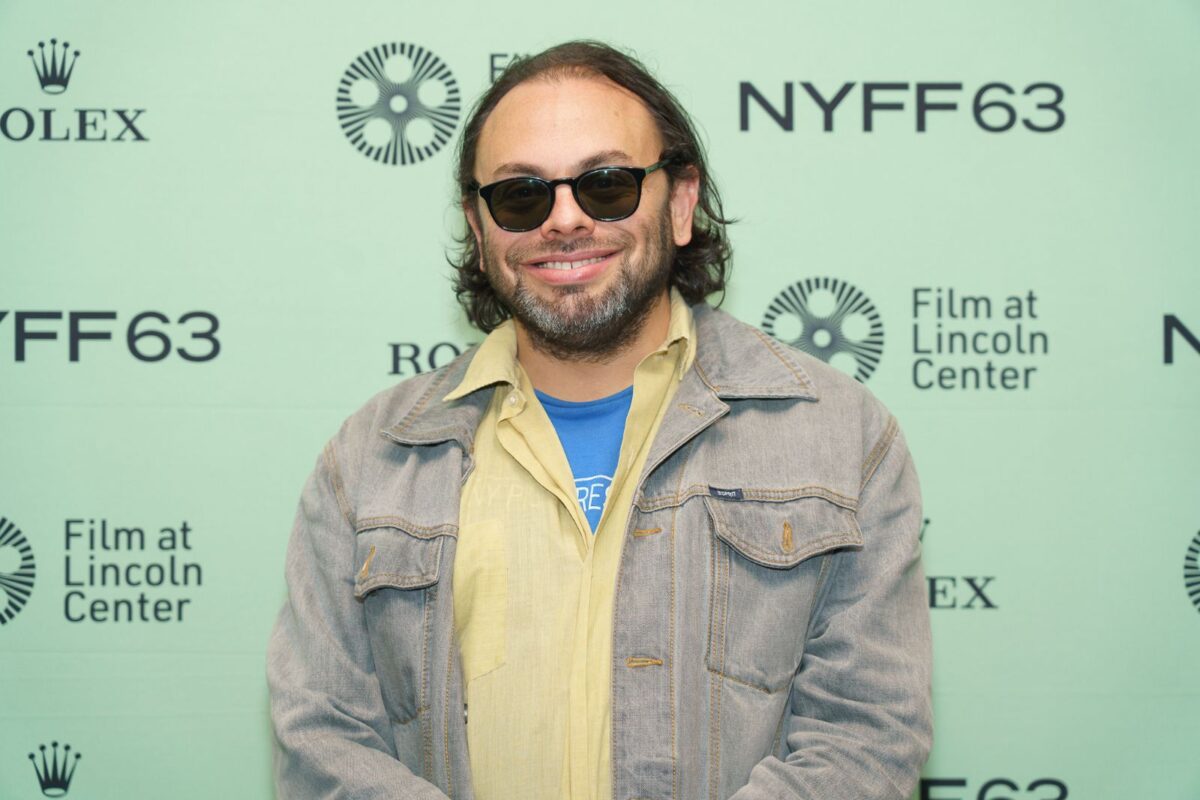
Nathan Silver at the 63rd New York Film Festival. Photo by Colleen Sturtevant.
You had what seems like an uncommon out-of-the-gate success with this thing because it also screened at Telluride.
Yup.
You’re up in the mountains with all the A-listers. I laughed hard at the photo of you with Elle Fanning just because… I mean, don’t get wrong: you deserve to be there with anybody else, but there’s just something like, “Oh, there’s Nathan with Elle Fanning.”
[Laughs]
And then Natalie Portman is getting involved as an executive producer, which is really not a small thing—so I guess I’d like to know a little bit about how she came aboard and what that involvement has looked like, generally.
Oh, absolutely. I happened to have a meeting with Sophie Mas, who’s her producing partner, in Paris, and mentioned this as an aside that I was finishing up this film, and she said she would love to take a look—it sounds like something they might want to get involved in—so it was actually through that, and they helped us finish the film; they basically brought on financing to it and they’ve also pushed it. They’ve been lovely, lovely collaborators. It’s kind of funny because I didn’t even think to ask them to come onboard. It was just kind of out in a very organic way. But this project has had goodwill throughout. Most people who worked on it didn’t take pay because they just wanted to do it, because of Carol and Joy.
It brought me back to when I first started making movies—the feeling of, the spirit behind the thing—and the initial weekend we shot was right before New Year’s, and everyone felt like it was a very quintessential New York “holiday movie,” for whatever reason. Even though the holidays don’t figure into it; it just feels like New York during that time. So I think people were eager to be a part of it, and it was very heartening, I will add, and I am very grateful that Carol and Joy allowed us in there. Now I’ve shot some more with them in Paris, actually, in the hotel where Joy lived.
Really?
Yeah. So I’m gonna try and make a sequel to this.
Can you say anything?
I don’t know yet what it’s going to be, but we were able to capture her and Joy and some of the people who figure into Joy’s French life in a hotel room here, and I’m quite excited to get into it. I have to start editing, but hopefully soon.
So it’ll be like Room 666 for Carol and Joy.
Yeah, exactly!
You have these shots of Joy where the camera feels like this active eye; then the image of you sitting there with Carol Kane to your left, Sean Price Williams right behind you. Whether or not one shows themselves in a documentary is often, if not always, a big question. Why did you decide to be this visual participant?
It kind of just happened. Because it was like: if we’re gonna treat the audience as a guest, to make them comfortable and to kind of make it feel more conversational—to make it feel like the first time I went there, I just need it to be as though I were sitting there talking to them, and inherently it meant that I was going to be on-camera at times, when we had the second camera. Because we had a limited number of rolls—we only had that for a bit of the shoot—but it just felt like I wanted, basically, to be there in the audience’s stead, and they’ve invited me over and we’re getting what it’s like to visit Joy. So that was how it came about on a very base level, and I told Hunter [Zimny] when he was shooting that shot, “Feel free to get me, Sean, whatever—I’m fine with that.” Because it was a very small crew. We’re all guests in their apartment, and I wanted it to be seen and be known.
There are certain shots that—and I kind of hate to use this term, for various reasons—feel more composed.
Yeah.
Or a—again, tricky word—cinematic shot of Carol looking over her shoulder while asking what you want in your coffee. I’d like to know a bit about that relationship between wanting it to feel lively and spontaneous, but also maybe you have Sean or Hunter get the camera, compose, get her, do a bit of blocking—a bit of that strategy of doing that but not making it seem like it’s breaking any sort of boundaries.
We broke down what it was to go into that apartment and then we broke down, in order for it not to simply be us sitting, talking the whole time—what could get us in there in a more active way—and that’s when we came up with the idea of starting with her making coffee. Basically, we had a list of all the things that I thought I needed in the movie, and then I had a knowledge of how much film I had—so I was just weighing all these things, at all times. What I knew I needed in order to get Joy’s stories make sense—that was most important—and second to that was all of the more active things, the voice lessons, the other guests coming in. It was almost like I knew it was about getting Joy’s stories first and foremost, and then all of the other things I need to fill in to give it life.
We just were able to carve the shooting around that, and Sean and Hunter are extremely, just wonderful reactors—they’re always there for whatever. Whenever something’s happening, I always noticed Sean’s camera drifting over to it; there was no monitor on this, so I couldn’t see what he was shooting, but I could see the camera go towards something that I thought needed to be on film. I would be looking around to tap him and he’d already be on the thing that I thought he needed to attend to. It was this funny thing where we’ve shot a lot together—I’ve shot a lot with both of them—and so we have the sense of what’s needed, like a good scene, or whatever were the essential parts of the documentary.
And I think that John—also when I say essential parts—he’s like: “It’s about the details.” The poster of France, the map of France with all of the city circled where Joy taught. All the things that feel essential to what their lives are and what they talk about. You know, his camera’s always drifting through the things that make up a person’s life, and working with him and Hunter follows in that tradition as well.
It kind of keys in with a quote I read from you that really sparked me. You were talking to Filmmaker Magazine about this project, and you were pretty honest about what you felt was an errant strategy you used to have as a director—you had a heavy hand and were over-directing, trying to dictate things.
Yeah.
And it was really an embracing of improvisation that helped you flourish. Seemingly, you’ve brought the same thing to documentary. Anybody who knows about documentary production knows that that can be even more constructed than a narrative, because in documentary you’re trying to make it look like real life and then you end up… anyway, it seems like that was all just a very natural one-to-one—your improvisation process with how you wanted this to come out.
Yes. Because a lot of the things—like, in many of my movies—I’m working with people where aspects of their characters are based on stories from their lives or people that they’ve known. This way I’m trying to get Joy to tell her stories, I’m reminding certain people—like my mom in Exit Elena—it’s like: “Mom, tell that story. Just tell that story of when dad was in the office and how annoyed you were with him and just pretend, you know, the man playing your husband in this film is dad, and duh-duh-duh-duh-duh.” It’s similar elements of recalling certain events or things that I’ve noticed; it’s just the same kind of energy that goes into my fiction films as goes into my nonfiction stuff, and there’s a lot of overlap.
I mean, if you think about this, Cutting My Mother—this documentary I made about my mom—is what led to Between the Temples; I discovered that my mom was taking B’nai Mitzvah classes and was thinking about getting her Bat Mitzvah in her 60s, so that was the seed of the idea from Between the Temples. When we cast Carol in Between the Temples, it was funny, because she watched Cutting My Mother and that convinced her that she liked me—she liked how I was. Because I feature in Cutting My Mother. Watching me work with my mother, it kind of sealed the deal that she wanted to work with me, and then this movie, Between the Temples, of course leading to Carol & Joy. It’s always, like, from nonfiction to fiction to nonfiction—it’s this lovely cycle that seems to be going.
I wonder if the programming and distribution path of Carol and Joy kind of encourages and engenders the making of a follow-up project. Or do you think you would have done it anyway?
I would have done it anyway, because when I found out that Carol and Joy were gonna be in Paris, I knew that we needed to do something with them here. It’s part of her life and it seemed to make sense, but it would be neat if it found a home later on. We’ll see. You never know with these things, you know?
You’ve been in Paris for a bit.
Yeah.
You’ve been working on some stuff. I guess it was in May, the last time I saw you, and it was such a surprise—you were like, “I’m moving to Paris in four days.” And I said, “Oh. Why?” And you said that you were working on a project. But you were somewhat cagey about it—you were not giving up the game just yet—and I guess I wonder if there is anything you can say about it, or if it remains a matter of private record.
It unfortunately remains a matter of private record.
Okay.
But the future will tell. The future will show, I guess—the future that isn’t written will be written. Or be filmed.
I respect that. I’m excited to know that it will be coming, and I’m very happy for this success. My hat is off to you. Any time a friend of mine achieves something, it feels like a fluke. This time, though, it seems genuinely earned.
Oh, thank you. It’s just a fluke. [Laughs]
Well, embrace it.
Yeah, embrace it. Embrace the fluke.
Carol & Joy is now streaming on the Criterion Channel.