
Robert Grainier lives a narrow life of hard work and sudden, inexplicable tragedy. As played by Joel Edgerton in Train Dreams, he’s someone who looks on from afar, who watches rather than participates.
Based on a novella by Denis Johnson, Train Dreams explores Grainier from his childhood through events that make up a quiet, unnoticed life. Written by Clint Bentley and Greg Kwedar, the period drama also stars Felicity Jones as his wife Gladys, William H. Macy, and Kerry Condon.
Director of photography Adolpho Veloso worked with Bentley on his previous film Jockey, a vivid character study starring Clifton Collins, Jr. Working almost entirely on location in Washington for Train Dreams, Veloso has shot one of the most striking films of the year.
We spoke with Veloso at this year’s EnergaCAMERIMAGE, where he and Edgerton introduced Train Dreams at a special screening. Train Dreams is currently streaming on Netflix, and you can read our other conversations about the making of the film here.
The Film Stage: Can you talk about your visual approach? Why use a boxier aspect ratio?
Adolpho Veloso: That came from our earlier conversations about how to make the movie look like memories. We liked the feeling of watching someone’s memories, almost like you found a box full of pictures of someone’s life and you’re trying to piece that life together. They’re all out of order: some photos are posed, some more spontaneous.
Because we had that metaphor, and because in research we kept seeing older pictures of loggers from the period, we thought about using the 3:2 aspect ratio, which is basically the ratio of still pictures. Whenever you are looking at your old pictures, or even today, you have photos on your phone—that’s usually the aspect ratio you’re going to see.
We knew we would shoot a lot in nature, use the trees and sky as a character. Having that taller aspect ratio, we help not only to show nature, but also to isolate Joel’s character Robert Grainer within it. We could position him in the bottom of the frame with a lot of headroom around him. We looked at a lot of Dorothea Lange’s portraits from the Great Depression, where she was able to capture a kind of beauty within all this chaos and despair. She could do that by isolating the faces, having a lot of context around them. You’d see the devastation around those faces.
Did this aspect ratio affect your framing?
I think it affected everything. In most of the scenes we have a bunch of space around the characters because we wanted to show how the places affect those people. One of the themes is how we affect nature and the places where we live, how what we impose on nature makes our lives change.
How did you fill out the frames inside the cabin at night? What do you position behind Robert and Gladys?
We have two big scenes where they’re eating and talking; they have different tones. In the first, the conversation is positive, they’re having fun, they’re connected. We wanted warmth around them, so we put candles on the table, but also around them so you can actually see the cabin. In the other scene there’s a misunderstanding between them; they’re arguing. We wanted them isolated, more disconnected, so the light was just on them. We let the cabin fall into darkness.
The framing was different as well. In one they are together and in the other, more isolated. We worked with Alex [Alexandra Schaller], the production designer, and her team to be careful about what we were putting in each frame and what was changing from scene to scene. That whole cabin was practical—built on location—so if the actors open a drawer there are things inside.
What that meant for us is: we could have enough candles and lamps and lanterns to light whatever we needed.
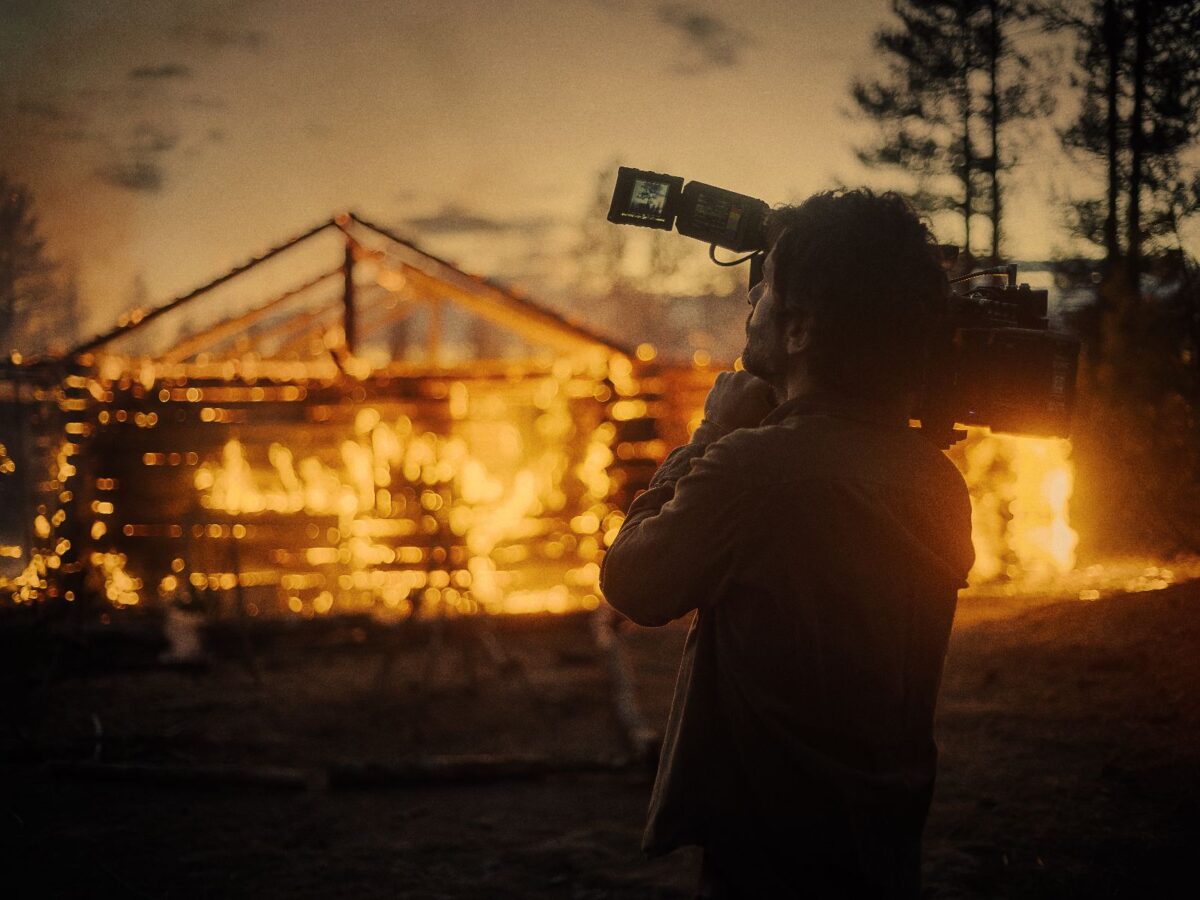
There’s a scene where a newcomer threatens Apostle Frank [Paul Schneider]. You shoot it so the camera doesn’t move or cut to another angle.
Almost as a rule in this movie, we didn’t want to glamorize people being killed. One of the first scenes, the shooting on the bridge, we wanted to keep our distance, not necessarily go for the obvious: close-up on the gun, close-up on the shooter, seeing the victim dead on the floor, whatever. We wanted to show what would have happened in the time period, but without glamorizing it. Almost like you were an observer.
With Apostle Frank, it could be you were taking a break, sitting down for a moment, then this shooting happens and you’re just there witnessing it. It felt like the right choice. The only thing the camera does is pull back to reveal the guy talking. It’s almost like you hear him first, then you see him when we dolly back a little.
We wanted to be really assertive with how we used the camera. Why are we moving the camera? How are we placing people? For that scene, let’s block it in a way where we establish a fresh presence in the frame. Then you see from the distance what’s happening, almost like you are there just seeing it. Then he gets out of frame, and it’s almost like they go back to their lives.
That was the idea for the whole movie: in general, to have the feeling that you are there, you are just another character there, witnessing everything with them.
As the narrator tells us, the entire movie is set in the past, the equivalent of a flashback. What Grainier is seeing are incidents, moments that will become his memories. They will become our memories of the film as well.
Yes. That’s something that Clint and [editor] Parker [Laramie] did in that final scene, when Grainier’s on the plane reliving his memories. They used scenes that we hadn’t seen before, or different takes from scenes, almost to convey that feeling that when you remember things, you’re not necessarily remembering what actually happened.
There is a scene where Robert is leaving for work and he shows a flower to his child Katie, who is not interested; she doesn’t really care. When we revisit that scene in the end of the movie, they use a take where she reacts to the flower, almost like he’s having a sweeter memory than what actually happened.
We knew from the beginning that the film wasn’t necessarily going to be chronological. We had this idea that you’re telling someone’s life. You start when he was a kid and then he grows up and then he gets married—but then he remembers something that happened actually like 10 years earlier, which you need to include before you can continue the story. The whole concept while shooting and then editing was how to perceive the story as memories.
When you’re composing a frame, is there a way to make the image more like a memory than reality?
We used rules depending on what area of his life we were seeing. Whenever it’s something that happened to him as a kid or as a teenager, distant memories, we didn’t want to move the camera at all. The thinking was to make it look more like a photograph. When I’m reliving a memory from my childhood, I’m not really sure if I am remembering actual things or something that I saw a photograph. So the rule became: whenever we see him as a kid, it feels like a picture.
Later in his life, it’s a combination of everything. Sometimes the camera doesn’t move at all; sometimes it’s fluid and handheld and moving around. Sometimes we observe through windows something happening outside. That’s a bit like how memories work. Sometimes you remember things really well. Sometimes it’s only an impression, a smell or taste or feeling. Or a light. You don’t remember it very well. A lot of times you won’t even remember what was in the background, just who was in front of you. We can make the background fall off into darkness, for example, or out-of-focus, to convey that.
For his adult life, we used everything: fixed cameras, dollies, crane, handheld. In his later years, we don’t use handheld anymore. We start using Steadicam because we wanted to stay fluid, but a bit steadier. Like he’s understanding his life better.
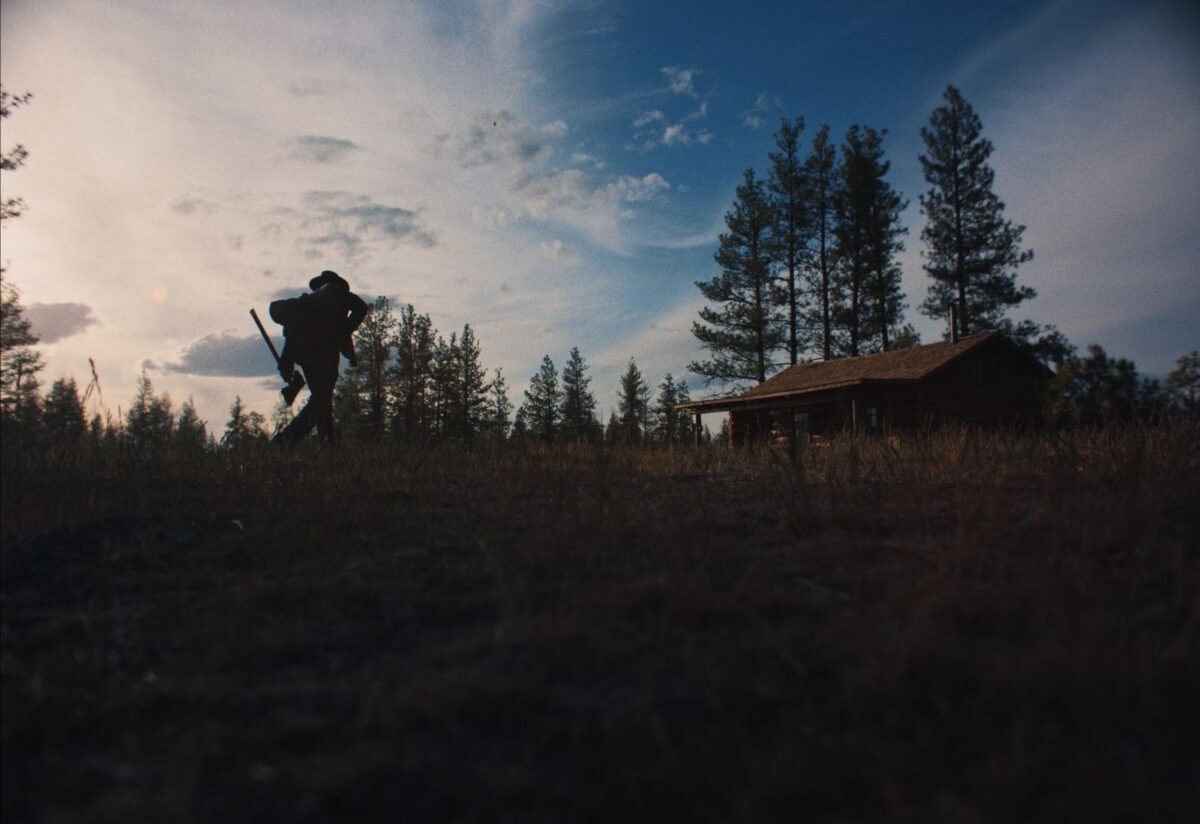
The wonderful Kerry Condon has a couple of scenes with Edgerton. She plays Claire, a forest worker, who meets Grainier on the way to a fire tower. You did an extended two-shot of them on a moving wagon.
For Clint, it’s a really important scene because she’s saying things Robert’s never really heard before. Clint wanted to make a strong impression. We wanted it to feel like Grainier’s immersed in what she’s saying. But the scene is two characters talking on a wagon, which is basically a car shot. Right? We’ve seen that so many times.
We went back to Jockey to see what we liked and could repeat, what we hated and wanted to avoid. I think there were three zoom shots that we loved. We found a few places where a zoom made sense here. Always slow zooms that immerse you in the moment. This was one of those moments. We rigged the camera to the wagon, which was moving. I’m operating, zooming slowly in on her while she’s talking. It’s almost like you’re being like hypnotized by what she’s saying.
You have to be hitting certain beats in her dialogue while the wagon’s shaking. Plus, your depth of field keeps shrinking.
First of all: we wanted to keep it real. Not shoot on a green screen because we’re in such a beautiful place. Because the camera’s rigged to the wagon, the characters aren’t moving—the background is. The thing with those slow zooms is that they’re hard to get on the first take. I have to get a feel for the timing. And each take is slightly different to some extent.
By the end of the shot, only her face is in-focus.
We wanted that feeling that he’s totally swept up by what she’s saying. It’s so different from anything else he’s heard before. It’s a point in his life when he realizes he’s not totally alone. His life experiences have been shared by others as well. It’s such an important point in his journey. If we can help convey that feeling with the camera, why not try?
Did you know when Bentley was going to use dissolves?
No, but I thought they did an amazing job with them. It’s a lot of the same team that worked on Jockey. Parker, the editor; Lee [Salevan] with the sound; Bryce [Dessner] with the score. Knowing they would be involved, you build a sense of trust, you feel your material will be in good hands. Also, they watch everything, all of the footage. So I could have my eyes open to shoot other things. They ended up using those small moments we grabbed.
Watching this, I thought your job is not to make pretty pictures, but to illuminate a life, which is a very different thing.
The movie works well beyond specific ways of making things look good. We still wanted to show a life that was magical, especially his moments with Gladys, Felicity Jones’s character. We really wanted those moments to be beautiful, special. We shot many of them in magic hour. After he loses his family, then we have a much stronger sun. Then it’s more about showing devastation, which can also be beautiful.
You had 29 days to shoot. Was the weather a problem?
Something I learned with Clint is that he embraces everything that comes our way. He’s always ready to adapt and to encourage everybody to adapt. So if it was cloudy and it was supposed to be sunny, we would just embrace it. If it was raining, we would embrace it. We would never try to fight against what was brought to us. The same thing with the kids and the animals in the movie. We have so many scenes that could have been a nightmare if it weren’t for Clint and the cast, especially Joel and Felicity, embracing whatever those kids would give them. If the scene was supposed to be “the kid is happy” and the kid started to cry, they wouldn’t fight it. They would make it work.
When their daughter Katie throws her bucket into the river, did you anticipate that?
No, no, not at all. She just threw it. And then it became a moment.
What were you shooting on?
We shot with the Alexa 35. We had two bodies, but we just shot single camera the whole time. We had two sets of lenses. Kowa for daytime, mostly because I love their flares. I really wanted to feature them when we knew we were going to have a lot of scenes with the sun. They’re slow lenses, and because we were going to shoot with real fire, we needed faster lenses for the interiors. Then we had the MK II super speeds. We also used them on Jockey.
No drones?
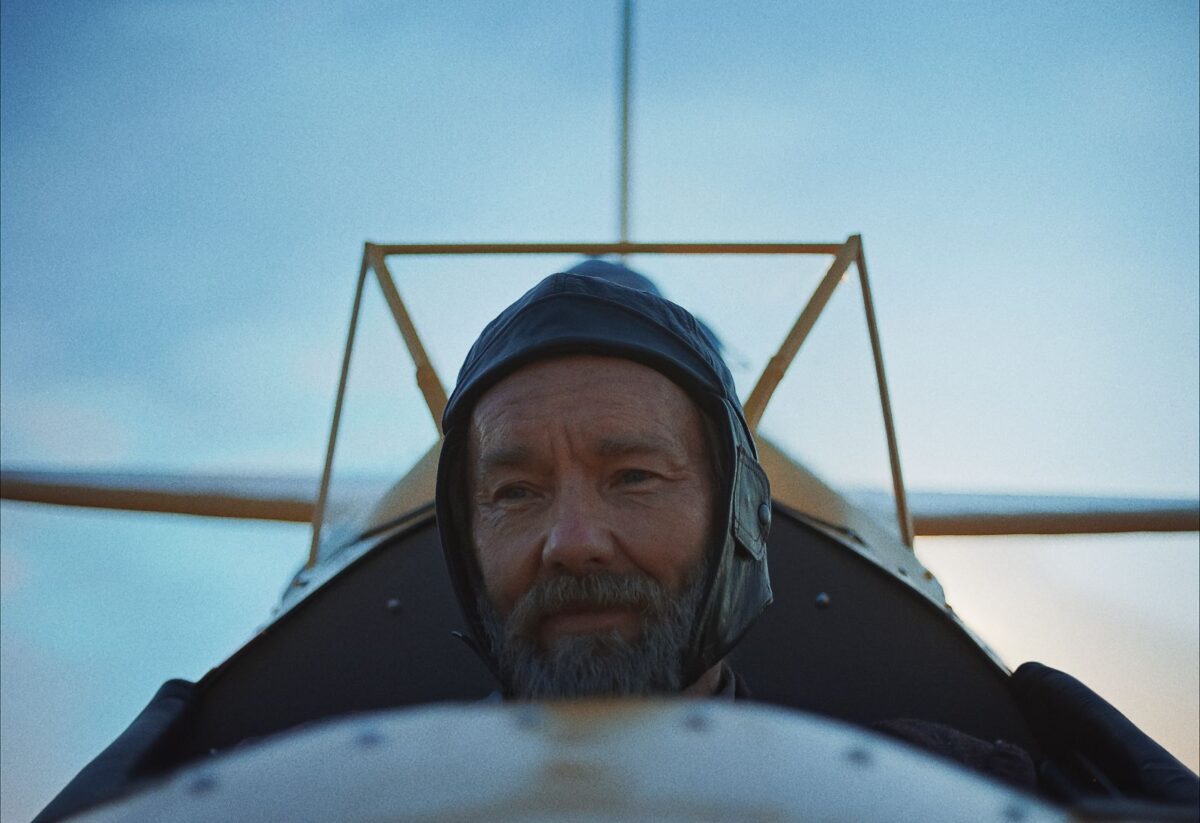
No drones. Going back to what I said before: we wanted to portray nature as a character. We don’t shoot people with a drone; that doesn’t make any sense. We shot nature almost like a reverse, or an over-the-shoulder. That’s why we have shots of Grainier with nature around him that’s seen over his shoulder. We also wanted to keep that higher point of view for the ending when he’s on the plane. That’s the first time he’s seen the world from that perspective.
At the screening last night, Edgerton said that older viewers might find it easier to connect to the movie because they’ve experienced grief.
I feel like I could identify with the character. He’s basically how I am.
An observer?
Exactly. That’s basically who Robert is. Understanding that, connecting with that, was important for me. Robert goes away from his family to work for months at a time with people he doesn’t really know. He might never see them again. Everybody’s kind of eccentric and full of ideas and opinions. And then he goes back home. It’s really hard to reconnect when you go back home. He doesn’t know what to do. Things have changed.
My life on this movie was going to Washington for five months, living a life that doesn’t have anything to do with my “real” life or the place I come from. With people I never saw before and might never see again. Then going back to either Brazil or Portugal and feeling, “Oh, my God, what am I supposed to do when I’m not working? How do I reconnect to this place? It doesn’t make sense anymore.” There were a lot of personal aspects on the movie that really made it special for me.
I think Joel’s answer is still good. The older you are, the more this hurts.
There are so many ways to connect to this movie. When Clint sent me this script, he was like, “I’m not sure you’re going to want to collaborate with me on this.” He was surprised that it meant so much to me. I think this is how art should be.
I just wrapped a movie with M. Night Shyamalan. It’s amazing to work with directors I’ve admired since I was a teenager. But I cannot wait to work with Clint again. There’s something special about building a project, developing a language together, making mistakes together, dealing with frustrations together. It’s like growing up together. I’m waiting for Clint to have another script.
Train Dreams is now on Netflix.