
It’s a scenario that, under certain fascistic goverments, may not seem so far away: in order to increase economic output, the elders of society are mandated to live out their lives in far-off colonies. This is the backdrop of Gabriel Mascaro’s Berlinale Silver Bear winner The Blue Trail, a wonderfully expressive Brazilian drama following Tereza (Denise Weinberg), a 77-year-old who defies orders and charts her own journey through the Amazon and beyond.
Ahead of The Blue Trail‘s U.S. release this Friday, I spoke to Mascaro about its inspirations, mixing genres, inverting the perspective of the coming-of-age film, being part of the recent wave of Brazilian cinema, and how relevance will only continue to grow.
The Film Stage: I read that the film was partially inspired by your own grandmother. Can you discuss how you came up with the story and what kind of tones and feelings you wanted to capture?
Gabriel Mascaro: Yes, it was very special because she started painting after my grandfather passed away. It was very inspiring to see someone her age creating new meaning for life. I told myself I wanted to make a movie about this feeling, featuring an elderly protagonist and showing this perspective. When I started investigating elderly characters in cinema, I found they are rarely associated with that specific feeling. Generally, the large majority of movies associate the elderly with death, terminal illness, or nostalgia for the past. Elderly bodies are often seen as repositories of the past.
I tried to invert this perspective. Suddenly I realized that the genres dealing with coming-of-age, of learning something—or “rites of passage”—are almost always associated with young bodies. Dystopias as well, if you think about rebellions, they are also rarely associated with elderly people. I wanted to play with that: to create a playful movie where the protagonist reclaims the capacity to be the lead in different genres that normally do not accept the elderly. The soundtrack also helps with the tone, making it a very playful, almost lyrical and ludic experiment, making a road trip movie where she is facing this coming-of-age and not death, but life.
A thing I love about all your movies, and especially this one, is that there is a message, but you convey it through mood and atmosphere rather than being didactic or heavy-handed. You leave the audience with very memorable images and characters, and that often says more than words could. What was the process to ensure the audience was engaged through your visual storytelling?
For me, it’s a movie about an older woman who wants to fly, but in the end she discovers she can fly even higher than she imagined. It’s about the understanding of the right of choice, taking risks, and finding new friendships, new complicities, and new allies at a late age. It has been special to see mature audiences engage with this character where they can mirror themselves in this “fabulist,” absurdist way.
But seeing a young audience in the cinema is also beautiful. The capacity to celebrate life and new experiences through an older character is special because we quite often associate the idea of “discovering life” or “coming of age” with young people. It was a challenging project because of the arc of the character, because seeing an older character have a psychotropic experience is usually associated with someone who was at Woodstock or was a hippie. This character isn’t that; she starts from a very conservative, pro-regime, and patriotic standpoint. She realizes she only has a few years left when the government tries to reduce the age of entrance to the colony. That’s the starting point. Then how the character changes, it’s beautiful. She starts conservative and then she starts experiencing life and other desires. She has a new consciousness. Even at the end, when she has a “queer” encounter with another lady, she has no label for it. For me, that was beautiful because it was something that could happen to anyone.
It was also interesting to premiere in Brazil, as we have this famous actor (Rodrigo Santoro), and many different kinds of audiences came out. Brazil is so polarized, a bit like the U.S. I can imagine, but it was beautiful to see some people who were not expecting to watch this kind of movie, but at the same time, they felt so connected to the character because this character comes from this conservative thinking, patriotic, then it’s a glimpse of life that occurs to someone else.
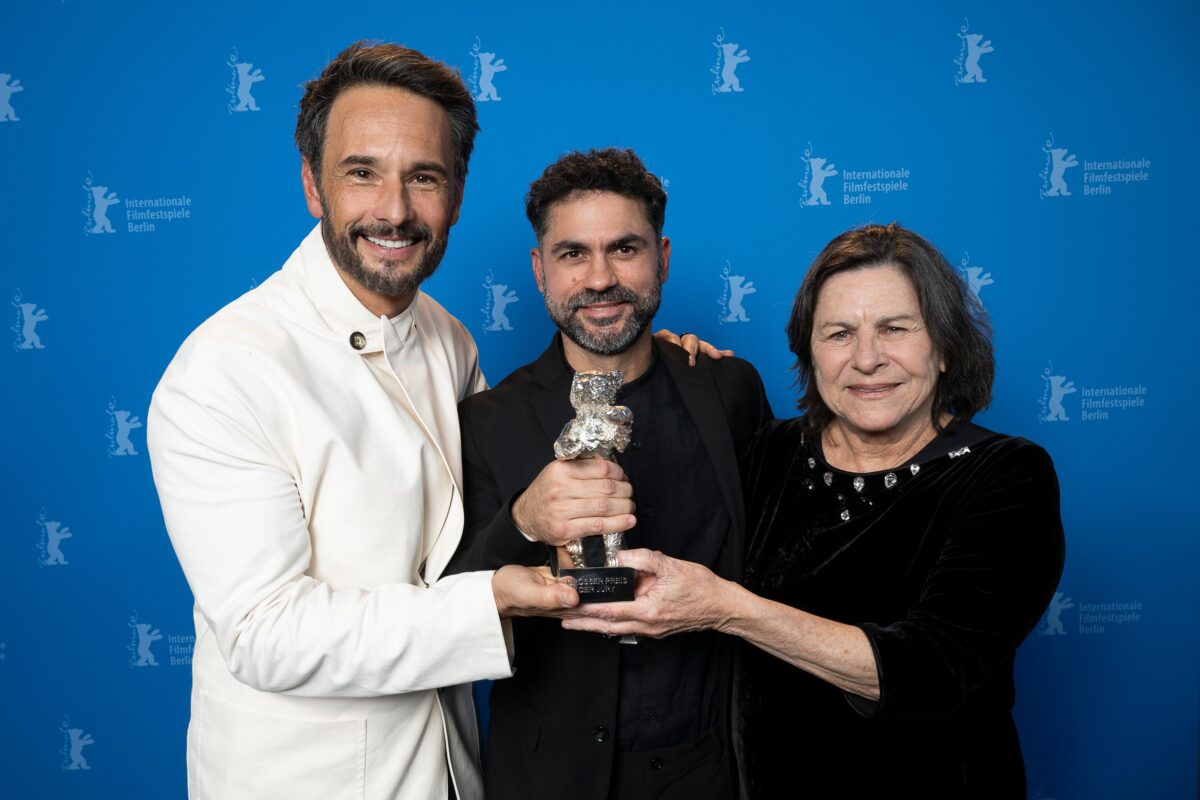
Rodrigo Santoro, Gabriel Mascaro, Denise Weinberg at Berlinale 2025
Yes, an awakening. The sequences with Rodrigo Santoro floating down the river are some of the most beautiful shots I’ve seen all year. What was your collaboration like with cinematographer Guilherme Garza? Were there specific films or paintings you referenced?
Since this movie plays with different genres, we had to look at many films while trying to find our own unique way to make them work together. That was the most risky and challenging part. During the screenplay phase, I was influenced by Before Sunrise. During shooting, I remember watching the trilogy by Ulrich Seidl, and he has amazing cinematography, specifically Paradise: Love. I like the way he creates very symmetric, still shots, and then at some point, things become very flourishing and open as we follow an erotic body. That was very special for us.
The movie has many different kinds of references just because it is a genre-playing movie, mixing dystopia with “coming of age” and road movie elements. We were really excited to make this counterintuitive provocation by blending genres that do not usually accept elderly bodies. That’s why the movie starts with a dystopian feeling, but the character is dancing for the camera. It’s almost like an invitation to dance together. This movie is not a hard dystopia. It’s a playful experience. Let’s play together like the old-lady character having different experiences.
The movie premiered at Berlin last year and it’s finally coming out here. In the time since then, I’m Still Here won an Academy Award and The Secret Agent had a huge run. It’s been a great time for Brazilian cinema. What has it been like as a director seeing all this excitement, and do you feel part of a collective movement?
It is so special. As a filmmaker that is also part of the audience. I was influenced by this kind of discovery. You see the Romanian cinema, and I was touched later by the “Argentinian Boom” with Lucrecia Martel and Lisandro Alonso. It’s beautiful to see Brazil as part of this moment, for sure. If you watch these three movies (I’m Still Here, The Secret Agent, and The Blue Trail), they are all quite different. It is great to see Brazil showing this diversity; we aren’t talking about something standard. We can be singular but together under this label of “Brazilian.” It has been a very intense year for Brazilian cinema and a very special recognition.
Regarding casting Denise Weinberg, what did she bring to the role that surprised you beyond the script?
She is an amazing actress. I met her during pre-production. She comes more from the theater world than the cinema world, so it was special to have someone like her who was so open and very proud of her wrinkles. Sadly, the first generation of actresses of her age in Brazil were pressured by the industry to hide their age with procedures. It was very special to find someone really proud of her aging and very smart about her understanding of how her wrinkles and marks of life could be part of her character.
She’s very smart. She studied the character and proposed a lot. She was really open to experiencing different directions and this “psychotropic trip” with the blue rose snail. It was a totally free performance in terms of what the body would feel while experiencing the snail. It was an amazing, magical experience in the Amazon with her and Rodrigo Santoro as well. He’s a very big, very experienced actor. It was nice to reshape the idea of how the Amazon is portrayed in cinema. It’s not this almost fabulistic, absurdist world.
As average life expectancy gets older, I can see this film becoming even more relevant. You present a scenario of what could happen, but you aren’t interested in giving concrete answers, you’re offering a perspective for people to consider. Can you talk about that approach?
The film has this humorous approach, almost like a comedy, but it deals with very serious issues. Some audiences ask me if it’s real. “Is this really happening in Brazil?” It’s funny because, in reality, Brazil is the opposite: we are still very family-connected and don’t have many nursing homes compared to Europe. But while it’s not “real,” the feeling that it could be real is what is so scary. That is the most powerful thing the movie generates: the idea that it could happen. You can laugh and have fun, but in the end, you feel so violated by the possibility of it happening. It makes you alert. People can say, “It’s not real, but I could easily understand this happening.” It’s like 1984 for the elderly.
The Blue Trail opens in theaters on Friday, April 3.