
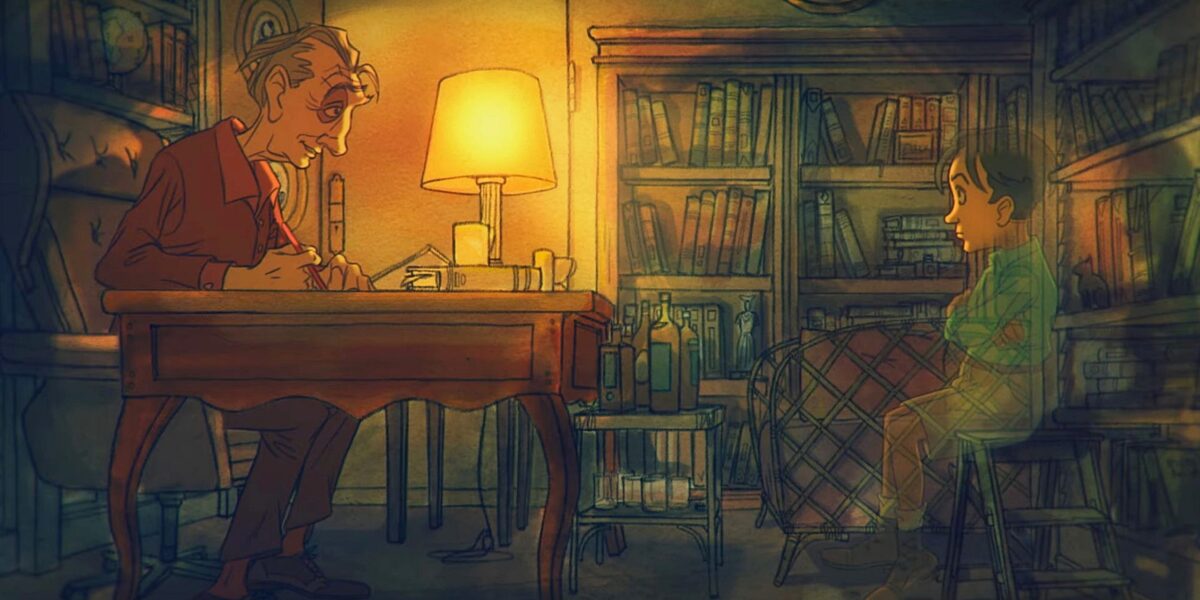
“The idea of the young [Marcel] Pagnol visiting the older Pagnol is nowhere to be found in his books,” director Sylvain Chomet tells me when it comes to A Magificent Life, his first film in fifteen years, a wistful animated portrait of one of France’s greatest artists. “The story about him being encountered by himself is me. It’s my creation. I don’t want people to believe that it’s coming from a book; it’s absolutely not the case.”
While the French filmmaker is adamant about his personal touch when it comes to the structure, he is also keen to note that every story in the film comes from Pagnol’s real life, down to exact dialogue. Hopping through key points of Pagnol’s life and career, as we also get an in-depth look at the filmmaking process, Chomet captures a man of ideals in a changing culture, all beautifully captured in digitally hand-drawn animation.
Ahead of the film’s U.S. release beginning this Friday, I spoke with Chomet about his process of animation, utilizing real footage from Pagnol’s films, the film’s connection with Martin Scorsese’s The Aviator, what it was like to collaborate with Todd Phillips on Joker: Folie à Deux, and how he’ll return to the world of Triplets of Belleville for his next feature.
The Film Stage: One of my favorite scenes is when Pagnol says how important it was for cinema to be protected, even in France. Obviously, that’s a major thing that’s come up in recent years with how the US government is talking about art, culture, and tariffs. He wrote this many decades ago, but what was it like for you, incorporating it into this story many years ago?
Sylvain Chomet: Every single sentence in this speech comes from him. That was made right after the war, so it’s really, really old. But Pagnol had the feeling that cinema was a very powerful tool. He knew that from Adolf Hitler, who used cinema a lot to pass through his ideas and his conception of life. So Pagnol was really aware that through cinema, you can change a culture.
He wasn’t against American cinema; actually, he really loved American cinema. He was very good friends with Orson Welles, and he’d always been fascinated with American culture and American cinema. But he didn’t want to see American cinema being the only cinema that you can watch in France. So he decided that, through the profits that the studios were going to make in France, they would take some money and they would finance French movies, which explains why we still have a cinema today and some countries don’t. Some countries have really lost that; they didn’t have this protection thing.
But then he was right, because it’s still the same today. There’s a quota, so you can’t have a majority of American movies. And the way I actually introduced it, because he’s talking a bit also the way that it could change a lot of things culturally—the only thing he didn’t talk about because he didn’t see that coming, it’s about the food. That also there would be a change in the way people feed themselves. So that’s something I’ve added because I lived longer, I live after him, so I know exactly how it became. But otherwise, it’s really not against American cinema. It could have been Russian cinema; it would have been the same. There were a lot of Italian movies, for example, and Italian cinema has perished because they didn’t have this protection thing. Belgian cinema has perished as well because they didn’t have this thing. So I’m very happy that this thing happened and that we still have a very strong French cinema.
I really loved how you used his actual live-action footage from his films throughout. I assume that was decided very early on, but how important was it for you for people to see a glimpse of his actual genius and how audiences reacted to it?
Yes, it was very important. I mean, it’s something I did already in my other films. I always had, in The Triplets of Belleville and in The Illusionist, the characters looking at live-action as if it’s through a mirror or through a hole into a parallel universe. It’s always people watching a screen, you know? It’s not just the full [frame] because that would have been weird. And like that, it’s working; it’s like the other side of the mirror. It’s quite funny.
And also what I did: I tried to make the look of the live-action being a bit graphical, putting some filters on it so it’s not too clean and too perfect. And I think it was very important to actually see the real actors, because in the film you see a lot of Raimu, you see a lot of Orane Demazis, you see a lot of Jacqueline Pagnol, but it’s quite nice to see them in real life.
It’s really funny, because Nicolas Pagnol, who is the grandson of Marcel Pagnol, he said something really nice. He said after a while, it’s like the animation part is the real life, and that the live-action footage looks like animation. That’s something I really wanted to do, because if it’s just an animated movie, people might think it’s not completely real. But everything is real, all the stories are real inside the movie. The only unreal thing is the little Marcel and old Marcel. But if you take things like the thing with the sheep, that’s a real story. Most of the words are actually from Marcel Pagnol and from his memories. I had to put at the beginning “based on a true story” because a lot of people after screenings were saying, “Is it true that…? Is it true that…?” And I say, “Everything is true.” I wouldn’t invent someone’s life.
You mentioned how it was important to make the story a bit universal. You’ve compared the approach to Scorsese’s The Aviator and how you don’t need to know anything about Howard Hughes’ films to enjoy it. I’ve only seen a few Pagnol films, but I really enjoyed the whole movie just learning more about his life. Could you talk about that approach to make sure any audience could watch it and enjoy it?
Yes, I really believe that you don’t have to know who Howard Hughes was. Most of the people in their 20s or 30s don’t even remember who he was. But you don’t have to because it’s the story of a man. And also it’s a story of cinema. The Aviator is very much about that, and the Pagnol movie is really a film about cinema. If people love cinema, they’ll be really interested to know how someone invented the dialogues for cinema, because basically, the very well-written dialogues for the cinema really started in France with Marcel Pagnol.
Marcel Pagnol is saying that at one point: “Now the movies are talking. It’s not really important that they talk; it’s important to understand that they’re saying something.” And the first movies were basically musicals—a lot of singing, things like that. And when he came, he just decided to have the dialogues being really something very artistic and very powerful.
And I think it’s important to see, also, this period in France and see how things were going really fast. Technologies were changing, life of people was changing, there was war and things like that. But it’s a film about cinema, and I’ve always been a big fan of films about cinema. I’m a big fan of films like Ed Wood, for example; I really love this film. La Nuit Américaine [Day for Night] from Truffaut. I really like when cinema is talking about cinema.
I’m very interested in the day-to-day process of animating. How big is the team that’s working on the film? And I know you use computers, but you’re hand-drawing on tablets, right? Can you just walk through the day-to-day? In one week, how much do you get done and what are you focusing on?
Oh my God, that’s really big.
Anything you could answer about it would be great.
It’s very difficult because there are teams I didn’t even know. There were teams based in Vietnam. There’s a lot of Vietnamese people there who were doing in-betweens. There were studios in Luxembourg and Belgium. So it was a bit all over the place, as the way you do films these days. But technically for this film, it’s basically the same technique as Triplets or The Illusionist, but this is the first time we didn’t use paper at all. So we didn’t have to cut trees to do this film. It was just tablets, Cintiq. But everything is drawn the same. You need someone to actually draw every single frame of the animation. But there was quite a lot of people. I can’t really say how many there were.
As the director, what are you giving them as a reference and how frequently are you reviewing? Are you seeing it in six-second chunks, or are you seeing bigger? I’m just curious about that process that you oversee.
For this movie, I used something which I never used before because it’s a talking movie, and my other two films were silent movies. So I didn’t have to focus on the acting, really. And this film, there’s a lot of dialogues, a lot of scenes where they are at tables and they’re talking and they are reacting. So it couldn’t be as cartoony as my other films.
So this time I used the method that Disney was using since Snow White. Basically, all the human actors have been shot and were used as a reference, with the real costumes and everything. So I shot all the film with actors. Then I edited it. We had actors on a green screen without the backgrounds or anything like that, just to get the gist of the acting. I edited that and that’s what I gave to the animators. But I really did it the way Disney was doing it. Basically, we use the motion; we don’t retrace the actors. We don’t do what you call….
Rotoscoping?
Rotoscope, yes. We didn’t do rotoscope because the characters don’t have the same size—they don’t have the same proportion—and the heads are very different. We didn’t use the faces of the actors. But we used the reference for the costumes, for the dresses, for everything like that, and also for the acting of the characters—the way they talk with their hands. Because I’ve directed that, then it was easy to give that to the animators because all the direction was made. So we went really fast then. It was really useful, because we could go really fast in the animation. We didn’t have to have the animators going, “Is that okay like that?” and trying things and maybe they don’t work. Everything was already spot-on, so they just had to enjoy making it nicer and making it very fluid.
I know you haven’t done many interviews for it, so I just want to quickly ask: you did the opening sequence for Joker: Folie à Deux. What was that process like?
I was contacted by Todd Phillips, a very nice man. He contacted me by email, and he introduced himself. It was really nice because he said, “Hello, I’m Todd Phillips. I don’t know if you know me, but I did this film called Joker.” [Laughs] And I said, “Yes, I know you.” So the idea for him—he’s a big fan of The Triplets of Belleville, and he wanted his film to start with a cartoon like Triplets starts with a musical cartoon.
But I said to him, “In Triplets, it’s more like a Fleischer kind of animation, it’s more like a Betty Boop kind of thing, and it’s black-and-white. And I’m not sure you want to start your film with black-and-white. Maybe we do something vintage, but like Tex Avery or something like that.” And so that’s what we did. I designed all the characters and we made a fake old film. It was the idea to make it look like a very old vintage film. And for me, it was like a kid’s dream because, when I was a kid, the only animated films I could see on television were coming from Warner Bros.—Bugs Bunny and all these things—and for me, it was really great to actually see the logo, the first logo when it starts, the Warner Bros. logo and we hear [hums the “The Merry-Go-Round Broke Down” opening music]. Oh my God, it means so much to me. And then the film starts.
But I didn’t see the script for the rest of the film. I just saw, probably, the first two minutes because there was a link with our animation. But the animated film was written by Todd. He had everything he wanted to say. But I designed the characters and I did some other stuff. It was really nice. It was a great collaboration.
It was great to see you on the IMAX screen like that. And you mentioned your next project is a sort of spin-off of Triplets of Belleville set in the space race. I’m just curious if that is still happening and what it is like to return to that world around 25 years later?
Yes, well, it’s in a very bizarre way. It was written at the same time as The Triplets of Belleville. So it’s a very old scenario. And it will have the same feeling as Triplets of Belleville—it’s that quirkiness and silliness. People who are going to see Swing Popa Swing—that’s the name of the new film—they’re going to be transported back 25 years ago. It’s really me 25 years ago; it’s my brain from there.
But also it’s a film that you won’t need to know the first one. It’s not a sequel or prequel or anything like that. You don’t actually have to know the first film. And we’re just taking the characters of the Triplets, the three tall old women. It’s a story where we see them when they’re young, when they’re little girls. It’s a story with their dad. It’s just mad because these characters are still mad. And it takes place in Belleville and there’s a lot of different stories going on. It’s really full of music as well. It’s a feel-good movie. That’s really something I want people to get out of the cinema and have a big smile and have the music in their heads and want to dance. This is really what I want to do. A bit different from my last two films, which are a bit more—I won’t say intellectual, in a way, but this one is going to be really a feel-good movie.
And it’s great because most of the people—I can see people now, probably people your age, who were quite young when Triplets was released, and now they have children and they say, “Oh my God, yes, I’m going to take my kids to see the new Triplets.”
A Magnificent Life opens in theaters on Friday, March 27.