
Harry Lighton’s Pillion was one of the highlights of last year’s Un Certain Regard at Cannes, garnering wide acclaim and a fair amount of titters for its frank sex scenes. Lighton’s feature debut, after the 2017 short Wren Boys, earned him the Best Screenplay award in the section.
Adapted from the novel Box Hill by Adam Mars-Jones, the film follows a young gay man named Collin (Harry Melling), as he enters into a dom/sub relationship with mysterious biker Ray (Alexander Skarsgård) and starts to come into his own. While romantic and sexy, what most surprised me was how tender and sweet the film can be, showcasing a subculture and community that’s still relatively fringe without sugar-coating the often turbulent experiences of its young lead. Melling and Skarsgård’s excellent performances are anchored by Lighton’s strong visual sensibility, which lets audiences draw their own conclusions from both the rush of a motorcycle ride and the harsh reality of sleeping on the floor.
While already opening in its native UK––with three BAFTA nominations to boot––A24 is releasing the film in the U.S. this Friday, while a wider release comes February 20. I spoke with Lighton about his adaptation decisions, depressing gay films, and how to do justice to the community at the center.
The Film Stage: I wanted to start by asking about how you first came to the novel Box Hill by Adam Mars-Jones. You mentioned in the press notes that you initially thought about setting it in Ancient Rome or on a cruise ship. Why did you consider those places for this dynamic, and what made you come back to the story as it is?
Harry Lighton: I was sent the novel by a woman called Eva Yates, the Head of Film at the BBC. We had been working together on another film set in the world of sumo wrestling in Japan, but then the pandemic happened and that became unviable. She sent me this book and said she thought I’d like it. She was right; I loved it. It had this amazing tonal cocktail where in one sentence you’d be laughing, in the next you’d be considering something, and in the next you’d be emotionally moved. I like material that has that kind of “tonal plasticity.”
Part of my writing process is exploring things in a broad way—setting wide parameters to test things out before narrowing in. The novel is set in the 1970s biking world in England. I was pushing against the original material, thinking about other places where power dynamics might play out. Ancient Rome—though in retrospect, I don’t think it was a good idea—has gladiator schools with obvious homoeroticism.
I could see a version of this story there, but maybe not for this specific dynamic.
That might work better for a “porn version” of the story.
The book itself feels very… not pornographic, but like a strange, seedy paperback fantasy of that era, with poker parties and oral sex as a reward.
Yeah. As for cruise ships: I find them fascinating in terms of status. You have all these hierarchies, people above and below board. There is a lot of capacity for power dynamics in a setting that reflects that hierarchy. I also liked the idea of setting a kink relationship within a world that felt “normal.” A cruise has so much collective behavior—200 people doing the same yoga routine or eating the same meals. Seeing an unusual, transgressive relationship happen on a cruise ship provided a great juxtaposition. We ended up doing a similar thing by setting it in the High Street in Bromley and shooting with hidden cameras to contrast that “everydayness” with what’s going on between Colin and Ray.
It’s interesting because, in my experience, seeing people with lock necklaces or pup masks around my community isn’t necessarily “normal,” but it’s not unusual.
It’s matter of fact. The idea was to present it in a non-sensationalized way where you see the “warts and all” of these people. And often, when you specifically think about “doms,” their hardness is the main way they’re depicted, but in these communities there’s also warmth and campiness. I wanted to lean into that campiness in moments like the scene where they throw him a birthday party.
It reminded me a bit of The Duke of Burgundy, the way where something like scrubbing boots can be this intimate thing.
I love that film. It’s slightly different from Pillion—it’s more ironic and otherworldly, dealing with different themes and symbols—whereas Pillion is very rooted in realism.
Regarding the modern-day setting: was that purely a practicality regarding the budget, or was it also to avoid themes like period-typical homophobia and the AIDS crisis?
It was predominantly a budget decision, as setting it in the ’70s would have limited us. But it was also about the context of homophobia in Britain. I felt that context actually made the character of Ray less interesting. If he’s in the ’70s, there’s an easy explanation for his mystery: he’s likely closeted and reacting to the bigotry of the times. He became instantly more interesting to me in a modern setting where you don’t know why he’s so secretive.
There is often an “easy out” when writing gay characters in the past or today—defaulting to discrimination as the primary source of conflict. It’s more fascinating to wonder who this person is today.
There’s such a lack of anonymity now because of the Internet, yet there is real erotic power in anonymity. I didn’t want to rule out the possibility that Ray keeps his identity hidden simply as part of his erotic game.
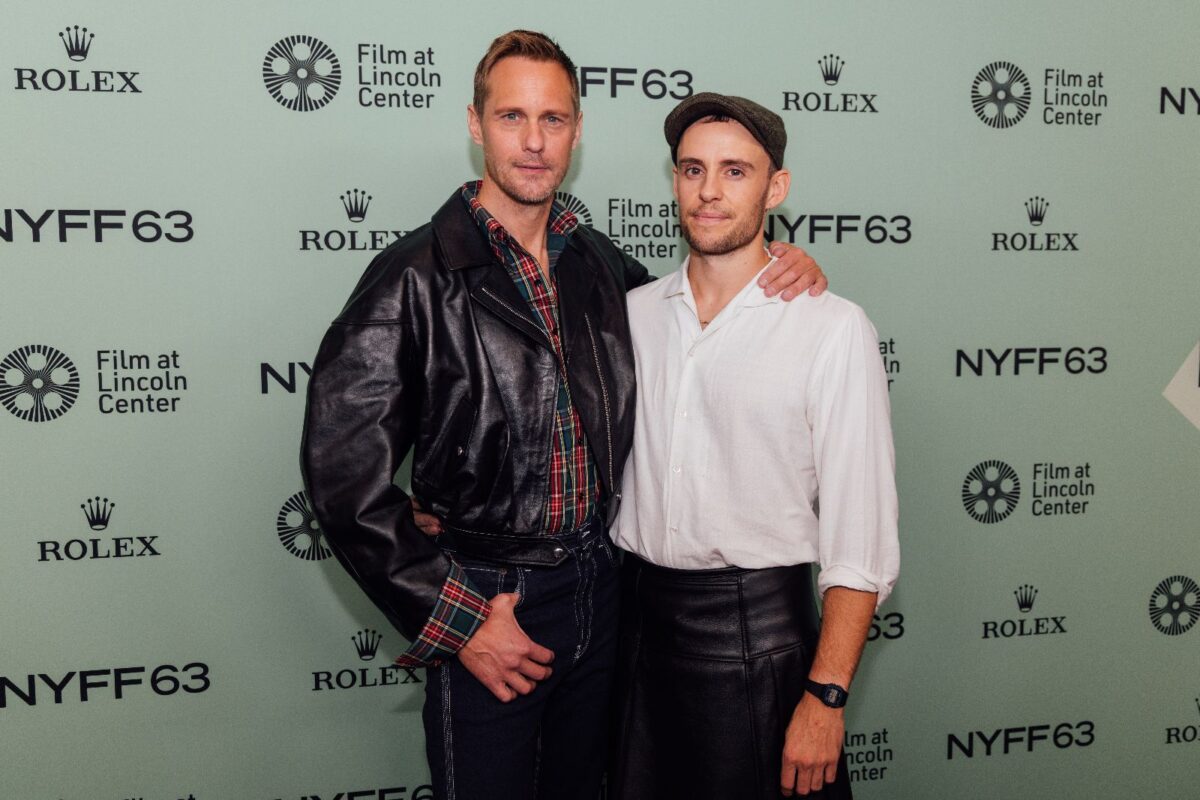
Photo by Sean DiSerio, courtesy of Film at Lincoln Center
In modern gay life, you can meet someone on apps for months and not really know anything about them. When you were talking with Alexander about his performance, were you negotiating how much of his character was “him” versus a front? You can see it drop a little towards the end.
We definitely spoke about Ray being someone who is very well-practiced at embodying a sexual fantasy. We don’t often see the chinks in that armor, but we wanted moments where you saw a little crack. It doesn’t give the audience confirmation, but it lets them know something is going on underneath. To me, if you build a life outside the norms of society, it’s courageous, but it comes with a cost. You give up the ease of a normative life. Occasionally we see that Ray experiences the way he lives as a loss.
Another adaptation choice: you gave Colin a bit more power, or like how the couple in The Duke of Burgundy negotiates between the fantasy and what they need. You were toeing the line between not making it “sanitized” but also not making it “depressing.”
Ray is less of a “beauty monster” here than in the book. In the novel, their first sexual encounter is described as a rape. That really stuck out to me and made it very difficult to view the relationship in “gray” terms. It became categorically abusive. Even if Colin denied it was abuse, the reader would see it that way. I wanted to ask the audience: “Is this relationship good for Colin or bad?” I want people to disagree about that rather than it being a categorical thing. I wanted to see what someone gets out of this kind of submission.
The club feels much more realistic here than the almost pornographic “fantasy” version in the book. How did you research the culture and the community?
I wanted the club to feel like an individual club rather than something representing the entire culture. I did a lot of research so I knew when I was deviating from leather community practices. I interviewed people in D/s relationships of varying degrees of strictness.
Three months before filming, I spent a weekend with the GBN (Gay Bikers Northwest), the biggest gay bike club in England. I chatted with them and realized we should cast these guys in the film because they look and sound the part. They were enthusiastic about portraying something authentic to their experience. We did an open call, and a bunch of them submitted videos. Paul, who plays the “pup” in the film, turned up to our meeting with his mask and spoke about how there was room for a pup in this gang. They were very generous with their lives.
A lot of the conversation around the film was about how explicit or “shocking” it was. Did you go into it wanting to shock people? Personally, it didn’t feel as graphic as the headlines suggested.
I definitely didn’t set out to shock. I knew that because the film is about gay BDSM, there would be certain headlines, but I don’t mind that. People go in expecting one thing and are then surprised by the tenderness. I didn’t want to be prudish or “hands-off.” When I was applying for funding, I wrote a treatment about how I would approach the sex. It was important to show it in a matter-of-fact way. If you pan away from kinky sex, you are judging it as a director. You’re saying, “This is too scandalous to be seen.” I wanted to leave the audience to decide what they thought.
It feels realistic. The focus on touching and intimacy, like Colin holding onto Ray on the bike, shows the relationship through things other than just sex.
Some of that was done through production design. When Colin first arrives at Ray’s house, there are beer bottles and a mess. Over the course of the film, the house becomes spotless because Colin is performing his duties as a domestic sub. Then there is Colin’s transformation—the “high school movie moment” where he emerges from his chrysalis with a shaved head. We also considered how Colin occupies space. At the beginning, he stands nervously in corners. By the end, he’s maneuvering his way onto Ray’s sofa to ask if they can relax the rules of the relationship.
You also made them both musically inclined. Why the barbershop quartet for Colin and the piano for Ray?
In the book, Colin and his mum are members of Mensa. It spoke to Colin’s “lameness,” but watching people answer Mensa questions isn’t very cinematic. I wanted an equivalent that was cinematic and sat in juxtaposition to the bike gang. If a bike gang is the epitome of “macho cool,” a barbershop quartet is the opposite.
With Ray and the piano, I wanted Colin to be better at something than Ray. Ray isn’t a great piano player. He makes Colin turn his pages, and because we know Colin’s musical background, we know he could play the piece perfectly, but Ray never lets him touch the keys. The piano becomes a point of rebellion. Before Colin steals the bike, he bashes the piano as a way of saying “fuck you” to Ray’s rules.
The ending was changed but still felt like it kept the spirit of the book. Why did you decide to leave it more ambiguous?
I felt tired of queer narratives that end with one of the guys dying. It’s very common. It was much more interesting to me that the relationship ended not because of an extraordinary tragedy, but because it stopped working for Colin. It speaks to his development; despite being in love with Ray, he realizes he needs more than Ray is able to give. In the book, the characters are quite static. Ray is always in control and Colin is always passive. I wanted to see Colin push back.
I agree. It reminds me of the discourse around Carol—how striking it was that they both lived and stayed together. Do you think it’s becoming more common to let queer characters survive their own narratives?
If a filmmaker wants to kill their gay character, they should, but as a queer filmmaker it’s something you think about. My creative process is led by a fear of boring myself and the audience. I get bored when I see things that feel familiar. I’m bored of the “closeted kid comes out and the parents say it’s okay” story. I’m always trying to find a way to do something original.
Gay work is often expected to stand in for the entire community. Does that ever enter your mind, or are you just writing for yourself?
I definitely want Pillion to be seen by a broad audience. I think about ways to invite people in, whether through music or a certain style. But I resist writing from a “sense of duty.” If you do that, the work becomes infected. You start second-guessing yourself and avoiding bold choices because you’re worried about offending people. There are a million different people in this community with a million different opinions, and that’s a good thing.
Finally, were there cultural differences between American and British biker gangs? It feels like they are all influenced by that Marlon Brando/Tom of Finland style, but did you notice anything specific to the UK?
Interestingly, the bike club I hung out with had a much more contemporary style than the “Tom of Finland” leather look. There’s a crossover between gay bike clubs and leather clubs, but the bike clubs are often more about functionality and safety. I recently went to Mid-Atlantic Leather to show the film, and their protocols regarding what leathers they wear are much more defined than the bike clubs, where it’s often about the gear’s secondary purpose: protection.
Are you taking a break now or looking forward to a new project?
I’m going to start writing my next film at the beginning of March. I’m doing a five-month residency. I think I’ve worked out what the next film is about, but I’ll keep that to myself for now!
Pillion opens in theaters on Friday, February 6.