
“Someone at Sony Ericsson did a very good job!” Shielded from Locarno’s scorching heat inside the air-conditioned lobby of the Kursaal theater, Alexandre Koberidze is extolling the virtues of the camera with which he shot his latest, Dry Leaf. Not the high-resolution equipment he used for his sophomore feature, 2021’s feted What Do We See When We Look at the Sky?, but the W595, a Walkman phone Sony Ericsson launched in 2008 and outfitted with a 3.20-megapixels camera filming at 15 frames per second, about five times less than state-of-the-art smartphones. Which explains the film’s striking aesthetic. So blurry and pixelated are Dry Leaf’s visuals that it can be difficult to know exactly what you’re watching, people and places often blurring in amorphous shadows. But that’s entirely of a piece with a film that seems designed to stress-test the limits of your vision and open up new ways of seeing.
Middle-aged Irakli (played by Koberidze’s father David) is searching for his 28-year-old daughter Lisa, a photographer who set out to take pictures of football fields across Georgia’s countryside but disappeared before she handed in the assignment. Joining Irakli on his quest is one of Lisa’s coworkers, Levani. But “like many others in this film’s reality,” a voiceover warns as Koberidze’s camera rests on an empty street corner, the young man is invisible. Time and again across its sprawling, three-hour travelogue, Dry Leaf teases your senses, inviting you to squint at its viscous images and picture the several ghost-like figures who interact with Irakli as disembodied voices.
With just three features to his name, Koberidze continues mining the dreamlike vein he’s been exploring since his 2017 debut, Let the Summer Never Come Again (also shot on a W595), turning cities—and football fields—into spaces where the boundary between what’s real and what’s imagined is as blurry as the film’s own frames. Heightening that feeling is the score composed by the director’s brother Giorgi, blending winds with a lilting piano ditty to lift the whole journey onto an oneiric realm. Dry Leaf‘s plot is almost skeletal, but the film teems with all kinds of sensorial delights. At a time when a depressingly vast number of festival titles all seem to abide by the same narrative and aesthetic conventions, and audiovisual works straying beyond our high-definition media regime are considered aberrations, here’s a film insouciantly committed to being its own thing, a space oddity whose imperfect images suggest a new way of relating with the screen.
As Dry Leaf premiered in Locarno last summer—the first in a long series of festival stops that will culminate with its U.S. theatrical release this weekend—Koberidze and I spoke about the film’s textures, his fascination for the antiquated W595, and the importance of hiding as much as you show.
The Film Stage: I know you’re someone who really enjoys writing, so I was hoping we could start by talking about that process in this film. I ask because Dry Leaf doesn’t exactly feel scripted—not always, at least. So much of it seems captured on the spot, the result of mere chance and serendipitous circumstances.
Alexandre Koberidze: Yeah, you’re right: I think this one is the least script-driven film I’ve ever made. I started to work on it in the middle of the pandemic. Georgia back then had some very strict rules; as soon as you arrived in the country from abroad, they would put you up in a quarantine hotel for two weeks. I wrote the first draft over the time I spent in this hotel room with nothing to do and no laptop to work with. I wrote the script and really quite liked it.
But then, as the first shooting day approached, it became clear to me that I didn’t want to stage all the situations I had imagined; I wanted to rely on the journey instead. I knew something would happen on each day of the trip, but I still wanted to follow the flow. That said, the beginning and end remained as I had written them—the idea that they’d start here and finish there—but that’s about it. How the journey played out, what happened during it… nothing you saw in the film was in the script. Everything I wrote somehow remained on the paper.
What was the first thing you wrote? Was there a specific idea or image that triggered the entire story in motion?
I think the biggest trigger for me in this case was the fact that I really just missed filming. I’d shot my first feature myself, but didn’t shoot my second, and there were years in between the two projects when I just stopped filming altogether. And I missed that. I spent years before making my first feature just shooting with this [Sony Ericsson] camera. Five, six years—I was taking pictures every day. And then at some point I just stopped, and I really longed to return to this life of making images every day. I think, in a way, the whole idea behind Dry Leaf was built around this wish.
I’d be very curious to hear more about your decision to make some characters invisible. Levani, like the missing Lisa, is almost a structuring absence.
I was thinking about this today and trying to figure out how and where the idea started. And then I remembered a small exercise we were given when I was in film school in Germany back in 2008. We were asked to shoot something, and I wanted to shoot something super-dangerous, so was testing different ideas when I suddenly realized that the thing I had in mind was so dangerous it would have to be invisible. It was the same idea [as in Dry Leaf]: to film someone as if they were there. To pan, follow—to compose the whole shot as if the person really was in the frame. That was the first time I imagined an invisible character.
Levani is only one of several other invisible actors in Dry Leaf. But where their voices always seem to emerge from the landscape, as it were, his own sounds as if it was superimposed on those empty backgrounds. It’s a choice that heightens a distancing effect. Could you speak about it?
That was me experimenting. And I want to work on this more. This idea of having invisible characters in the film opens up a whole new world in terms of how you can build your images, think about camerawork, and yes, sound. When you make room for these invisible presences, your frames can be anything—they can look empty and be filled with people at the same time. What you do with these people, how you use them in your film… the options are endless. For [Dry Leaf], I knew from the very beginning that I would try to keep things as simple as possible.
Also in terms of sound. Levani might sound closer to you than other characters because he’s mostly shot in close-ups, whereas you might struggle to hear the people Irakli chats with just because they’re shot from farther away. If you want to make this work then you have to be careful of these distances in the film’s sound design. That’s work for the future: I really want to have more characters like Levani in my next films and maybe even give them a more prominent role and really try to make you feel as if they were there.
This is one of Dry Leaf‘s most fascinating aspects. Not only do you feel as if these invisible figures really are in the frame; there are times when the film seems to embrace their perspective. There’s a scene halfway through when Irakli takes a nap and Levani says he’ll go for a walk, and the following montage suggests we’re watching the world through his POV: mosses, fallen leaves, water flowing down a stream…
That’s interesting—I hadn’t thought of the sequence that way, but it makes sense. I like when this happens: it’s a sign that your work, which is always based on intuition, can take on different meanings, that things can be built and only make sense much later, in ways you didn’t expect. I think I learned to rely on that, somehow—to not be afraid to embrace different perspectives. Before I went to film school I had no idea that a movie had different perspectives, and that you should be mindful of them. As a rule, it was one of those I found least interesting.
There was always this question in dramaturgy class: “Okay, so who is doing the watching? Who’s seeing this?” And I never had an answer. I never thought this was a question that was necessarily relevant to me. But that’s the thing with filmmaking: there are so many aspects that I still don’t know. You’d have to be Kubrick to think about and have complete control over everything. I think it’s interesting when you can let go of that a bit. You don’t have to be in charge of everything; if you do some of it sincerely, the rest will follow.
Which aspects did you really want to control here?
Well, maybe [Dry Leaf] was the film I tried to control the least. I knew what I was doing and made several choices throughout—what to film, how to frame, how to move the camera… we have invisible characters, yes, but those that aren’t invisible are also hard to see clearly. The aesthetic is not sharp enough for you to see their faces, which means you can’t expect their performances to work the way they would in other films; there’s no point trying to work on their precise emotions. What you can control has more to do with the light, the shot’s composition, colors, and so on.
You shot Let Summer Never Come Again with a Sony Ericsson, and after toggling between celluloid and digital for What Do We See, returned to the mobile phone for Dry Leaf. Why the shift?
It was an interesting change. With the Sony Ericsson, well, you almost don’t see anything. There are no details, and you are kind of free to film people because most of them won’t be recognizable anyway. And anything can be beautiful: you might lose the details, but you still have shapes and colors and so on. Which is why to shift to something like the Alexa was almost shocking—you end up seeing more than your eye can, like every little thing—and I almost panicked, because you must learn new ways to hide stuff. If you see everything, to me that’s just not interesting. It’s important to choose what to show and what to hide. And that becomes super complicated. That’s why in What Do We See When We Look at the Sky? I often tried to be far from the actors, because I felt that if we were too close then we’d see too much of their faces, we’d reveal too much of their reality, their lives.
It’s a challenge, much like shooting with this [nods at his phone]. When I shoot with the Sony Ericsson, I can work alone; you rely on intuition, follow your ideas. Film and digital involve a much bigger group, a cinematographer… you need to explain why you want things a certain way; you get to address doubts and questions. It’s a very different way of working, and it can be quite hard to shift from being completely in control of things to sharing that control with others. But I’ve enjoyed it.
That blurriness can make watching Dry Leaf quite a jarring experience, but once you adjust to that aesthetic you start registering other things, like the way these frames all seem to pulsate, as if each shot had its own heartbeat.
Yeah. And there are different levels there too, I think. On the one hand, the Sony Ericsson’s camera has such a low resolution it will automatically try to find the right light and exposure—the camera is always working to get as much light as possible. And I think this struggle between light and darkness is essential to visual arts like cinema and photography. But then, on the other hand, your own brain will have plenty of work to do to process images like these. It can take a while for your brain to understand shots this blurry. But what I like is that this doesn’t feel like intellectual co-working with the film; it’s more like a chemical reaction between viewers and images. And that happens whether you like it or not. The brain is working because it wants to see more.
Did you use the same Sony Ericsson with which you shot Let the Summer Never Come Again?
Yeah, the Sony Ericsson W595.
Why that model in particular?
Oh, I bought it a long time ago, back in 2009. I never made videos or took pictures before I had it because I always felt I couldn’t do it. I just think the camera is kind of unique; I’ve never seen one making images like these. It also has a really beautiful microphone—the way it captures sound is really quite striking. Someone at Sony Ericsson did a very good job! [Laughs]
Did you already know you’d shoot the film with the W595 once you started working on the script? I wonder if these issues—which camera you’ll use, for one—are things you usually address before you begin writing.
Yeah, for Dry Leaf it was always clear that this was the format we were going to use. And these are all questions often addressed before the script. Of course, you can’t film every story with this camera; each film needs its own way of filming. And the fact that our industry should dictate which format you should follow is one of its most aggressive aspects. I think anytime you set out to do something, it’d be good for you to choose how you want to do it. Maybe one project will require a very high-resolution aesthetic, maybe the next one will be shot on a TV cam. I don’t know. But I do know one needs to have enough freedom to make those choices. We did receive some funding for Dry Leaf, but I always knew that even if we didn’t get anything, I’d still be able to make the film because the phone costs fifty euros and I know how to work with it.
So how much did you shoot, and how much material made the final cut?
I shot a lot. Really, a lot. But that was always the plan: I wanted to have plenty of time, and we shot the film in two big blocks: the first during summer and autumn in 2022, and then again summer and autumn the following year. It wasn’t an everyday thing; sometimes we would go on for a few weeks, shoot, and come back again. I can’t remember the exact number, but I guess we had over a hundred shooting days. Maybe 130 or something. Some days we did something very small, others we tackled bigger scenes. I have material for a few films now.
I edited it myself, and each time I cut a film it is always a lesson; I think the first cut is the strongest, but then once you start to work on it you get to experience the two sides of the medal. On the one hand, you discover all the little magic things that editing can do—you get to play with sounds and visuals and frames and so on. On the other, you come out of it heartbroken because sometimes you delete things you really love. I might walk down the street and suddenly remember something I took out and it makes me so sad, because I often can’t remember why. I knew there was a reason at the time, but you can’t remember everything… still, I think this final version you saw is the best.
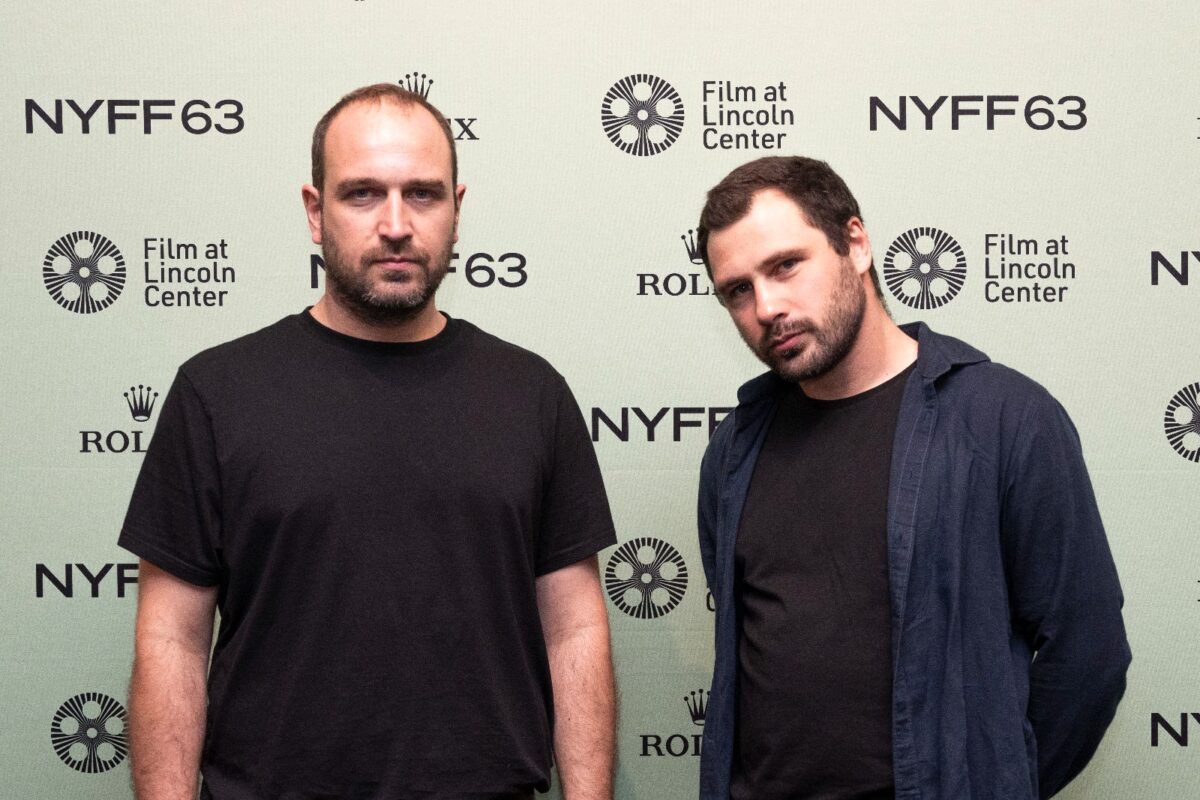
Alexandre and Giorgi Koberidze at the 63rd New York Film Festival. Photo by Julie Cunnah.
Can you talk about the montages, then? I must confess I found them to be among the film’s most moving passages—the first one especially, a snapshot of present-day Tbilisi pieced together through some of its most unassuming sights: street corners, stray cats, some statues… I fear this might be a little broad, and please excuse the pun, but what do you see when you look at a city? Which criteria do you follow when choosing which landmarks and details to linger on?
There are different reasons. The statues, for instance, were all planned; I already knew which ones I wanted to shoot. As for the rest, it was mostly a case of me walking around and stopping in my tracks. Not because I knew I wanted to stop there, but because something struck me. Because I found something beautiful, however imprecise and subjective the term might be. Sometimes—and this is especially true for a city like Tbilisi—there are things I see and think, “Okay, if I don’t shoot this now, tomorrow it’ll all be gone.” The city is changing so fast. So it’s a matter of catching things that you know won’t be there forever.
Maybe when I’m in Berlin I’m a lot calmer, as a filmmaker, because even though the city is also changing very rapidly, the speed isn’t the same. You know if you don’t shoot today that house will still be there in a year, but in Tbilisi it’ll be replaced by something else. Definitely not a park; most likely something ugly. Which means that walking around the city is kind of like entering a computer game where the world is built as you walk, but if you turn back you’ll see everything disappearing behind you. That’s what you get at the end of the film, with the sports university being destroyed: it’s the fear of losing all this beauty.
We don’t see many people playing soccer in Dry Leaf, yet there’s a rhythm to these montages that made me think of a football passed around, image to image, shot to shot.
I hadn’t thought about it that way. But maybe it’s true… maybe there’s a tiki-taka approach to the editing! [Laughs]
In all fairness, I found it refreshingly difficult to tell when exactly the journey takes place, or just how long it stretches. There are moments when, true to the title, Dry Leaf seems to unfold in a protracted autumn, and others when the light and vegetation suggests a much warmer season.
Well, at first I remember thinking I really wanted to make things as clear as possible and stick to a very precise timeline: day one, day two, day three… that’s how the script was written. But then, as I started editing, I realized there were some images that didn’t quite fit with the plan—images I really wanted to have in the film. I had to make a choice: either be strict and leave out anything that messed up the timeline, or open up and play with time a little, which meant losing this day-by-day approach. In the end there were too many things I wanted to keep, and I went for the latter.
Dry Leaf shares the same fairytale DNA of your previous works, and that’s in no small part a function of your brother Giorgi’s score. I wanted to hear more about your collaboration. Just how involved were you in the creation of the soundtrack?
It was different this time. Generally speaking, I think it’s good to have music while you edit, so while I was cutting What Do You See I relied on layout music while Giorgi was working on the film’s score, but I did tell him what kind of music I wanted. Here, the idea was that I wouldn’t suggest anything and let him do the thinking. Plus he was with me for almost the entire shoot, anyway—he recorded sound and made the sound design, too. He knew what the film was about, so I didn’t feel like I had to explain it.
The thing is—parallel to his work on the film’s score and while we were shooting—he was also working on his own album. And I like to think the album got some character through all our traveling. And it also inspired me a lot in the editing. But the interesting thing is that even though the piece he made [for Dry Leaf] wasn’t meant for the film, it was still meant to be listened in a cinema hall. It’s about an hour and ten minutes. The vinyl is out already, but the live performances will be in cinemas.
Will there be footage from Dry Leaf to accompany these live performances?
No, no footage, no images. So when I was editing, I started to listen to this other music he was composing and ended up borrowing some pieces. It became a mix. Which was only natural, in a way: because we were working at the same time and in the same circumstances, it was obvious that film and music would speak to each other. I guess that 70% of what you hear in Dry Leaf comes from his album, and the remaining thirty percent he composed specifically for the film.
Giorgi is not the only member of your family who took part in the film. I’d love to hear more about what it was like to work with and direct your father—especially as the guy is acting opposite an invisible co-star!
Ah, those were the best moments! [Laughs] Sometimes I’d be filming him from very far away and random people would walk past him without knowing I was shooting and they’d see this guy talking to a fountain or shaking invisible hands… that was fun. But he was always very cool; he never broke character, was always very focused. And for me it was clear that the only person who could do this was him. On the one hand, he’s got all the skills one needs to be in front of the camera. On the other, to give so much of your time and energy to a project like this… only a family member could do that! [Laughs] Also because he had to drive so much. He was completely devoted to the project for months on end. It’s a mix between being able to do it and wanting to, and it was of course very interesting for me to spend so much time with someone so close to me and experience new things together.
Where Dry Leaf really does depart from your previous works is in its setting; we’re no longer in a city but roaming a sprawling countryside. As a predominantly “urban” filmmaker, how did you navigate that shift?
I think this is connected to the invisible characters I invented to protect myself, in a way. I’m always embarrassed to go and film in new places. When I started to work [on Dry Leaf], I was convinced that we would film lots of people in all the areas we would visit. And sure: in the end we did include some, but it’s really just a fraction of what I’d originally intended. Because every time we showed up somewhere, I just had this strange, awkward feeling… like, who was I to go, “Hey, can I film you? Can you do this? Can you do that?” It was killing me. I did it once or twice and I just felt so bad. But then I realized: why insist when I could just have invisible characters instead? Slowly, they started increasing. Anytime I felt bad about asking a stranger to do something I was like, “Well, let it be invisible people instead!” And it made my work a lot easier. I became a lot calmer because I knew I wouldn’t have to bother anyone.
But yeah: leaving the city was very important. When you live in a place like Tbilisi, you may convince yourself the city is everything, and it is only by leaving that you realize just how wrong you are. I’d set my first two films in these different towns to try and go back to Georgia and feel again what it means to be there. Our nationality is an essential part of our identity—the simple question “where are you from” is such an interesting one to consider, and I learned a lot about who I am through all the traveling we did for the film. And of course the political situation in Georgia is so hard right now. I think we were looking for reasons to be brave, and what we found along the way were people and places which should be protected. Had I not seen them, had I not known about them, I would have probably given up and thought protesting every day was pointless. I might have wondered if this land really deserved the energy of all these people. But if there’s so much beauty in it, surely it’s worth fighting for. And in order to understand that, you have to see and experience it yourself.
I suppose the word “fairytale” has become something of a critical commonplace to account for your filmography, but the descriptor holds. You are among very few working filmmakers who can mine a kind of magic realism out of the most quotidian settings, be they random street corners or empty football fields. What draws you to this register?
It’s strange to say, but this time—especially while I was writing—it was very clear to me that I wanted to avoid that approach. Even with Levani as an invisible character, I just didn’t want this to feel like a fairy tale, but to have a certain reality and follow a more-or-less-straight story from start to finish. Except, as I told you, I didn’t embrace the script so much as the flow, and I guess if I make something at this moment of my life, that’s just where things lead. I don’t want to fight that. I don’t want to resist it. As soon as it became clear that the film was moving in that direction, I remember thinking, “Okay, should I stop it?”
But then again: why? If this is who I am, if this is what my world looks like, then I’d rather just follow those instincts. Maybe things will change, maybe not. But I’m glad. Some years ago, as I was making my first film—which, in a sense, dealt with fairy tales—I asked myself which kind of filmmaker I wanted to be, and the decision was very straightforward: I want to capture miracles. And I think I’m still in this flow, and though I wanted to stop, well, you don’t always get what you want. Luckily, sometimes what you get is better than what you’d imagined.
Dry Leaf opens in theaters on March 20 and will expand.