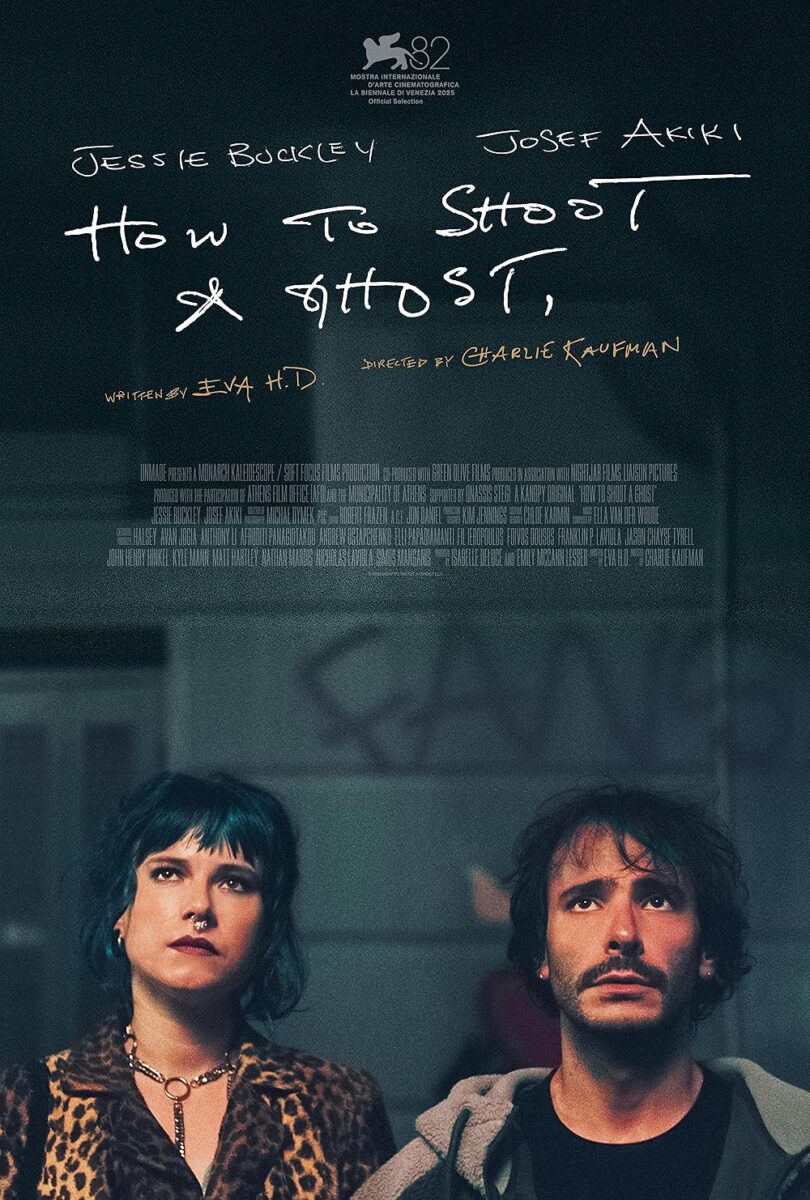
From just his scripts alone, Charlie Kaufman is certainly one of the most distinctive voices in American cinema, be it Being John Malkovich or Adaptation. Ever since 2008’s Synecoche, New York, he’s turned to directing, realizing his visions of neurosis and despair with the least amount of compromise possible.
In recent years he’s found a kindred spirit in Canadian poet Eva H.D., who’s written multiple scripts under which Kaufman has only taken a directing credit. Their newest collaboration, How to Shoot a Ghost, premiered at the recent Venice Film Festival and is currently making more stops on the circuit. Starring previous Kaufman collaborator Jessie Buckley and the unknown Joseph Akiki as two spirits wandering through Athens, Greece, the poetic leanings of its author are apparent, while paired with the director’s fixation on mortality.
I was lucky enough to catch up with Charlie Kaufman and Eva H.D. before How to Shoot a Ghost’s U.S. premiere at the Woodstock Film Festival today.
The Film Stage: I believe your collaboration began in 2020 when text by Eva was used in I’m Thinking of Ending Things. How did both of you come into contact initially?
Charlie Kaufman: We met in 2017 at an arts residency called MacDowell in New Hampshire, and we became friends there.
Eva H.D.: It’s true.
It’s true? Okay.
EH: Yeah, I was supporting that statement in case you thought it was mendacious.
Well, how did you two hit it off? What did you two have in common?
EH: What we had in common was that we were the first two people to show up for breakfast.
CK: And that’s remained the only thing that we have in common. We’re consistent in that way.
What were the topics that came up in conversation between the two of you? Because mortality and aging are a running theme in Charlie’s work, and it’s something that’s very present in this short. So I imagine it was a mutual preoccupation.
EH: We talked about, against Charlie’s wishes, the Toronto Blue Jays.
Oh, wow. I’m in Toronto, so I’m very happy they won last night.
EH: You’re from Toronto?
Yeah, I’m happy they won last night after those first two games.
EH: Where are you from?
I’m originally from Winnipeg, but I’ve been living in Toronto for the past ten years. Those first two games were tough to watch.
EH: Did you ever go to the Done Right on Queen West?
I have been there, yeah.
EH: That’s where I worked for years and years and years. Amazing. I may have sent you a beer. Did you ever go to Communist’s Daughter? I worked there too.
Yeah.
CK: So you know, we’re doing a screening at The Paradise Theatre in November, of this film, along with some musical stuff.
EH: So you should come. Are you going to be in Toronto?
I should be, unless there’s a death in the family that happens and I have to go to a funeral or something, but I should be there.
EH: What are you, a murderer? [Laughs] But you should come to our screening at The Paradise.
Yeah, I’ll try to. I’ll definitely at least promote it, tell people to come.
EH: Yes, do that, because we’re very bad at it: Anyway, we talked about the Blue Jays because there was no Internet there, which was really nice. So I would come into the main hall and look in the New York Times for the box scores, and then I’d be like, “Guess what, Charlie? The Jays won!” And he tried to hold out for a little while, like a few days. He’d be like, “I don’t follow baseball.” But then he just acquiesced. Because it was relentless.
CK: But to swerve back to your specific question about mortality: I don’t think we really talked about that stuff. She didn’t know my stuff at all. She didn’t even know that I was a filmmaker when we met. Because I was working on a novel while I was there, and so she assumed I was a novelist. But you watched Synecdoche, New York there, right?
EH: No, no, I watched Anomalisa. I thought you were dabbling in filmmaking because you said you made a film with puppets, and I was like, “Oh, that’s so sweet, puppets.” And it was in the MacDowell Library. That was like a month-and-a-half into our friendship.
CK: But you did eventually watch that movie [Synecdoche, New York].
EH: Yeah, I watched it when I got back to Toronto, and you revealed more things, like you told me about it. So I took it out of the Toronto Public Library. And I have to warn you, their copy is scratched, their DVDs. I had to rub it with that jizz cream you can put on CDs to make them not skip.
This film does feature the recurring theme in Charlie’s work of mortality and everything, but it came off to me as more optimistic than Synecdoche or I’m Thinking of Ending Things. Do you think that’s kind of true in terms of your relationship? Do you think someone has a more optimistic worldview than the other?
CK: I don’t know. I’ve heard that––not about Eva, but about this film. People have said what you said, and I’m happy about that.
EH: Do you think I’m more optimistic than you are?
CK: I don’t think so, but I could be wrong. I mean, she’s got a different energy than I do. But I do think that your response to this film seems to be common among people, and I’m glad of that.
EH: I have more suck-it-up-ism than you do.
CK: You do?
EH: Yeah, like “suck it up and carry on.”
CK: I think she’s been helpful for me in that way, personally. She offers good advice in that regard.
EH: My faux-optimism is very helpful.
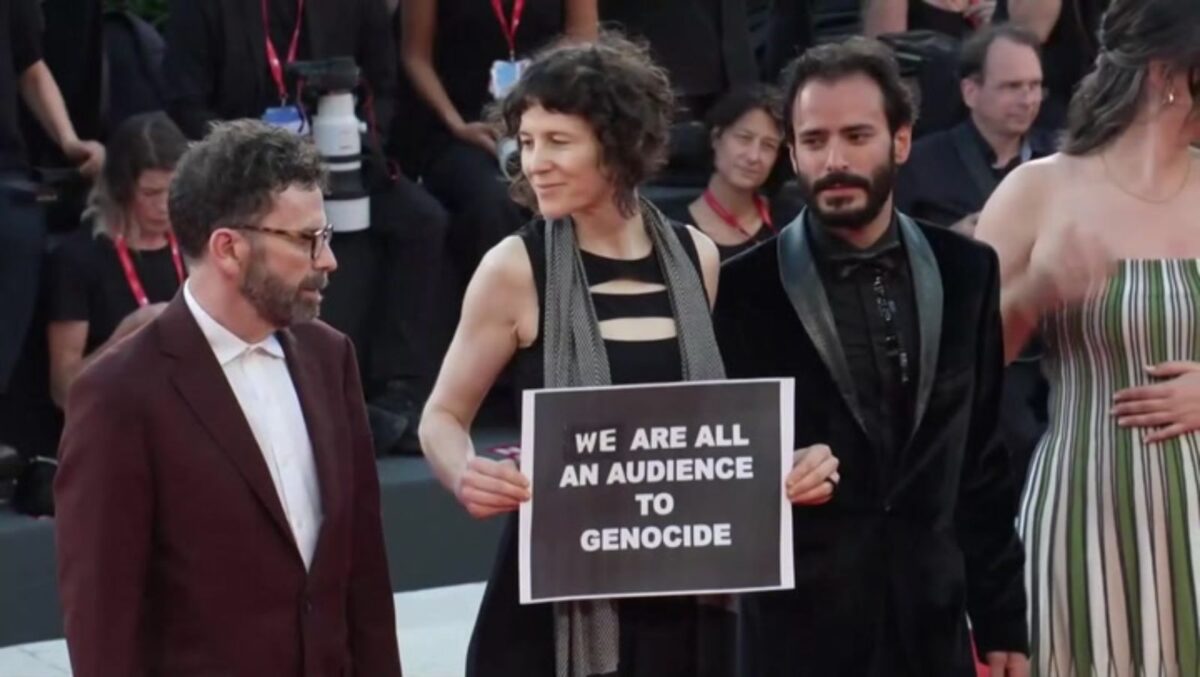
Charlie Kaufman and Eva H.D. at the How to Shoot a Ghost premiere at Venice Film Festival
Charlie, in terms of your past experiences with screenwriting, I know there were instances where you handed off a script you’d written to another director, and they made changes. Did you have a new appreciation for the process, having been in a reverse situation where you were handed someone else’s script and it was your job to realize it?
CK: I think, for the most part, I’ve been very lucky with the directors that I worked with. I mean, there were things that got changed, but after conversation and some disagreement, I think I more or less felt respected in those relationships. So I didn’t come to this with a feeling that I’d been burned in the past. I did come to it feeling I had a responsibility to somebody else’s words, but just because that’s the way I feel. And I wanted to understand as well as I could what I was trying to do and not fuck it up, because I feel less worried about that with my own writing, I feel a little looser, just because it’s mine and I’m the only one fucking myself up.
EH: Eventually, in the editing room, I convinced you to loosen up a bit.
CK: Yeah, I think so. But I do still feel the responsibility. If we were to do another one of these, I think I would still have to contend with that.
EH: I think you should feel free to play with what you’ve got.
CK: I agree, [stress] is still something I bring to it, though, because of my own issues, maybe.
Eva, is this inspiring you to direct?
EH: Me? To direct what?
A film.
EH: I feel like nobody’s going to write me a film and going to ask me to direct it or something. [Laughs] Does it inspire me to direct a film? Sure. I mean, I don’t think that’s going to happen. But I don’t know. No one ever asked me to direct a film.
CK: No one ever asked me to direct a film, either. [Laughs]
EH: Well, there you go! Yeah, I guess I could.
CK: You’re gonna strong-arm your way in there.
EH: Like, I have a film that I have to direct! I’d need a lot of help, though. In which case, why bother? I don’t know. Maybe I don’t really understand the question. Let’s just say “no.” That’s easier.
In terms of the film, too, did it always start with Athens, or was that more a location you found later?
CK: We had done another short film together previously that was set in New York and Toronto. Eva was in Athens at the time, where she had spent part of her childhood, and she had a relationship with the city. We had been talking about doing something else, and she suggested Athens.
EH: There’s this queer collective in Athens called Lala. And I was staying there at the time for the month. So I had some time to work on it, and that was nice. Athens is a very particular city, so I wouldn’t have written this somewhere else. It was for, it was to, and for Athens.
Charlie, you’ve had some scripts that have never been made, and I’m curious if you can look at them as their own separate work. Can an unmade script function as a piece of literature if it’s never made? Or is an unmade script not a finished work in itself? I’m thinking of this great script you wrote years ago called Frank or Francis, which I remember was widely shared on the Internet, and I feel like everyone I know read it and loved it, but it just never got made. But can you look back at these projects as literary works in a way, comparable to Eva’s medium?
CK: A film script, in my mind, is written to be made into a film. I try to write them in a way that maybe some people don’t write screenplays as sort of pieces of writing, I tried to do that. You know, I wanted it [Frank or Francis] to be made––came close to it, I mean. I cast it. It was certainly a source of great frustration to me for many years that I couldn’t get it off the ground. I mean, I’m happy that people read it. I’m happy that you read it and liked it.
EH: Maybe you should publish your unmade scripts.
CK: I sort of feel like that’s where this question was going. I’d be happy if someone wants to publish Frank or Francis.
Well, I remember reading the physical screenplay of Synecdoche, New York, and it was pretty much published as a book. And I remember there were a lot of scenes in it that weren’t in the final film. So it felt, in a way, almost like the Synecdoche screenplay that was published complemented the finished film in a way, but also just the fact that I could physically read it like a book, it made it sort of feel like it was also a piece of literature in its own way.
CK: It always comes up whenever there are screenplays that are published: do we want to conform to the finished movie, or do we want to do the script as it was? I always prefer to keep the stuff in there that didn’t make it to the movie because I like a lot of that stuff. I tend to choose that route. Yeah, it’s nice, but I don’t know what people want in a screenplay that they’re reading. I think I would like what you like: that it would define things and help you understand different colors that were in there and learn things about characters that may not have made it into the finished movie.
I feel like you’ve been doing something different with every new project: you did animation, you wrote a novel, you adapted someone else’s book, and now you’re directing a short based on someone else’s material. Are you very consciously experimenting with every new project, or is that just where luck takes you?
CK: I would say it’s a combination of those two things. I had initially written Anomalisa as a play, and a friend of mine had seen it performed, and he had started an animation company and asked if I’d want to make it into an animated film. So that wasn’t my idea. It fell into my lap.
EH: That was your Greek friend, right?
CK: Dino Stamatopoulos, yes. He has a company called Starburns with Dan Harmon. And with I’m Thinking of Ending Things, I was trying to figure out something that somebody might allow me to direct, so I found a book that was a thriller––it was a genre thing with very few characters and locations, so I thought maybe I could get maybe a little bit of money to do it, and that turned out to be the case. But yes: I’m also interested in challenging myself and trying to do things I don’t know how to do. And, you know, these short films that Eva and I have done have been an opportunity for me to do things that I couldn’t do in a feature. It’s more poetry stuff and more experimental stuff, less narrative. Trying to figure out how to do justice to the words of Eva’s, which I like so much. Yeah, I am always trying to do something that I don’t know how to do. And it’s fortunate because I don’t know how to do much.
I’m also curious, Eva, what was your perspective on his book, Antkind, as a novelist?
EH: I was its first reader. Wasn’t I?
CK: Yeah. I’m not gonna answer for her, but I’ll just tell you briefly: when we met at MacDowell, I was working on that book and we became friends, and I generally don’t show things that are a work in progress to anyone, because I’m afraid of either people liking it or not liking it, and that derailing the process. But somehow I trusted Eva. So I’d send her pieces as I wrote them, once we’d left the residence. I would send her stuff in emails, and she would respond. It was very helpful for me.
EH: And you put a Done Right look-alike in there.
CK: I put a Done Right look-alike in there?
EH: Yeah, the bar. Unless it was The Communist’s Daughter. I mean, they look kind of the same. Charlie put a look-alike. It’s the bar where he sexually harasses Zadie Smith and explains feminism to her. It’s like he goes to a bar, a real hole in the wall.
As someone not in the film world, were you familiar with Richard Brody and some of the other things being made fun of in that book?
EH: No, but it was explained to me by the author. I’m not familiar. Let’s see. I probably didn’t get any of the pop-culture references, but that was okay. It didn’t matter because I guess what he’s skewering is quite recognizable. Who’s this man who’s turning forty or whatever that you’re always talking about? I didn’t know about him. It was someone named Judd?
CK: He was turning forty? Oh, you mean This Is 40?
EH: Yeah, that’s right. And he has a fantasy about Friends. I never saw Friends, but I know that his fantasy of what happens in Friends is not in the show, like covering corpses under the bed and all this stuff. It’s lovely. It’s a functioning satire.
And I guess this will be my last question, but: can we expect another collaboration from you two soon?
CK: I wouldn’t say soon, because these things take a while to get off the ground, and we don’t have anything in the works right now, but we certainly talked about doing another short, making a trilogy.
EH: Yeah, maybe we’ll go to Mexico City and make another short.