
I’ve done interviews in many settings: multiplexes, screening rooms, green rooms, distributor offices, post houses, cafés, hotels—many hotels—or whatever space could be found then and there. (A conversation with a veritable architect of the modern cinema wound up in a coat closet.) Christian Petzold is the first who has apologized for the room. I saw no problem as I entered it last October, when he was visiting for the New York Film Festival premiere of his latest project, Miroirs No. 3, but he was quick to note that it has no windows—a bit like a movie theater, but also an interrogation room. “It’s a little bit as if I’m guilty.”
This is the life of a filmmaker they don’t really tell you about: flown around and accordingly jet-lagged, brought from one anonymous space to another while needing to represent their movie by degrees beyond coherence—outright brilliance if they want to convince anybody the thing’s worth seeing. Petzold, despite three hours of sleep and protestations that his English “is a little bit poor,” passed the test (which I’d never administer!) with flying colors, sharing as much about his vexing picture as the shirking of nationalist tendencies and philosophies of the end-credits song.
Christian Petzold: I had a masterclass two weeks ago in Switzerland with young students and I said to them, “Don’t make this mistake with your first short or your first movie. When you perhaps receive an award or you’re getting a little bit famous, you will be invited to festivals all over the world. There are more festivals than cinemas in the world. Then you have hotels—four stars, five stars—they pay your breakfast, there’s a dinner party in the evening. You are surrounded by people who make films and actors and actresses and so on. But in these years when you’re on journeys, you can’t write or work something because you’re very lonely and at the same time you’re always surrounded by people. Never do this. Never go to journeys. Say to every festival, ‘I can’t come, it is not possible for me.’”
Because it’s always the same. When I’m on a festival, the first morning I wake up in my anonymous hotel room, I can ask myself, “What am I doing here?” So there are some festivals—like the New York Film Festival, the Berlinale—where you don’t have this feeling, but most of the festivals: you don’t have to be there. It’s the movies and the audience—these are the most important thing, and not the directors.
Well, you premiered this movie at Cannes and you’ve done some interviews for it, plus press conferences and such. With films—either generally or this one specifically—do you find your feelings about the movie and your perspective on it evolving and changing as you talk about it, or is it a little more fixed?
No. This is interesting. I must say, when we finished our first edit, it was at the end of November [2024]. So I have some ideas why I have made this movie, what this movie is about, the metaphors, and so on. But when I saw this first edition with the editor and so on in a screening, I thought it was totally different to all these things I have in my mind. And then, for example, I made a big mistake: I have another final scene in this movie. I have written down the script and I’ve made this movie in the time of the Ukraine war, Gaza, the 7th of October, and the world of pre-fascistic new structures, and racism, and so on. And so I have written down a script very harmonizing. Yeah?
There was a movie [César and Rosalie] by Claude Sautet I like so much with Romy Schneider and Yves Montand. It’s a movie about two men who are in love with one woman, and they are always arguing and fighting and this woman, she can’t stand this anymore and she is leaving this city with these two guys. And after two years she came back and she’s standing in front of the fence of the house of one of these guys, and she’s standing there and there’s an open window in this house and she can see that these two men are now friends. Really deep friends. So they don’t need her anymore, and in this moment she starts smiling and this is the end of the movie.
This, I made the same thing in my own movie: that she’s coming back to the fence and she’s watching the family there and the family is still together. So she can smile and she opens the door of the fence and, as I had written down in the script, she’s intruding the room of a family. This was the last sentence of the script, and when I saw this in November [2024], it was… it was nothing. What is the metaphor? To be a daughter for your whole life and so on? And so, the long answer for your question, the thing is: I have the feeling that the movie is more intelligent than I. The material and the actors and the things that happened have their own life, and I have to rethink the structures. So in January [2025] we made a new final scene, and all the things I’ve written down after seeing my own movie are things which are totally different to the things I’ve written down before I made the movie. Is this an answer?
Yes, absolutely. You’ve premiered so many films at the Berlinale, but this debuted at Cannes. You had said—I think pretty honestly and nonchalantly—”I’ve premiered so many movies at Berlin, it wasn’t ready in time, it’s ready for Cannes, Cannes is great, sure.”
Mmm-hmm.
But I still wonder how the overall experience of premiering a movie at Cannes felt different—if there’s any desire or pressure to support German film institutions. Having a film at Berlin is a big deal and suddenly it’s not there, or if for you —
None of that.
None of that really concerns you.
I have no national feelings, I must say, really. I haven’t got it. I read, some years ago, a book by Jean Renoir about his movies—his autobiography—and in one chapter he’s telling a story that when, for example, an American tailor is meeting a German tailor and a French tailor, they are not talking about America, Germany, and France; they are talking about stuffs, skills, tools, and about their experiences. It’s a little bit like this. I like festivals because I’m not representing a country—I’m representing cinema—but I must say: I hate when everybody’s making the same movie.
You know, in the Coronavirus time when you have to watch Netflix because you have to survive this one-and-a-half year, you see many, many of these movies—these garbage things to kill the time—and you see that all the structures are the same. But it’s fantastic to see a movie like Aftersun from England, The Quiet Girl from Ireland, when you see a Kelly Reichardt movie. This is, for me, not an American movie. It’s a movie about America, but it’s not an American movie. So I don’t represent Germany. They try, always, the journalists in the country say, “Now we win some awards” and so on, but nobody’s interested in this.
The movie had a distributor changeover here in the United States: it was initially with Metrograph Pictures and then went to 1-2 Special. What was your experience of all that? Was that stressful, difficult?
No. You know, the structure I’m working in for 25 years, it’s a small production company, Schramm Film in Berlin. They are independent, three people. They don’t have much money. They have bad espresso in their office.
Is it a Nespresso?
No, it’s not Nespresso. It’s an old espresso machine from Switzerland, but it doesn’t taste [good]. But it’s no problem. We want to make independent movies, and we have made a contract 25 years ago that they make everything with money and I do everything with the moviemaking, and they never are on the set. They never make a visit to the set, and I never want to know anything about money. I don’t want to know.
And also: I think making movies is a collective work. There are some geniuses in the history of cinema who want to do everything. They want to make the advertisement, the posters, the editing, they want to make the camera on their own, and so on. It’s not me. For me it’s collective intelligence, cinema. So I have to respect the departments. For me, the department of money, it’s a department I’m not interested in. I trust them, I must say. They told me later that Metrograph [Pictures] is going out of business, and 1-2 Special are the new distributors for the USA, and so and I said, “Are they okay?” and they said, “Yeah, okay.” So it’s not a problem. They are very friendly, these guys. We had a conversation 20 minutes ago, very short. I like them.
Your films have jumped between distributors in the United States, but it doesn’t seem like it’s affected your films’ profile or reputation. You know what I mean?
Yeah. But I think it’s just the United States, because in France I have, always, the same distributor. Spain, Germany, and so on. I met some friends yesterday, and I think the capitalism in New York or in the USA is totally different to the capitalistic structures in Europe, for example. We are more familiar, we are loyal, and here the people are friendly and kind, but they are divorced at the same moment. So we can’t behave like this in Europe.
Lucky you. Speaking of distribution: I had interviewed you when Undine came out in 2021, so I had mentioned this before—not that you would remember it, but just to repeat—I used to work for Grasshopper Film, which published your infamous list with Den of Thieves.
Oh, yeah! Okay, I remember. I haven’t seen the second part.
Oh, I was going to ask what you thought of part two. That answers the question.
I haven’t seen it yet. My son was there and he said it’s not so good, like the first, but I want to see it. It was not a joke.
No, I know! No.
I saw the movie after New York because everybody’s laughing at the Lincoln Center when I mentioned it. They thought I made one of these intellectual jokes there. Every intellectual, when he’s asked for the 10 best movies of his life, there are nine masterpieces and one erotic movie or something like that, that nobody knows.
All of Grasshopper watched it after you put it on there. So I get it.
And I rewatched it. Sometimes in my life I I like a movie and I saw it the second time and I say, “What is happening to me? Why did I like it?” Perhaps just because of one minute or one song. But this movie is really good. I bought the Blu-ray in Germany and there was the American version, 30 minutes longer, on it. It’s also very, very good. I like it.
Hopefully that’s the last time anybody ever asks you about Den of Thieves. Getting back to Miroirs: something I really admired about it was the… “dynamic” is an easy word, but the particular physical energy between each of the people in this small cast in this small house. Do you find yourself thinking about casting differently the smaller the ensemble gets? What are maybe some philosophies for casting a small group?
Okay, it was a little bit like this: 25 years ago, I had made a movie about a terrorist family in the underground, and it was not so hard to make this because there’s the daughter and the parents. So you have two sides, and when you have two sides in a movie, it’s not so hard to think about the montage, the editing, the positions of the camera, because it’s a shot-countershot story. All the years later, I only make love stories. It’s always based on two people. Like we are talking here—it’s not hard to find camera positions, I must say. You make the over-shoulder or you make the close-up.
But then, I’m a big fan of courtyard movies—for example, Sidney Lumet made the movie The Verdict—and this costs you much more. Because there are so many axes. What’s the desire in this movie? What is the sub-cutaneous things which are happening under the table? So when I made my last movie, Afire, there were long sequences on tables with five people, and this was a new experience for me: five people around a table, there’s love and hate and jealousy and everything’s working there. And they are eating at the same moment, under the same sun, in the same wind. It was fantastic to work with this ensemble, to think about what is happening here, because it’s a more complex situation than a situation between two people.
And in this moment, I have the idea to make a movie about a family again. Because the family is a very complex thing. A family, also a traumatic family. Remember this beginning of this novel by Tolstoy, Anna Karenina. The first sentence is: “All lucky families are lucky in the same way. All unlucky families are unlucky in their different way.” Yeah? Because cinema is always about the difference. I said there, at the shooting of Afire together with the ensemble, “I want to make a movie about a traumatic family, and I want to make it with you because you’re a little bit my family in this moment when we are working here and we have a collective experience of our time here with Afire, and perhaps we can use this experience for this new subject.” This traumatic family and this young woman who is on her way to suicide, and this young woman on her way to suicide is meeting a traumatic family, and both are so depressive that their depression together gives them comfort. So this was the idea at the table of the last movie. Then I started writing.
When Phoenix came out—I think the exact second Phoenix premiered—people called it a Vertigo narrative, right? It’s interesting how this movie also has a Vertigo narrative, but it’s like you have to peel back five layers before you even get to that.
Okay. I understand.
Its revelations made me want to rewatch the movie as soon as I had finished. I wonder, for you, if there’s a feeling of… some of your movies, I feel like there’s this immediate… how do I phrase this. Some, there’s this immediate gut-punch feeling of “I understand it, I take it in.”
Mmm-hmm.
But other movies of yours, I feel like I need to go back. Do you sometimes think of your films in these different strata of: there’s certain movies you need to rewatch, certain movies you need to revisit, while others are imparted to you right away?
I have this feeling. Especially for this last one. There were so many decisions—decisions I made. For example: I cut out the first one-and-a-half days of shooting. It was a little bit a portrait of this young woman, Laura. She was in the university, she can play on the piano, she had a conversation with another student. So it was an introduction, yeah? And I cut the introduction out because there was, in my mind, a memory—I remembered Alice in Wonderland. So for me, Laura’s a little bit like Alice in Wonderland, and in Alice in Wonderland you don’t know anything about Alice. In this moment when she’s jumping into the rabbit hole, the story starts. There’s no biography before. You don’t know what her parents are, what their profession is, and so on. So when I have this in my mind—that we are making a movie like Alice in Wonderland—I know that the step from our reality into this dream-like world, our rabbit hole, there must be some things like in a tale. For example, the red car after the accident is a little bit like an installation by Jeff Wall. A little bit like this. She lost one of her shoes during the accident—like Cinderella, for example.
So you have some signs that said, “Now we are on the other side of the mirror.” Therefore, mirror three. This was in my mind; I’m telling you this. It was just for me. We are going from reality into the other side of the mirror. There’s some things from tales, like the Cinderella shoe and so on, and now we are in another world and this movie is in this other world. So I think when you are passing the mirror to the other side, and you are leaving after the movie—you are leaving the screening room— you go back to the other side of the mirror again, to reality, and you want to make it a second time.
This is something I learned from Hitchcock. For example: the movie we had seen together with the cast during the rehearsals was Rebecca by Hitchcock. In Rebecca it’s also: she’s coming into a castle. At the beginning she’s in the reality—love affair with a guy and so on—and she’s marrying him, and then he takes her with him to the castle. So in the castle, he was married with a woman, Rebecca, but Rebecca’s dead. But the dead Rebecca is always there in the castle. It’s not like a ghost, but it is a little bit like a ghost—like an imagination—and there is a female servant who said, “Rebecca’s the only original. There is no second woman who can live here.” So she is really like someone who’s watching the world of ghosts. This I saw with the actors, this movie.
It’s a little bit like Rebecca in another way—not as a horror movie. It’s more Rebecca as a comfort movie. She’s coming to a house and she’s a substitute for someone, and she knows it from the beginning. She knows that there was something—a girl or a daughter with the name of Yelena. She knows this because the mother said, “Yelena! Oh, sorry—Laura!” You have to know this. But she likes to be someone else. And this is something everybody’s understanding: it’s great to be someone else. Just for one week. Sometimes for one day it’s enough not to be yourself, to change your identity
It’s a big, big desire of people, and she knows that she’s the substitute for a dead daughter, but she liked to be the substitute because you have other experiences. She learned to taste, to smell, to work. She has another childhood. She has a new bed, a new mother, so this is something she likes. And at the end, when she is disappointed, she’s disappointed because the boy said, “It’s not true what is happening here,” and she’s angry not because she doesn’t know this—that she was betrayed. No, she’s angry that this fantastic time is now at the end. Now she has to be back, and then I think the comfort of the movie is that, at the end, she understands that she’s now independent and she can live by her own. I like this final scene so much because it had something to do… when I have to go to a Q&A, the last five minutes of the movie I have to see.
Sure.
Because I’m waiting behind the curtain! And you know, when your final scene is shit and the music over the credits is also shit, these five minutes are very hard. But I like this scene and I like the music at the end.
Have you had a final five minutes that are shit?
Yeah. It was many, many years ago. You know, when I made Afire, this movie is about a guy who had to write his second novel. He knows the second novel is shit, and he’s playing a writer, but he’s not a writer. And when I made my second movie [Cuba Libre]—because my first movie was, in Germany, famous, and I received money for the second one—I knew, during the shooting, this doesn’t work. It’s a movie of a student with people, with guns and black cars and a very beautiful young woman. It was really… I don’t like this. But I’m playing the director. I’m not directing a movie; I’m playing a director, and I feel this each day. I feel, “What am I doing?”
Then my wife came to visit me during the shooting—it was 1996, yeah?—and said, “Sorry, you are playing a director. You are not a director. It’s embarrassing to see you.” This is something I remember, but I have to fight that this movie works a little bit in the distribution scene. So I have to make many interviews and to rescue the movie, and I have to wait behind curtains 25 times for the last five minutes and I hate it. I hate it totally. I feel ashamed.
Sounds like purgatory.
It’s a purgatory, and it was a big luck that I can work after this experience.
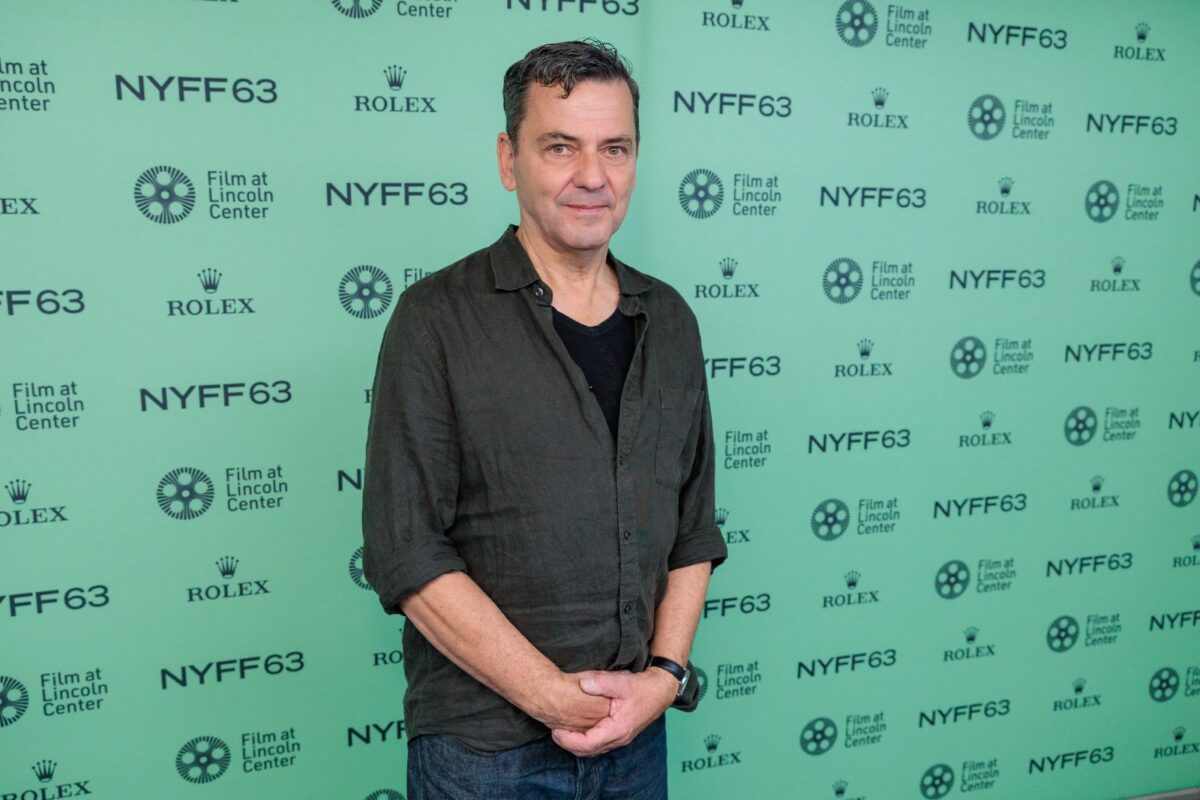
Photo by Richard Jopson, courtesy of Film at Lincoln Center
You have a great instinct for end-credits songs. I remember seeing Transit, and “Road to Nowhere” was like this high—it was amazing. In this film you have the Frankie Valli song “The Night,” which you said you heard in Miguel Gomes’ The Tsugua Diaries. At what point do you decide something will be the end-credits song? Is there a criteria specific to the movie, or some general metric for what a song needs to do?
Okay, okay, yeah. So I’m not religious anymore, but I was educated and grew up in a religious family—Protestant family in Germany. And you know the Protestants: they have music. The Catholics, they have pictures. Scorsese is not a guy for music, but he’s using the music. Protestants have music. At the end of a church session… what’s the word in English —
Mass.
At the end of a Mass in the Protestant churches in Germany, they open all the doors so that the outside world is waiting for you, and then the fantastic music of Johann Sebastian Bach is bringing you outside, into the world. You have the ideas of the Mass and the pictures of the Mass in your head, but you’re going back into your world. I think it’s the same thing when I’m leaving a cinema: the lights are switched on, you hear the music of the credits, and the doors are open and you go outside. Because during the whole screening, you have a body in a chair, but your mind is very far away, and when the doors are open in the church and in the cinema, the body and the soul are coming together and they are guided by music. And therefore it’s important to have music. Perhaps silence is also kind of music at the end. So I’m thinking about this moment.
When I made Barbara, it was a movie in the German Democratic Republic in the year 1980. In the credits, I have the song by Chic, “At Last I Am Free.” Everybody was totally… irritated that a movie which happens in the German Democratic Republic of 1980 has something to do with Chic and “At Last I Am Free.” But I said there is the desire for freedom there in USA, and there’s a desire for freedom in the German Democratic Republic, and the desire for the blacks and the homosexuals in the USA which is in this song. And also the desire to be free, but also to be anxious, because freedom means also loneliness. This is the same feeling, then, in the German Democratic Republic, so these two desires are coming together with this song. Or if in Transit: this movie is made today, but the story was from 1942. In this moment David Byrne is singing “we are on the road to nowhere,” it’s so that there is a road from 1942 to our contemporary time, and this road also goes out of the cinema into the outside world when you’re leaving the cinema. This was the idea.
And Frankie Valli comes from the Miguel Gomes movie, where I have recognized this song the first time, really, in my life, and I love it from the beginning. But Frankie Valli I love because of The Deer Hunter. “Can’t Take My Eyes Off You” is the song in The Deer Hunter and gives the characters, before they have to go to Vietnam, they are singing this song—”I love you, baby!” There’s so much energy and desire in their young, half-Russian, half-American bodies, and so this song by Frankie Valli gives them an expression for their desire, and I love this song, therefore. Lauryn Hill makes a cover version years later.
And so I remember this, and in the movie Miroirs No. 3, there is a scene between the two young people, Max and Laura. In this moment, when they are hearing this song, they are out of their characters; they are by themselves. They love for one moment, and not only the characters are out of their life—also the actors. The actors are free for a moment. It’s just as if the curtain was open for one minute, or one second, with the help of Frankie Valli, and therefore I want to hear this song at the end again.
Do you have a new film in development?
Yeah, I have to make two things. One for TV: a crime story, 90 minutes.
Oh, great.
I like to make it because when you are working for German TV—for primetime Sunday—you are not an artist. You are surrounded by the ordinary world. There’s the news before, and after there’s a talk show about top political things. And so I have the feeling not to be so alone. When I make a movie for cinema, I have to go to Toronto, Telluride, and so on, and I’ve made one movie—it’s a masterpiece or not, but I have made something. But in cinema, it’s like one house in a street, and not the big, fantastic Chippendale Museum at the end of the street. So I like it. Then the year after—in one-and-a-half years—I’m making a movie for cinemas about fighting against capitalism by a group of young… what’s the name in English for people who can make curses?
Make curses—witches?
Yeah, like witches. Political-left witches who are killing capitalists.
That sounds good.
[Laughs] Yeah.
On the German-TV-movie angle, I actually just watched Dominik Graf’s A City Is Blackmailed.
Yes, yes, yes.
Terrific.
Fantastic, yeah. But it’s an older movie, it’s…
2006?
Yeah, 2006. I saw it together with him because we are friends. I saw it together with him in Hof—it’s a very small festival in Germany. The German title, Leipzig: Eine Stadt wird erpresst, it’s fantastic. This is a great movie.
I’m glad to get that on the record so more people will see it.
Okay. Perfect.
Miroirs No. 3 enters a limited release on Friday, March 20.