
Welcome to The B-Side! Here we talk about movie stars! Not the movies that made them famous or kept them famous, but the ones that they made in between. And sometimes we’re lucky enough to talk to the movie stars about their B-Sides.
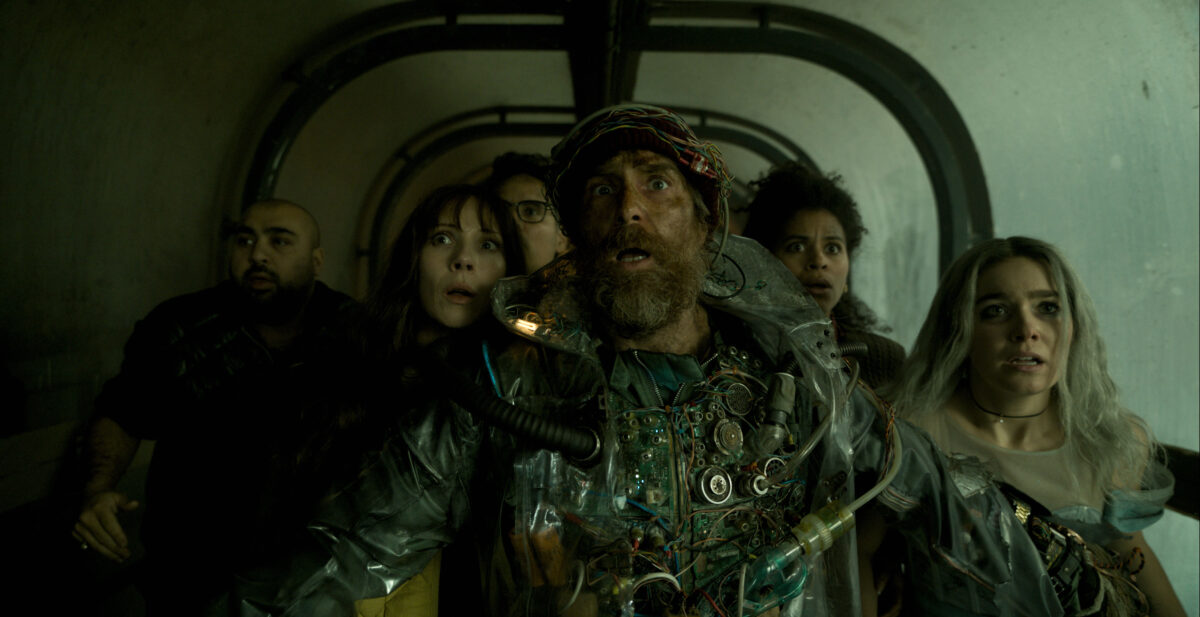
The great Sam Rockwell joins us today to chat about his new film, Gore Verbinski’s Good Luck, Have Fun, Don’t Die, as well as B-Sides like Lawn Dogs, Safe Men, Snow Angels, and The Winning Season. We marvel at the range Rockwell has, the sheer amount of films he’s made (big and small alike), and the line reads from the Martin McDonagh comedy Seven Psychopaths.
Watch, listen, or read below and subscribe here. Be sure to give us a follow on Bluesky at @tfsbside.bsky.social. Enjoy!
The Film Stage: You have an incredible opening monologue in this film. You’ve done them throughout your career, but recently it’s become your signature. What is that prep like? I read in the press notes that you rehearsed with Gore a lot, but what is that process like, and when you’re filming it, how are you keeping it interesting?
Sam Rockwell: Well, that was a big part of Gore’s job—to make it physical. The diner monologue, specifically. He did a great job with that. We got a stunt guy to help us choreograph a couple of sketchy stunt moves. In that outfit, I was carrying almost 40 pounds, so being agile in it was a trick. Jumping on tables was a challenge because the weight wasn’t evenly distributed. I actually wore a weight vest at the gym to prepare for it, but nothing could really prepare me for what was going on with that suit. It was a lot.
But it looked cool! At one point the battery overheated. I had, like, six dressers and a cooling suit, like the ones astronauts have. It was pretty intense. Physicalizing the monologue made it less boring—not that it was boring to begin with, but I prepped it the way I always do. The monologue is beautiful; Matthew Robinson wrote a great script. There are about five monologues in that movie, that one being the biggest. By the time I got to White Lotus, I was “monologue-ed up.” I had also done a play right before.
What were you doing? Was that American Buffalo?
Yeah, it was American Buffalo. I did the famous “Ruthie” speech.
I saw you in that! I was going to say, American Buffalo is basically all monologues.
Yeah, it’s a bunch of monologues. That one with Darren Criss and Laurence Fishburne really got me ready. By the time I got to White Lotus, I was ready. If people dug White Lotus, they’re going to dig this even more. I think this one’s even crazier.
It was really well-done. To that end, with Good Luck, Have Fun, Don’t Die, I’m always curious about this: Gore Verbinski is a famously visual filmmaker. There is so much happening in-camera, and I imagine the set-ups are sometimes more complicated than your regular independent film. When you’re working with him, is that its own fun challenge? As an actor, do you approach that differently when the camera is choreographed so specifically, or does it just add another element?
You’re not wrong. Great directors, like Gore and Sam Raimi, know how to move the camera, and that’s important. There is a bit of choreography and some of it is tricky, especially when you have a lot of words. I was doing what I would normally do for theater—voice warm-ups every day—because I had to do it over and over again. I don’t normally do voice warm-ups for film, but this was a very theatrical piece. I didn’t want to blow my voice out because I was doing these really loud sections.
Do you remember the hardest sequence or setup?
I think crossing the tables while doing the Gestapo parody. That was a tricky one. It’s actually harder than it looks because I couldn’t look down at my feet to see where I was walking. We had to find a way to do that safely.
That’s interesting. It’s often the things you wouldn’t expect that are the hardest, because in the movie it feels very natural.
Yeah. Sliding on my knees was really fun, though. That was easy. I got some knee pads and just went for it. That’s like doing Fosse stuff.
Now, jumping back to “young Sam”—there’s been so much good work. We’ve been re-watching and discovering gems like Lawn Dogs, Safe Men, Snow Angels, and The Winning Season. Those are such great small movies. Even Snow Angels—that was only David Gordon Green’s third or fourth movie. You also worked with Richard Shepard on Mercy a long time ago. He recently re-released The Linguini Incident—have you seen that?
I’ve never seen The Linguini Incident. What is that?
It was his first movie, with David Bowie. It’s weird and good.
Wow. All in a restaurant? I love Richard Shepard very much.
With movies like Safe Men, we were lucky enough to have Steve Zahn on the podcast recently, and we talked to him about it. That is such a great movie.
Did he tell you about when we cracked up the first day? We couldn’t stop laughing. Did he tell you about that?
I don’t think so! Tell us.
We had a good time on that, man. Peter Dinklage, John Hamburg, Harvey Fierstein, Paul Giamatti, Michael Lerner, Mark Ruffalo… so many great people.
It’s a bit of a quieter comedic performance from you than some of your later roles. Do you remember if you were just bouncing off Steve Zahn’s more “aggrieved” energy, or was it just the two of you clowning around and figuring it out?
In the auditions, we actually swapped parts. I think Phil Hoffman was going to play the Josh Pais part at one point. It was a great script, though nobody had ever heard of John Hamburg yet. I actually imitated John a little bit for the role. John did this thing where he’d hold onto his shirt as a nervous habit. The character is a bit of a Woody Allen archetype—or like an early Michael Cera vibe. I was a bit of the straight man.
You’re the lead, though. You have the romance.
When you play a lead, someone once told me you can’t always be the brightest color on the canvas. You have to carry the film, like the way Kevin Costner does in Field of Dreams or The Untouchables. He can’t flash as much as Sean Connery or Andy Garcia; he has to be slow and steady.
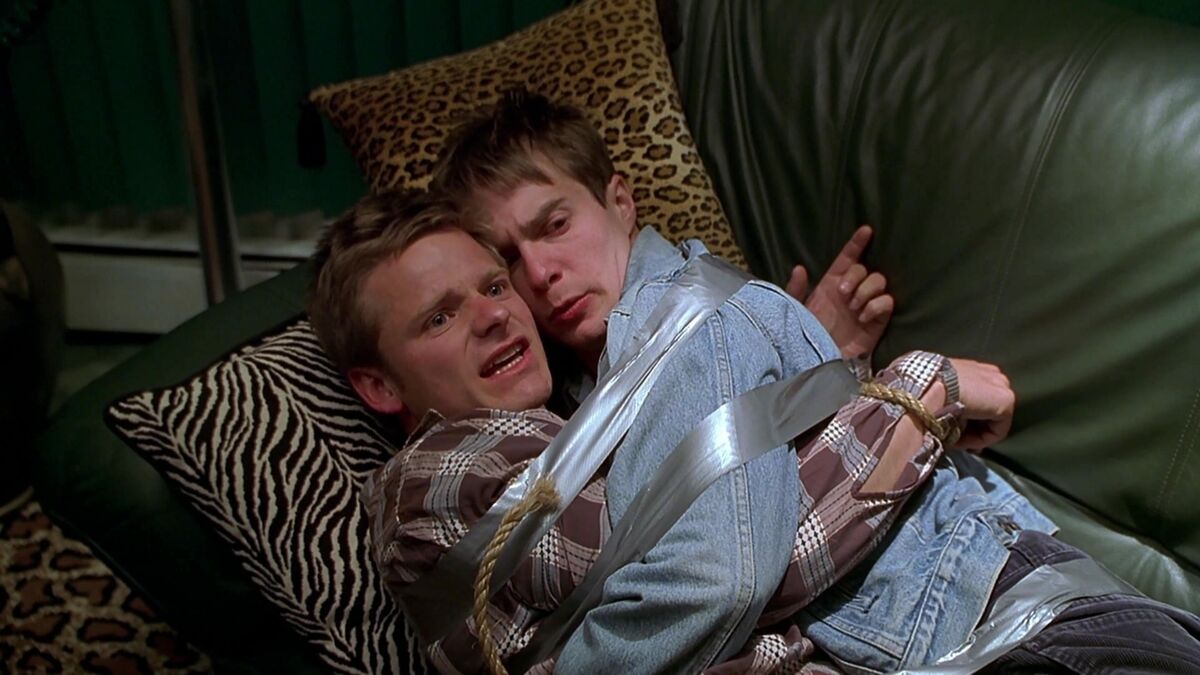
Safe Men
It’s interesting, because in Lawn Dogs and The Winning Season, you’re working with kids—like a young Mischa Barton. You allow those younger costars to spark a bit. The Winning Season is such an underrated basketball movie.
Thanks, man. I love that movie.
It captures a specific feeling, similar to The Way Back with Ben Affleck. In those cases where you’re the lead, is there any big difference between the biggest and smallest movies? Is it just prep time and trailer size, or is the core process the same?
I think the core thing is the same, but it depends on the role. If you’re playing a misanthrope like in The Winning Season, or a very disturbed guy like in Snow Angels… for Snow Angels, Brad Pitt actually gave me a documentary recommendation when we were doing Jesse James about born-again Christians who blow up abortion clinics. I watched that to help with the “Travis Bickle” archetype.
George Clooney also taught me a lot on Confessions of a Dangerous Mind about not doing too much. You don’t always need five props and a bozo nose; sometimes you just need to be simple. Alan Rickman taught me that on Charlie’s Angels, too. I’ve definitely drawn from Walter Matthau in Bad News Bears and Billy Bob Thornton in Bad Santa.
When you were coming up, was there an actor you looked at and thought, “I want to be that guy”?
It was probably Robert De Niro, initially. Then I watched a lot of Christopher Walken, Gene Hackman, Dustin Hoffman, Al Pacino, Meryl Streep, and Morgan Freeman. Walter Matthau was an interesting one, too. His performance in Bad News Bears is extraordinary. I was definitely doing a bit of that in The Winning Season. I also stole from Richard Pryor in Bustin’ Loose for that movie.
You mentioned Christopher Walken—you guys were in Seven Psychopaths together.
We did a movie and a play together! We’re friends. It’s pretty nuts.
I rewatched Seven Psychopaths the other day, and I love that performance. A lot of Martin McDonagh’s comedy is geared toward repetition, which reminds me of David Mamet’s work. How much of that is you? Is McDonagh’s script the “Bible” and you just follow it, or do you carry over things you know will work comedically?
His script is the Bible, but we fuck around sometimes. We fucked around on the new one [Wild Horse Nine] I did with John Malkovich that’s coming out next year. Martin lets us play a little bit, but his scripts don’t really need fixing. They’re foolproof. For Seven Psychopaths, Martin and I talked about Travis Bickle—obviously, the character’s name is Billy Bickle. We sat on my couch and watched all of Taxi Driver together and then ran the lines.
As we wrap up, is there one performance or movie of yours that you wish more people would see or that you would recommend?
I love Snow Angels. I’m always trying to do more minimalistic stuff on film, but I often get called upon to do “a lot” of acting. Lawn Dogs is probably more minimalistic. Conviction is a nice one, too—sort of my Dead Man Walking. I think that one could be rediscovered.
But bringing it back to Good Luck, Have Fun, Don’t Die, I feel like I get to do everything in this one. In my initial conversations with Gore, I was channeling Kurt Russell, but Gore said, “It’s too cool. This guy is the bottom of the list for this job.” So he’s a bit of a goofball. We went for Robin Williams in The Fisher King, Christopher Lloyd in Back to the Future, and maybe a little bit of Brad Pitt in 12 Monkeys.
Good Luck, Have Fun, Don’t Die opens in theaters on Friday, February 13.