
Among the true faithful, Serpent’s Path is no new object from Kiyoshi Kurosawa. But despite standing among his greatest films, it’s stayed in a much greater obscurity than Cure or Pulse, likely only seen on DVD rips or salutary upscales. Perhaps this is the natural result of a sensation that, even by the director’s significant standards, is so pitch-black as to border on evil—if anybody would dare remake it, Kurosawa was probably the only one who could do it justice. (And, to my mind, did.)
It should mark a decisive point in Kurosawa’s western exposure that Janus Films would release Serpent’s Path in a 4K restoration ahead of the more-or-less-inevitable Criterion disc. The nationwide release on a double-billing with his exquisite mini-feature Chime (the less-than-ideal NFT origin of which forbids any further exhibition) is basically the best value for one’s theatrical dollar in 2026, to say nothing of its rigorous study in Kurosawa’s form and preoccupations. I was pleased to speak with him via Zoom—me in New York by evening, him in Tokyo by morning—for a quick overview of both projects, his forthcoming Cannes premiere Kokurojo, and (it must be done) Robert Zemeckis.
Thanks to Aiko Masubuchi for providing interpretation.
The Film Stage: Watching Serpent’s Path and Chime together could almost serve as a Rosetta stone for your filmography: doubles and echoes, the lines between morality and immorality, the underground networks, these narratives that travel deathward. Even that great visual motif of wind blowing through curtains. After so many films over the course of your more-than-40-year career, have you come to think of your larger corpus as hosting a consistent set of themes and obsessions, or—conversely—how much is my auteurist reading just a result of you chasing certain interests and passions more instinctively?
Kiyoshi Kurosawa: So I’ve never once tried to make films in a way where I’m trying to pursue one particular theme throughout my career. Each time I try to figure out what is the theme that is very specific to that film, whether it’s because of the people that we managed to gather or whether it’s the time period or the era that the film was made. I really try to be very specific to the film, and so I’m definitely not trying to be consistent in that way.
But as you said: I do believe that human imagination, at the end of the day, is not infinitely vast, and so I think—perhaps unconsciously—I am doing something, repeating some things. But I think ultimately those kinds of commonalities and those repetitions is something that can be discovered by the viewer. But as somebody who’s making the films, for me it feels like every time I’m doing something different—I’m doing something new and trying to tread on new paths in a way. At least that’s something that I really tell myself and sit with when I make my films.
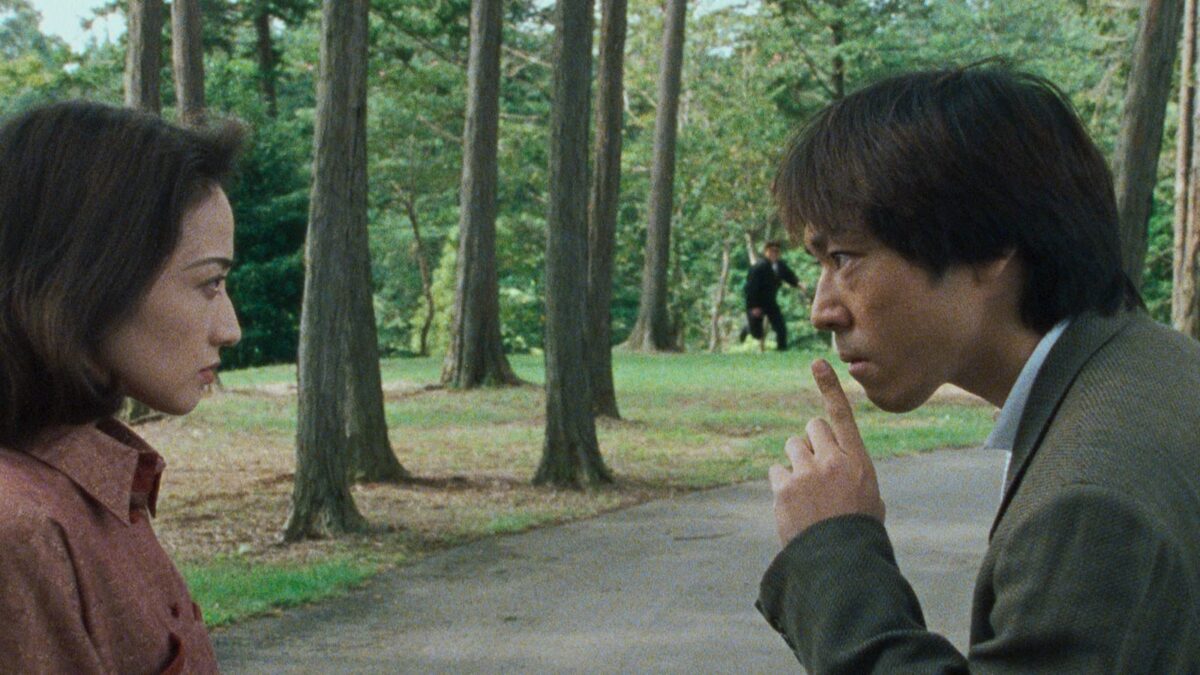
Serpent’s Path
But in terms of what you said about Serpent’s Path and Chime sort of being a Rosetta stone to my works: maybe you are, in fact, very much right in saying that. And the reason I say that is because, when you’re making films, sometimes there’s certain kinds of limitations that come across—whether that’s because you’re working with a big company or there’s an original story that you’re basing things on, or you’re working with a famous actor—and so these values that are actually not coming from myself end up affecting the filmmaking or what the film ends up being.
However, regarding Serpent’s Path, this was the last film that I made in the V-Cinema format, and so I was very much given a lot of freedom and I was told that I can do whatever I want to do when making this film. And Chime was also sort of a rarity. Of course it’s also a shorter film, and I was given the freedom to do basically whatever I want. Of course both of these films were very much low-budget films, but because of that, I was really given a lot of freedom. And so, in that sense, it’s two films that are quite rare for me. In some ways, perhaps these two films present what I end up making if you sort of just let me be and do whatever I want.
Do you feel any differently about the original Serpent’s Path after the remake?
You know, to remake a film that I’ve made myself—this is something that doesn’t happen so often. In fact, it was the first time for me to be able to. So in that sense, it was a very fun and precious experience for me. And of course they resulted in very different kinds of works. I think, regarding the 1998 Serpent’s Path, the script was not written by me; it was written by my good friend Hiroshi Takahashi, who also famously has written the script for films like Ring. So, in some sense, I felt that the ‘98 Serpent’s Path is, of course, my film, but at the same time, it feels like his film as well. And so in remaking the film, I felt that, “Oh, this might in fact be my film.” That was kind of the personal feeling that I can share with you.
You have a new film, Kokurojo, premiering at Cannes next month and opening in Japan this June. It’s your first film set in the feudal era; some have even referred to it as your first period piece, because—unlike Wife of a Spy—it’s not even set in the 20th century. I’m wondering how you felt about going into this era of Japanese history, as well as—from what I understand—a locked-room mystery.
The film is in Japanese, but the English title is probably going to be The Samurai and the Prisoner. It’s not 100%, but that is also what the original story is in English as well. This is the first time I’m getting asked about this new film, but it is a samurai film, but it’s not in the sense that there’s a lot of action—as you might expect with a samurai film. It’s more sort of a chamber-like piece that happens inside rooms. It’s a detective, mystery story that happens, revealing a sort of mystery. And I’ve always wanted to do this kind of period film, but of course it takes a lot of money to be able to make films like this. But I was given the opportunity to work with adapting a different story. As we’ve been talking about, this film very much was a new territory for me, so I was doing it with a fresh feeling of doing something very much new.
Like myself, you’re a great fan of Robert Zemeckis. In the last interview with you I read, you’d not yet seen his film Here. Did you get around to it, and (if so) what did you make of it?
So unfortunately I have not seen it yet. It’s something that I really do want to watch and feel that I need to watch. In fact, I’ve been so busy that I haven’t been able to find the time to do it. But now I remember that this is something I must do. [Laughs]
I’m glad I could remind you; I think it’s one of his best films. But you make up your mind.
Thank you so much for the reminder. I’d forgotten about it, so thank you. I will watch it.
It’s always such a pleasure—frankly an honor—to speak with you and have some of your time. I really appreciate it.
Of course. Thank you. Next time, I promise we will be able to talk about Zemeckis’ film.
Serpent’s Path and Chime are now playing.