
Comedian John Early has been waiting for his film to be seen by audiences. Premiering at TIFF last fall, Early’s directorial debut is a sublime comedy that commits to simultaneously becoming a serious drama about a woman with a returned eating disorder. Maddie’s Secret, which Early also wrote and leads, plays like a 1980s TV movie. But its hokey, stilted dialogue is an advantage. Early’s film—its successful comedic and dramatic moments—feel wholly intentional. It’s a rich text of cultural touchpoints and inspirations. It’s completely absurd yet an emotional gutpunch. Early has created a story that exists on two playing fields, both of which find their footing.
Early has recruited some friends to fill out the project, with his comedic partner Kate Berlant, Connor O’Malley, Vanessa Bayer, and Eric Rahill in the supporting cast. Maddie’s Secret follows the eponymous Maddie as she becomes an overnight food media sensation, a content creator for GourMaybe, and a possible consultant on a hit TV show called The Boar. Early isn’t going for subtlety with his first feature; he’s fully committing to the bit. He and the rest of his cast believe in the silliness of this story just as much as the seriousness. And that’s what becomes endearing, then overwhelming, through the course of 101 minutes.
Ahead of Friday’s theatrical release, we chatted with Early about his inspirations for Maddie’s Secret, fully committing to every scene, and his own obsession with food content.
The Film Stage: How are you feeling towards the film now that it’s been almost a full year since it initially premiered at TIFF?
John Early: I spent months thinking that I was making this kind of high-style—like almost a fairy tale that was so far removed from my own life—and then the more I look at it, I’m like, “Jesus Christ, John.” In some sort of more poetic, mysterious way, it feels very revealing, and I was initially very scared by that. So, like, around TIFF time, I was terrified of that and now I’m a little more loving and forgiving, and I’m kind of almost impressed by it. I’m not impressed by myself, but I am impressed by just the nature of making something, the way that you can channel these unconscious feelings and not know you’re doing it. I felt very in control of what I was doing, and I wasn’t at all, actually.
Do you think that is just subconscious, or do you think, regardless of whatever you made, there had to be a specific percent of you in it?
If you are compelled to make something––and in this case, I felt very mysteriously compelled to do this––if there’s real desire, I just think we’re always revealing ourselves, no matter what. You see something that you don’t like, you’re going to text the person that made it. You go to a play, you don’t like it, but you have to text them. It’s a text message, so you should conceivably have all the power and all the distance necessary to lie your face off and be like, “That was staggeringly beautiful. You’re a genius,” because you’re just texting, so you could just type the lie, and yet even in a text, you reveal yourself…
You give some sort of backhanded compliment.
It’s so crazy. It’s shocking when I see myself doing that. I’m like, “John, just lie,” but even if this were some weird assignment that the studio had given me to make, and my heart wasn’t in it, I’m sure I would have unavoidably revealed something about myself.
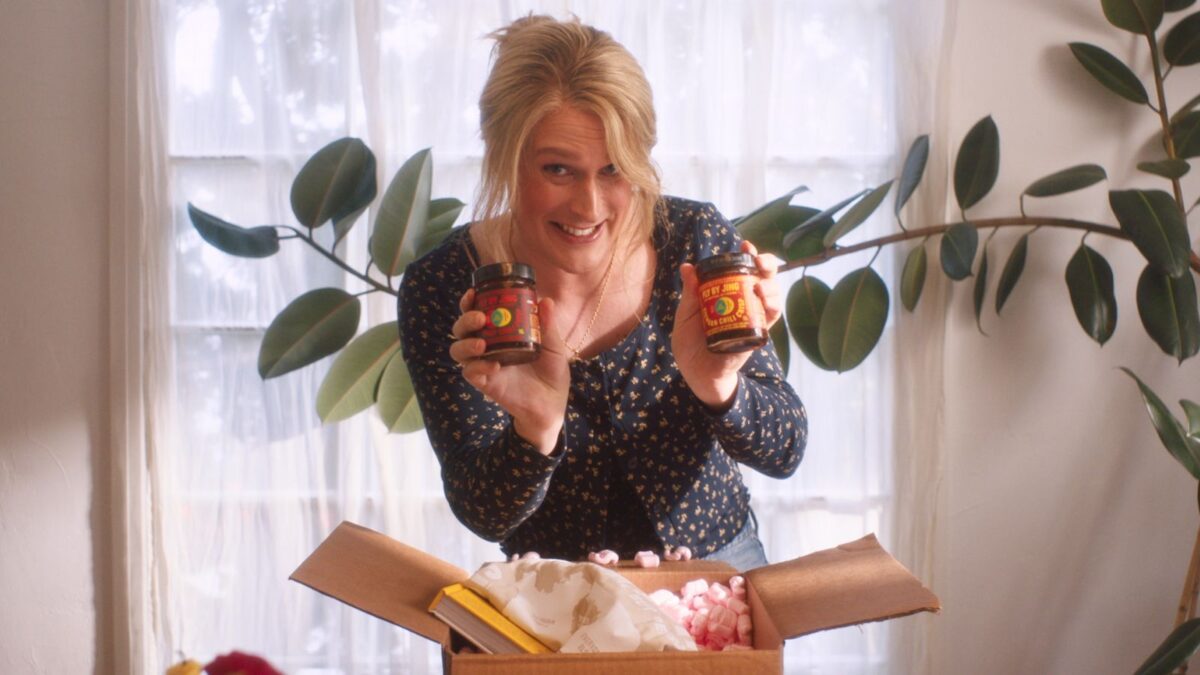
Where do you think our collective fascination with food comes from, and how that fits into the movie? And is it revealing anything about us?
This movie is borne out of, among many things, my own obsessive consumption of food content on my phone. One thing that was interesting to me about bulimia, symbolically, is early common connotations with the Roman Empire—like, intentionally vomiting would be common. At least mythically, the way people think about it is that kings—like the elite, the ruling class—it’s about the decadence before the fall of a civilization. Binging to the point of needing to vomit. I don’t know. Sometimes I wonder if all of the food content and the excessiveness of it and indulgence or heaviness, like creaminess––there’s a richness of it. It feels like it might be some sort of collective free-for-all before the fall and collapse of civilization.
Food is a resource. We need it to survive, and it’s possible that we all feel some looming sense of ecological collapse that we’re not going to be able to provide food for everyone. I mean, we’re already not. People are already starving, but it does seem like we’re on the precipice of something. So I think it makes sense that there’s this kind of manic consumption of food content—before it’s gone or something. I don’t know. I mean, that’s crazy and maybe too high-minded, and I certainly wasn’t writing about this in the same way with the movie, but I do think that’s part of what’s going on symbolically in the movie.
It feels like there’s a gluttony.
That’s the word! It’s gluttonous.
And it feels like Bon Appétit got replaced by Chef’s Table and then got replaced by millions of videos on TikTok that I scroll by.
Exactly. It was like the gates hadn’t opened, the dam hadn’t been broken down yet. The Bon Appétit thing is so fascinating to me, obviously. Because there was just this brief window of time where we had this somewhat elegant form of the Bon Appétit video, because it’s a kind of doc. It’s gentle; it’s doc-style. It doesn’t have an aggressive editing format. It’s, like, not grating, and it’s just very simply watching someone who’s good at what they do.
I really loved those videos, and then suddenly—I guess during lockdown—it all got offloaded onto the phone, and it was, like, TikTok food, Instagram food. The videos lost everything, got condensed to no time, and they became very quick-cutty, and the sound design became very pornographic, and deliberately so. It’s lots of squishing and slurping and slapping. That’s where I actually felt I knew what I was doing with this movie, because those videos made me think of Paul Verhoeven, like the sound design of Showgirls and Starship Troopers. It’s totally pornographic, but in a very conscious and very funny way. I think it’s very carnal, and I was like, “Wait, wait, wait, wait.” That’s when it went from a little genre experiment into a movie.
Photo by Arin Sang-urai, courtesy of Film at Lincoln Center.
The movie has this intentional silliness, almost a hokey nature to it. And moments later, it’ll be intensely serious and emotionally charged in a way that’s certainly not played for laughs. How do you attempt to find balance between those two tones? Or were you even trying to necessarily balance them?
I knew that being delicate and tiptoeing and being cautious was going to be the death of this movie. I obviously chose a subject matter that would very easily, in today’s culture, invite cautiousness, but I had to really force myself not to give into that feeling. I just followed the rules of the genre on the script level, and then each line had to be approached with total, bleeding-heart commitment. Then I knew that I would have to let go of what I needed the audience to do in any given moment and let the chips fall where they may, tonally.
It was our job to commit, and then it was going to be up to the audience to decide how it made them feel. But I think what happens is that as you spend more and more time with the commitment… it’s like in the beginning you’re laughing because there are jokes, of course—there’s silliness, there’s conscious silliness and gags and stuff—but also part of why people are laughing is just the audaciousness of the premise and of our commitment to the style. Then you become accustomed to the commitment, you accept it, and that was on purpose. I wanted this not to be a sketch. I didn’t want it to be a 12-minute sketch. I wanted it to be a full-length movie, so that after a certain point you become inoculated.
And then you yield to the emotion. As the movie goes on… and this is just my experience of writing: it was more focused in the beginning of the script on balancing some of the more tragic elements with humor, and then as it went on, I was just more and more emotional as I was writing it. It was totally crazy. I’ve never had this experience before artistically. I never thought of myself as this kind of an artist, but I was a fucking wreck writing the script. I was weeping, and I just… I think it’s my age.
It’s not like I set out to make something that was more in the style of something I would have made when I was 23 or 24. I wanted to make something subversive and wild and outrageous, and bratty or something. But as you get older, I don’t know, maybe it’s that you get a little more protective of the characters you’re writing. I just felt very protective of Maddie, and I cared about her, and it was just moving me. It was such an intense emotional response. I just was like, “I have to trust this, and something is happening here. I’m gonna trust it.” Before I knew it, we were shooting these intensely emotional scenes, and I’m in a wig, and I was like, “What the hell have I done?”
What about the colors of the movie, which feel as though they’re framing Maddie’s emotions? She talks to her mom on the phone under dark blue; she prepares food in front of bright red. There’s a brightness to this world.
If there is one big influence, it’s Marnie, the Hitchcock movie. One of the things that I just absolutely love about that movie is that it’s psychologically terrifying, and it’s full of physical and emotional and sexual violence, but on its surface, it’s these glowy feminine pastel colors. It’s these little canary yellows and Pepto Bismol pinks. It’s an early-60s movie, but it has a very 1950s look to it, and it’s just very feminine and delicate with these little pastilles, or pastels like the candy. It’s like those little mints you get that you scoop out that have germs all over them. It’s those colors.
Even in the treatment center, I didn’t want to just totally give over to bleakness and grittiness. I didn’t want to punish the audience. I wanted there to still be a kind of respite in its fairy tale color palette. I wanted it to always be… even at its darkest, most emotional moments, I wanted you to always feel safe, like you were being pulled through a dream or a fairy tale or a sweet little story. Then the colors also just come from Los Angeles. Because Los Angeles, to me, is always depicted as being this seedy, artificial kind of place where it’s like boob jobs and smog. But it’s actually full of totally psychedelic tropical plants and busy wildlife and bright flowers. It’s like a fairy tale.
Maddie’s Secret opens in limited release beginning Friday, June 19.