
Ahead of the Academy Awards, we’ve reviewed every short film in each category: Animation, Documentary, and Live Action. Below are the Best Documentary Short nominees:
Butcher’s Stain | Israel | 26 mins

Everyone at the Israeli supermarket where he works loves Samir (Omar Sameer) … or so it seems. Because if that were actually true, he wouldn’t be accused of tearing down the October 7th hostage posters in their breakroom with zero proof beyond the words of a coworker. Nir (Meyer Levinson-Blount) tries to calm him by saying they don’t all see him as the enemy due to his Arab heritage, but that’s little comfort considering he’s done everything in his power to prove he’s not. Shouldn’t his actions mean more than their prejudice?
As Levinson-Blount’s Butcher’s Stain shows, our world isn’t just enough for that seemingly simple question to be answered in the affirmative. We live in a moment where truth is rendered meaningless in the face of emotion. Where the fear of allowing oneself to acknowledge the horrors done in their name ensures they will declare any opposition to their desperately hypocritical façade as lies. Even worse, they’ll label it terrorism. So, what recourse does Samir have to clear his name? Not even proof of his absolution would change their minds.
The film effectively portrays the reality that your actions are meaningless to those whose own actions are steeped in malice. It doesn’t matter how good a butcher Samir is, how little he’s willing to be paid, or how dedicated he is to the job by staying past his shift to service customers and earn trust. They will take his kindness as charity and give nothing in return. The same is true with his ex-wife where it concerns custody of their son. At a certain point, he must resign himself to the truth that civility won’t change the minds of people without empathy.
Levinson-Blount’s script and Sameer’s performance do well to address the complexity of this issue by never allowing Samir’s justifiable anger to spill into violence. Because it’s not about him needing power or control. He simply wants agency. Dignity. It’s the realization that one can easily fall into a routine of subservience as a means of survival under oppression. It’s why Arab visibility is so important now—especially via a non-Arab artist. Because the concept of “good ones” is a fallacy. Samir is an Israeli-born citizen proving it’s always been solely about race.
B
A Friend of Dorothy | UK | 21 mins
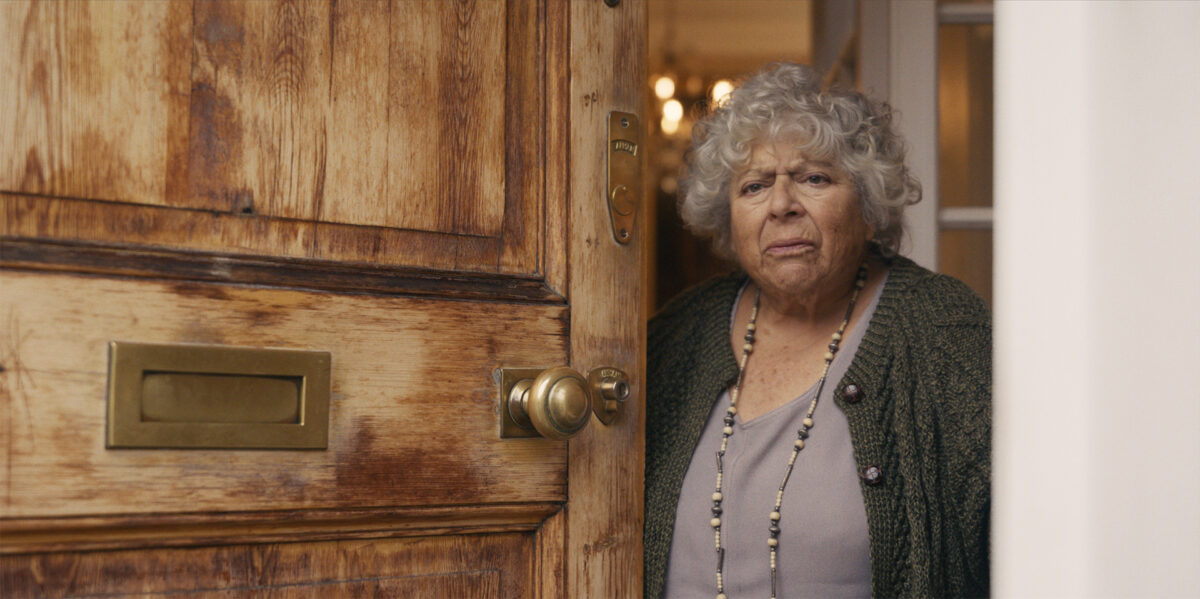
There’s confusion when the executor (Stephen Fry) of Dorothy’s (Miriam Margolyes) estate prepares to read her will. JJ (Alistair Nwachukwu) doesn’t quite know why he’s been summoned and Scott (Oscar Lloyd), Dorothy’s grandson, is curtly frustrated at the prospect of this outsider potentially taking what he believes he’s owed. It’s an economical way for Lee Knight to set the stage for his look at the stark differences between obligation and desire.
A Friend of Dorothy then rewinds to the day JJ meets his new friend and the journey that follows after his hope to retrieve a soccer ball turns into a daily visit to read and perform the plays on Dorothy’s shelves. We see the light behind both their eyes as she finally has someone to help reignite her passion for the theater without leaving her home and he discovers what it means to find someone willing to see him for who he is and what he dreams to become.
It’s a cutely funny yarn that excels during that initial meeting’s juxtaposition of JJ’s shyness and Dorothy’s loquaciousness. We understand the overt narrative thrust being introduced and the quieter implications of its messaging as things move towards a montage of their blossoming friendship. Things soon get very heavy-handed, though, and Scott’s reappearance proves as grating as you’d expect, but the groundwork laid is enough to overcome those inevitabilities.
B-
Jane Austen’s Period Drama | USA | 12 mins

When the highly educated Mr. Dickley (Ta’imua) readies to ask for Essy Talbot’s (Julia Aks) hand in marriage, we just know everyone will be ecstatic by the news. This is a period drama in the vein of Jane Austen, after all. The love between two protagonists defeating all odds to better position the woman’s family status is part and parcel to the genre. There’s just one wrinkle, though. The word “period” in Aks and Steve Pinder’s Jane Austen’s Period Drama isn’t describing its era-specific aesthetic.
The title proves to be an inspiring play on words used to comment on the reality that “educated” men in the Regency Era probably never had women’s anatomy or biology included on their curriculum. So, when Dickley sees blood on Essy’s dress, it cannot be assumed that his frantic reaction is merely a case of mistaken folly. While that might be the case and his love has simply blinded him from its most obvious cause, one must also consider that he might have no clue how to pronounce menstruation let alone comprehend its meaning.
What then should the Talbots do? Explain the error and risk offending him? Explain the hows and whys of this monthly ordeal and risk disgusting him? Or, as Essy’s sister Labinia (Samantha Smart) suggests, pretend she’s truly hurt to both avoid the topic altogether and wield the pity card so Dickley finishes his proposal? Each choice holds as much potential for laughter as the continued gag of everyone’s name being a sexual innuendo. And the whole story proves as smart in its unique approach to the subject matter as it is silly in its execution.
It should come as no surprise, though, with Emma Thompson serving as “executive menstrual advisor,” a gag title chosen because she doesn’t like taking executive producer credits without doing “actual work.” (Many would argue sending the film to everybody she knows counts.)
B
The Singers | USA | 18 mins

Adapted from Ivan Turgenev’s 19th-century short story, Sam A. Davis’ short film The Singers epitomizes the phrase “hold my beer” to perfection once presumptions are quickly dashed to leave room for unlikely heroes to ascend during an impromptu singing competition amongst roughnecks at a dimly lit dive bar.
It starts with the bartender (Michael Young) deciding to throw a bone towards a penniless patron annoying the rest while fishing for a free drink (Will Harrington) and offering a song in return. Knowing one of his oldest regulars (Chris Smither) has the pipes to sing anyone under the table (even with an oxygen tank attached to his nose), he sets the challenge: whoever sings the best wins a beer and one hundred dollars.
We’re meant to assume Smither will put Harrington in his place but know the former isn’t going to prove himself a slouch incapable of keeping pace (he actually sits at the piano to voluntarily accompany the latter’s song in a bid to show as much). So, when a shy customer (Judah Kelly) escapes to the bathroom to inform us in private how he’d porbably beat them both, we realize anything is possible.
More than just the voices (rounded out by Matthew Corcoran), however, this is also a deeply felt drama speaking to the emotional complexity of hardened and tortured men finding the vulnerability to stop hiding behind gruff exteriors and truly reveal their souls to the world. It’s a funny and heartfelt salve at a moment where it’s too easy to let cynicism reign.
A-
Two People Exchanging Saliva | France, USA | 36 mins

I love a surreally absurd concept handled in a delicately humanist way because it always leaves you uncertain as to which direction it may fall. Will the absurdity overpower things and devolve the whole into pure farce—for better or worse? Or will its compassionate take on the human condition rise to the surface as a prevailing force that cannot be expunged no matter how wild the rules of its manufactured world prove? The singular ride that is Alexandre Singh and Natalie Musteata’s Two People Exchanging Saliva memorably achieves the latter.
It’s a case where narrative details are meticulously doled out to render them potential spoilers insofar as the experience is concerned. Yes, we’ll ultimately need to know the reasons behind why two men are throwing a coffin-sized cardboard box over a cliff with the muffled screams of a woman heard from within or why employees of a department store must prove their breath is rancid before entering the premises, but letting the film tell you is part of its appeal. Because none of it is presented as a joke. It’s all merely a collection of truths setting the stakes.
And rather than have Vicky Krieps narrate these realities, the filmmakers trust their script and performers to explain each via their actions. Not the reasons for them, but their presence within the day-to-day lives of the characters on-screen. Because it’s less about the why behind their use of pain for transactional commerce and the transformation of kissing into an unspoken taboo than how both affect the people being forced to adhere. How does one inform the other? How has the dynamic between private intimacy and public indifference flipped?
The answers arrive via a blossoming relationship between new employee Malaise (Luàna Bajrami) and regular customer Angine (Zar Amir Ebrahimi)—all under the watchful and jealous eye of store manager Pétulante (Aurélie Boquien). The youthful desire for familiarity in a world that shuns it. The desperate desire for connection one woman never thought could be fulfilled and another had stolen. Because in this world, capitalism replaced love. Real human connection demands a purchased smack … unless you’re willing to risk everything for a press of the lips.
A-
Starting February 20, the 21st annual Oscar® Nominated Short Films, presented by Roadside Attractions, will debut in theaters only. Click here for details.