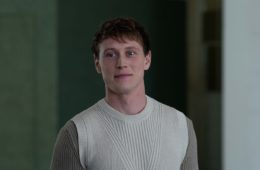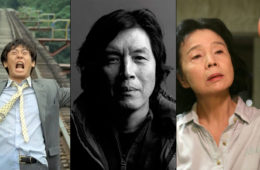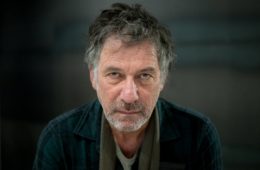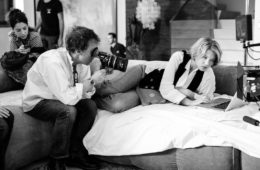
A few weeks ago I had the pleasure of doing an exclusive interview with the amazing Korean auteur filmmaker Bong Joon-Ho, director of the wildly successful The Host and the critically acclaimed Memories of a Murder, who is best known for his unique method of subverting genres. His new film Mother releases this weekend and is no different in continuing his style, subverting the Korean family drama into a taught web of mystery and suspense worthy of Hitchcock, anchored by a phenomenal performance from the titular character Hye-ja Kim. Enjoy the following interview which offers some interesting insight into the film and the process behind some of his choices. Read the full story
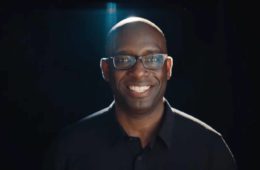
Hue Rhodes (left of the photo with Saint John of Las Vegas producer Mark Burton) is a fascinating filmmaker to speak with. I had the pleasure of talking to him the other day about his debut feature film, Saint John of Las Vegas, which will open nationwide this Friday. It has an amazing ensemble cast and a lovable lead actor in veteran Steve Buscemi. Rhodes talked with us about his film, his thoughts on social media and what it’s like to light a guy on fire.
TFS: How does it feel to have you movie open nationally?
H: It’s overwhelming, you know. I’m definitely thrilled at this point. I’m hoping that people like the movie. These kinds of films are so dependent on opening weekend box office, so I’m hoping people go. I’m thrilled to be in the situation but I still have anxiety.
What do you think about traditional theatrical release?
H: I’ve watched this movie on a TV screen and I’ve seen it in a theater full of people and there’s a communal experience to watching a movie, an energy. I don’t think you can deny that even if you quantify it. We’re social animals and hopefully we find a way to preserve that communal aspect as we explore new channels. Having said that, if theatrical isn’t available it doesn’t mean you shouldn’t see it. I just want people to see it. I think if you can get people in the theater it’s great. If you don’t want that and prefer the smaller screen great. There’s a lot of other options available to you, and if small screen’s the only thing available well then you do that too.
What do you think of social media in independent film?
H: I think the real change will come when people who’ve grown up in social media use it; when people who use it start making decisions. Because what you have right now is people who did not grow up in this environment adding it onto their old metaphors. So I think social media isn’t a channel to reach customers, I think social media reflects a new leap. The generation that grows up with social media expects to be heard. They have something to say. They may have a small audience but it’s their audience and I think you can expect people to expressively contribute. Everybody gets to play a little bit. For me social media has been effective because people use the content of this movie to communicate to their peers that they like the movie, they like the trailer. It doesn’t have to even do with me. It doesn’t necessarily have to do with my movie. It’s the content they are using to reach their audience. And I respect that. If they’re using our content to reach their audience and that helps us to promote the film, great. If people post the trailer, write their opinions about the trailer or the movie on their website, I comment. I thank them. If they have a negative opinion I try to address it because the important thing is they’ve created a little community around that content, that I can go and visit. I can’t make that community look at me, I can’t make that community pay attention to me by going ‘ooh look at me, follow me.’ That’s not what they care about. They care about themselves. But I can go join that community for a little bit, chop it up, talk, and get them interested. I think the way social media works is that the people doing all the twittering and the blogging are the ones who are generating content. I don’t know if that makes sense but that’s sort of how I feel about it.
How was the transition from software product manager to filmmaker?
H: I always loved movies but not the way a cinephile would. I feel like movies are where people learn how to be adults, in a way. I grew up in a multiplex but I didn’t have any refined sensibility and I certainly didn’t know what any of the people were involved in filmmaking did. [As] the co-founder of BlueLight.com, I worked as his product manager. I was responsible for the online music and DVDs. By selling DVD’s online I learned a little bit about the business. And from learning about the business, I thought ‘maybe I could make one of these.’ I started researching books on film, in my spare time, and I liked them. I just liked everything I was reading. I went and a bought a camera, I started taking pictures, I liked all the parts. One of the things I’ve learned from business is that success in the long run goes to the person who doesn’t get tired. You don’t get tired if you’re interested in something. The devil is in the details. For example, there are a lot of people involved in the internet and software who don’t really like technology. But ultimately the people who love technology excel in that business because they love the details. I knew that was true in technology and I thought it might be true in film. And, fortunately, I love the film details. I took a bunch of community college classes on filmmaking, at Berkley extension. Anything in the film catalog, I took. I took photography, storyboarding and filmmaking and writing. And I just loved it.
What inspired you to write a story inspired by Dante?
H: In between BlueLight and film school I sold software to insurance companies. Insurance is a surreal industry. I couldn’t get my head around it. It was so crazy, and so perfect for a surreal setting for an office movie. And I always loved Dante. I just liked that Dante would make a perfect structure. Reading Dante is a great ride and I just thought that writing a screenplay about Dante would be a great one.
What is the main theme of the film?
H: The theme of the film is the evolution of the accepting of yourself as you are for better or for worse. I think the traditional structure of a hero’s journey is that you think you’re nobody but then through some ridiculously stressful event you find out that you were more than you thought you were ever going to be. Our theme is a little bit different in that the purpose of the hero’s journey is a kind of exhaustion – in the end John gets to just settle down. That’s what happens to everybody in high school. You show up with these ambitions of who you want to be and it’s exhausting; just relax and you’ll finally get to be cool because you’re relaxed.
How was it working with well-known actors like Steve Buscemi?
H: It was great. When you deal with people who are professionals in a vocational sense they’re easier to work with because they’re so good. Steve [Buscemi] was great because he’s been in so many movies. If you bring Steve in the edit [room] for voice over he drops it in his mouth like he’s saying it for the first time. Steve is great. It’s a real, real luxury to work with people of this caliber because they all really knew what they were doing.
What was the toughest scene to shoot?
H: Logistically, we lit a guy on fire in a flame suit. We had to inter-cut that with footage of acting because we couldn’t light John Cho on fire. The script calls for him to be lit seven times. We could only afford to light him four times because its extremely expensive. I didn’t know this before the morning of the shoot. Stunt people charge by the amount of time they are lit on fire, and the duration. We could only light our stuntman on fire four times for up to 10 seconds. We had to block the scene with cameras and anticipate what the live action would be, and what Jon Cho would do, and then light him on fire so that the cameras couldn’t see each other while they were filming different parts of the scene, simultaneously. We had to face the camera so that one was capturing the second, fourth and sixth burn and the other camera was capturing first, third, fifth and seventh burn, which is extremely difficult blocking-wise. Extremely difficult blocking. We couldn’t do it again if we didn’t get it the first time. That was the hardest and most intense scene to shoot.
What other influences did you have for the film? You reference William Eggleston and Harold Pinter on your blog…
H: We watched a lot of Ozu. Very square plane, simple action straight at the camera, and 90 degree cuts rather than 180 degree cuts. The purpose of that kind of cutting is less about accelerating time, more about establish space. We did that pretty religiously, with pretty huge benefits, because it adds to the overall style. It also turns out that if you shoot geometrically, you don’t always have to shoot a master shot. Because if the framing is really consistent then even if the audience does not know what the room looks like, they know what the movie looks like. It has a geometry that makes us uncomfortable. So we have several scenes in the movie with no master shot and you wouldn’t know it. On a tight budget and schedule, not shooting a master can save you 1-2 hours. Master shots are exhausting to light …and you end up shooting something which you hope you don’t have to end up using, anyway. So by not having to shoot a master shot, every frame of the film had more attention.
What do you think about film festivals and the Cinevegas demise?
H: I think film festivals are really important for a couple reasons. First, they help you believe. I went to festivals before I brought a movie to one. To the outsider, movies are this impossible thing to make. Film festivals deconstruct them a little bit. ‘Oh, there’s a short. I can do that. There’s a feature that came from a short…’ – it maps out steps people can do. It’s also a wonderful community of people, investing their psychic energy in films. It’s also a great environment to build momentum for a film.
I had a wonderful time at Cinevegas. it was a dream premiere in a huge auditorium that held 1200 people. The festival also put on a fantastic show. I watched Yellow Submarine projected on a jumbotron while sitting in the beach of Manderlay Bay. It was the best! I think everybody loved Cinevegas and hopefully they’ll come back soon.
Last 3 films you saw:
Invictus
Up in the Air
Avatar
Top 3 Directors:
Paul Thomas Anderson
Francis Ford Coppola
Matteo Garrone
Check out the trailer for Saint John of Las Vegas here:
This picks up where we left off with screenwriter Gary Whitta in the Part 1 segment of our interview concerning The Book of Eli. Enjoy.
I remember hearing earlier on that everyone involved wanted to keep what the book was a secret, but that hasn’t really been carried over into the marketing campaign.
Gary Whitta:Yeah, they just changed their minds at one point. Initially earlier on everyone was instructed not to say what the book is and for that to be apart of the twist in the film. At some point, I wasn’t involved in this because that is a totally separate conversation, but at some point they just said,”we wouldn’t be able to hide this, we can’t really do trailers for this, and it’s too big of a part of the movie.” The interesting thing is that a lot of people are still going in not knowing what the book is. Not everyone reads as much about movies as people like you and me. Some people are going in not knowing what it is and it’s not a huge reveal. It’s interesting the first time you see what the book is.
I’ve never interviewed a screenwriter before. I’ve talked to directors/screenwriters, but never just a screenwriter. So when I hopped on the phone with Gary Whitta I was hoping for a good experience which actually ended up being a great one. I was a bit worried about seeing the film just a day before our chat since that’s not the best amount of prep time, but after I saw the film I had plenty of questions running through my head I was excited about asking. If you’ve read my review then you know I really enjoyed it and it’s always great to talk to people behind films you not only enjoy, but also admire. The Book of Eli is ambitious and different from the current wave of post-apocalyptic films. It also features a new side of Denzel we haven’t seen before, Gary Oldman going all out as the villain and it’s also a welcoming return for the Hughes brothers. Whitta is one of the main men responsible for Eli’s audacity and talking to him for an hour and forty minutes was a real treat. While not all of that conversation is here since some of that time involved us sidetracking and talking about other films, I have of course included everything revolving around Eli. Now with the long introduction out of the way, here’s what Mr. Whitta had to say: Read the full story
Quinn Lord is a remarkably talented actor. At the age of 10, he has managed to do what some actors go their whole lives hoping for; to create a memorable character who will be watched on a yearly basis for years to come. As Sam in Trick ‘r Treat he embodied the spirit of Halloween without saying a single word. Quinn has also appeared in the highly anticipated film The Imaginarium of Dr. Parnassus with Heath Ledger, Johnny Depp and Jude Law as well as The Hole (Nathan Gamble, Haley Bennet) and has had many TV appearances, including Smallville. I had an opportunity to talk to him about Trick r’ Treat and his many other endeavors. Check out the interview below.
The Film Stage: How are you?
Quinn Lord: I’m doing spectacular.
TFS: Are you excited for Halloween?
Quinn: Yes, I’m all set for Halloween. I’m going to dress up as Ash from Evil Dead. Read the full story
If you don’t know the name then you have been living under a rock for the last 10 years. Troy Duffy is the mastermind writer/director of the cult classic The Boondock Saints and he returns for the sequel. I got to talk to the man himself to get his thoughts on the upcoming sequel, the return of Rocco and the handling of the film release. Read the full story
These two need no introduction. They are the ones people think of when they hear The Boondock Saints. The duo of Norman Reedus and Sean Patrick Flanery, better known as the MacManus brothers Connor and Murphy. I got to speak to both of them about the sequel, other projects they have going on and their opinion of Troy Duffy and Overnight.
Julie Benz’s work ranges from the bloody-entertaining Dexter to female leads in action films such as Rambo and Punisher: War Zone. She’s now adding another action film to her resume with The Boondock Saints: All Saints Day. She’s a new character for the Boondock world, but is connected through Willem Dafoe’s character from the first film. Benz declares this as new territory for her and yet it will still go down as another geek-friendly film under her filmography.
Playing perhaps one of the more well known (or at least cult-famous) supporting characters in recent memory, David Della Rocco’s “Rocco” provides the comic relief of the cult classic. I had the opportunity to speak to him about the upcoming installment to the Boondock series. Read the full story
Boondock isn’t Boondock without some cops chasing the tail of the two brothers right? Well, that is exactly what Brian Mahoney and Bob Marley, who play Detective Duffy and Detective Greenly respectively, do in The Boondock Saints. Mahoney was a military pilot before getting into acting and Marley to this day is a stand-up comic who got to play one of the most popular roles of his career. I spoke with both of them about what it was like to work on the first film and being able to return 10 years later. Read the full story